Dmitry Trenin: One year on, here’s how the Ukraine conflict is changing the world order

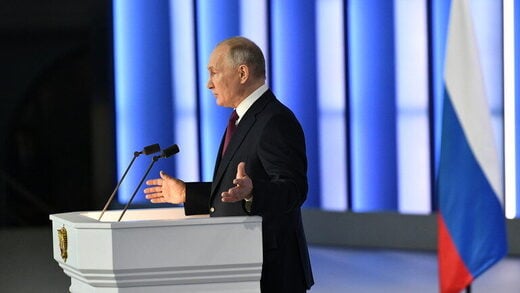
© Sputnik / Maksim Blinov Russian President Vladimir Putin delivers his annual address to the Federal Assembly, including lawmakers of the State Duma,
members of the Federation Council, regional governors and other officials, in Moscow, Russia, on February 21, 2023.

Dmitry Trenin

March 8, 2023

The West’s failed Ukraine strategy has empowered the Global Majority to reject US domination

In his recent landmark address to Russia’s parliament, President Vladimir Putin cited the war in Ukraine and US/NATO involvement in the conflict as the main reason for his decision to “suspend” Moscow’s participation in the 2010 New START Treaty on strategic nuclear weapons. Putin also suggested that Russia should be ready to resume nuclear testing.

Effectively, this announcement, promptly turned into law by the Russian parliament, means a formal end to the long-ailing institutions of strategic arms control that began over 50 years ago. If New START is followed by the CTBT (Comprehensive Test Ban Treaty) and then the NPT (Non-Proliferation Treaty), strategic deregulation will be complete. 

Putin’s logic is that the United States cannot be allowed to inspect Russian missile bases while at the same time pursuing a policy of “strategically defeating” Moscow in Ukraine.

The Kremlin’s decision was anything but a bolt from the blue. The proxy war in Ukraine came as the culmination of a decade-and-a-half-long process of steady deterioration of Russian-American and Russian-EU relations.

Ever since it became clear – somewhere in the mid-2000s – that Russia would not fit into the US-dominated order, and that Washington, and its allies would not let Russia sign up on terms that Moscow would find acceptable, the trajectory of the relationship has generally pointed toward confrontation.

True, there was a brief period, which coincided with the presidency of Dmitry Medvedev (2008-12), which witnessed, besides the signing of New START, an attempt to build a strategic partnership between Russia and NATO and modernization and technology partnerships between Russia and key Western countries, including the US and Germany. That attempt, however, turned out to be the last hurrah of the efforts to integrate Russia into, or at least with, the West following the end of the Cold War.

Essentially, while Moscow was looking for equal and indivisible security, as well as technology and business opportunities, Washington and Berlin were mostly interested in softening and diluting Russia’s domestic political regime. 

There was also no question of treating Russian security concerns about NATO’s enlargement seriously: Moscow had to accept the post-Cold War order in which it no longer had a decisive voice. That mismatch of key goals could not last long. Already by 2011-12, the outlook for Russia-West relations could be summarized as something like: it will get worse before it gets worse.

Right now, we are still on the same trajectory – things can become even more grim than they are now.

Hopefully, the credible threat of complete annihilation — the heart of nuclear deterrence — will still protect us from the very worst outcome, but the changes wrought by the Ukraine war on the global strategic landscape during its first year are indeed massive. Strategic deregulation between Moscow and Washington has already been highlighted.

In practice, this will mean that each party will be free to build, structure, and deploy its strategic forces as it sees fit and rely on its own so-called national technical means – such as spy satellites and other forms of intelligence – as the prime source of information about the other. It is natural to expect that under such circumstances, both parties would have a powerful incentive to engage in worst-case-scenario planning.

It is true that of the five ‘established’ nuclear powers and the four other countries that possess nuclear arms, only two — America and Russia — have historically engaged in nuclear arms control. For years, Washington sought to find ways to link Beijing to the US-Russia strategic dialogue, thus leading to a tripartite arrangement. China, which was never interested in the US offer, is now believed to be in the process of substantially expanding and improving its strategic nuclear forces.

Whether and when Beijing will be ready to engage Washington in strategic arms talks is anyone’s guess. After the US formally designated China as its principal adversary, Sino-American relations have been growing increasingly tense. In any event, managing a strategic equation among the three leading nuclear powers, one of which regards the other two as its adversaries, will now become more difficult.

Strategic deregulation is not just the absence of binding treaties. It is also likely to mean the unravelling of the conceptual framework for arms control, which was originally developed by the Americans in the 1960s and then accepted by the Soviet Union. Any future arrangements among the world’s nuclear powers – whenever it comes – will require a wholly new concept that might be based on the agreed-upon and mutually fitting elements developed by the participating countries, with their vastly different strategic environments and cultures. It will certainly be a most daunting task.

Putin’s angry reaction to NATO’s call for Russia to observe New START and let US inspectors in has opened up another relatively minor issue: the nuclear weapons of Britain and France. The Soviet Union had long insisted on including those two countries’ nuclear arsenals in the US ceilings, and only relented during Gorbachev’s perestroika.

With Paris and London taking an active role in the proxy war in Ukraine, Moscow is no longer pretending that UK and French nuclear forces are there solely to defend their own countries. They are seen as part of the combined arsenal of the adversarial, US-led West. This is no big deal for the moment, but any conceivable future arrangement would have to address the issue of the Anglo-French forces.

In geopolitical terms, the war in Ukraine energized Washington to build a global coalition to oppose Russia. This is often presented as a major achievement of the administration of President Joe Biden.

Yet, to look at this from a different perspective, the Russia (and China) policies of the three successive US administrations – Obama’s, Trump’s, and particularly Biden’s – have led to a major split among the great powers that widened from competition to bitter rivalry (with China) and proxy war (with Russia in Ukraine).

US efforts to get China to distance itself from Russia appear ridiculous in a situation where Washington’s strategy appears to be to defeat/contain its two main adversaries one by one, and, moreover, to pit them against each other.

The famous Kissingerian triangle is now pointed in a different direction: it is Washington that has the worst possible relations with the other two. As for Moscow and Beijing, they are getting even closer as a result.

Closer cooperation and coordination between China and Russia amid the war in Ukraine, which is gradually emerging on the platform of common strategic interests, represents a major shift in the world power balance.

What is more – and what goes well beyond the usual Western concept of ‘great power competition’ – is the rise of over a hundred actors of different calibre in many parts of the world that have refused to support the US, and its allies, on the Russia sanctions and have maintained or even expanded their trade and other relations with Moscow. 

These countries insist on following their own national interests as they see them and seek to expand their foreign policy autonomy. At the end of the day, this phenomenon – call it the Rise of the Global Majority (no longer silent) – could be the single most important development so far en route to the new world order.

Originally published on the Russian International Affairs Council, RIAC’s, homepage on February 24, 2023.

About the author

Dmitry Trenin is a research professor at the Higher School of Economics and a lead research fellow at the Institute of World Economy and International Relations. He is also a member of the Russian International Affairs Council.

Please help TFF remain truly independent by contributing if you benefited from this article

Related Posts

The agreement is catastrophic both because of what it says and what it doesn’t mention. It reduces further the major asset of security policies: Freedom of action. Jan Oberg TFF director September 25, 2026 A couple of hours before the agreement was signed on September 22, 2026, I published the following 13 hypotheses about what it would most likely contain on TFF Substack (in English). I was wrong on only the first point. Contrary to what Trump had written on his Truth Social platform, it does not appear to come into force immediately. In fact, it turned out to be worse than even I had anticipated. After these hypotheses now come a number of reflections in light of what the agreement actually contains, and does not contain, as well as the way in which it has generally been presented by major media outlets and by the public-service broadcaster DR. My...
Jan Oberg May 15, 2026 Go to this Fox News page and scroll the whole way down: President Donald Trump tells the world that his meeting with President Xi Jinping yielded a lot of very concrete political and economic results – of course, only where the Chinese side, according to him, agreed with him. He does not mention the Taiwan issue, but Secretary of State, Marco Rubio, says that it did not feature prominently in their talks and that the US policy on Taiwan has not changed. Then go to China Daily – or Global Times – and you will see that for the Chinese it is framework, principles, structure of cooperation etc. that matters – all embedded in the overall idea of “constructive bilateral relationship of strategic stability.” Nowhere is any concrete agreement or deal – all that Trump refers to – mentioned. At the general level, this gives you insights into the very different social...
In contrast to most, we’ll bring alternatives, solutions, hope and strategies for a better future. Times are dangerous, yes, but that only intensifies the need for constructive thinking and action! Jan Oberg, TFF director April 13, 2026 The new TFF Peace Pulse uses video messages in a new way: Max 3-5-minute-long comments, ideas or perhaps mini-lectures, all about peace – positive peace. We launch them today on April 13, 2026 with a carefully crafted visual aesthetic fitting the content. We hope to publish them regularly from now on. We launch Peace Pulse (PP) – for a number of reasons. The world is in chaos, and there are countless reasons to feel concerned, frustrated, even angry. The atmosphere is saturated with doom and gloom, with negative energy and rear‑mirror thinking, while vision, imagination, alternatives, strategies and genuine future‑mindedness remain in short supply. And without them, we simply can’t save the world. Looking at problems from a hundred angles will...

Recent Articles

Tony Robinson October 4, 2026 Violence is easy to recognise when someone is being beaten, shot or killed. It becomes more difficult when nobody is holding a weapon. Poverty, discrimination, exploitation and repression can restrict a human life just as effectively, although they do so in very different ways and with very different consequences. Simply adding more categories to an ever-growing list of forms of violence does not really solve the problem. The more interesting question is what all these different situations have in common and why it makes sense to describe them using the same word. Human beings do not simply react to what happens around them. They remember the past, imagine things that do not yet exist, make plans and undertake projects. Workers organise because they imagine different working conditions; people migrate because they imagine another life somewhere else; social movements emerge because people refuse to accept the...
It’s a matter of principles, courage, vision and pulling together – while the militarist world is falling apart… Peter Langille October 3, 2026 “Here, then, is the problem which we present to you, stark and dreadful and inescapable: Shall we put an end to the human race; or shall mankind renounce war?”The Bertrand Russell—Albert Einstein Manifesto, July 9, 1955 ⁕ The forecast for what’s ahead is worrisome. The sharp rise in armed conflicts over the past three years is adding to what was already the highest level in over seventy years. Genocides, which should be prevented are supported. A shared climate emergency that jeopardises survival is ignored. Diverse polls now suggest that people are war-weary, worried and interested in a more effective United Nations. And, there are viable policy options for a more secure world! Yet governments are doubling-down, betting on more war and investing heavily. If current trends persist,...
Johan Galtung 1930-2024October 2015 Published here on October 3, 2026 Let us focus on Civilization for conflict analysis and remedies. Major forms of disorder use violence; war is state organized violence. The most belligerent states are the United States of America and Israel, both with civilization roots. National Evangelism, the US Protestant Christian civilization– more national than evangelical–justifies US warfare as exceptionalism of a people chosen by God, with a manifest destiny to run the world. Orthodox Judaism justifies Israeli warfare to conquer and expand from Nile to Euphrates as a religious right and duty to the Eternal One. The third most belligerent country, the UK, no longer believes it is God-chosen but chosen by the USA; not quite the same but something. But the root cause of global disorder lies in the Occident–with Islam–seeing itself as the single, universal civilization valid for all at all times, all others being...

TFF on Substack

Discover and subscribe to more peace materials on TFF Substack

Most Popular

Tony Robinson October 4, 2026 Violence is easy to recognise when someone is being beaten, shot or killed. It becomes more difficult when nobody is holding a weapon. Poverty, discrimination, exploitation and repression can restrict a human life just as effectively, although they do so in very different ways and with very different consequences. Simply adding more categories to an ever-growing list of forms of violence does not really solve the problem. The more interesting question is what all these different situations have in common and why it makes sense to describe them using the same word. Human beings do not simply react to what happens around them. They remember the past, imagine things that do not yet exist, make plans and undertake projects. Workers organise because they imagine different working conditions; people migrate because they imagine another life somewhere else; social movements emerge because people refuse to accept the...
It’s a matter of principles, courage, vision and pulling together – while the militarist world is falling apart… Peter Langille October 3, 2026 “Here, then, is the problem which we present to you, stark and dreadful and inescapable: Shall we put an end to the human race; or shall mankind renounce war?”The Bertrand Russell—Albert Einstein Manifesto, July 9, 1955 ⁕ The forecast for what’s ahead is worrisome. The sharp rise in armed conflicts over the past three years is adding to what was already the highest level in over seventy years. Genocides, which should be prevented are supported. A shared climate emergency that jeopardises survival is ignored. Diverse polls now suggest that people are war-weary, worried and interested in a more effective United Nations. And, there are viable policy options for a more secure world! Yet governments are doubling-down, betting on more war and investing heavily. If current trends persist,...
Johan Galtung 1930-2024October 2015 Published here on October 3, 2026 Let us focus on Civilization for conflict analysis and remedies. Major forms of disorder use violence; war is state organized violence. The most belligerent states are the United States of America and Israel, both with civilization roots. National Evangelism, the US Protestant Christian civilization– more national than evangelical–justifies US warfare as exceptionalism of a people chosen by God, with a manifest destiny to run the world. Orthodox Judaism justifies Israeli warfare to conquer and expand from Nile to Euphrates as a religious right and duty to the Eternal One. The third most belligerent country, the UK, no longer believes it is God-chosen but chosen by the USA; not quite the same but something. But the root cause of global disorder lies in the Occident–with Islam–seeing itself as the single, universal civilization valid for all at all times, all others being...
Read More
Living-Peace-Sign-Budapest-copy
Tony Robinson October 4, 2026 Violence is easy to recognise when someone is being beaten, shot or killed. It becomes more difficult when nobody is holding a weapon. Poverty, discrimination, exploitation and repression can restrict a human life just as effectively, although they do so in very different ways and with very different consequences. Simply adding more categories to an ever-growing list of forms of violence does not really solve the problem. The more interesting question is what all these different situations have in common and why it makes sense to describe them using the same word. Human beings do not simply react to what happens around them. They remember the past, imagine things that do not yet exist, make plans and undertake projects. Workers organise because they imagine different working conditions; people migrate because they imagine another life somewhere else; social movements emerge because people refuse to accept the...
b54a1f10-8c65-4f0b-9dd5-4abc0a7d04cc_2659x2659
It’s a matter of principles, courage, vision and pulling together – while the militarist world is falling apart… Peter Langille October 3, 2026 “Here, then, is the problem which we present to you, stark and dreadful and inescapable: Shall we put an end to the human race; or shall mankind renounce war?”The Bertrand Russell—Albert Einstein Manifesto, July 9, 1955 ⁕ The forecast for what’s ahead is worrisome. The sharp rise in armed conflicts over the past three years is adding to what was already the highest level in over seventy years. Genocides, which should be prevented are supported. A shared climate emergency that jeopardises survival is ignored. Diverse polls now suggest that people are war-weary, worried and interested in a more effective United Nations. And, there are viable policy options for a more secure world! Yet governments are doubling-down, betting on more war and investing heavily. If current trends persist,...
010
Johan Galtung 1930-2024October 2015 Published here on October 3, 2026 Let us focus on Civilization for conflict analysis and remedies. Major forms of disorder use violence; war is state organized violence. The most belligerent states are the United States of America and Israel, both with civilization roots. National Evangelism, the US Protestant Christian civilization– more national than evangelical–justifies US warfare as exceptionalism of a people chosen by God, with a manifest destiny to run the world. Orthodox Judaism justifies Israeli warfare to conquer and expand from Nile to Euphrates as a religious right and duty to the Eternal One. The third most belligerent country, the UK, no longer believes it is God-chosen but chosen by the USA; not quite the same but something. But the root cause of global disorder lies in the Occident–with Islam–seeing itself as the single, universal civilization valid for all at all times, all others being...
Screenshot 2026-10-02 011738
Jan ObergPhD, director, The Transnational Foundation for Peace and Future Research, TFFLund, Sweden October 2, 2026 This is my full original manuscript. The Chinese Academy of Social Science, CASS, makes two publications out if it. 1. China’s Five-year plan emphasized the capabilities of basic research and original innovation. It is regarded as the goal of the future social development, which, as required, should be significantly enhanced. Can you comment on the importance of original innovation in research and academic study? I believe it is easier to define “original innovation” in the natural sciences than in social sciences. The breaking points of what constitutes something new, or innovative, are not quite as sharp in the latter. But in both fields it is about opening up something that was closed, unseen, unexplored before – making manifest what was earlier latent. Innovations come in many forms and shapes – naming something that was not...
arctic-circle-map
The agreement is catastrophic both because of what it says and what it doesn’t mention. It reduces further the major asset of security policies: Freedom of action. Jan Oberg TFF director September 25, 2026 A couple of hours before the agreement was signed on September 22, 2026, I published the following 13 hypotheses about what it would most likely contain on TFF Substack (in English). I was wrong on only the first point. Contrary to what Trump had written on his Truth Social platform, it does not appear to come into force immediately. In fact, it turned out to be worse than even I had anticipated. After these hypotheses now come a number of reflections in light of what the agreement actually contains, and does not contain, as well as the way in which it has generally been presented by major media outlets and by the public-service broadcaster DR. My...
girl-5894831_1280
Below are TFF-related media mentions, comments, videos and social media posts published elsewhere but not on this homepage. We happen to catch and list only a fraction. Regarding video comments and debates, we recommend that you go to the TFF Video Channel on Substack where many of them are reproduced. Jan Oberg is a contributor to China Daily – 52 million daily clicks – and Global Times, CGTN and CCTV (the national television), China Investment, Xinhua News Agency and several others. Articles and videos on these media very often multiply into countless Chinese (and Western media) that re-post them from these main media. Thanks to The China Academy, his analyses, interviews and comments are frequently posted on YouTube channels such as Thinkers Forum and Wave Media. These videos are often re-posted on Bilibili (China’s YouTube), the China Content Center on TikTok, and on the Chinese edition of TikTok, Douyin.com. This means reaching hundreds of millions of viewers worldwide over a year. While there are too many to catch on all these...