The Ukraine War: Think Deeper Or We Shall All Lose

Jan Oberg

February 20, 2023

This comment was written and video created for and published by China Daily on February 20, 2023. The daily also used it for a special feature with three experts, which you may read here. It has also been published by The Citizen in India.

Whatever other reasons that a war is raging in Ukraine, one major reason is that we live in times characterised by the increasingly dangerous – perhaps fatal – combination of intellectual-moral disarmament and military re-armament. Militarism is now the main factor holding the West NATO/EU world together. It’s a religion and NATO its church.

In different ways, militarists argue that their side was historically innocent and are justified to do what they do now; NATO’s Jens Stoltenberg even states that NATO is not a party to the conflict. Secondly, they argue that they must win, meaning others must lose. The latter too is an intellectual fallacy because it is fairly obvious that all parties could also win, and all parties could also lose.

Those who have studied conflicts and wars know that, over time, warring parties tend to become mirror images of each other and argue alike – just with the roles reversed – and make the same fatal miscalculations and logical fallacies.

For the Ukrainians, Ukraine must win – win back all its territory and get protected by NATO in the future. For Russia, Russia must win – win national security by controlling Crimea and the Donbas of Ukraine and secure that Ukraine never becomes a full NATO member. For NATO/EU, NATO must win – in the sense of getting Russia out, Ukraine into NATO and Russia, once and for all, weakened so a) it can never again transgress its borders and b) is destroyed economically if not also dissolved as a state à la Yugoslavia.

These are the parties’ completely unrealistic, maximalist and incompatible goals – illusions – at the war level and the government level.

But what about the level of the underlying conflicts – and the peoples’ level?

Totally obsessed with weapons and the war, neither the media nor politicians seem to have the slightest focus on, or understanding of, the underlying conflicts, the root causes of the violence that plays out in Ukraine. They do not understand that the solution – not the win – has to do with an understanding of these root causes; they behave like a quack doctor who diagnoses a patient by asking where the pain is and then applies pain boosters or killers never searching the relevant question: Why the pain and where the pain and what’s the cure?

This obsession – together with the three main parties’ goals and dreams/illusions – make for a very long and utterly destructive war which everybody will lose, not the least the people in Ukraine but also in Western Europe and Russia.

Cartoon by China Daily

The moment decision-makers and the media would educate themselves and leave behind conflict and peace illiteracy, the focus could move to root causes: What were the conflicts that stood between the parties – the problems which they could not handle peacefully but took to violence about – politically, psychologically and militarily?

And that is the moment when, in the best of cases, we open a new road to intelligent conflict-handling, to a negotiated solution and a sustainable peace. The think-alike militarists on all sides believe that peace will come when somebody wins militarily. But like the mentioned doctor who never opened a textbook in medicine, can’t re-create health, this thinking cannot re-create peace.

Peace never grows out of the battlefield. Any fool can start a war; starting peace requires neutral professional expertise and empathy.

If one or more of the parties stop and begin to think – there can be hope that the war will end and the deep conflicts will be addressed – and peaceful coexistence finally becomes a possibility.

Essentially, Ukraine is about the world’s classical dilemma: the mindbogglingly immature Realpolitik paradigm with national military ’security’ based on conventional and nuclear long-range offensive deterrence weapons. Invariably, it will lead to war – which calls for more weapons and leads deeper down into the intellectual and moral quicksand. And eventually, someone presses the wrongest of all buttons.

The world of security politics is run by peace-illiterate elites of the Military-Industrial-Media-Academic Complex, MIMAC. The world’s military expenditures have never been so high as today. The pace of NATO countries’ re-armament (already 12 times bigger than Russia’s before the Ukraine war) has never been so fast. A major war in Europe and the use of nuclear weapons have never been so probable. Civil society is being starved.

If this weapons-obsessed thinking could bring world peace, it would have happened decades ago. But NATO’s decision-makers are, well, drunk on weapons.

The civilisational truth is that the enemy is us. Governments have let militarism loose instead of respecting the world’s finest norm in the UN Charter’s Art 1 – that peace shall be created by peaceful means. Ask how many military institutes, academies, think tanks, government units, research facilities and associations there are in the world compared with those for peace. No minister or statesman has peace advisers.

The discourse on peace – in research, politics and media – has disappeared. If we never stop to think more deeply, we shall all lose – dying eventually as patients of society’s cancer called militarism.

Let’s use the NATO-Russia conflict playing out so tragically in Ukraine to stop and think. Let’s make it the last war before it makes this humanity the last.

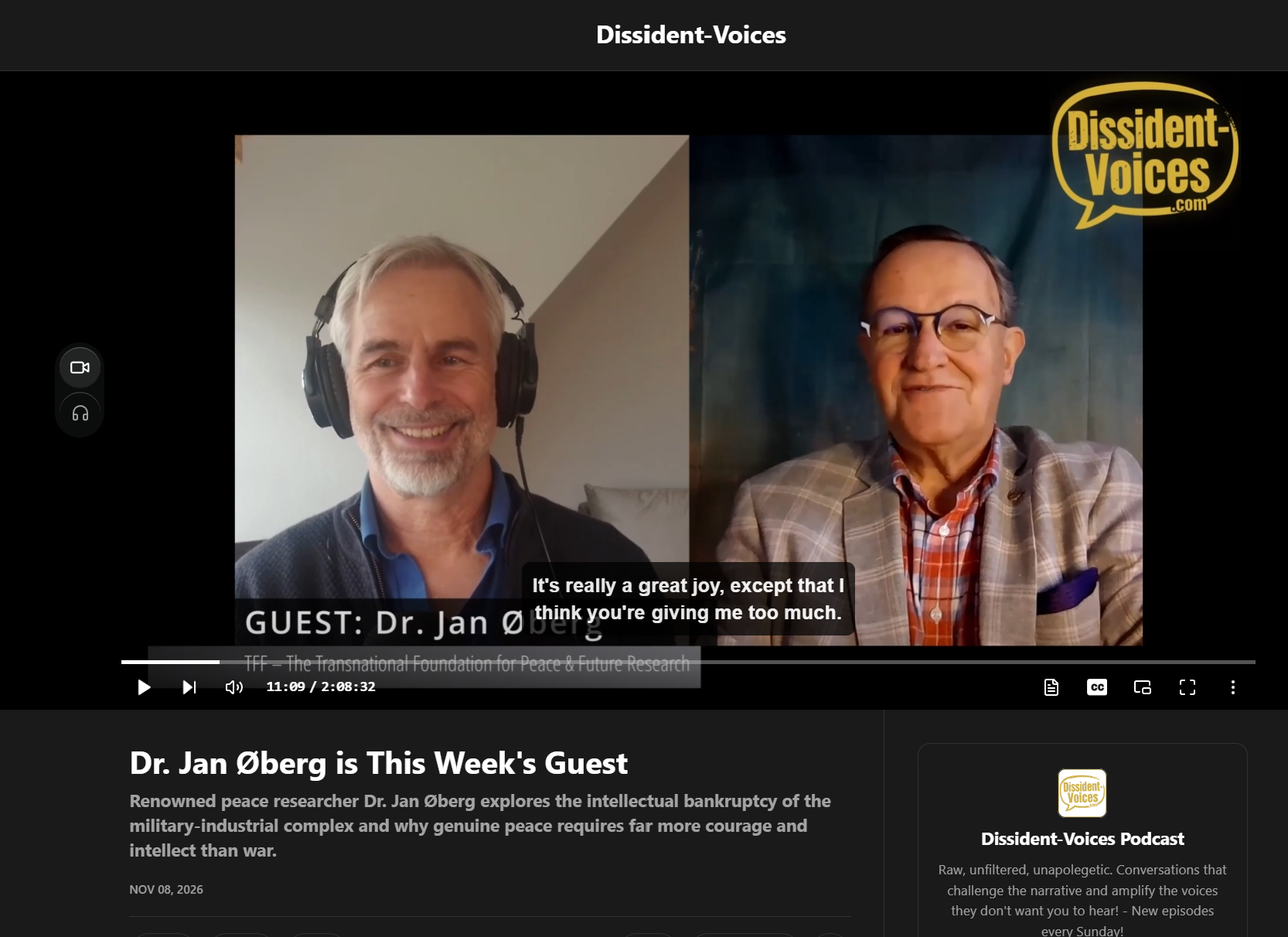
Video made for China Daily

PhD, Peace & future researcher + ‌Art Photographer, Professor Emeritus and media commentator

Related Posts

A Message from Jan Oberg November 6, 2026 Over the past fifty years, I have devoted roughly 175,000 hours to research and public education for a more peaceful world: thinking, researching, writing, organising, publishing, debating, maintaining websites, corresponding, reaching out, leading a foundation, work in conflict and war zones, professorships, teaching courses and giving public lectures and doing media work. In short, ten hours a day, seven days a week, for half a century. The focus was on international political peace – analysing and trying to stop wars, address underlying conflicts and making alternative peace plans – at the desk and on the ground. Important as that has been and remains, it is only one kind of peace and it is now in a tragic militarist state compared with what it could have been.  Lately, however, I have found myself thinking about a concept from economics as well as everyday...
Photo above: Carl Fredrik Reuterswärd’s Non-Violence outside UN Headquarters in New York. Kirill Levin, CC BY-NC-SA 2. Jan Oberg November 3, 2026 I am happy to be published in Horizons which is produced by the Center for International Relations and Sustainable Development, CIRSD, in Belgrade. My contribution brings out a radical re-thinking of what concepts such as defence, security, deterrence – and peace – may mean if we want to create a more peaceful world. It also summarises a few things I have been working with the last few decades. Please read it here Og her er den på dansk, takket være Johnny Baltzersens lynhurtige oversættelse
UNITE-tillid, DREAM-velstand og andre konstruktive komponenter Normally we publish articles in English here. But this is a translation of a very important TFF document that should reach as many as possible in Denmark since this country’s government has been one of the most hardline in Europe and, up till now at least, has refused to use diplomacy and, instead, spent tremendous sums on arming Ukraine with the express goal of defeating Russia. Thus this – unique – article is in Danish. Vi er Johnny Baltzersen og hans Fælles Sikkerhed – Fælles Fremtid på Substack overmåde taknemmelige for at have oversat og publiceret TFF’s 2025-portfølje for fredsidéer med henblik på Ukraines fremtid. Vi håber den nu kan nå mange flere danskere – som også vil sprede den og skabe debat – nu den danske regerings og folketingspartiernes politik på dette område siden 2022 står nu – forudsigeligt – ved vejs ende....

Recent Articles

Serious but also a lot of laughs and positive energy. Because peace is also about conviviality and enchantment… Jan Oberg, TFF director November 16, 2026 This is a long (129 minutes) conversation with me. We cover very many, also personal, issues that makes a somewhat unusual media event. I am very grateful to Flemming Blicher for giving me this opportunity. I can’t remember any channel or editor who spent as much time as he did preparing it – including also asking me to answer a series of pre-interview questions, which are now posted under the conversation. If you sympathise with its content, please share it. Watch it here
A Message from Jan Oberg November 6, 2026 Over the past fifty years, I have devoted roughly 175,000 hours to research and public education for a more peaceful world: thinking, researching, writing, organising, publishing, debating, maintaining websites, corresponding, reaching out, leading a foundation, work in conflict and war zones, professorships, teaching courses and giving public lectures and doing media work. In short, ten hours a day, seven days a week, for half a century. The focus was on international political peace – analysing and trying to stop wars, address underlying conflicts and making alternative peace plans – at the desk and on the ground. Important as that has been and remains, it is only one kind of peace and it is now in a tragic militarist state compared with what it could have been.  Lately, however, I have found myself thinking about a concept from economics as well as everyday...
Photo above: Carl Fredrik Reuterswärd’s Non-Violence outside UN Headquarters in New York. Kirill Levin, CC BY-NC-SA 2. Jan Oberg November 3, 2026 I am happy to be published in Horizons which is produced by the Center for International Relations and Sustainable Development, CIRSD, in Belgrade. My contribution brings out a radical re-thinking of what concepts such as defence, security, deterrence – and peace – may mean if we want to create a more peaceful world. It also summarises a few things I have been working with the last few decades. Please read it here Og her er den på dansk, takket være Johnny Baltzersens lynhurtige oversættelse

TFF on Substack

Discover and subscribe to more peace materials on TFF Substack

Most Popular

Serious but also a lot of laughs and positive energy. Because peace is also about conviviality and enchantment… Jan Oberg, TFF director November 16, 2026 This is a long (129 minutes) conversation with me. We cover very many, also personal, issues that makes a somewhat unusual media event. I am very grateful to Flemming Blicher for giving me this opportunity. I can’t remember any channel or editor who spent as much time as he did preparing it – including also asking me to answer a series of pre-interview questions, which are now posted under the conversation. If you sympathise with its content, please share it. Watch it here
A Message from Jan Oberg November 6, 2026 Over the past fifty years, I have devoted roughly 175,000 hours to research and public education for a more peaceful world: thinking, researching, writing, organising, publishing, debating, maintaining websites, corresponding, reaching out, leading a foundation, work in conflict and war zones, professorships, teaching courses and giving public lectures and doing media work. In short, ten hours a day, seven days a week, for half a century. The focus was on international political peace – analysing and trying to stop wars, address underlying conflicts and making alternative peace plans – at the desk and on the ground. Important as that has been and remains, it is only one kind of peace and it is now in a tragic militarist state compared with what it could have been.  Lately, however, I have found myself thinking about a concept from economics as well as everyday...
Photo above: Carl Fredrik Reuterswärd’s Non-Violence outside UN Headquarters in New York. Kirill Levin, CC BY-NC-SA 2. Jan Oberg November 3, 2026 I am happy to be published in Horizons which is produced by the Center for International Relations and Sustainable Development, CIRSD, in Belgrade. My contribution brings out a radical re-thinking of what concepts such as defence, security, deterrence – and peace – may mean if we want to create a more peaceful world. It also summarises a few things I have been working with the last few decades. Please read it here Og her er den på dansk, takket være Johnny Baltzersens lynhurtige oversættelse
Read More
Screenshot 2026-11-10 174455
Serious but also a lot of laughs and positive energy. Because peace is also about conviviality and enchantment… Jan Oberg, TFF director November 16, 2026 This is a long (129 minutes) conversation with me. We cover very many, also personal, issues that makes a somewhat unusual media event. I am very grateful to Flemming Blicher for giving me this opportunity. I can’t remember any channel or editor who spent as much time as he did preparing it – including also asking me to answer a series of pre-interview questions, which are now posted under the conversation. If you sympathise with its content, please share it. Watch it here
AbstractVision_2017_#1_800 (kopia)
A Message from Jan Oberg November 6, 2026 Over the past fifty years, I have devoted roughly 175,000 hours to research and public education for a more peaceful world: thinking, researching, writing, organising, publishing, debating, maintaining websites, corresponding, reaching out, leading a foundation, work in conflict and war zones, professorships, teaching courses and giving public lectures and doing media work. In short, ten hours a day, seven days a week, for half a century. The focus was on international political peace – analysing and trying to stop wars, address underlying conflicts and making alternative peace plans – at the desk and on the ground. Important as that has been and remains, it is only one kind of peace and it is now in a tragic militarist state compared with what it could have been.  Lately, however, I have found myself thinking about a concept from economics as well as everyday...
knotted gun
Photo above: Carl Fredrik Reuterswärd’s Non-Violence outside UN Headquarters in New York. Kirill Levin, CC BY-NC-SA 2. Jan Oberg November 3, 2026 I am happy to be published in Horizons which is produced by the Center for International Relations and Sustainable Development, CIRSD, in Belgrade. My contribution brings out a radical re-thinking of what concepts such as defence, security, deterrence – and peace – may mean if we want to create a more peaceful world. It also summarises a few things I have been working with the last few decades. Please read it here Og her er den på dansk, takket være Johnny Baltzersens lynhurtige oversættelse
TFFPortfolioVign
UNITE-tillid, DREAM-velstand og andre konstruktive komponenter Normally we publish articles in English here. But this is a translation of a very important TFF document that should reach as many as possible in Denmark since this country’s government has been one of the most hardline in Europe and, up till now at least, has refused to use diplomacy and, instead, spent tremendous sums on arming Ukraine with the express goal of defeating Russia. Thus this – unique – article is in Danish. Vi er Johnny Baltzersen og hans Fælles Sikkerhed – Fælles Fremtid på Substack overmåde taknemmelige for at have oversat og publiceret TFF’s 2025-portfølje for fredsidéer med henblik på Ukraines fremtid. Vi håber den nu kan nå mange flere danskere – som også vil sprede den og skabe debat – nu den danske regerings og folketingspartiernes politik på dette område siden 2022 står nu – forudsigeligt – ved vejs ende....
JoGSS-Silent
Jan Oberg TFF director October 28, 2026 Exactly one month has now passed since I published my criticism of the introduction to the special issue on Johan Galtung published by the Journal of Global Security Studies, JoGSS, and of Tor Egil Førland’s chapter about Galtung which serves as a preview to his forthcoming biography of Galtung to be published by PRIO. See the original on The Transnational here and the same article on TFF Substack with many general and critical comments and, in particular, the people who decided to withdraw from the biography project in protest. The special issue itself was extraordinary. It was devoted to the intellectual legacy of one of the founders of peace research and contained a number of strong assessments of his personality, scholarship, intellectual trajectory, and public role. Such assessments are, of course, entirely legitimate. No scholar is beyond criticism, and neither was Johan Galtung....
Screenshot 2026-10-26 115647
An aspect of Iran’s culture and civilisation you’ve probably never heard about. Don’t be surprised if the US and Israel also try to bomb them. Jan ObergTFF director October 26, 2026 Today – under the “USraeli” threat of new “annihilating” bombings – opens the 7th International Conference on Peace and Conflict Resolution at Tehran’s University. As far as I can tell, this is the only permanent, advanced peace research institution in West Asia/the Middle East. Perhaps more countries in that region could be inspired? I mean, how many military “security” institutes and military academies do they have? Many peace research institutes and university departments have been established since the 1950s in the West. They are now all under attack; some have closed down, some have gone mainstream, yet others kept the name but do nothing to research peace and disseminate results or advice; instead, they cooperate with militarism’s platforms such...