
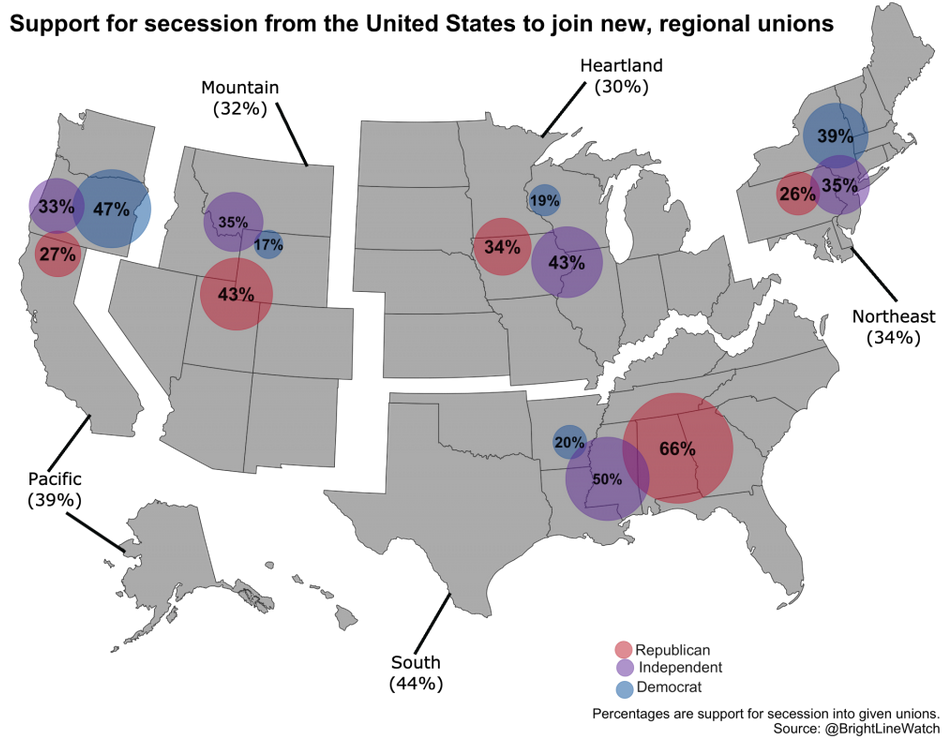

Bright Line Watch polling results by region. Question:
“Would you support or oppose [your state] seceding from the United States to
join a new union with [list of states in new union]?”
This article was originally published on July 16, 2021
October 9, 2021
Since 2016, I have watched America’s slow march over a cliff with a mix of fascination and horror.
But the results of recent polls by Bright Line Watch have provided the first hard and frighteningly conclusive evidence that Americans are moving fast down the road I predicted—towards a national divorce.
I have unfortunately been right about almost every major development in America since Trump won the Republican Party nomination in 2016.
Originally published at gen.medium.com
Like many observers, I didn’t take Trump’s campaign seriously at first. His first attempt at a campaign in 2012 collapsed before the first primary. The second defied every rule I had learned across a lifetime of observing and privately studying American politics. I assumed that the Republican Party leadership would find a way to block his ascension.
Turns out, I underestimated their craven cowardice and lust for power at any cost.
When he did win the GOP primary, I wound up devoting a substantial part of that summer — when I was supposed to be getting ready to write a doctoral dissertation — doing a deep dive into the polling data and assumptions being made by national political analysts.
And what I discovered terrified me: evidence of a systematic polling error that understated Trump’s appeal in Rust Belt states like Wisconsin and Pennsylvania.
Being just a lowly doctoral student, nobody was willing to listen to me when I tweeted to Hillary Clinton that she needed to camp out in Pennsylvania until the end of the election.
Then came that awful night in November when Americans around the country were shocked — but not me. I instead had real-world confirmation that I understood what was happening better than most experts.
Since then, I’ve been right so often it’s frankly painful — not that it has mattered.
I predicted that Trump’s tenure would start out in chaos but he would eventually surround himself with dangerous sycophants when mainstream pundits were telling Americans to “give Trump a chance.”
When the anti-Trump “resistance” embraced the narrative that Russian hacking had swayed the election and the Mueller investigation would bring Trump down, I couldn’t agree — and I was right.
I correctly anticipated that Trump would do everything he could to start a war with Iran short of ordering a bombing campaign out of the blue. He pulled out of the hard-won nuclear deal negotiated by the Obama administration and ultimately killed IRGC Commander Soleimani in Iraq in an operation that defied international law and technically started a war with Iran — that the mullahs thankfully chose not to escalate beyond injuring American service members with a carefully orchestrated missile barrage the United States military was powerless to stop.
I knew that the polls were off again in critical rust belt states in 2020, that pollsters had not solved their problem with under-sampling Trump voters. I knew 2020 looked like a repeat of 2016 — and again I was proven right.
And throughout 2020 I warned that the Trump administration was going to try and subvert the election if it were remotely close. The focus would be on using state legislatures and the Supreme Court to throw out Biden votes then gaming the normal certification process in an attempt to stay in power.
It all happened pretty much as I predicted. And here America is, in 2021, right where I feared it would be.
And I’m afraid the nation’s near-future is now all but set in stone. Powerful forces have been unleashed, and events are proceeding as they must.
Americans have been educated into a set of dangerous myths about their country and its permanence. After the Second World War the influencers and trend-setters of the day realized the past 15 years had been so traumatic the America they themselves had been born into was gone forever.
America has, in fact, died and been reborn a few times in its 250-year history.
First America, Colonial America, lasted from about 1619 with the importation of the first African slaves to 1776 and the War of Independence.
Second America, the Founders’ America, emerged out of a need to unite thirteen very different colonies under some kind of federal structure. A debate raged between federalists — supporting the new Constitution — and anti-Federalists, who preferred the looser Articles of Confederation.
The Federalists won, and from 1789 to 1861 Second America grew, embracing westward expansion and maintaining an increasingly tenuous balance between pro-slavery and pro-abolition groups. These were not exclusively Southern and Northern, either — when Civil War came many counties in the new Confederacy voted to remain part of the Union.
And a few Northern Union states like Delaware and Maryland were slave states. Whose laws allowing slavery were not repealed by Lincoln’s Emancipation Proclamation for brutally political reasons — his administration hoped to spark slave uprisings in the South to support the Union war effort.
Third America, Imperial America, was born in 1865 as the Confederacy was finally smashed, but the divides of the past were not so easily forgotten. Jim Crow and the KKK replaced the Confederacy, the Union effectively abandoning the freed slaves to their fate in order to prevent a second Civil War from breaking out — as it threatened to on several occasions.
Third America focused on westward expansion and Manifest Destiny, using the tools of genocide to secure a national push to the mineral rich Pacific. This was the America of the gilded age, when powerful barons in control of major industries colluded together and began dispatching the American military — before the Civil War not a truly permanent force — on foreign adventures.
Third America lasted from 1865 to 1945, ending in another near-collapse of the country after the Great Depression averted by Franklin Delano Roosevelt’s stabilizing efforts during his four-term administration and, ultimately, the outbreak of the Second World War.
Fourth America is the version that is dying right now. Lasting from 1945 to 2020, it has been characterized by the old divides between Federalist and Anti-Federalist re-emerging as part of the hardening of the two-party system.
All complex systems like countries, go through a regular four-step cycle of fast growth, slowing growth, collapse, and reorganization.
The pace can vary dramatically, but is ultimately a function of changing social values as older generations give way to younger, shifting economic incentives, and the balance of power between political parties. The cycle never ends, and the shift from one phase to the next can only be deferred, never halted.
Change comes during the reorganization phase when — and America will likely soon reach this critical point — people self-sort into groups who start adapting to the new reality and building new structures to cope with it.
Fourth America is collapsing as the postwar global international order decays, the digital generations — Xers, Millenials, and Zoomers — become the majority, and wealth inequality within and between nations reaches the same extreme levels they did back in the Gilded Era, during Third America before the Great Depression.
On top of it all, carbon pollution has caused the climate to begin an inexorable shift to a new, warmer regime. A process that will magnify every other kind of dysfunction already afflicting the world.
In times like these, trust between people goes way down. People stop feeling confident they know what will happen next. Disasters and catastrophes mount, driving collective anxiety.
And so people begin to re-sort themselves into tight-knit groups based on common shared values — like how to appropriately respond to a global pandemic.
There is an old folk curse allegedly from China: may you live in interesting times.
Welp, these are those.
But in the words of Gandalf — “All we have to decide is what to do with the time that is given to us.”
Fourth America is dying — but the shape of Fifth America is still unwritten.
And in a way, that’s kind of exciting.
Because anyone with a brain between their ears knows the status quo in America is not working. The evidence is everywhere:
- Mass shootings almost every day
- Inability to agree on basic concepts like the germ theory of disease
- Half the population living just $400 away from bankruptcy
- Widespread housing shortage forcing people onto the streets
- Complete separation between white and blue collar jobs
- A university education is required to get a good job, but is expensive
- 600,000+ dead from a disease other countries did a better job at fighting
- 50% of income tax revenues flow to a military that can’t win wars
- Climate disasters burning and flooding whole towns
- Shortages of critical supplies and wildly varying prices
If you go back and look at the Soviet Union in the late 1980s, the pattern should jump right out at you.
The country is falling apart, and the billionaires and political hacks running the show are selling inadequate solutions. Linear treatments to exponentially growing problems.
And this is why between 30% and 44% of Americans depending on the region support outright secession — an issue thought to have been fully resolved 150 years ago.
If you asked Americans whether they were willing to legally separate, as opposed to pursuing secession, these numbers would jump even higher.
And what is more, what is so devastating to President Joe Biden’s effort to unite Americans by, mostly, telling them they’re united in every other speech, is that these numbers have increased since January and the Capitol riot.
Even among Democrats, particularly in Pacific America — the West Coast states of California, Oregon, Washington, Hawai’i, and in this survey design Alaska — support for outright secession is incredibly high.
45% of Democrats — who are more than half of the voters out here — want to be free from D.C.
That’s only surpassed by Republicans and Independents in the South — the heart of the old Confederacy — at 66% and 50%. That’s not a surprise, given the region’s history and Republican rejection of the 2020 Presidential Election.
But that even with a Democrat in office Pacific Americans are becoming more supportive of secession — that should come as a dire warning.
There is a reason that, back in 2020 when a group of senior Democrats and Republicans gamed out how a disputed election might go, one of the main outcomes was California, Oregon, and Washington seceding.
The powers-that-be back East might not say it out loud, but they know full well what’s coming.
Trump’s ability to come within 45,000 votes of winning the electoral college — while still losing the popular vote by more than 7 million — is what powers his continued false claims to have won the election. To have come so close, to have turned out a truly unprecedented number of people — that is why Republicans believe Trump’s lies.
As I also predicted, Biden’s public outreach across the aisle has failed. Sure, he may get a watered-down bipartisan infrastructure bill passed yet. And it is even possible that reconciliation will give him a big win.
But the cost will be high. He is going to lose the House to Republican gerrymandering and the normal decline in support for the incumbent President’s party that almost always happens in midterm elections.
No matter how small a reconciliation spending bill might be, the centrist mood has shifted strongly to fears of inflation and the rising national debt. Republicans will cast Democratic spending as socialism, and their voters will turn out in 2022 to fight it.
The Republicans more or less want the Articles of Confederation back. And they’re willing to rig elections to ensure the federal government can never tell their states what to do.
That means by 2023 the Biden administration is toast unless it is willing to move right. Which would upset the progressives the Democrats must get to turn out in 2024 — an option the Dems might well chose, though it will be fatal.
But 2016 and 2020 have both offered strong evidence that American elections are, in the electoral college, bound to be close. Barring the emergence of a strong third party, 2024 will be a repeat of 2020, which was a repeat of 2016, but lacking a deadly pandemic the incumbent utterly bungled in responding to.
And that means once again Republican-controlled states will be in a position to impose a second Trump term on America.
In 2020, they chose not to. Elected officials in Georgia and Arizona defied Trump and safeguarded the free and fair election.
And their party punished them for it. The laws being passed across the Red States right now are legalizing Trump’s attempts to steal the last election. Their voters want this — there is no way they’ll hold off now.
So unless the Democratic candidate somehow wins in a landslide on the back of massive public support that doesn’t seem likely to materialize, it is probable that Trump will be President again in 2025.
Americans are exhausted by politics and strife and just want to go about their lives. With mail-in voting being curbed, turnout will be lower in 2024 than it was in 2020.
This will affect both parties — Trump is unlikely to get 74 million votes again, just as Biden is unlikely to hit 80 million. The negative partisanship is too high, and after 2020 the “this is for democracy” argument won’t motivate as many people as it did.
15,000 vote margins in Arizona and Georgia are easy to wipe away with changes in voting rules. If in 2020 Biden got 1 million votes and Trump 990,000, then in 2024 Biden sheds 20% of his voters and Trump loses just 15%, the margin of victory shifts in Trump’s favor by over 25,000 votes. That’s more than his margin in Wisconsin, and thanks to the census results it’s enough to put him over 270 if he can maintain his grip on the other states he actually won.
And that’s not even taking into account the probability that in any close election Arizona, Georgia, and Wisconsin officials will be GOP partisans by 2024.
If they do what their GOP voters expect of them and make sure Trump wins a second term, I expect the country will fracture.
And the way the rhetoric is escalating on the right, if a Democrat won again the Red states — which is half of them — may very well choose to actually secede.
One way or another, the 2024 Election is going to be brutal. It will heavily determine the shape of Fifth America.
It is absolutely vital to preempt this awful scenario, which could produce a split in the federal government that forces the military to take sides.
Or worse, the armed forces could fracture, creating warring factions within the wreckage of America. This would fast escalate to ethnic cleansing and likely bring in foreign powers.
After all, the United States has over 2,000 nuclear weapons ready to use. What happens to America will impact all the world.
The best option America has now follows from what the Bright Line Watch polls indicate is happening anyway: a split of the country into smaller and more culturally coherent regions.
But this must not come after a disputed election and a total collapse of the federal government.
Instead, the federal government simply needs to be formally split up.
Secession is unconstitutional — but Amending the Constitution is a basic democratic right.
The challenge is developing an Amendment both Red and Blue legislators — at the state if not federal level — can accept.
That means it has to be simple, straightforward, and reflect the real regional divisions cleaving America apart.
The Constitution must be Amended to split the federal government into at least five, if not eight, Autonomous Federal Regions made by states self-grouping.
Each AFR must be given the existing Constitution, all the federal laws and bureaucratic rules and caselaw, and invested with the right to interpret and further amend it according to the will of the regional electorate.
ALL existing federal roles except declaring war and maintaining a common currency and the right of travel between regions will be ported down to the new sub-federal governments. This includes military formations.
Each region will directly elect a single President to serve on a supra-national Presidents’ Council in D.C. They will be charged with appointing Federal Reserve bank chairs and the leaders of the remnant of the United States Armed Forces, which will only be activated in times of declared cross-region crisis.
Everything else must be done on a regional level going forward. The United States is a continental federation just like the European Union. It is full of different cultures, different perceptions of shared history.
Separation is sadly the only remaining way to keep America as united as it can be while giving different regions the flexibility their citizens demand to build the government they want.
The alternative is a messy divorce, perhaps even open civil war.
And the clock is ticking.
Update: In response to the incredible amount of attention this piece received (selected for GEN, woo!) I wrote a follow-up.
If you want to better understand why breaking up the federal government would actually salvage American Democracy in more detail, here you go.
Thanks, and take care out there people.
Originally published at gen.medium.com
About the author
Andrew Tanner is the author of Bringing Ragnarok and Bivrost Nine, Rogue Analyst, Cat Devotee. Autistic, True Neutral, Pro-Science, Anti-Authoritarian, Rural Pacific American.
Please help TFF remain truly independent by contributing if you benefited from this article





