
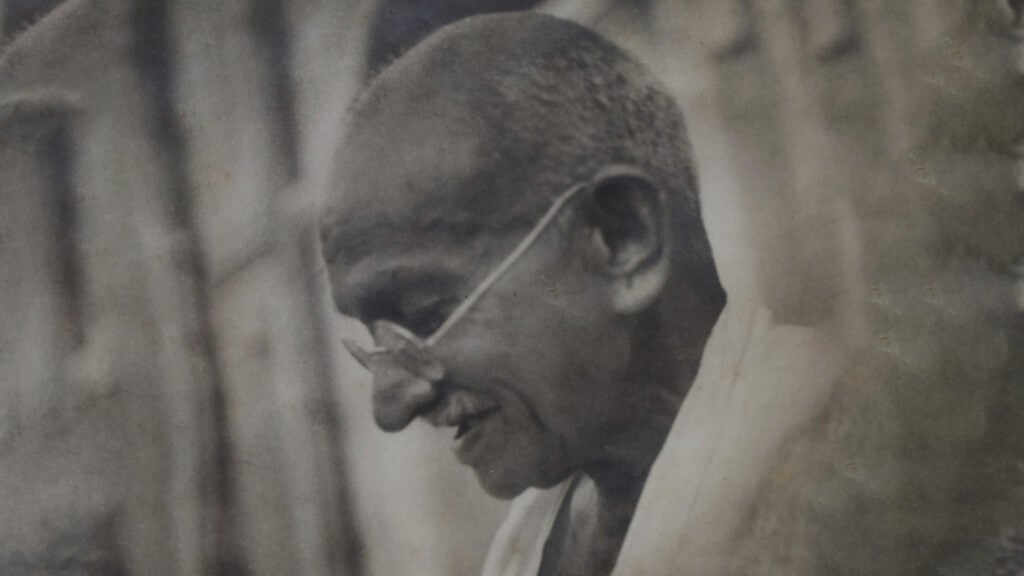
(Mahatma Gandhi, ph. Rajni Kothari, photo credit: Wall Street International)

March 2, 2021
In a world that is increasingly torn by conflicts and crises of many kinds.
On October 2, political and business and religious leaders in India and elsewhere remember Mahatma Gandhi, sing his praises, and pledge to live by the ideals he espoused. A day later, or perhaps the same evening, he is left behind as suddenly as he was remembered that morning.
Worse, they get back to assassinating him and the ideals of non-violence, self-reliance, universal well-being, that he lived and died for. And yet it is worth asking: in this 151st birth anniversary month, does he still hold relevance in a world that is increasingly torn by conflicts and crises of many kinds?
Originally published by Wall Street International
Interestingly, over the last few years there appears to have been a rekindling of attention to his life, ideas and actions. Several local to global movements are applying principles like civil disobedience and non-violence, with explicit or implicit recognition of their inspiration being Gandhi.
Others are recalling his prescient views on the ecological impacts of unfettered ‘development’. But there is also the adverse attention brought to him by some of the anti-racism movements, recalling the racist views he seemed to hold in his early years as an activist in South Africa.
And in India, he has become a cynically convenient symbol of the government’s pet programmes on cleanliness and, most recently, self-reliance; even as some people implicitly encouraged by the current hyper-nationalist regime are even celebrating his assassin Nathuram Godse as a patriot!
Whatever one makes of the contrasting nature of this recently revived interest, there is no doubt about Gandhi’s continued relevance in the daily struggles and initiatives of peoples but around the world.
Directly or indirectly, his notions of swaraj, satyagraha, sarvodaya, and ahimsa live on, and become even more crucial in a world that is being torn asunder by growing inequalities, ecological devastation, and continued and new forms of deprivation from basic needs for a couple of billion people.
Satyagraha: Speaking truth to power
Multiple pre-existing global crises have been exacerbated by the Covid-19 pandemic, and even more so, by state responses to it. In many countries, the government has used it as an excuse to increase authoritarian tendencies, including citizens’ surveillance in the name of security.
Additionally it has used it as an opportunity to take decisions that are blatantly anti-labour or anti-environment, knowing that the ability for dissent is significantly reduced amongst populations who are supposed to not venture into the streets. This is where the Gandhian notion of satyagraha, of speaking truth to power in non-violent ways, is so crucial.
In many different ways, Gandhi practiced satyagraha, resisting colonial power, or the marginalization of Muslims in a Hindu-majority society. Interestingly, he also used it as a means of trying to achieve an ethical basis for transformation; for instance, when he called off a national non-cooperation movement against colonial rule, as a mark of atonement for an incident in which movement members burnt a police station and killed several policemen.
This closely linked to his constant stress on ahimsa or non-violence, especially relevant both in resisting forces of oppression as in not harbouring feelings of violent revenge.
Nelson Mandela was inspired by this to call for a process of ‘truth and reconciliation’ that enabled a peaceful transition out of apartheid in South Africa, rather than a period of bloody vengeful acts against white settlers (which would have been entirely understandable given the horrors of apartheid).
Another disciple of this approach, Martin Luther King, is one of the ancestors of the ongoing anti-racist movement in the USA, including the latest George Floyd rebellion, which is explicitly non-violent. (As an aside it is interesting that the more explicit Gandhi connection seems to be the demand amongst some elements of the anti-racism movement to take down his statues, to protest what is seen as his racist attitude when he was in South Africa, a view that has been qualified by several scholars of Gandhi, including by digging deep into black movement journalism of the time).
Others that have picked up the satyagraha approach include Extinction Rebellion, a global movement of non-violent disruption bringing attention to the massive devastation of the planet and of human lives by the climate crisis caused by the dominant economic and political system.
In India a satyagraha was called on 25th August by youth across the country, to protest the blatant attempt by the government to weaken legislation mandating environmental impact assessment of development projects.
Many grassroots movements of resistance in India have been similarly inspired. The Chipko Movement in the Himalaya, facilitated by senior Gandhians, attempted to save forests from being axed for industry in the 1970s.
As one of the world’s most iconic environmental and livelihoods movements, it has inspired similar forest-saving initiatives in USA and elsewhere. The Narmada Bachao Andolan against megadams in central India has been explicitly non-violent, and has inspired similar movements in other parts of the world.
Global movements for peace, nuclear and weapons disarmament have a similar legacy; this includes the UN charter and multilateralism, in which Indian negotiators influenced directly by Gandhi had a strong role.
Sarvodaya: Collective uplifting of all
To Gandhi, however, satyagraha was only one in a toolbox of approaches to achieve justice. Travelling through the length and breadth of the country, he had realized that abysmal levels of deprivation and marginalization, stemming from an intensely feudal and colonial history, had to be dealt with.
Truth was not only to be spoken to power, but also towards grounded action towards sarvodaya, the upliftment of all in an equitable manner, or as Gandhi put it in Young India, not “the utilitarian formula of the greatest good of the greatest number (but) … the greatest good of all”. This could be achieved through nirman, or reconstruction.
He himself, and some of his followers or advisers such as economist JC Kumarappa, inspired several experiments in local, dignified livelihood generation and self-reliance, with the spinning of khadi cloth being a core symbol.
In current times, several initiatives at dignified livelihoods and self-reliance have been inspired by Gandhian approaches to a ‘non-violent economy’. The Gandhian worker (and well-known theatre personality) Prasanna, initiated Charaka, a women-run khadi cooperative that has provided dignified livelihoods to 200 women while emphasizing hand labour, self-reliance, and environmentally sensitive production.
It has been in the news of late (Sept-Oct 2020), having been on satyagraha to highlight the non-payment of dues by the government, because of which it had to shut down for over a month.
It has done this not through typical street protest, but by publicly cleaning up offices of the local administration, distributing cloth to the poor, and other methods of ‘changing hearts’ of those in power.
Elango R., a Dalit sarpanch near Chennai, explicitly combines Gandhian and Marxist principles, and the anti-casteism of the Dalit icon Babasaheb Ambedkar (who headed the committee to frame India’s constitution), in his attempt to transform Kuthambakkam village where he lives, including providing more dignity and livelihood security to Dalit families.
He has advocated a ‘network economy’ in which clusters of 20 or so villages can be self-reliant for basic needs; an idea somewhat differently put by another Gandhi-inspired social worker, Ela Bhatt, in her idea of ‘100-mile radius’ self-reliance.
All these ideas are under increasing discussion in Covid-affected India, as stories of community response in the lockdown period show that where there is food and livelihood self-reliance, there is maximum resilience.
Across the world, there are amazing examples of constructive alternatives to the currently dominant system: sustainable and holistic agriculture, community-led water/energy/food sovereignty and nature conservation, solidarity and sharing economy, worker take-over of production facilities, resource/knowledge commons, local governance, community health and alternative learning, inter-community peace-building, re-assertion of cultural diversity, gender and sexual pluralism, and much else (see for instance Vikalp Sangam for hundreds of examples from India; from elsewhere, see Radical Ecological Democracy.
Most of these do not necessarily take direct inspiration from Gandhi, but the ambience of his ideas and practices is likely to have influenced very many of them, such as for instance farmer movements for anna swaraj (food sovereignty).
The principle of sarovadaya, and a related concept of trusteeship that Gandhi advocated, can lead one to a radical focus on the commons, rather than on private ownership. In 2013, the gram sabha (village assembly) of Mendha-Lekha (Gadchiroli district, Maharashtra), took the historic decision of converting all its private agricultural land into the village commons.
To give this legal backing, they used the mostly-forgotten Gramdan Act, which was inspired by Gandhi’s disciple Vinoba Bhave.
Gandhi has been criticized (perhaps justifiably so) for not being explicitly anti-capitalism, such as in his entreaties to industrialists in India to take on the notion of trusteeship. But he also said:
Everybody should be able to get sufficient work to enable him to make the two ends meet. And this ideal can be universally realized only if the means of production of the elementary necessaries of life remain in the control of the masses. These should be freely available to all as God’s air and water are or ought to be; they should not be made a vehicle of traffic for the exploitation of others. Their monopolization by any country, nation or group of persons would be unjust.
This indicates that he was clearly against a handful of individuals (or indeed the state) owning or controlling the means of production, as also against the concentration of wealth in the hands of a few.
He was also for a more Eastern approach to achieving “a truer socialism and a truer communism than the world has yet dreamed of”. There have been a series of proposals in recent times, for radical redistribution of wealth from the horrendously iniquitous concentration the world faces today, by taxation, abolishing inheritance and indeed private property itself, and other means. These can be seen as means of achieving sarvodaya.
In the health sector too, echoes of Gandhi’s very strongly-articulated focus on self-healing, on facilitating the body’s natural powers, on the use of herbal treatment, etc., are seen in the very many naturopathy and ayurvedic centres across India.
The Pune-based National Institute of Naturopathy has built its extensive programme and outreach on Gandhi’s approach to health. In the time of Covid, the necessity of having healthy bodies or to boost immunity using such approaches, for faster and fuller recovery has been amply demonstrated.
As also the need to be self-reliant for personal needs rather than today’s debilitating reliance on ‘professionals’; an approach powerfully argued by the brilliant scholar Ivan Illich, who was influenced by Gandhian economist JC Kumarappa.
Swaraj: True democracy
For Gandhi, the ultimate expression of self-reliance was swaraj, rather inadequately translated as self-rule. Swaraj actually has a deeply democratic and ethical approach that puts today’s liberal democracies to shame, incorporating freedom and autonomy but with responsibility towards the freedom and autonomy of others, possible only if one also lives the ethics of self-restraint rather than the insane consumerism promoted by today’s economy.
Such a notion of radical, direct democracy has to be a crucial fulcrum of the response to global crises. The majority of progressive social and political movements have been oriented at ‘taking over the state’, at trying to replace regressive political parties with progressive ones, and making the state accountable.
In so far as this is necessary as long as the state exists, this does not fundamentally challenge the nature of the state itself, or indeed whether a centralized state needs to exist.
Nor has there been an adequate challenge to the centrality of the nation-state in our lives, despite the enormous failings of this structure in dealing both with internal problems of its people and with global issues (climate being a spectacularly scary example). Various forms of anarchy, Marxist or Gandhian, have mostly been relegated to the sidelines.
In India, the government has made only a few hesitant steps towards direct democracy, and moved very far from the ideal of self-reliance for communities (or the country as a whole). The 73rd and 74th Constitutional amendments promised decentralization of decision-making power to villages and urban wards, but severely curtailed it by not providing for financial and legal devolution; in any case, implementation has been halting, at best.
Kerala’s process of village-level planning, and Nagaland’s communitisation initiative in which a part of the state government funds (for education, health, power, roads) go directly to village councils for use, are examples of states that have come closer to the intent of the 73rd Amendment. But even they have been flawed or not sustained for long enough.
For Gandhi, swaraj had to be built ‘bottom-up’, from the village outwards across the landscape in what he called ‘oceanic circles’. Across India several individuals who were part of the Gandhian activist Jayaprakash Narayan’s youth movement, Chhatra Yuva Sangharsh Vahini, have worked with village communities to build local self-reliance in areas like water and food, and to struggle for gram sabha (village assembly) based decision-making.
In central and eastern India, Adivasi and other local communities have attempted varying degrees of self-rule; as Mendha-Lekha (referred to above) declared three decades back, “we elect the government in Delhi, but in our village, we are the government”. Around 90 villages in the same part of India have formed a Maha Gramsabha (federation of village assemblies) with a similar orientation.
Close parallels to these are the struggles for self-determination by indigenous peoples and other local communities in many parts of the world, including the right to consent or refuse any external proposal for a project in their territories.
The Zapatista in Mexico and the Kurdish movement in western Asia have achieved such a radical democracy at relatively large scale; many other peoples in Latin America have claimed and gained recognition for full self-determination, and movements to reclaim territorial sovereignty by first nations in Turtle Island (Canada/USA) and Australia have a similar basis.
Many of these emanate from indigenous cosmologies that are closely aligned (though mostly unconsciously so) to the Gandhian principles of swaraj, sarvodaya, and satyagraha … and may even go beyond in their complete immersion into nature.
One can therefore posit an extension of swaraj and sarvodaya to encompass all of life, an ‘eco-swaraj’ or ‘prakritik (natural) swaraj’, or a radical ecological democracy. A spate of legal and juridicial pronouncements and demands by citizens and communities in many parts of the world have proclaimed that nature (or elements of it, like rivers and mountains) has an intrinsic right, similar to that of a ‘legal person’.
Though often couched within formal western discourse and therefore prone to serious limitations, these can be seen to be aligned to indigenous worldviews that recognize all aspects of nature having their own spirit, worthy of as much respect as humans. Gandhi’s remark, that the worth of a civilization can be gauged by how it treats animals, comes to mind.
Such perspectives have also emerged from within ‘the belly of the beast’, so to speak. Movements based on ecofeminist approaches, for instance, strongly emphasise the need to end the millennia-old domination of one half of humanity by the other half, simultaneous to healing the ‘metabolic rift’ between humans and the rest of nature.
Challenges to unsustainable production and consumption patterns, including the growing demand for radical degrowth of so-called ‘developed’ economies, and for fundamentally altering the growth-based model of development, would relate closely to the Gandhian perspective on self-restraint inherent in swaraj, and his trenchant critique of industrialism as exploitative of both nature and humans.
It is important to note that grassroots movements of resistance and alternatives do not necessarily imprison themselves in one or the other ideological camp; this is more the pre-occupation of academics and professional activists.
Rather, such movements consciously or subconsciously borrow from several inspiring figures in history, including those in their own past who have struggled for justice.
Nor ought they to push for a single, homogenous ‘alternative’ across the world. A seamless integration of such diverse legacies, and the interweaving of a pluriverse of worldviews and practices, are what will guide us past a world riven by crises.
Originally published by Wall Street International
About the author

Ashish Kothari is founder-member of Indian environmental group Kalpavriksh, Ashish taught at the Indian Institute of Public Administration, coordinated India’s National Biodiversity Strategy & Action Plan process, served on Greenpeace International and India Boards, helped initiate the global ICCA Consortium.
Please help TFF remain truly independent by contributing if you benefited from this article





