
(Photo credit: iai.tv)

February 1, 2021
We’re now living in an age of opacity, as Rudy Giuliani pointed out in a courtroom recently. Here was the exchange:
“‘In the plaintiffs’ counties, they were denied the opportunity to have an unobstructed observation and ensure opacity,’ Giuliani said. ‘I’m not quite sure I know what opacity means. It probably means you can see, right?’
“‘It means you can’t,’ said U.S. District Judge Matthew Brann.
“‘Big words, your honor,’ Giuliani said.”
Big words indeed! And he couldn’t have been more on the mark, whether he knew it or not. Thanks in part to him and to the president he’s represented so avidly, even as hair dye or mascara dripped down his face, we find ourselves in an era in which, to steal a biblical phrase from Swedish film director Ingmar Bergman, all of us see as if “through a glass darkly.”
Originally published at Juancole.com and Tomdispatch.com
As in Election Campaign 2016, Donald Trump isn’t the cause but a symptom (though what a symptom!) of an American world going down.
Then as now, he somehow gathered into his one-and-only self so many of the worst impulses of a country that, in this century, found itself eternally at war not just with Afghans and Iraqis and Syrians and Somalis but increasingly with itself, a true heavyweight of a superpower already heading down for the count.
Here’s a little of what I wrote back in June 2016 about The Donald, a reminder that what’s happening now, bizarre as it might seem, wasn’t beyond imagining even so many years ago:
“It’s been relatively easy… — at least until Donald Trump arrived to the stunned fascination of the country (not to speak of the rest of the planet) — to imagine that we live in a peaceable land with most of its familiar markers still reassuringly in place… In truth, however, the American world is coming to bear ever less resemblance to the one we still claim as ours, or rather that older America looks increasingly like a hollowed-out shell within which something new and quite different has been gestating.
“After all, can anyone really doubt that representative democracy as it once existed has been eviscerated and is now — consider Congress Exhibit A — in a state of advanced paralysis, or that just about every aspect of the country’s infrastructure is slowly fraying or crumbling and that little is being done about it? Can anyone doubt that the constitutional system — take war powers as a prime example or, for that matter, American liberties — has also been fraying? Can anyone doubt that the country’s classic tripartite form of government, from a Supreme Court missing a member by choice of Congress to a national security state that mocks the law, is ever less checked and balanced and increasingly more than ‘tri’?”
Even then, it should have been obvious that Donald Trump was, as I also wrote in that campaign year, a wildly self-absorbed symptom of American-style imperial decline on a planet increasingly from hell.
And that, of course, was four years before the pandemic struck or there was a wildfire season in the West the likes of which no one had imagined possible and a record 30 storms that more or less used up two alphabets in a never-ending hurricane season.
In the most literal sense possible, The Donald was our first presidential candidate of imperial decline and so a genuine sign of the times.
He swore he would make America great again, and in doing so, he alone, among American politicians of that moment, admitted that this country wasn’t great then, that it wasn’t, as the rest of the American political class claimed, the greatest, most exceptional, most indispensible country in history, the sole superpower left on Planet Earth.
An American World Without “New Deals” (Except for Billionaires)
In that campaign year, the United States was already something else again and that was more than four years before the richest, most powerful country on the planet couldn’t handle a virus in a fashion the way other advanced nations did.
Instead, it set staggering records for Covid-19 cases and deaths, numbers that previously might have been associated with third-world countries. You can practically hear the chants now as those figures continue to rise exponentially: USA! USA! We’re still number one (in pandemic casualties)!
Somehow, in that pre-pandemic year, a billionaire bankruptee and former reality TV host instinctively caught the mood of the moment in an ever-less-unionized American heartland, long in decline if you were an ordinary citizen.
By then, the abandonment of the white working class and lower middle class by the “new Democrats” was history. The party of Bill and Hillary Clinton had long been, as Thomas Frank wrote recently in the Guardian,
“preaching competence rather than ideology and reaching out to new constituencies: the enlightened suburbanites; the ‘wired workers’; the ‘learning class’; the winners in our new post-industrial society.”
Donald Trump arrived on the scene promising to attend to the abandoned ones, the white Americans whose dreams of better lives for themselves or their children had largely been left in the dust in an ever-more-unequal country.
Increasingly embittered, they were, at best, taken totally for granted by the former party of Franklin Delano Roosevelt. (In the 2016 campaign, Hillary Clinton didn’t even consider it worth the bother to visit Wisconsin and her campaign underplayed the very idea of focusing on key heartland states.)
In the twenty-first century, there were to be no “new deals” for them and they knew it. They had been losing ground — to the tune of $2.5 trillion a year since 1975 — to the very billionaires whom The Donald so proudly proclaimed himself one of and to a version of corporate America that had grown oversized, wealthy, and powerful in a fashion that would have been unimaginable decades earlier.
On entering the Oval Office, Trump would still offer them blunt words, which would ring bells in rally after rally where they could cheer him to death.
At the same time, with the help of Senate Majority Leader Mitch McConnell, he continued the process of abandonment by handing a staggering tax cut to the 1% and those very same corporations, enriching them ever so much more.
So, of course, would the pandemic, which only added yet more billions to the fortunes of billionaires and various corporate giants (while granting the front-line workers who kept those companies afloat only the most meager and passing “hazard pay”).
Today, the coronavirus here in the United States might be more accurately relabeled “the Trump virus.” After all, the president really did make it his own in a unique fashion.
Via ignorance, neglect, and a striking lack of care, he managed to spread it around the country (and, of course, the White House itself) in record ways, holding rallies that were visibly instruments of death and destruction.
All of this would have been clearer yet if, in Election Campaign 2020, he had just replaced MAGA as his slogan with MASA (Make America Sick Again), since the country was still going down, just in a new way.
In other words, ever since 2016, Donald Trump, wrapped up eternally in his own overwrought self, has come to personify the very essence of a bifurcated country that was heading down, down, down, if you weren’t part of that up, up, up 1%.
The moment when he returned from the hospital, having had Covid-19 himself, stepped out on a White House balcony, and proudly tore off his mask for all the world to see summed up the messaging of this all-American twenty-first-century moment perfectly.
Waving Goodbye to the American Moment
Unique as Donald Trump may seem in this moment and overwhelming as Covid-19 might be for now, the American story of recent years is anything but unique in history, at least as so far described.
From the Black Death (bubonic plague) of the fourteenth century to the Spanish Flu of the early twentieth century, pandemics have, in their own fashion, been a dime a dozen.
And as for foolish rulers who made a spectacle of themselves, well, the Romans had their Nero and he was anything but unique in the annals of history.
As for going down, down, down, that’s in the nature of history. Known once upon a time as “imperial powers” or “empires,” what we now call “great powers” or “superpowers” rise, have their moments in the sun (even if it’s the shade for so many of those they rule over), and then fall, one and all.
Were that not so, Edward Gibbon’s classic six-volume work, The History of the Decline and Fall of the Roman Empire, would never have gained the fame it did in the eighteenth and nineteenth centuries.
Across the planet and across time, that imperial rising and falling has been an essential, even metronomic, part of humanity’s story since practically the dawn of history.
It was certainly the story of China, repeatedly, and definitely the tale of the ancient Middle East. It was the essence of the history of Europe from the Portuguese and Spanish empires to the English empire that arose in the 18th century and finally fell (in essence, to our own) in the middle of the last century.
And don’t forget that other superpower of the Cold War, the Soviet Union, which came into being after the Russian Revolution of 1917 and grew and grew, only to implode in 1991, after a (gulp!) disastrous war in Afghanistan, less than 70 years later.
And none of this, as I say, is in itself anything special, not even for a genuinely global power like the United States. (What other country ever had at least 800 military garrisons spread across the whole planet?) If this were history as it’s always been, the only real shock would perhaps be the strikingly bizarre sense of self-adulation felt by this country’s leadership and the pundit class that went with it after that other Cold War superpower so surprisingly blew a fuse.
In the wake of the fall of the Berlin Wall in 1989 and the Soviet Union’s plunge to its grave in 1991, leaving behind an impoverished place once again known as “Russia,” they engaged in distinctly delusional behavior.
They convinced themselves that history as it had always been known, the very rise and fall and rise (and fall) that had been its repetitious tune, had somehow “ended” with this country atop everything forever and beyond.
Not quite three decades later, in the midst of a set of “forever wars” in which the U.S. managed to impose its will on essentially no one and in an increasingly chaotic, riven, pandemicized country, who doesn’t doubt that this was delusionary thinking of the first order?
Even at the time, it should have been obvious enough that the United States would sooner or later follow the Soviet Union to the exits, no matter how slowly, enveloped in a kind of self-adoration.
A quarter-century later, Donald Trump would be the living evidence that this country was anything but immune to history, though few then recognized him as a messenger of the fall already underway.
Four years after that, in a pandemicized land, its economy a wreck, its military power deeply frustrated, its people divided, angry, and increasingly well-armed, that sense of failing (already felt so strongly in the American heartland that welcomed The Donald in 2016) no longer seems like such an alien thing. It feels more like the new us — as in U.S.
Despite the oddity of The Donald himself, all of this would just be more of the same, if it weren’t for one thing.
There’s an extra factor now at work that’s all but guaranteed to make the history of the decline and fall of the American empire different from the declines and falls of centuries past.
And no, it has next to nothing to do with (blare of trumpets!) Donald Trump, though he did long ago reject climate change as a “Chinese hoax” and, in every way possible, thanks to his love of fossil fuels, give it as much of a helping hand as he could, opening oil lands of every sort to the drill, and dismissing environmental regulations that might have impeded the giant energy companies.
And don’t forget his mad mockery of alternative power of any sort.
I could go on, of course, but why bother. You know this part of the story well. You’re living it.
Yes, in its own distinctive fashion, the U.S. is going down and will do so whether Donald Trump, Joe Biden, or Mitch McConnell is running the show.
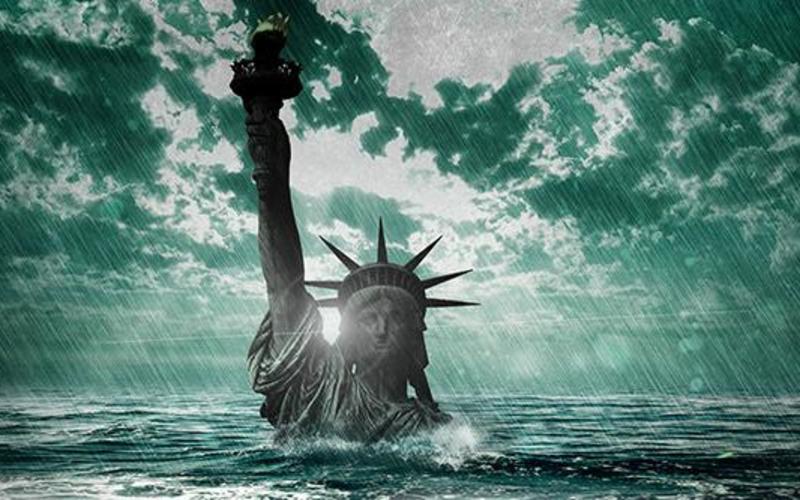
But here’s what’s new: for the first time, a great imperial power is falling just as the earth, at least as humanity has known it all these thousands of years, seems to be going down, too.
And that means there will be no way, no matter what The Donald may think, to wall out intensifying storms, fires, or floods, mega-droughts, melting ice shelves and the rising sea levels that go with them, record temperatures, and so much more, including the hundreds of millions of people who are likely to be displaced across a failing planet, thanks to those greenhouse gases released by the burning of the fossil fuels that Donald Trump loves so much.
Undoubtedly, the first genuine twist in the rise-and-fall version of human history — the first story, that is, that was potentially all about falling — arrived on August 6th and 9th, 1945 when the U.S. dropped nuclear bombs on the Japanese cities of Hiroshima and Nagasaki.
It soon became apparent that such weaponry, collected in vast and spreading arsenals, had (and still has) the power to quite literally take history out of our hands.
In this century, even a “limited” regional war with such weaponry could create a nuclear winter that might starve billions. That version of Armageddon has at least been postponed time and again since August 1945, but as it happened, humanity proved quite capable of coming up with another version of ultimate disaster, even if its effects, no less calamitous, happen not with the speed of an exploding nuclear weapon, but over the years, the decades, the centuries.
Donald Trump was the messenger from hell when it came to a falling empire on a failing planet. Whether, on such a changing world, the next empire or empires, China or unknown powers to come, can rise in the normal fashion remains to be seen.
As does whether, on such a planet, some other way of organizing human life, some potentially better, more empathetic way of dealing with the world and ourselves will be found.
Just know that the rise and fall of history, as it always was, is no more. The rest, I suppose, is still ours to discover, for better or for worse.
Originally published at Juancole.com and Tomdispatch.com.
Copyright 2020 Tom Engelhardt.
About the author:
Tom Engelhardt is a co-founder of the American Empire Project and the author of A Nation Unmade by War (Dispatch Books) and The United States of Fear as well as a history of the Cold War, The End of Victory Culture.
He is a fellow of the Nation Institute and runs TomDispatch.com. His latest book is Shadow Government: Surveillance, Secret Wars, and a Global Security State in a Single-Superpower World.
Follow TomDispatch on Twitter at @TomDispatch
Please help TFF remain truly independent by contributing if you benefited from this article





