
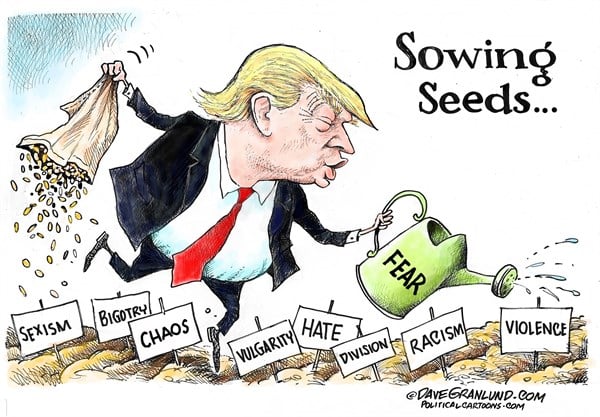
The rhetorical brilliance of Trump the demagogue

Dr. Jennifer Mercieca

December 02, 2020

Donald Trump’s December 7 Statement on Preventing Muslim Immigration has attracted worldwide disdain. Nearly 500,000 Britons have signed a petition asking their government to prevent Trump from entering their country. In the US, Trump’s comments have been denounced by Democrats, Republicans, the media and religious groups.

Originally posted on The Conversation on December 11, 2015

Yet a recent poll has found that 37% of likely voters across the political spectrum agree with a “temporary ban” on Muslims entering the US.

Trump possesses an arrogance and volatility that makes most voters recoil. So how has he maintained a grip on a segment of the Republican base that – at least, for now – seems unshakable?

And how has his support persisted, despite the fact that some have called him a demagogue and a fascist, or that political observers have found parallels between him and polarizing figures like George Wallace, Joseph McCarthy, Father Coughlin – even Hitler?

As a scholar of American political rhetoric, I write about and teach courses on the use and abuse of rhetorical strategy in public discourse. Scrutinizing Trump’s rhetorical skills can partially explain his profound and persistent appeal.

The rhetoric of demagoguery

The Greek word “demagogue” (demos = people + agōgos = leader) literally means “a leader of the people.” Today, however, it’s used to describe a leader who capitalizes on popular prejudices, makes false claims and promises, and uses arguments based on emotion rather than reason.

Donald Trump appeals to voters’ fears by depicting a nation in crisis, while positioning himself as the nation’s hero – the only one who can conquer our foes, secure our borders and “Make America Great Again.”

His lack of specificity about how he would accomplish these goals is less relevant than his self-assured, convincing rhetoric. He urges his audiences to “trust him,” promises he is “really smart” and flexes his prophetic muscles (like when he claims to have predicted the 9/11 attacks).

Trump’s self-congratulating rhetoric makes him appear to be the epitome of hubris, which, according to research, is often the least attractive quality of a potential leader. However, Trump is so consistent in his hubris that it appears authentic: his greatness is America’s greatness.

So we can safely call Trump a demagogue. But one fear of having demagogues actually attain real power is that they’ll disregard the law or the Constitution. Hitler, of course, is a worst-case example.

Amazingly, one of Trump’s very arguments is that he won’t be controlled.

On the campaign trail, he’s harnessed his macho businessman persona – crafted through social media and years spent on TV (where he was often the most powerful person in the room) – to make his case for the presidency. It’s a persona that rejects restraints: he speaks of not being constrained by his party, media, other candidates, political correctness, facts – anything, really.

In a sense, he’s fashioning himself as an uncontrollable leader.

Using speech to demolish detractors

But most voters would never want an uncontrollable president. So why do so many remain adamant in their support?

First, Trump draws on the myth of American exceptionalism. He depicts the United States as the world’s best hope: there is only one chosen nation and, as president, all of his decisions work toward making America great. By tying himself to American exceptionalism – while classifying his detractors as “weak” or “dummies” – he’s able to position his critics as people who don’t believe in, or won’t contribute to, the “greatness” of the nation.

Trump also uses fallacious and divisive rhetorical techniques that prevent him from being questioned or backed into a corner.

He often uses ad populum arguments, which are appeals to the wisdom of the crowd (“polls show,” “we’re winning everywhere”).

When opponents question his ideas or stances, he’ll employ ad hominem attacks – or criticisms of the person, rather than the argument (dismissing his detractors as “dummies,” “weak” or “boring”). Perhaps most famously, he derided Carly Fiorina’s appearance when she started to go up in the polls after the first Republican debate (“Look at that face!” he cried. “Would anyone vote for that? Can you imagine that, the face of our next president?”).

Finally, his speeches are often peppered with ad baculum arguments, which are threats of force (“when people come after me they go down the tubes”).

Because demagogues make arguments based on false claims and appeal to emotion, rather than reason, they’ll often resort to these devices. For example, during his 1968 presidential run, George Wallace declared, “If any demonstrator ever lays down in front of my car, it’ll be the last car he’ll ever lay down in front of” (ad baculum). And Senator Joseph McCarthy resorted to an ad hominem attack when he derided former Secretary of State Dean Acheson as a “pompous diplomat in striped pants with a phony British accent.”

Donald Trump’s rhetoric has elicited comparisons to former Alabama governor George Wallace.

Trump will also employ a rhetorical technique called paralipsis to make claims that he can’t be held accountable for. In paralipsis, the speaker will introduce a topic or argument by saying he doesn’t want to talk about it; in truth, he or she wants to emphasize that very thing.

For example, in New Hampshire on December 1, he said, “But all of [the other candidates] are weak and they’re just weak – I think that they are weak generally if you want to know the truth. But I don’t want to say that because I don’t want to…I don’t want to have any controversies, no controversies, is that okay? So I refuse to say that they are weak generally, okay?”

Trump’s ultimate fallacy

Let’s return to Trump’s December 7, 2015 statement about Muslims to analyze which rhetorical techniques are in play:

Without looking at the various polling data, it is obvious to anybody the hatred is beyond comprehension. Where this hatred comes from and why we will have to determine. Until we are able to determine and understand this problem and the dangerous threat it poses, our country cannot be the victims of horrendous attacks by people that believe only in Jihad, and have no sense of reason or respect for human life. If I win the election for President, we are going to Make America Great Again.

In this statement, Trump immediately makes two things axiomatic (or unquestionable): American exceptionalism and Muslims’ hatred for America. According to Trump, these axioms are supported by the wisdom of the crowd (ad populim); they are “obvious to anybody.”

He also defines Muslims in essential terms as people who believe only in jihad, are filled with hatred and have no respect for human life. Trump uses Reification – the treatment of objects as people and people as objects – to link his axioms together and support his case: “Our country cannot be the victims of horrendous attacks by people that believe only in jihad.”

Here, he personifies “our country” by presenting the nation as a person. Meanwhile, he uses “that” rather than “who” to signal that Muslims are not people, but objects.

His underlying logic is that our nation is a victim of these “objects.” Objects need not be treated with the same amount of care as people. Therefore we are justified in preventing Muslims from entering the country.

Finally, it’s worth noting that Trump’s use of evidence is incomplete and biased toward his point of view. His announcement cites a survey of American Muslims “showing 25% of those polled agreed that violence against Americans here in the United States is justified.”

The polling data came from the Center for Security Policy (CSP), which the Southern Poverty Law Center has called an “anti-Muslim think tank.” Furthermore, Trump fails to report that in the same survey, 61% of American Muslims agreed that “violence against those that insult the prophet Muhammad, the Qur’an, or Islamic faith” is not acceptable. Nor does he mention that 64% didn’t think that “violence against Americans here in the United States can be justified as part of the global jihad.”

Unfortunately, like a true demagogue, Trump doesn’t seem all too concerned with the facts.

Please help TFF remain truly independent by contributing if you benefited from this article

Dr. Jennifer Mercieca is an historian of American political discourse, especially discourses about citizenship, democracy, and the presidency. Her scholarship combines American history with rhetorical and political theory in an effort to understand democratic practices. She argues that current views of citizenship rely upon the tragic and ironic views, which do not enable citizens to act to control their government. She is Associate Professor of Communication and Director of the Aggie Agora, Texas A&M University and frequently appears as an expert commentator for news stories about democracy and communication


Related Posts

The MSC’s closed groupthink militarism offers only one prescription — more weapons — even as record military expenditures, squeezed from taxpayers in economic crisis, destroy diplomacy and drive escalation to the highest war risks in decades. Jan Oberg TFF director February 13, 2026 From Dialogue Forum to Militarised Ritual For decades, the Munich Security Conference (MSC) – which opened today and runs till Sunday – was one of the few places where adversaries could meet without theatrics. Founded in 1963 as the Wehrkundetagung, it served as a discreet Cold War dialogue forum between NATO and the Warsaw Pact. Even at moments of high tension, Soviet and later Russian representatives were present, and Munich allowed uncomfortable messages to be delivered directly rather than through press releases or military manoeuvres. That era has vanished. The MSC has become something entirely different: a €13–20 million annual gathering of a closed Western security elite, a polished meeting...
By Jan ObergTFF co-founder and director February 11, 2026 PART 3 — ECONOMICS, TRADE & FINANCIAL SOVEREIGNTY A. Trade Measures & Market Signaling Economic pressure can be applied instantly and scaled without violence. Immediate Measures (within a week) Government boycott US goods and services  A very powerful signal which over time will be felt. Targeted tariffs on selected U.S. goods Symbolic but high-visibility sectors send a clear message. Suspend trade facilitation talks A peaceful pause that signals deep concern. Freeze U.S. participation in public procurement – military procurement in particular A nonviolent way to reduce influence. Competition law review of U.S. corporations A legal tool to scrutinise market dominance. Longer-Term Measures EU–Asia–Africa trade corridors Reducing reliance on U.S. markets. European supply chains for critical minerals Strategic autonomy in resource access. European Strategic Trade Authority Monitoring coercive practices globally. Euro-denominated commodity markets Weakening the dollar’s pricing monopoly. The EU must resume contacts and negotiations with Russia, focusing on energy cooperation To...
Farhang Jahanpour TFF Associate, former Board member February 11, 2026 Oxford (Special to Informed Comment; Feature) – Today, 11 February, marks the 47th anniversary of the victory of the Islamic Revolution in Iran, and coincidentally, it also marks the 15th anniversary of the ousting of Hosni Mubarak after 30 years of oppressive rule. There were some other uprisings during what came to be known as the Arab Spring, which resulted in the ousting of ruling dictators. Undeterred, Iranian leaders, after the terrible carnage in January this year, are making big plans to celebrate the anniversary of the 1979 Islamic Revolution. Many people optimistically assume that massive popular revolutions against dictators will automatically result in the establishment of democratic governments. Unfortunately, the aftermath of the Iranian revolution and the massive uprisings by Arab masses during the so-called Arab Spring have led to the establishment of even worse regimes. Far from resulting...

Recent Articles

Tony Robinson October 4, 2026 Violence is easy to recognise when someone is being beaten, shot or killed. It becomes more difficult when nobody is holding a weapon. Poverty, discrimination, exploitation and repression can restrict a human life just as effectively, although they do so in very different ways and with very different consequences. Simply adding more categories to an ever-growing list of forms of violence does not really solve the problem. The more interesting question is what all these different situations have in common and why it makes sense to describe them using the same word. Human beings do not simply react to what happens around them. They remember the past, imagine things that do not yet exist, make plans and undertake projects. Workers organise because they imagine different working conditions; people migrate because they imagine another life somewhere else; social movements emerge because people refuse to accept the...
It’s a matter of principles, courage, vision and pulling together – while the militarist world is falling apart… Peter Langille October 3, 2026 “Here, then, is the problem which we present to you, stark and dreadful and inescapable: Shall we put an end to the human race; or shall mankind renounce war?”The Bertrand Russell—Albert Einstein Manifesto, July 9, 1955 ⁕ The forecast for what’s ahead is worrisome. The sharp rise in armed conflicts over the past three years is adding to what was already the highest level in over seventy years. Genocides, which should be prevented are supported. A shared climate emergency that jeopardises survival is ignored. Diverse polls now suggest that people are war-weary, worried and interested in a more effective United Nations. And, there are viable policy options for a more secure world! Yet governments are doubling-down, betting on more war and investing heavily. If current trends persist,...
Johan Galtung 1930-2024October 2015 Published here on October 3, 2026 Let us focus on Civilization for conflict analysis and remedies. Major forms of disorder use violence; war is state organized violence. The most belligerent states are the United States of America and Israel, both with civilization roots. National Evangelism, the US Protestant Christian civilization– more national than evangelical–justifies US warfare as exceptionalism of a people chosen by God, with a manifest destiny to run the world. Orthodox Judaism justifies Israeli warfare to conquer and expand from Nile to Euphrates as a religious right and duty to the Eternal One. The third most belligerent country, the UK, no longer believes it is God-chosen but chosen by the USA; not quite the same but something. But the root cause of global disorder lies in the Occident–with Islam–seeing itself as the single, universal civilization valid for all at all times, all others being...

TFF on Substack

Discover and subscribe to more peace materials on TFF Substack

Most Popular

Tony Robinson October 4, 2026 Violence is easy to recognise when someone is being beaten, shot or killed. It becomes more difficult when nobody is holding a weapon. Poverty, discrimination, exploitation and repression can restrict a human life just as effectively, although they do so in very different ways and with very different consequences. Simply adding more categories to an ever-growing list of forms of violence does not really solve the problem. The more interesting question is what all these different situations have in common and why it makes sense to describe them using the same word. Human beings do not simply react to what happens around them. They remember the past, imagine things that do not yet exist, make plans and undertake projects. Workers organise because they imagine different working conditions; people migrate because they imagine another life somewhere else; social movements emerge because people refuse to accept the...
It’s a matter of principles, courage, vision and pulling together – while the militarist world is falling apart… Peter Langille October 3, 2026 “Here, then, is the problem which we present to you, stark and dreadful and inescapable: Shall we put an end to the human race; or shall mankind renounce war?”The Bertrand Russell—Albert Einstein Manifesto, July 9, 1955 ⁕ The forecast for what’s ahead is worrisome. The sharp rise in armed conflicts over the past three years is adding to what was already the highest level in over seventy years. Genocides, which should be prevented are supported. A shared climate emergency that jeopardises survival is ignored. Diverse polls now suggest that people are war-weary, worried and interested in a more effective United Nations. And, there are viable policy options for a more secure world! Yet governments are doubling-down, betting on more war and investing heavily. If current trends persist,...
Johan Galtung 1930-2024October 2015 Published here on October 3, 2026 Let us focus on Civilization for conflict analysis and remedies. Major forms of disorder use violence; war is state organized violence. The most belligerent states are the United States of America and Israel, both with civilization roots. National Evangelism, the US Protestant Christian civilization– more national than evangelical–justifies US warfare as exceptionalism of a people chosen by God, with a manifest destiny to run the world. Orthodox Judaism justifies Israeli warfare to conquer and expand from Nile to Euphrates as a religious right and duty to the Eternal One. The third most belligerent country, the UK, no longer believes it is God-chosen but chosen by the USA; not quite the same but something. But the root cause of global disorder lies in the Occident–with Islam–seeing itself as the single, universal civilization valid for all at all times, all others being...
Read More
Living-Peace-Sign-Budapest-copy
Tony Robinson October 4, 2026 Violence is easy to recognise when someone is being beaten, shot or killed. It becomes more difficult when nobody is holding a weapon. Poverty, discrimination, exploitation and repression can restrict a human life just as effectively, although they do so in very different ways and with very different consequences. Simply adding more categories to an ever-growing list of forms of violence does not really solve the problem. The more interesting question is what all these different situations have in common and why it makes sense to describe them using the same word. Human beings do not simply react to what happens around them. They remember the past, imagine things that do not yet exist, make plans and undertake projects. Workers organise because they imagine different working conditions; people migrate because they imagine another life somewhere else; social movements emerge because people refuse to accept the...
b54a1f10-8c65-4f0b-9dd5-4abc0a7d04cc_2659x2659
It’s a matter of principles, courage, vision and pulling together – while the militarist world is falling apart… Peter Langille October 3, 2026 “Here, then, is the problem which we present to you, stark and dreadful and inescapable: Shall we put an end to the human race; or shall mankind renounce war?”The Bertrand Russell—Albert Einstein Manifesto, July 9, 1955 ⁕ The forecast for what’s ahead is worrisome. The sharp rise in armed conflicts over the past three years is adding to what was already the highest level in over seventy years. Genocides, which should be prevented are supported. A shared climate emergency that jeopardises survival is ignored. Diverse polls now suggest that people are war-weary, worried and interested in a more effective United Nations. And, there are viable policy options for a more secure world! Yet governments are doubling-down, betting on more war and investing heavily. If current trends persist,...
010
Johan Galtung 1930-2024October 2015 Published here on October 3, 2026 Let us focus on Civilization for conflict analysis and remedies. Major forms of disorder use violence; war is state organized violence. The most belligerent states are the United States of America and Israel, both with civilization roots. National Evangelism, the US Protestant Christian civilization– more national than evangelical–justifies US warfare as exceptionalism of a people chosen by God, with a manifest destiny to run the world. Orthodox Judaism justifies Israeli warfare to conquer and expand from Nile to Euphrates as a religious right and duty to the Eternal One. The third most belligerent country, the UK, no longer believes it is God-chosen but chosen by the USA; not quite the same but something. But the root cause of global disorder lies in the Occident–with Islam–seeing itself as the single, universal civilization valid for all at all times, all others being...
Screenshot 2026-10-02 011738
Jan ObergPhD, director, The Transnational Foundation for Peace and Future Research, TFFLund, Sweden October 2, 2026 This is my full original manuscript. The Chinese Academy of Social Science, CASS, makes two publications out if it. 1. China’s Five-year plan emphasized the capabilities of basic research and original innovation. It is regarded as the goal of the future social development, which, as required, should be significantly enhanced. Can you comment on the importance of original innovation in research and academic study? I believe it is easier to define “original innovation” in the natural sciences than in social sciences. The breaking points of what constitutes something new, or innovative, are not quite as sharp in the latter. But in both fields it is about opening up something that was closed, unseen, unexplored before – making manifest what was earlier latent. Innovations come in many forms and shapes – naming something that was not...
arctic-circle-map
The agreement is catastrophic both because of what it says and what it doesn’t mention. It reduces further the major asset of security policies: Freedom of action. Jan Oberg TFF director September 25, 2026 A couple of hours before the agreement was signed on September 22, 2026, I published the following 13 hypotheses about what it would most likely contain on TFF Substack (in English). I was wrong on only the first point. Contrary to what Trump had written on his Truth Social platform, it does not appear to come into force immediately. In fact, it turned out to be worse than even I had anticipated. After these hypotheses now come a number of reflections in light of what the agreement actually contains, and does not contain, as well as the way in which it has generally been presented by major media outlets and by the public-service broadcaster DR. My...
girl-5894831_1280
Below are TFF-related media mentions, comments, videos and social media posts published elsewhere but not on this homepage. We happen to catch and list only a fraction. Regarding video comments and debates, we recommend that you go to the TFF Video Channel on Substack where many of them are reproduced. Jan Oberg is a contributor to China Daily – 52 million daily clicks – and Global Times, CGTN and CCTV (the national television), China Investment, Xinhua News Agency and several others. Articles and videos on these media very often multiply into countless Chinese (and Western media) that re-post them from these main media. Thanks to The China Academy, his analyses, interviews and comments are frequently posted on YouTube channels such as Thinkers Forum and Wave Media. These videos are often re-posted on Bilibili (China’s YouTube), the China Content Center on TikTok, and on the Chinese edition of TikTok, Douyin.com. This means reaching hundreds of millions of viewers worldwide over a year. While there are too many to catch on all these...



