
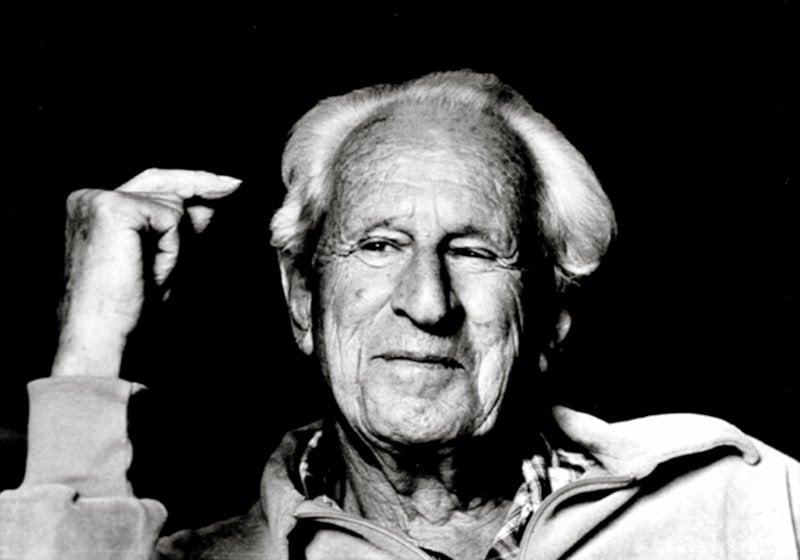
Fifty years later, One-Dimensional Man looks more prescient than its author could have imagined.
November 23, 2020
When Herbert Marcuse’s One-Dimensional Man appeared fifty years ago, it was a revelation. To many of us who were becoming the New Left, Marcuse reflected and explained our own feeling of suffocation, our alienation from an increasingly totalitarian universe that trumpeted its freedom at every moment.
We had grown up in it, we had encountered it in Allen Ginsberg’s Howl; but until One-Dimensional Man, we could scarcely understand, let alone describe, it. A student of Marcuse’s, I wrote at the time in Radical America that the book was “a major step in our breaking out of that closing universe. By naming it, by helping us to get conscious of it, by conveying its overwhelming power, [Marcuse] helped us to define ourselves in opposition to it—total opposition.”
Originally published af Boston Review
He spoke to a deep sense of alienation. “The pure form of servitude,” he wrote, is “to exist as an instrument, as a thing. And this mode of existence is not abrogated if the thing is animated and chooses its material and intellectual food, if it does not feel its being-a-thing, if it is a pretty, clean, mobile thing.” Moreover, “Free election of masters does not abolish the masters or the slaves.”
The “society without opposition” Marcuse described was mobilized against the enemy to the point of threatening all-out nuclear destruction. It was based on the “supreme promise” of “an ever-more-comfortable life for an ever-growing number of people who, in a strict sense, cannot imagine a qualitatively different universe of discourse and action.” Their “many liberties and comforts” only “perpetuated and intensified” their “subjection to [the] productive apparatus.”
As we read One-Dimensional Man today, do we not again and again seem to be encountering the society in which we live?
The distinguishing feature of advanced industrial society is its effective suffocation of those needs which demand liberation—liberation also from that which is tolerable and rewarding and comfortable—while it sustains and absolves the destructive power and repressive function of the affluent society. Here, the social controls exact the overwhelming need for the production and consumption of waste; the need for stupefying work where it is no longer a real necessity; the need for modes of relaxation which soothe and prolong this stupefaction; the need for maintaining such deceptive liberties as free competition at administered prices, a free press which censors itself, free choice between brands and gadgets.
Although products of the Cold War and containing many themes that are now outdated, these lines still have an aura of prophecy about them.
Unlike his equally alienated colleagues Theodore Adorno and Max Horkheimer, Marcuse never lost his revolutionary outlook. He insisted on the technical and historical prospect of human liberation, even if no movement was demanding it.
He believed even Marx’s eschatological vision was not radical enough: the society’s actual capacities far exceed any emancipation Marx might have imagined. In spite of the book’s negativity, it is not hard to find the utopianism underlying One-Dimensional Man. In this sense An Essay on Liberation, published five years later, was already implied in 1964.
Referring to Civil Rights demonstrations, Marcuse writes hopefully of “the substratum of the outcasts and outsiders”: “The fact that they start refusing to play the game may be the fact which marks the beginning of the end of a period.”
In the early 1960s Marcuse could not see any political force demanding that the society use its capacities for what he called “the pacification of existence”—a life free from domination, scarcity, and unnecessary toil.
But this would change shortly after the publication of One-Dimensional Man, as the New Left exploded onto the scene with its deeper demands for liberation as well as black-white equality and an end to the war in Vietnam. Marcuse embraced us.
And we embraced him in return. Marcuse was not only a striking analyst of politics and culture but also a writer of towering intellectual authority. How remarkable that the great philosophical work of the American New Left was penned by a German Marxist born in 1898 who had participated in the revolutionary events of 1918–19.
The demanding pages of One-Dimensional Man, which sold more than 300,000 copies in its first edition, are steeped in Plato and Aristotle, Kant and Hegel, Marx and Freud, as well as the avant-garde classics of modern culture.
Marcuse’s perspective integrates them all: the deepest hopes of humankind form a single civilizational thread. From Plato and Marx to Marcuse: in the classroom he self-consciously saw himself as keeping alive the great tradition of Western rationalism, referring to each predecessor as “the old man.”
The New Left had to create itself. We lacked continuity with an older radical movement, had no theory at hand to clarify our goals and tasks. So Marcuse’s presence and contributions were essential.
The support of this dignified grandfather figure speaking with a foreign accent and belonging to the civilization’s great intellectual and political traditions helped us to overcome our tentativeness and defy the parent-figures ruling our world.
Thus we discovered, despite our youth and seeming marginality, that we too belonged to these traditions. As the philosopher Andrew Feenberg, another Marcuse student, observed, “Our protests were not merely personal, but belonged to history with a capital H.”
There is little doubt that few readers were able to struggle all the way through One-Dimensional Man, especially the dense philosophical half that critiques “one-dimensional thought”—philosophy of science, linguistic philosophy, philosophical analysis, and the theory of social science.
But the book’s main argument is clear enough. Although its subtitle (“studies in the ideology of advanced industrial society”) is modest, Marcuse self-consciously follows in Marx’s footsteps by updating Marxism to fit capitalism in his own time.
Historical changes, he argues, have made some but not all Marxist categories obsolete without abolishing rulers or ruled, capitalists or proletariat.
Two changes are key.
First, through countervailing mechanisms and practices, capitalism has overcome Marx’s predictions of massive crisis. These mechanisms and practices created a system able to deliver the goods to those at its center while visiting its worst terrors on those at its margins, both within the society and overseas.
Second, in the process of this overcoming, the proletariat has ceased to be a fundamentally oppositional force: “Assimilation in needs and aspirations, in the standard of living, in leisure activities, in politics derives from an integration in the plant itself, in the material process of production.”
The starting point of Marcuse’s post-Marxism is strictly Marxist. The change in the consciousness of the working class stems from a change in its being. The key word is “integration”: as workers become integrated into the process of production, as their most compelling material needs are met, as they become integrated into the society, that society ceases to experience opposition.
It becomes one-dimensional. Marcuse asserts the eclipse of the proletariat as the concrete source of opposition at the center of Marxism, as well as the fading of the cultural and religious transcendence built into all previous societies.
His analysis diverges from the process of production and, at this stage of capitalist history, points to the centrality of culture, of the whole realm of consciousness and the unconscious: the lessening ability to feel, think, and articulate alternatives, whether in fantasy or reality, to the prevailing forms of life.
At stake is not only the proletariat’s diminished class-consciousness, its incapacity to project a different form of society, but also a broader inability to transcend daily experience in poetry, music, and literature, perhaps even in imagination and daydreams.
Marcuse’s point is that advanced capitalism’s immense productive power and, already in 1964, media wizardry created a superficially richer yet strictly contained sense of possibility within the system.
This is joined by and predicated on a profound mood of resignation about alternatives and a decreasing ability to think critically about the dominant way of life.
The totalitarian direction of the one-dimensional society is wholly compatible with civil rights, a free press, and free elections. In place of exploitation, Marcuse speaks of “domination” and “repression.”
He rarely focuses solely on the capitalist class in his discussions, preferring to speak of the “interest in domination.” He conveys the sense of a smooth, comfortable oppression that has managed to exorcize or repress its contradictions.
Is the notion of totalitarianism an exaggeration? To be sure, Marcuse is hurling back at the “Free World” its own epithet for the Soviet enemy. But there is more here than an especially pointed barb.
In describing capitalist societies as totalitarian, Marcuse has in mind “the total mobilization of all media for the defense of the established reality.”
By this he means that the Cold War global political and military situation brought corporations and unions together to serve “national security,” enlisted all cultural institutions from Hollywood to the universities, marked the boundaries of tolerable and unsafe discourse, and generated spontaneous as well as organized policing mechanisms.
During a period of seemingly endless prosperity, stabilized in the West by its welfare-warfare states, the people of the advanced and advancing industrial world were manipulated into going along with the threat of nuclear destruction and became unable to think in terms of alternatives.
Yet according to Marcuse there is a deeper source of the society without opposition. Such a society is an outgrowth, more fundamentally, of “technology as a form of social control and domination.” By technology, he has in mind Adorno and Horkheimer’s definition in Dialectic of Enlightenment (1944): the instrumentalization of nature and of humans.
This refers both to human oppression of other humans and to the project of overcoming scarcity by dominating nature. Certainly technical progress entails meeting the basic material needs of the vast majority, but it also entails something more: creating the false needs that sustain consumer society.
The manufacture of false needs predefines the universe of thought and experience; technology thereby becomes totalitarian. “Technological rationality reveals its political character as it becomes the great vehicle of better domination, creating a truly totalitarian universe in which society and nation, mind and body are kept in a state of permanent mobilization for the defense of this universe.”
Marcuse stresses that the totalitarian world is dedicated to “the progress of self-perpetuating productivity on the basis of oppression,” endlessly expanding the consumer economy that “delivers the goods.” In serving this project “the established universe of ordinary language tends to coagulate into a totally manipulated and indoctrinated universe” in which the pleasures of consumption absorb political opposition. An alternative logic is possible, but it can emerge “only in the struggle against the established society.”
Many of us young radicals felt unable to tolerate the situation Marcuse described and denounced. Resistance became our vital necessity. Inspired by the courage of the Civil Rights movement, inflamed by the Vietnam War, and fueled by the vague yet thrilling new sense of possibility we discovered among ourselves, we attacked our universities’ and elders’ stifling liberalism. Women among us contested our own and the society’s sexism.
Although Marcuse did not explore sources of possible resistance to the one-dimensional society—for the foreclosure of serious resistance is one of the main threads of One-Dimensional Man—he immediately identified himself with the student movement when it emerged.
And soon the phenomenon of Herbert Marcuse was born. Described in a 1968 New York Times story as “the foremost literary symbol of the New Left,” he was also its most unlikely media star. More interviews and articles appeared in publications such as Psychology Today and Playboy, and an impressive range of prominent intellectuals writing in virtually every language was moved to comment on him and his ideas.
Celebrity was an odd outcome for an author whose book so darkly captured our alienation. Yet he inspired, encouraged, and outraged with his unsettling blend of Hegel, Marx, and Freud, with his placement of the utopian beside the grimly realistic. Marcuse became fashionable because his complex message made sense.
Yet no matter how insightful One-Dimensional Man is, it bears a date: written during the late 1950s and the early 1960s, published in 1964. It recalls a world of conformity that is long gone—the prosperous postwar “golden years,” the Cold War and the nuclear threat, the welfare and warfare state, the high tide of the labor movement in advanced capitalist societies, the American and European belief in progress, the threat and attraction of communism.
This was the politically passive time just before the Civil Rights movement and the explosion onto the scene of the anti–Vietnam War movement and the New Left.
The moment of One-Dimensional Man passed. In brilliantly capturing that moment, Marcuse mistakenly gave off the sense that it was stable. But communism and the Cold War are over, ended by the Party-state’s inherent blockages and capitalism’s clear economic and political superiorities.
It turns out that there never was such an entity as “advanced industrial society.” That society was always capitalism, and the other industrial society, communism, never was able to become advanced enough, one-dimensional or totalitarian enough, to survive the competition.
The international stasis at the core of One-Dimensional Man ended in 1989, along with its paralytic effect on politics, society, and culture. The result: no more enemy, no more moment-to-moment nuclear threat, no more Cold War bipartisan political consensus, no more witch hunts, no more externally imposed harmony between labor and capital.
“One-dimensionality” also did not foresee that social movements, already beginning in the early 1960s, might have a transformative effect on the flat, gray American society many of us grew up in.
These movements made all capitalist societies more diverse, more racially equal, more tolerant, multicultural, and feminist—in key ways, more livable for almost everyone. When women become CEOs of major corporations, same-sex marriage rites become common, government agencies use Spanish, and an African American family occupies the White House, the watchword of our times is no longer “conformity” but “individual freedom.”
Marcuse didn’t look for unexpected places where the system’s contradictions might break out. He seemed to have too much faith in domination and too little in resistance, too much respect for the rulers and too little for the ruled.
But if he failed to anticipate these social and political changes, he did realize that any such changes would become intertwined with a kaleidoscopic and immensely profitable expansion of choices and forms of expression.
Thus Marcusean analysis is immensely useful in understanding the profusion of tattoos and pornography, the Internet and smart phones, coffee houses and art fairs, T-shirts and jeans, oral sex and divorce, yoga and foreign travel, Twitter and Facebook, Whole Foods and Trader Joe’s, “your comments” on everything under the sun.
A combination of movements and markets led to a space freer, more inclusive, more interesting and diverse, and humanly and socially richer than any of us would have imagined upon closing the pages of One-Dimensional Man.
Thus, on the one hand, Marcuse’s expectations were unmet: we capitalist subjects responded to the repressions and the possibilities within and around us in assertive ways that significantly changed ourselves, others, and the world.
But, on the other hand, that world has also been shaped by what Marcuse understood as capitalism’s dazzling ability to generate and meet new needs, to deliver the goods and then some.
The system’s emancipatory possibilities, Marcuse knew, “are gradually being realized through means and institutions which cancel their liberating potential.” He foresaw the sexual dimension of this with his notion of “repressive desublimation”: release of sexual impulses in socially tolerated ways—for example, throughout the mass media—that serve, rather than challenge, the existing order.
Indeed, capitalism co-opts not only sex, but also hipness and tolerance: to young people today, entrepreneurship has some of the same cachet political activism had in the days of the New Left. Far from threatening the capitalist system, the energies released in the 1960s have become vital sources of its expansion and profits, especially in the crisis-ridden years since 1975.
The cultural and social changes in which we participated not only failed to threaten the capitalist system, but have been happily accommodated by it.
While capitalism’s absorptive power seems universal, its prosperity is not. Here, again, Marcuse’s analysis shows some wear. Today’s reality contrasts sharply with his premise that the welfare state would remain stable.
The general prosperity has ended and, especially in the United States and Britain, the ideology of neoliberalism has been fashioned to replace the welfare-warfare state. Those running the system have scrapped the social compact of the Golden Age.
Wholly unanticipated by Marcuse, we have been living through a revival of class conflict—from above. Inequality is on the rise, labor movements have shrunk and lost much of their political clout, and the direct political power of corporations and the wealthy has increased enormously.
Against Marcuse’s expectation, there is no overarching administrative apparatus running the show, much of economic life has been given over to unproductive financial speculation, the standard of living of the vast majority is no longer rising, and the gains of rising productivity are being wholly captured by the owners of capital.
In his post-Marxism, Marcuse could not have foreseen the Marxist paradox we are living: capitalism has proven unable to create an “ever-more-comfortable life” for everyone in spite of its unstoppable drive for profit and growth.
Yet—and, in this respect, Marcuse’s analysis remains prophetic—in key ways today’s society is even more starkly one-dimensional than that of fifty years ago.
The social-democratic and revolutionary lefts have collapsed throughout the advanced industrial world and in most other places. There are dozens, hundreds, thousands of opposition organizations and movements trying to save animals, clean up the environment, help workers, protect children, support women, remove poisons from food—but no significant opposition to the system as a whole and its way of life.
Neoliberal capitalism rules nearly everywhere despite all apparent conflicts. The financial meltdown and Great Recession produced Occupy and indignados, but six years later the world system is unchanged, the culprits have escaped prosecution and, however bizarre it seems, the Tea Party sprang to life by demanding more of the same policies that caused the crisis in the first place.
Despite the Arab Spring, change in the Middle East seems caught between Islamist fundamentalism and military dictatorship. The possibility of another world is being refuted on the ground.
Today’s “society without opposition” is unlike Marcuse’s because it lacks an administrative layer, “the interest in domination,” overseeing the whole. The economy is the whole.
As the late New Left philosopher André Gorz has written, unlimited economic growth, fueled by advertising, fundamentally alters our social world: the economy, which was once only a sub-system of social life with specific and necessary tasks to perform, “swallows up all areas of social activity.”
Gorz supplements Marcuse: as the market becomes the meaning and content of everything, as its dynamism overwhelms the stability Marcuse predicted, our “free society” becomes ever more enveloped by capital’s relentless production of false needs and its co-optation of even genuine opposition. Thus society continues further along the totalitarian path Marcuse anticipated fifty years ago.
It may be useful to conclude this reflection on One-Dimensional Man closer to home, with a discussion of today’s left, especially the Occupy movements that flourished briefly in 2011 and have now mostly disappeared.
Many observers were struck by Occupy’s refusal to make concrete political demands and by its other novel ways of functioning: camping in public spaces; organizing the dozens of activities needed to sustain an alternative community; avoiding traditional leadership forms by relying on horizontalism, consensus, and the people’s microphone; and holding interminable meetings.
Obviously a movement so located and structured could not last, and many post-mortems understandably criticized these features.
But consider the wider context, our one-dimensional societies. There is no meaningful opposition in the political, social, and media worlds; all new forms of opposition become paralyzed before being formed; cynicism infects all politics; even imagining an alternative seems futile.
The American political system is widely regarded as broken, but this is certainly by intent, so that the government is rendered unable to take effective action on anything that matters, including soaring inequality and corporate domination of the political and legislative process.
So how can opposition form? How to respond? As Marcuse asked toward the end of One-Dimensional Man, “How can the administered individuals—who have made their mutilation into their own liberties and satisfactions… liberate themselves from themselves as well as from their masters? How is it even thinkable that the vicious circle be broken?”
His answer, framed in semi-apocalyptic terms, is a root-and-branch rejection of the existing order and the creation of a “new sensibility.”
This means that typical political strategies go nowhere. “The totalitarian tendencies of the one-dimensional society render the traditional ways and means of protest ineffective—perhaps even dangerous because they preserve the illusion of popular sovereignty,” Marcuse writes.
Thus, from the point of view of One-Dimensional Man, most arguments over the strategy and structures of Occupy miss the point. Rather than be recognizably political, a new radical movement would have to—will still have to—be as much about creating a different sensibility and different values as about an effective alternative politics.
Creating a movement for an alternative is an immense and many-sided task, one that Occupy barely began. But Occupy did begin it. It tried to create a genuine alternative to what passes for democracy today, to reclaim public spaces for a public use, to actively involve its participants, to find ways of keeping them unified, to overcome their habituation to roles of dominance and passivity. It refused to give the media its requisite sound bites and rejected the foreshortened “realism” of the status quo.
Some critics understood this while Occupy was underway; others didn’t. One who didn’t was Shawn Gude, who wrote in Jacobin of “occupiers’ aversion to politics.” He makes the familiar demand for the political: “acting politically means confronting power, not side-stepping it. It means reshaping existing institutions, not just building alternative ones. It means directly and indirectly engaging the state, not cocooning oneself from it.” Compare Gude’s focused criticism with Matt Taibbi’s more enthusiastic Rolling Stone appreciation. Taibbi was obviously delighted that Occupy allowed
people to show how tired they are not just of Wall Street, but everything. This is a visceral, impassioned, deep-seated rejection of the entire direction of our society, a refusal to take even one more step forward into the shallow commercial abyss of phoniness, short-term calculation, withered idealism and intellectual bankruptcy that American mass society has become. If there is such a thing as going on strike from one’s own culture, this is it. And by being so broad in scope and so elemental in its motivation, it’s flown over the heads of many on both the right and the left.
What Taibbi appreciated in Occupy is obviously not what Gude or any of us would call a radical politics. He is talking about what Marcuse called the “Great Refusal—the protest against that which is.” That was the heart of Occupy: the hope and experience of creating an alternative, the creation of a new radical generation, the insertion of inequality and the political power of the wealthy and corporations into political discourse.
Of course Gude is right: Occupy faded before creating lasting or





