
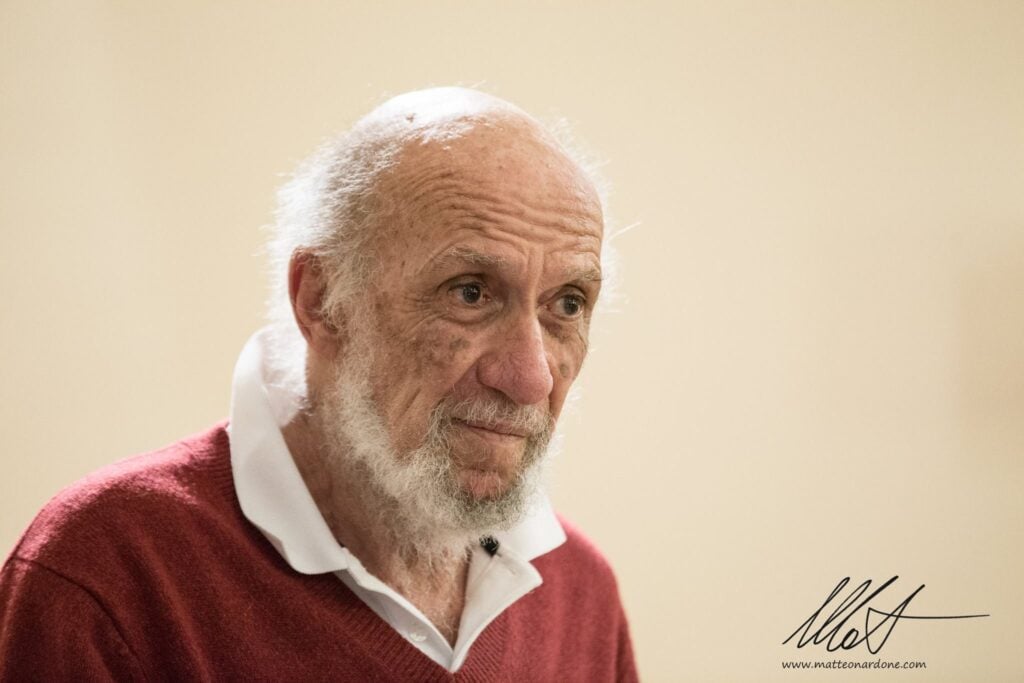
Richard Falk: A citizen pilgrim in search of justice and peace turns 90

TFF celebrates the world-renowned international law professor, activist, writer, TFF Associate and dear friend

By Jan Oberg

November 13, 2020

At TFF, we are blessed by having a number of peace and future scholars, world-leading in their professions, who have followed world events over many decades and continue to be committed to world order change and public education.

I say “blessed” because I assume that the reader share my reverence for high age and the sharing of long life experience as well as the wisdom that may accompany it in the midst of the youth-worshipping which characterises the ageing and increasingly grumpy West itself – also sometimes called age discrimination.

Last month we celebrated Johan Galtung at 90. And today, Richard Falk at 90 – both world-renowned mega-productive scholars restlessly seeking ways to make the world a more peaceful place. And both TFF Associates, mentors and friends of the founders even before we set up TFF in 1985.

As a student of sociology, peace and world affairs in the 1970s, I had been drawn to Falk’s pioneering writings and textbooks – and the “relevantly utopian” World Order Models Project, WOMP, that he participated in. I then met him in Lisbon for that project’s meeting in 1980 and have benefited ever since from his academic/law perspectives, peace thinking as well as from his sophisticated, elegantly complex style of writing.

Richard Falk with some of his many books,
March 2018, at TFF’s headquarters

To write this heart- and brain-felt homage, I went back first to TFF Associate’s “Treasures” section 1998-2005 and found 43 articles by Richard. Then on to TFF’s homepage – 2006-2012 and found 46 articles by him. Continuing to TFF Associates’ blog 2012-2017, I find that we published no less than 243 articles by Richard during those five years. And finally to our present site, The Transnational from 2018 where there are some 50.

In sum, more than 380 pieces of theory, visions, commentaries, analyses and debate articles. Although this is only a fraction of his total production, I allow myself to interpret this publication result as a modest token of my deep gratitude and my joy of paying back a little of what he has so generously given TFF and me personally during all these years – not the least, I may add, by reading and editing all these articles before I posted them!

It isn’t easy, perhaps actually impossible, to pin down who Richard Falk is, incessantly writing and speaking around the world, over so many years. But it suffices here to just celebrate the incredible diversity. Richard’s lifelong engagement with the Palestinian people stands out – as do critical analyses of USand NATO militarism and interventionism; Middle Eastern developments and wars, of course; international law and the UN in particular – we share a big heart for its basic idea and role in the world – as well as nonviolence and peace and analysis of topical issues such as this from just a couple of days ago. . .

Richard Falk is Jewish and explains what this identity means to him and, in passing, why he cannot in spite of his critical attitude to Zionism be categorized as he has been, as a self-hating Jew. He speaks rather from an ecumenical perspective – of great significance for world peace thinking:

“In a more fundamental respect my own evolution has always been suspicious of those who give priority to tribalist or sectarian identities. In other words, it is fine to affirm being Jewish, but it should not take precedence over being human or being open and receptive to the insight and wisdom of other traditions. We have reached a point in the political and cultural evolution that our future flourishing as a species vitally depends upon the spread of a more ecumenical ethos. We have expressed this embrace of otherness in relation to food, with the rise of ‘fusion’ cuisines, and with regard to popular culture, particularly music, where all kinds of borrowing and synthesis are perceived as exciting, authentic, valuable.”

And…

“In my experience what is most appropriate in our historical circumstances is an ecumenical and inclusive spiritual identity, and associated ethical and political commitments. In effect, what would awaken the collective sensibilities of the peoples of the earth to the challenges confronting humanity is a movement of spiritual and ethical globalization that approaches the universal through an immersion in a variety of particularities.

In this sense, I want to say, yes I am Jewish, and proud of it, but I am equally indigenous, Sufi, Hindu, Buddhist, Muslim, and Christian to the extent that I allow myself to participate in their rituals, partake of their sacred texts, and seek and avail myself of the opportunity to sit at the feet of their masters. Many persons living deprived lives do not have or desire such ecumenical opportunities, and can best approach this universal ideal, by seeking out the inclusive potentialities of their own religious and cultural reality.”

Of course, like many other experts critical of Israel’s policies in general and policies vis-a-vis the Palestinians, he has been accused of anti-Semitism. In this short video from autumn 2019, you’ll see how he – careful with formulations around the complexity of the issue – explains how Zionism’s rejection/diversion of all criticism as anti-Semitism has more dimensions and purposes than we may have thought of. Indeed, this short sequence a pearl of pedagogics.

Richard’s style of writing has literary qualities way beyond the normal academic text – and without losing its precision and attempted rational reasoning. That may very well have to do with his reading of fiction and his own writing of poetry.

You’ll see in Memoir sketch – Championing lost causes how literary-philosophical classics such as Albert Camus influences his thinking, not only about external academic issues and the world but what it means to be an intellectual acting responsibly into that world and – even in dark times – avoid the traps of losing hope and being overtaken by fear.

In this article he pays tribute to one of his dearest friends, literature professor Edward Said (1935-2003) taking as his point of departure Said’s 1997 essay “On lost causes”, something which he elaborates further on in this 2014 article in The Nation about the future of Palestine.

It wasn’t before he turned 80 that Falk started his personal blog, Global Justice in the 21st Century which contains posts of a fascinating diversity and in a quantity that makes you wonder whether the man ever sleeps (he maintains that he does but gives the impression that to him sleep is an unfortunate, necessary waste of time; it’s a feeling we share).

Not to be missed, throughout this blog, he explores directly and indirectly what it means to be what he calls a citizens pilgrim. He defines that as an identity shaped through an appreciative reference to ‘the citizen pilgrim,’ that is, to the citizen whose conscience is directed at others without heeding boundaries of space or time, or such contingent features of identity as nationality, ethnicity, race, religion, gender, class. The citizen pilgrim has embarked upon what is essentially a spiritual journey or pilgrimage, seeking an inspirational future that seems neither feasible nor impossible. Such an inspirational dedication also minimizes the imaginative foreclosures of mortality, making the certainty of death a part of life, and accepting this destiny without seeking the comfort of metaphysical fictions, and thus not deeply disconcerted by ‘the dying of the light.’

As I’ve hinted above, parallel with his academic and political production, Richard has consistently grappled with what it means to be a responsible intellectual – over the moral aspects of his lifelong project and its meandering path. “Responsible scholarship in dark times” from 2007 is but one of many such thoughtful pieces – rare in the academic world – with the greatest relevance for today’s – no less dark – world in which true knowledge, not to mention wisdom, seems to have lost out to the fast market’s banality-driven timespan-contracting and impulsive clicking fad that gives priority to fast, smart opinions rather than the slower knowledge-building – in short, a new illiteracy.

The world as a whole and as we experience it today in a macro-historical perspective has not progressed to the better, towards what he has struggled and hoped for. But is he frustrated?

Richard Falk in Lund, Sweden, March 2018 – from an interview with the author

Anti-war and pro-peace

This little tribute to one of the most prolific and elegantly-reasoning social scientists of our time cannot be anything but kaleidoscopic. The reader is advised to explore the Falk universe and its enlightenment on their own, perhaps through some of the links provided in this article.

Of particular importance for our relations with him is, naturally, his deep belief in and advocacy of using all the civilian means at humanity’s disposal and only use violence as the last resort, completely in unison with the UN Charter’s Article 1 – the promotion of which is TFF’s mission.

An example. Already in September 2002 – about half a year before the U.S. invasion and destruction of Iraq with its allies under Goerge W. Bush, Falk pulled the entire project apart, intellectually, legally, politically and morally in this short article on TFF – “A roadmap to war: A flawed debate.”

Falk stated his factual and intuitive pre-war criticism succinctly as did other TFF Associates such as Hans von Sponeck, Johan Galtung, Brian Martin, David Krieger, Burns Weston, Birgitte Rahbek, Else Hammerich and myself to mention some of the more vocal anti-intervention voices at the time.

It’s noteworthy that all TFF Associates who advised strongly against that war before it started also predicted its catastrophic consequences it would have in Iraq as well as for the possibility of a new and more benign world order that had been made possible by the demise of the Soviet Union and the Warsaw Pact. But few politicians and media in the US and NATO countries had any wish or capacity to listen. Today the consequences of that insensitive and self-destructive militarism causes the decline of the US and NATO itself.

Falk’s devotion to Gandhi, to eclecticist nonviolent thinking and policies, can be enjoyed in this article on TFF’s homepage “Mahatma Gandhi and the revival of nonviolent politics at the end of the 20th century” – as early as 1998.

If a Nobel Peace Prize should, for the first time, be awarded to a peace and conflict scholar, Richard Falk would be on top of the shortlist. Fortunately, he is on the list of the Nobel Peace Prize Watch. Here you may read the motivation for his nomination, every year over the last 12.

However, like Johan Galtung and the other qualified people on that list, Falk is probably too central to the essential peace concerns as Alfred Nobel expressed them in his will to ever even be considered – not that I think it bothers him the slightest.

♫ 🎊 🥂 💐 ♫

My wife and co-founder Christina – and many other TFF Associates – join you today to say thank you, dear Richard, for your friendship, mentorship and TFF Associateship over more than 40 years.

As we look forward, we wish you and you wife Hilal Elver everything good in years to come, good health in particular so you can continue happily your citizen’s pilgrimage which will, beyond a doubt, continue to inspire way beyond your own time and space. And do continue your daily ping-pong matches too…

Hilal & Richard in the founders home, March 2018

You may congratulate Richard Falk in the comments section below or write him at either falk@global.ucsb.edu or rfalk@princeton.edu

Peace & future researcher + ‌Art Photographer

2 Responses

  1. I have known and collaborated with Richard for oh so long, ever since I was a graduate student at Princeton University in my early 20s. I m now 83. His originality and brilliance shines through everything he does and despite the attacks he faces because he tackles some of the most difficult causes there are in this distraught world, he continues to struggle on, never dispairing, never giving up. He should be given the perserver award if one exists. And he does this all with a mellow style that belies the seriousness with which he faces down the world’s many problems. Stuart Schaar, Professor Emeritus Brooklyn College, CUNY

  2. Dear Jan, Today Richard Falk entered into my life. Johan Galtung is well-known to me. Richard Falk reminds me of my own experiences with conflicts in the Middle-East in the late 60ies: In Jordan contacting representatives of the Palestinian resistance; the secret service after me in Jordan and even Germany; giving lectures about the subject of Zionism, the Palestinian rights and the criminal western interests. Finally withdrawing from these actions and going into what one of my colleagues called the inner emigration. Richard Falk, this great thinker, being Jewish in a wide, liberal and human sense talks to my mind and heart. For this, dear Jan, I thank you With salam and shalom Hortense Reintjens (Posted by Jan Oberg at the writer’s request)

Related Posts

Tony Robinson October 4, 2026 Violence is easy to recognise when someone is being beaten, shot or killed. It becomes more difficult when nobody is holding a weapon. Poverty, discrimination, exploitation and repression can restrict a human life just as effectively, although they do so in very different ways and with very different consequences. Simply adding more categories to an ever-growing list of forms of violence does not really solve the problem. The more interesting question is what all these different situations have in common and why it makes sense to describe them using the same word. Human beings do not simply react to what happens around them. They remember the past, imagine things that do not yet exist, make plans and undertake projects. Workers organise because they imagine different working conditions; people migrate because they imagine another life somewhere else; social movements emerge because people refuse to accept the...
It’s a matter of principles, courage, vision and pulling together – while the militarist world is falling apart… Peter Langille October 3, 2026 “Here, then, is the problem which we present to you, stark and dreadful and inescapable: Shall we put an end to the human race; or shall mankind renounce war?”The Bertrand Russell—Albert Einstein Manifesto, July 9, 1955 ⁕ The forecast for what’s ahead is worrisome. The sharp rise in armed conflicts over the past three years is adding to what was already the highest level in over seventy years. Genocides, which should be prevented are supported. A shared climate emergency that jeopardises survival is ignored. Diverse polls now suggest that people are war-weary, worried and interested in a more effective United Nations. And, there are viable policy options for a more secure world! Yet governments are doubling-down, betting on more war and investing heavily. If current trends persist,...
Johan Galtung 1930-2024October 2015 Published here on October 3, 2026 Let us focus on Civilization for conflict analysis and remedies. Major forms of disorder use violence; war is state organized violence. The most belligerent states are the United States of America and Israel, both with civilization roots. National Evangelism, the US Protestant Christian civilization– more national than evangelical–justifies US warfare as exceptionalism of a people chosen by God, with a manifest destiny to run the world. Orthodox Judaism justifies Israeli warfare to conquer and expand from Nile to Euphrates as a religious right and duty to the Eternal One. The third most belligerent country, the UK, no longer believes it is God-chosen but chosen by the USA; not quite the same but something. But the root cause of global disorder lies in the Occident–with Islam–seeing itself as the single, universal civilization valid for all at all times, all others being...

Recent Articles

Tony Robinson October 4, 2026 Violence is easy to recognise when someone is being beaten, shot or killed. It becomes more difficult when nobody is holding a weapon. Poverty, discrimination, exploitation and repression can restrict a human life just as effectively, although they do so in very different ways and with very different consequences. Simply adding more categories to an ever-growing list of forms of violence does not really solve the problem. The more interesting question is what all these different situations have in common and why it makes sense to describe them using the same word. Human beings do not simply react to what happens around them. They remember the past, imagine things that do not yet exist, make plans and undertake projects. Workers organise because they imagine different working conditions; people migrate because they imagine another life somewhere else; social movements emerge because people refuse to accept the...
It’s a matter of principles, courage, vision and pulling together – while the militarist world is falling apart… Peter Langille October 3, 2026 “Here, then, is the problem which we present to you, stark and dreadful and inescapable: Shall we put an end to the human race; or shall mankind renounce war?”The Bertrand Russell—Albert Einstein Manifesto, July 9, 1955 ⁕ The forecast for what’s ahead is worrisome. The sharp rise in armed conflicts over the past three years is adding to what was already the highest level in over seventy years. Genocides, which should be prevented are supported. A shared climate emergency that jeopardises survival is ignored. Diverse polls now suggest that people are war-weary, worried and interested in a more effective United Nations. And, there are viable policy options for a more secure world! Yet governments are doubling-down, betting on more war and investing heavily. If current trends persist,...
Johan Galtung 1930-2024October 2015 Published here on October 3, 2026 Let us focus on Civilization for conflict analysis and remedies. Major forms of disorder use violence; war is state organized violence. The most belligerent states are the United States of America and Israel, both with civilization roots. National Evangelism, the US Protestant Christian civilization– more national than evangelical–justifies US warfare as exceptionalism of a people chosen by God, with a manifest destiny to run the world. Orthodox Judaism justifies Israeli warfare to conquer and expand from Nile to Euphrates as a religious right and duty to the Eternal One. The third most belligerent country, the UK, no longer believes it is God-chosen but chosen by the USA; not quite the same but something. But the root cause of global disorder lies in the Occident–with Islam–seeing itself as the single, universal civilization valid for all at all times, all others being...

TFF on Substack

Discover and subscribe to more peace materials on TFF Substack

Most Popular

Tony Robinson October 4, 2026 Violence is easy to recognise when someone is being beaten, shot or killed. It becomes more difficult when nobody is holding a weapon. Poverty, discrimination, exploitation and repression can restrict a human life just as effectively, although they do so in very different ways and with very different consequences. Simply adding more categories to an ever-growing list of forms of violence does not really solve the problem. The more interesting question is what all these different situations have in common and why it makes sense to describe them using the same word. Human beings do not simply react to what happens around them. They remember the past, imagine things that do not yet exist, make plans and undertake projects. Workers organise because they imagine different working conditions; people migrate because they imagine another life somewhere else; social movements emerge because people refuse to accept the...
It’s a matter of principles, courage, vision and pulling together – while the militarist world is falling apart… Peter Langille October 3, 2026 “Here, then, is the problem which we present to you, stark and dreadful and inescapable: Shall we put an end to the human race; or shall mankind renounce war?”The Bertrand Russell—Albert Einstein Manifesto, July 9, 1955 ⁕ The forecast for what’s ahead is worrisome. The sharp rise in armed conflicts over the past three years is adding to what was already the highest level in over seventy years. Genocides, which should be prevented are supported. A shared climate emergency that jeopardises survival is ignored. Diverse polls now suggest that people are war-weary, worried and interested in a more effective United Nations. And, there are viable policy options for a more secure world! Yet governments are doubling-down, betting on more war and investing heavily. If current trends persist,...
Johan Galtung 1930-2024October 2015 Published here on October 3, 2026 Let us focus on Civilization for conflict analysis and remedies. Major forms of disorder use violence; war is state organized violence. The most belligerent states are the United States of America and Israel, both with civilization roots. National Evangelism, the US Protestant Christian civilization– more national than evangelical–justifies US warfare as exceptionalism of a people chosen by God, with a manifest destiny to run the world. Orthodox Judaism justifies Israeli warfare to conquer and expand from Nile to Euphrates as a religious right and duty to the Eternal One. The third most belligerent country, the UK, no longer believes it is God-chosen but chosen by the USA; not quite the same but something. But the root cause of global disorder lies in the Occident–with Islam–seeing itself as the single, universal civilization valid for all at all times, all others being...
Read More
Living-Peace-Sign-Budapest-copy
Tony Robinson October 4, 2026 Violence is easy to recognise when someone is being beaten, shot or killed. It becomes more difficult when nobody is holding a weapon. Poverty, discrimination, exploitation and repression can restrict a human life just as effectively, although they do so in very different ways and with very different consequences. Simply adding more categories to an ever-growing list of forms of violence does not really solve the problem. The more interesting question is what all these different situations have in common and why it makes sense to describe them using the same word. Human beings do not simply react to what happens around them. They remember the past, imagine things that do not yet exist, make plans and undertake projects. Workers organise because they imagine different working conditions; people migrate because they imagine another life somewhere else; social movements emerge because people refuse to accept the...
b54a1f10-8c65-4f0b-9dd5-4abc0a7d04cc_2659x2659
It’s a matter of principles, courage, vision and pulling together – while the militarist world is falling apart… Peter Langille October 3, 2026 “Here, then, is the problem which we present to you, stark and dreadful and inescapable: Shall we put an end to the human race; or shall mankind renounce war?”The Bertrand Russell—Albert Einstein Manifesto, July 9, 1955 ⁕ The forecast for what’s ahead is worrisome. The sharp rise in armed conflicts over the past three years is adding to what was already the highest level in over seventy years. Genocides, which should be prevented are supported. A shared climate emergency that jeopardises survival is ignored. Diverse polls now suggest that people are war-weary, worried and interested in a more effective United Nations. And, there are viable policy options for a more secure world! Yet governments are doubling-down, betting on more war and investing heavily. If current trends persist,...
010
Johan Galtung 1930-2024October 2015 Published here on October 3, 2026 Let us focus on Civilization for conflict analysis and remedies. Major forms of disorder use violence; war is state organized violence. The most belligerent states are the United States of America and Israel, both with civilization roots. National Evangelism, the US Protestant Christian civilization– more national than evangelical–justifies US warfare as exceptionalism of a people chosen by God, with a manifest destiny to run the world. Orthodox Judaism justifies Israeli warfare to conquer and expand from Nile to Euphrates as a religious right and duty to the Eternal One. The third most belligerent country, the UK, no longer believes it is God-chosen but chosen by the USA; not quite the same but something. But the root cause of global disorder lies in the Occident–with Islam–seeing itself as the single, universal civilization valid for all at all times, all others being...
Screenshot 2026-10-02 011738
Jan ObergPhD, director, The Transnational Foundation for Peace and Future Research, TFFLund, Sweden October 2, 2026 This is my full original manuscript. The Chinese Academy of Social Science, CASS, makes two publications out if it. 1. China’s Five-year plan emphasized the capabilities of basic research and original innovation. It is regarded as the goal of the future social development, which, as required, should be significantly enhanced. Can you comment on the importance of original innovation in research and academic study? I believe it is easier to define “original innovation” in the natural sciences than in social sciences. The breaking points of what constitutes something new, or innovative, are not quite as sharp in the latter. But in both fields it is about opening up something that was closed, unseen, unexplored before – making manifest what was earlier latent. Innovations come in many forms and shapes – naming something that was not...
arctic-circle-map
The agreement is catastrophic both because of what it says and what it doesn’t mention. It reduces further the major asset of security policies: Freedom of action. Jan Oberg TFF director September 25, 2026 A couple of hours before the agreement was signed on September 22, 2026, I published the following 13 hypotheses about what it would most likely contain on TFF Substack (in English). I was wrong on only the first point. Contrary to what Trump had written on his Truth Social platform, it does not appear to come into force immediately. In fact, it turned out to be worse than even I had anticipated. After these hypotheses now come a number of reflections in light of what the agreement actually contains, and does not contain, as well as the way in which it has generally been presented by major media outlets and by the public-service broadcaster DR. My...
girl-5894831_1280
Below are TFF-related media mentions, comments, videos and social media posts published elsewhere but not on this homepage. We happen to catch and list only a fraction. Regarding video comments and debates, we recommend that you go to the TFF Video Channel on Substack where many of them are reproduced. Jan Oberg is a contributor to China Daily – 52 million daily clicks – and Global Times, CGTN and CCTV (the national television), China Investment, Xinhua News Agency and several others. Articles and videos on these media very often multiply into countless Chinese (and Western media) that re-post them from these main media. Thanks to The China Academy, his analyses, interviews and comments are frequently posted on YouTube channels such as Thinkers Forum and Wave Media. These videos are often re-posted on Bilibili (China’s YouTube), the China Content Center on TikTok, and on the Chinese edition of TikTok, Douyin.com. This means reaching hundreds of millions of viewers worldwide over a year. While there are too many to catch on all these...




