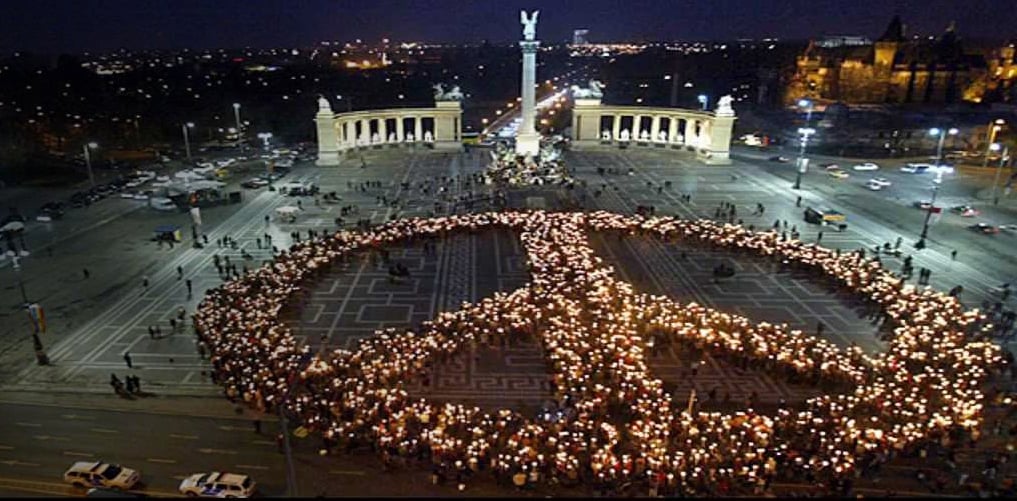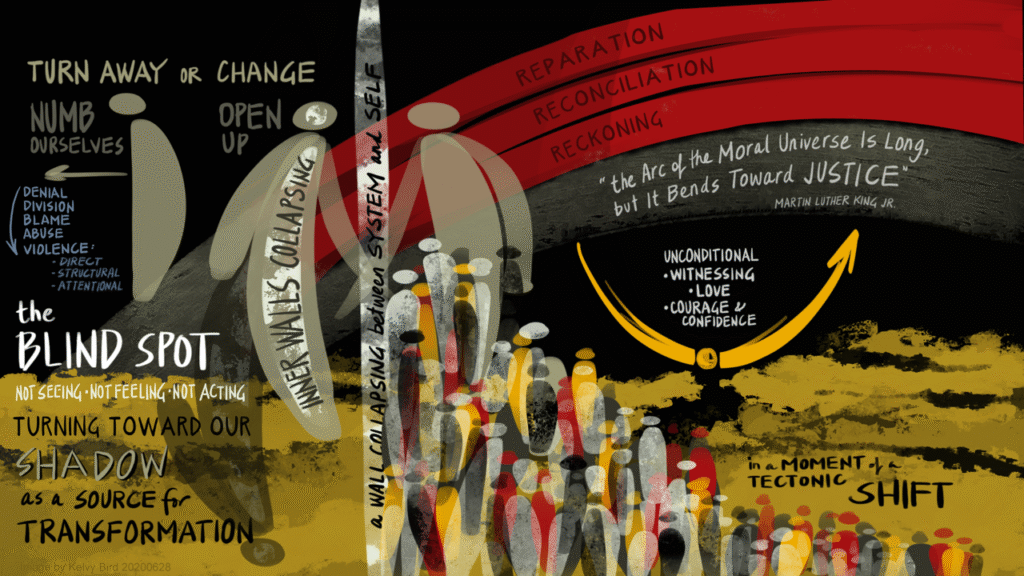
Fig. 1: From the Collapse of the Berlin Wall in 1989 to the Collapse of Our Inner Walls in 2020. Image by Kelvy Bird
October 3, 2020
We are living in a moment of tectonic shift in society. Something changed when we all watched the same images — 8 minutes and 46 seconds — the killing of George Floyd. During that unbearable experience, something broke down and broke open in our hearts, in how we relate to one another, and in how we want to live together.
Originally published Medium.com/@ottoscharmer
From the collapse of the Berlin Wall in 1989…
When the Berlin Wall collapsed in 1989, we witnessed the end of the 20th-century Cold War era. A wall collapsed between two conflicting social systems: capitalism and socialism.
Today we see a different type of wall collapsing: not a wall between systems, but between system and self — a wall that has kept us separated from each other for too long.
While the coronavirus pandemic has functioned as an eye-opening disruption, laying bare everything that is already broken in our social and economic systems, Black Lives Matter is shifting not only the way we see the world, but also the way we feel — how we sense each other’s well-being and pain — whether we numb ourselves or open ourselves to deeper human connection, whether we turn away or find the courage to change.
… to the collapse of our Inner Walls in 2020
Here are three observations that illuminate different aspects of the tectonic shift that is reshaping the social field of our societies as we know them.
The first observation concerns our streets. Over the past five weeks, millions of people have taken to the streets in thousands of places across the globe.
In the US alone, 15–26 million participated in the Black Lives Matter protests that have covered every corner of the country. These protests have fast-forwarded a conversation on the role our criminal justice systems have played in institutionalizing and sustaining racial injustice.
The toppling of statues honoring racists and racist events — from Virginia to Alabama to New York City to Boston to Bristol, UK — has also jumpstarted another conversation that is long overdue: Who should we remember, and for what reasons?
The second observation concerns our institutions. Wherever you are in the world, and whatever role you play in your organization, you are most likely dealing with the issue of systemic racism in one way or another.
Leadership teams across sectors and systems are taking a hard look in the collective mirror and reconceiving their own institutions, policies, and procedures from the margins of their systems — that is, from the viewpoint of racial equity.
The third observation concerns politics. Over the past few weeks and months, we have seen a seismic political shift: the onset of an accelerated decline of the Trumps, Bolsonaros, and Johnsons of the world.
The behaviors that in the past made these men successful (and at times seemingly invincible) are the same behaviors that are sinking them now. The world around them has changed, while these men and their behaviors have not.
In part this political shift is due to a very simple principle: the principle of limits. You can operate in denial for a while, but not forever. Denial is not a strategy. Being in denial of the pandemic is not a strategy — nor is denial of climate change.
Trump, Bolsonaro, and Johnson preside over three countries whose response to the pandemic is among the worst (measured by number of deaths). Politicians who operate like Trump are on a collision course with reality: the cycle of denial, dividing, blaming, abuse, and violence (against nature, the media, minorities, immigrants, and others) will eventually result in a backlash.
At some point reality is going to bite back. That moment has now arrived in the form of 128,000 coronavirus deaths in the US, 57,000 in Brazil, and 44,000 in the United Kingdom — and counting.
Donald, Jair, and Boris: the Deniers-in-Chief atop the horrific COVID-19 League of Shame.
The political shift also concerns a deeper emotional disconnect: Trump’s failure to connect to the Black Lives Matter moment and movement in any meaningful way.
A symbol of this disconnect is how he responded to the mass protests in front of the White House. Instead of stepping outside and connecting with the demonstrators, he fled to a bunker.
The physical act of walling himself off behind barricades is the posture of the administration as a whole, run by a leader surrounded by a shrinking circle of advisors, who governs through erratic tweets, thus demonstrating how out of touch he is with the heart of the nation he is supposed to serve — a nation shaken to its core and calling for a voice of healing.

These three events — the demonstrations in the streets, the difficult conversations starting to take place in organizations and institutions, and the seismic shift in the political landscape — are not unrelated.
All of them are part of a larger phenomenon, a larger tectonic shift in our societies.
Tectonic societal shift
The collapse of the Berlin Wall in 1989 brought down a physical barrier to unity and reconciliation. This may now be the other shoe dropping: the collapse of our “inner walls.” This second collapse opens a window to unparalleled collective possibility, a possibility for real societal transformation and change.
It may be a once-in-a-lifetime opportunity to profoundly reimagine and reshape our civilization. We can choose to step through that opening, or not.
Deep in his gut Trump probably knows he has already lost the election — despite the voter suppression efforts by the GOP, despite the manipulative support he keeps receiving from Russian election interference and from Facebook — that is, from his quiet alliances with Vladimir Putin and Mark Zuckerberg.
Because the tide has turned. Because millions are taking to the streets against racism and police brutality. Because the prospect of 200,000 or more deaths this August or September is too big to ignore.
Because the disastrous Trump response to COVID-19 is visible both in the United States and globally. (The current June and July wave of infection is mainly in states whose Republican governors have ignored science and followed Trump’s lead.)
Institutions in the United States are stronger than they seemed during the first few months of this administration: military leaders, the Supreme Court, governors, mayors, independent media organizations, and large companies have all started to stand up to Trump.
Yes, the current moment embodies in many ways a full-scale collapse of the old American empire.
But while the old system is crumbling, we can see something else coming to life: a different America, an America that applies the ideals of its Founding Fathers not only to land-owning white men, but to everyone — all people and all living beings, including the planet.
The Arc of the Moral Universe is long, but it bends toward justice
The summer of 2020 (in the Northern Hemisphere) is a summer of hope. Hope is not optimism. Hope can be counterfactual. And there is a lot of factual evidence stacked against any true transformational change.
But hope is grounded in a visceral sense of historic possibility that, in our better moments, we can connect with and bring into being.
It’s the set of principles that Martin Luther King Jr. spoke about when he said that “the arc of the moral universe is long, but it bends toward justice.”
This is the sense we tap into when we join the Black Lives Matter movement in the streets. We see in the faces of young people that another America is awakening and beginning to take shape.
It is a movement led by youth, but profoundly cross-generational. It’s a movement led by People of Color and finds strong participation across the entire country, the entire globe.
It’s a movement that focuses on police brutality and institutional racism, but it almost certainly won’t stop there and will advance to address deeper systemic root issues.
Yet, it’s also a movement that could derail at almost any moment, any day. Acts of violence are one way to derail it. Symbolic reforms that don’t address the deeper root issues are another.
It’s a profoundly fragile moment — a moment calling us to show up, to pull our own weight. As one of the participants in an event that I recently co-hosted put it:
“Everything that I have experienced in my life has prepared me for this moment now.”
When we look at big systems today, we see massive environmental destruction, appalling levels of inequality, and unnecessary suffering. Collectively, we are producing results that almost no one wants. And they lead to three different forms of violence.
Three forms of violence: Direct, structural, and attentional
An example of direct violence is police brutality. In the case of George Floyd we saw it in the almost nine minutes that an officer held his knee on Mr. Floyd’s neck.
Like direct violence, structural violence has victims, but no single person is the perpetrator. Instead, a socioeconomic structure — that is, a whole set of institutional arrangements — adds up to the same result: unnecessary human suffering.
The violence doesn’t happen in nine minutes, but is sustained over decades, and even centuries, such as the 400+ years of slavery and racial inequality in the United States. Other countries and cultures have even longer histories of sustained structural violence.
A third form of violence that in many ways enables and seeds the other two is attentional violence.
This form of violence is less discussed, but equally important. Not being seen for who you are and who you could be — your highest future possibility — is a form of violence that diminishes your ability to act from that capacity.
Perpetual attentional violence is collectively enacted — against others, but also against ourselves — every single day. The poor-quality public education available to most young men and women of color is just one example.
The funding mechanisms of public education in the United States perpetuate, rather than transform, inequality in the access to educational opportunity.
Turning toward our blind spots
Transforming these types of violence will require us to become aware of our blind spots, that is, to turning our attention toward them. As a white man of European descent, I personally benefit from enormous privilege. I know that many others, with more gifts and talents than I have, do not. Their potential is not given an opportunity.
As I explore my own blind spots in the context of systemic racism, I notice three dimensions of my own inability to truly connect:
Not seeing what is going on;
Not feeling what I do see;
Not acting on what I see and feel.
Not seeing what is going on. This is the issue of the frozen mind: ignorance and bias. An example of my own ignorance is the shockingly direct continuum in the United States from slavery and slave patrols to lynching practices to today’s police brutality against African American citizens.
Not feeling what I see. This is the issue of the frozen heart: cynicism and “othering.” Yes, I see what is going on. I know about the inequality and structural violence against African Americans.
But do I truly feel it? If I am honest, I am more emotionally distant from those things than I am comfortable admitting. The result of this distancing is othering — and acceptance of social conditions I know are not acceptable.
Not acting on what I see and feel. This is the issue of the frozen will: apathy. The frozen will mostly manifests in fear and indifference, but sometimes also in fanaticism and destruction.
In either case, the issue is this: Yes, I see what is going on. And yes, I also feel it. But I still do nothing that would help bring about change. Now that many of us are truly seeing it, are we going to commit to real action?

Figure 4 summarizes these three blind spots that, if not addressed by white people like me, will perpetuate what we claim we want to end: systemic racism and collective trauma.
Illuminating the blind spots
Figure 5 zooms out a bit and looks at how the three blind spots are grounded in an architecture of separation:
Separation from the world: NOT SEEING;
Separation from each other: NOT FEELING;
Separation from our transformative capacities: NOT ACTING.
What will it take to transform this condition of separation? It will take a different social field, one that is grounded in an architecture of connection, that allows us to access our deeper capacities for:
Unconditional WITNESSING, to truly see what is going on
Unconditional LOVE, to truly hold each other;
Unconditional COURAGE & CONFIDENCE, to truly support each other.
These three capacities, if activated and cultivated in the right way, could help us to shift our collective condition from denial and de-sensing to reckoning with our collective shadow.
From there we could seek the reconciliation and reparation needed to progress on a path of true healing.

Seeing one’s shadow as a source of transformation
What I have learned from various conversations and reflections on our blind spots over the past weeks is that seeing our own shadow is not a problem that we need ‘to fix.’ Seeing our shadow is a source of transformation that allows us to step into a new space of possibility.
To explore this space, my colleagues and I at the Presencing Institute launched a rapid-response initiative to COVID-19 back in March that we called GAIA: Global Activation of Intention and Action.
We invited people to join an impromptu learning journey with the purpose of reimagining our journey forward, both personally and collectively.
The response to our invitation was remarkable: within a couple of weeks, 13,000+ signed up for the 14-week journey, and 7,000 attended regularly.
More than 100 volunteers co-hosted events in seven different languages. The group was periodically joined by a remarkable lineup of special guests: from indigenous leaders in Australia, Brazil, and North America to global thought leaders and pioneers in the fields of awareness-based systems change — people who are working at the forefront of reinventing organizations, shifting our economic and agricultural paradigms, addressing systemic racism, and healing collective trauma.
Everyone volunteered their time.
Even though the event was perhaps just a high-quality holding space for connecting more deeply to our collective moment, afterward over 80 percent of the participants said they considered the impact of their GAIA experience on their own path forward to be “significant” or “life-changing.”
How can such a learning experience inform us about how to organize with the global movement that is rising up across all world regions?
The experience that the GAIA participants said was most transformative for them was the deep resonance they felt with the global community.
They felt the real potential for change. As one participant put it, “It feels as if we are on the verge of a profound collective possibility that we could choose to step into.”
Such a direct experience of a global field of connection is often critical to connect local action with whole systems transformation. As Dr. Noel Nannup, an Aboriginal Nyoongar Elder from Western Australia, shared with us during the opening session of the GAIA journey:
“All we need to do is to have a piece of the path to the future. And that’s ours. And we polish that and we hone that. And we place that in the pathway that we are building. And as we build that pathway it changes us as the builders of that path and it also shapes the destination that we are going to.”
Owning your piece of the path to the future is a critical part of movement-building today. How can we find and cultivate our own piece in the context of the larger whole? What is ours and what is mine to do? How can I contribute to the pathway that we are building together?
Answering these questions may require us to look in the mirror at our collective shadow and ask:
- What am I not seeing? (Where is my view distorted by a frozen mind?)
- What am I not feeling? (Where is my sensing distorted by a frozen heart?)
- What action, grounded in this deep seeing and sensing, am I not co-initiating yet? (Where are my actions distorted by a frozen will?)
Those are the questions that, if contemplated well, could help us hone and place our own pieces in the pathway to the future. We need to have these conversations on an individual level, but also in our organizations, communities, and societal systems.
Reimagining our civilization
Choosing to step onto a path toward awareness-based systems change will help us reinvent our economies, by moving from ego-system to eco-system and serving the well-being of all; to reimagine our democracy through more direct, distributed, and dialogic participation of citizens at all levels of governance; and to reshape our learning and leadership systems toward integrating head, heart, and hand.
What would it take to prototype the new in this space of profound possibility?
What would it take to ground our path forward in the reality of seeing our own shadows as a gateway to presencing our highest future possibilities?
What are the minimal enabling infrastructures that would allow us to reimagine and reshape our civilization at all levels: locally, regionally, nationally, and internationally?
If the collapse of the inner walls in 2020 is for the twenty-first century, what the collapse of the Berlin Wall was for the twentieth — the end of one age and the beginning of another — then the question I want to conclude with is this:
How can we democratize access to transformation literacy — methods and tools of deep systems change — to help the next generation of changemakers co-sense and co-shape the new world that is now rising from the rubble?
Originally published Medium.com/@ottoscharmer

Otto Scharmer is a senior lecturer and Massachusetts Institute of Technology (MIT). He is co-founder of