
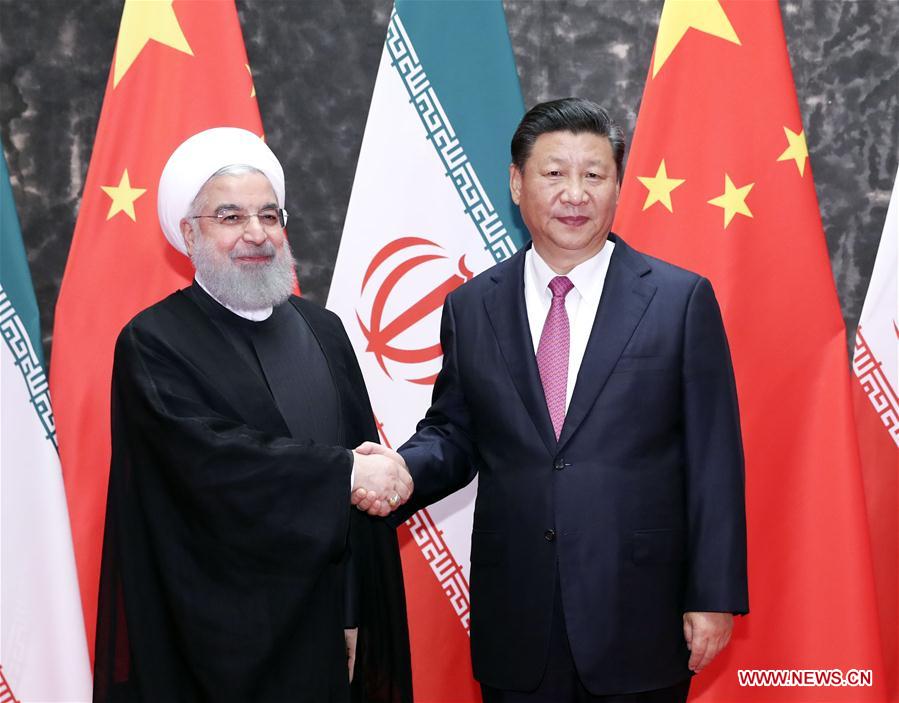
Will China’s bruited $400 bn. investment in Iran make Beijing an oil Gulf power?

Chinese President Xi Jinping (R) holds talks with his Iranian counterpart Hassan Rouhani in Qingdao, east China’s Shandong Province, June 10, 2018. (Xinhua/Ding Lin)

August 31, 2020

By Niranjan Jose

The relationship between China and Iran has been in the spotlight recently. A huge, 25-year deal is reportedly being considered that would see $400 billion of Chinese investment in Iranian energy and transport infrastructure. The deal is the latest effort by Beijing to expand from a regional hegemon into a global power through the Belt and Road Initiative (BRI) which aims to reshape regional economic topographies in its favour.

Beijing has ostensibly undertaken to make such a massive investment in key sectors of Iran’s economy in return for an assured supply of Iranian fuel for the next 25 years. The proposed investment is the biggest China has ever pledged to any country as a part of the BRI and envisages huge expenditure in building Iran’s oil and gas and infrastructure, at $280bn and $120bn respectively.

Originally published at juancole.com

According to the information available, China is to spend $120bn to develop Iran’s transport network starting with the 2,300 kilometre road that will connect Tehran to Urumqi in Xinjiang Province. This route will be paved with the Urumqi-Gwadar connection built under the “New Silk Road” in the China Pakistan Economic Corridor.

When completed, the road link will have an ambitious plan to connect with Kazakhstan, Kyrgyzstan, Uzbekistan and Turkmenistan, and thereafter via Turkey into Europe.

Beijing also plans to deploy over 5,000 Chinese security personnel to protect its investments in Iran. It is among the top three arms suppliers to the Iranians, according to SIPRI data, exporting weapons worth about $270 million to Tehran between 2008 and 2018.

The first trilateral naval exercise between China, Russia and Iran was held in the Gulf of Oman in December last year. Strategically, all three nations are empowered by the common perception of an enemy in Washington and fears of US military interventionism.

Iran seeks to expand its military influence in the region by obtaining Chinese weapons and expertise, while China seeks to develop Iran as a lucrative arms market and a strategic bulwark against US forces in Asia.

The top economic advisor to Iran’s Supreme Leader Ayatollah Ali Khamenei is Ali Agha Mohammadi who appeared recently on state television to address the need for a financial helping hand.

He said that to remain a player in the energy sector, Tehran needs to boost its oil output to at least 8.5 million barrels per day, and for that it needs China. As Iran’s biggest trading partner, China overtook the European Union in 2010, with about one-third of Tehran’s overall international trade being conducted with Beijing.

Iran’s oil industry was more dependent on China as a trading partner, despite sanctions implemented by the US and the UN in 2010. Only 5 percent of Iran’s overall oil exports went to China in 2000; however, by 2011 that had increased to 25 percent.

China has also become a major investor in Iran’s oil and gas industry, as the US and international sanctions have limited Tehran’s access to international finance and the innovations needed to develop its declining energy industry. In 2012, at the height of restrictive economic sanctions, China imported 54 percent of Iran’s oil output by alternative financial structures, including barter.

There are plenty of motives for China and Iran to collaborate as their economies are complementary.

China is the world’s largest oil importer, and Iran wants clients ready to counter US sanctions. Moreover, Iran needs modernized technology in areas such as rail and 5G networks, where Chinese companies have strengths.

Tehran has increasingly turned to Beijing for support in its long-running conflict with the US. China has also been vocal in its support for the 2015 Iran nuclear deal, vowing to uphold it even after Washington withdrew from the pact.

Iran is situated at the crucial nexus of the Middle East, Central Asia and South Asia, as well as the critical trading networks that run through the region. Beijing has identified Iran as a link along the BRI, connecting Xinjiang with the Middle East.

Relations between Beijing and Tehran, which date back to Iranian President Mahmoud Ahmadinejad’s “Pivot to the East“ policy, have blossomed under Chinese President Xi Jinping, who is pushing China’s ambitious initiative.

The alliance developed over four decades across three phases: military cooperation during the 1980/88 Iran-Iraq War; energy cooperation in the 1990s as China developed quickly; and oil deals which defied sanctions. The “maximum pressure” policy and sanctions imposed on Iran by the Donald Trump administration has failed.

Far from isolating Tehran, as intended, the exertion of significant economic pressure on the Iranian regime has pushed it further into the arms of Beijing. China is criticized by Western policy observers for its so-called “debt diplomacy”, the strategy of indebtedness through aggressive investment packages to an economically vulnerable country.

This acts as leverage for important property acquisitions; one of the most prominent examples is the Hambantota Port in Sri Lanka, which the government had to lease to China for 99 years after it struggled to repay Chinese loans.

Beijing is utilizing Tehran’s rising vulnerability intensified by the health and economic crises due to Covid-19. The latest cyber-attacks on its atomic and maritime facilities have also driven Tehran into the arms of China.

After all, the growing superpower provides an insatiable energy demand, military and industrial infrastructure, huge spending and a possible global diplomatic shield, with its veto at the UN Security Council.

All are needed desperately by Iran. The agreement is not only seen by both nations as mutually advantageous, but also as a possible tool to challenge US hegemony in the Middle East.

China sees seamless possibilities in its strategic partnership with Iran, with a low-cost supply of oil, abundant mineral resources and an untapped market. Beijing’s Iran strategy is affected by its increasing footprint in the Persian Gulf, where it cautiously develops a position centred on highly diverse ties with regional powers, along with its global confrontation with the US.

The State Department in Washington has already threatened to target Chinese companies if they make investments in Iran which defy US sanctions.

Nevertheless, China is already in a trade and technological war with the US and seems determined to go ahead with its partnership with Iran. Beijing continued to buy Iranian oil over the past year even after the US sanctions’ waivers expired in May 2019, albeit in smaller volume.

With the US swamped by exhausting wars in the Middle East in recent years, China has steadily increased its political, commercial and even military operations in the region.

Its motives are clear, though varied; it aims to promote its goals, such as a growing need for oil supplies and destinations for surplus labour and capital.

China is mindful that none of the major powers returned unscathed from wars in the Middle East and are confronting a very challenging variety of obstacles.

The broad political fissures in the region render it impossible for outsiders not to take sides in the numerous conflicts. This presents a challenge to China, which seeks to be a partner for everyone, Iran, Israel and Arab states alike, in order to reap the advantages of its global involvement.

Even if just a portion of what is envisaged under the planned Sino-Iranian deal comes to life, it presents a deadly threat to the campaign against Tehran by the Trump administration.

China’s investments in Iran allow it to exert its influence on Iranian foreign policy, and will enable China to do three things: allow China to diversify its energy needs without overly relying on Russian energy; elevate its claim to offer an alternative to the “Washington consensus” by defying US sanctions against Iran and continuing to trade with Tehran; allow China to control India’s access to Central Asia by enhancing Beijing’s relationship with Iran.

Originally published at juancole.com

About the author:

Niranjan Jose is a law student at the National Law University Odisha (NLUO), India.

If you appreciate this type of informative and trustworthy article, please show it here. Thanks!

Related Posts

Jan Oberg May 15, 2026 Go to this Fox News page and scroll the whole way down: President Donald Trump tells the world that his meeting with President Xi Jinping yielded a lot of very concrete political and economic results – of course, only where the Chinese side, according to him, agreed with him. He does not mention the Taiwan issue, but Secretary of State, Marco Rubio, says that it did not feature prominently in their talks and that the US policy on Taiwan has not changed. Then go to China Daily – or Global Times – and you will see that for the Chinese it is framework, principles, structure of cooperation etc. that matters – all embedded in the overall idea of “constructive bilateral relationship of strategic stability.” Nowhere is any concrete agreement or deal – all that Trump refers to – mentioned. At the general level, this gives you insights into the very different social...
Jan Oberg, TFF director April 9, 2026 I was recently invited to have a good, long talk about the world – and, of course, about peace too – with Boris Malagurski on his Weight of Chains Channel on YouTube. It was a real joy and seems to have been greatly appreciated by the viewers too. Mr Malagurski and I shall of course be grateful if you share this conversation in your circles – of course, only if you like what you see and hear 😉☮️ And remember that this one – like hundreds of others with TFF Associates – can be enjoyed at our TFF Video Collection.
This is not another geopolitical commentary on the Arctic. It is a visionary peace proposal that can save the region from militarised rivalry and ecological ruin. A blueprint for shared security, sustainable development, and human dignity — benefitting Greenland, the Arctic, and the rest of us. Jan Oberg TFF director Lund, Sweden, February 17, 2026 I. Four Principles for a New Arctic Vision The Arctic is often framed as a cold arena of rivalry — a place where great powers test each other’s resolve. But this worldview is outdated, unimaginative, and ultimately self‑defeating. The Arctic is not a vacuum waiting to be militarised; it is a living region, a climate stabiliser, and a cultural homeland whose future will shape the future of humanity. If we begin from that understanding, a far more rational Arctic order becomes possible — one that is peaceful, cooperative, and centred on the people who actually live there. This vision rests...

Recent Articles

Tony Robinson October 4, 2026 Violence is easy to recognise when someone is being beaten, shot or killed. It becomes more difficult when nobody is holding a weapon. Poverty, discrimination, exploitation and repression can restrict a human life just as effectively, although they do so in very different ways and with very different consequences. Simply adding more categories to an ever-growing list of forms of violence does not really solve the problem. The more interesting question is what all these different situations have in common and why it makes sense to describe them using the same word. Human beings do not simply react to what happens around them. They remember the past, imagine things that do not yet exist, make plans and undertake projects. Workers organise because they imagine different working conditions; people migrate because they imagine another life somewhere else; social movements emerge because people refuse to accept the...
It’s a matter of principles, courage, vision and pulling together – while the militarist world is falling apart… Peter Langille October 3, 2026 “Here, then, is the problem which we present to you, stark and dreadful and inescapable: Shall we put an end to the human race; or shall mankind renounce war?”The Bertrand Russell—Albert Einstein Manifesto, July 9, 1955 ⁕ The forecast for what’s ahead is worrisome. The sharp rise in armed conflicts over the past three years is adding to what was already the highest level in over seventy years. Genocides, which should be prevented are supported. A shared climate emergency that jeopardises survival is ignored. Diverse polls now suggest that people are war-weary, worried and interested in a more effective United Nations. And, there are viable policy options for a more secure world! Yet governments are doubling-down, betting on more war and investing heavily. If current trends persist,...
Johan Galtung 1930-2024October 2015 Published here on October 3, 2026 Let us focus on Civilization for conflict analysis and remedies. Major forms of disorder use violence; war is state organized violence. The most belligerent states are the United States of America and Israel, both with civilization roots. National Evangelism, the US Protestant Christian civilization– more national than evangelical–justifies US warfare as exceptionalism of a people chosen by God, with a manifest destiny to run the world. Orthodox Judaism justifies Israeli warfare to conquer and expand from Nile to Euphrates as a religious right and duty to the Eternal One. The third most belligerent country, the UK, no longer believes it is God-chosen but chosen by the USA; not quite the same but something. But the root cause of global disorder lies in the Occident–with Islam–seeing itself as the single, universal civilization valid for all at all times, all others being...

TFF on Substack

Discover and subscribe to more peace materials on TFF Substack

Most Popular

Tony Robinson October 4, 2026 Violence is easy to recognise when someone is being beaten, shot or killed. It becomes more difficult when nobody is holding a weapon. Poverty, discrimination, exploitation and repression can restrict a human life just as effectively, although they do so in very different ways and with very different consequences. Simply adding more categories to an ever-growing list of forms of violence does not really solve the problem. The more interesting question is what all these different situations have in common and why it makes sense to describe them using the same word. Human beings do not simply react to what happens around them. They remember the past, imagine things that do not yet exist, make plans and undertake projects. Workers organise because they imagine different working conditions; people migrate because they imagine another life somewhere else; social movements emerge because people refuse to accept the...
It’s a matter of principles, courage, vision and pulling together – while the militarist world is falling apart… Peter Langille October 3, 2026 “Here, then, is the problem which we present to you, stark and dreadful and inescapable: Shall we put an end to the human race; or shall mankind renounce war?”The Bertrand Russell—Albert Einstein Manifesto, July 9, 1955 ⁕ The forecast for what’s ahead is worrisome. The sharp rise in armed conflicts over the past three years is adding to what was already the highest level in over seventy years. Genocides, which should be prevented are supported. A shared climate emergency that jeopardises survival is ignored. Diverse polls now suggest that people are war-weary, worried and interested in a more effective United Nations. And, there are viable policy options for a more secure world! Yet governments are doubling-down, betting on more war and investing heavily. If current trends persist,...
Johan Galtung 1930-2024October 2015 Published here on October 3, 2026 Let us focus on Civilization for conflict analysis and remedies. Major forms of disorder use violence; war is state organized violence. The most belligerent states are the United States of America and Israel, both with civilization roots. National Evangelism, the US Protestant Christian civilization– more national than evangelical–justifies US warfare as exceptionalism of a people chosen by God, with a manifest destiny to run the world. Orthodox Judaism justifies Israeli warfare to conquer and expand from Nile to Euphrates as a religious right and duty to the Eternal One. The third most belligerent country, the UK, no longer believes it is God-chosen but chosen by the USA; not quite the same but something. But the root cause of global disorder lies in the Occident–with Islam–seeing itself as the single, universal civilization valid for all at all times, all others being...
Read More
Living-Peace-Sign-Budapest-copy
Tony Robinson October 4, 2026 Violence is easy to recognise when someone is being beaten, shot or killed. It becomes more difficult when nobody is holding a weapon. Poverty, discrimination, exploitation and repression can restrict a human life just as effectively, although they do so in very different ways and with very different consequences. Simply adding more categories to an ever-growing list of forms of violence does not really solve the problem. The more interesting question is what all these different situations have in common and why it makes sense to describe them using the same word. Human beings do not simply react to what happens around them. They remember the past, imagine things that do not yet exist, make plans and undertake projects. Workers organise because they imagine different working conditions; people migrate because they imagine another life somewhere else; social movements emerge because people refuse to accept the...
b54a1f10-8c65-4f0b-9dd5-4abc0a7d04cc_2659x2659
It’s a matter of principles, courage, vision and pulling together – while the militarist world is falling apart… Peter Langille October 3, 2026 “Here, then, is the problem which we present to you, stark and dreadful and inescapable: Shall we put an end to the human race; or shall mankind renounce war?”The Bertrand Russell—Albert Einstein Manifesto, July 9, 1955 ⁕ The forecast for what’s ahead is worrisome. The sharp rise in armed conflicts over the past three years is adding to what was already the highest level in over seventy years. Genocides, which should be prevented are supported. A shared climate emergency that jeopardises survival is ignored. Diverse polls now suggest that people are war-weary, worried and interested in a more effective United Nations. And, there are viable policy options for a more secure world! Yet governments are doubling-down, betting on more war and investing heavily. If current trends persist,...
010
Johan Galtung 1930-2024October 2015 Published here on October 3, 2026 Let us focus on Civilization for conflict analysis and remedies. Major forms of disorder use violence; war is state organized violence. The most belligerent states are the United States of America and Israel, both with civilization roots. National Evangelism, the US Protestant Christian civilization– more national than evangelical–justifies US warfare as exceptionalism of a people chosen by God, with a manifest destiny to run the world. Orthodox Judaism justifies Israeli warfare to conquer and expand from Nile to Euphrates as a religious right and duty to the Eternal One. The third most belligerent country, the UK, no longer believes it is God-chosen but chosen by the USA; not quite the same but something. But the root cause of global disorder lies in the Occident–with Islam–seeing itself as the single, universal civilization valid for all at all times, all others being...
Screenshot 2026-10-02 011738
Jan ObergPhD, director, The Transnational Foundation for Peace and Future Research, TFFLund, Sweden October 2, 2026 This is my full original manuscript. The Chinese Academy of Social Science, CASS, makes two publications out if it. 1. China’s Five-year plan emphasized the capabilities of basic research and original innovation. It is regarded as the goal of the future social development, which, as required, should be significantly enhanced. Can you comment on the importance of original innovation in research and academic study? I believe it is easier to define “original innovation” in the natural sciences than in social sciences. The breaking points of what constitutes something new, or innovative, are not quite as sharp in the latter. But in both fields it is about opening up something that was closed, unseen, unexplored before – making manifest what was earlier latent. Innovations come in many forms and shapes – naming something that was not...
arctic-circle-map
The agreement is catastrophic both because of what it says and what it doesn’t mention. It reduces further the major asset of security policies: Freedom of action. Jan Oberg TFF director September 25, 2026 A couple of hours before the agreement was signed on September 22, 2026, I published the following 13 hypotheses about what it would most likely contain on TFF Substack (in English). I was wrong on only the first point. Contrary to what Trump had written on his Truth Social platform, it does not appear to come into force immediately. In fact, it turned out to be worse than even I had anticipated. After these hypotheses now come a number of reflections in light of what the agreement actually contains, and does not contain, as well as the way in which it has generally been presented by major media outlets and by the public-service broadcaster DR. My...
girl-5894831_1280
Below are TFF-related media mentions, comments, videos and social media posts published elsewhere but not on this homepage. We happen to catch and list only a fraction. Regarding video comments and debates, we recommend that you go to the TFF Video Channel on Substack where many of them are reproduced. Jan Oberg is a contributor to China Daily – 52 million daily clicks – and Global Times, CGTN and CCTV (the national television), China Investment, Xinhua News Agency and several others. Articles and videos on these media very often multiply into countless Chinese (and Western media) that re-post them from these main media. Thanks to The China Academy, his analyses, interviews and comments are frequently posted on YouTube channels such as Thinkers Forum and Wave Media. These videos are often re-posted on Bilibili (China’s YouTube), the China Content Center on TikTok, and on the Chinese edition of TikTok, Douyin.com. This means reaching hundreds of millions of viewers worldwide over a year. While there are too many to catch on all these...




