
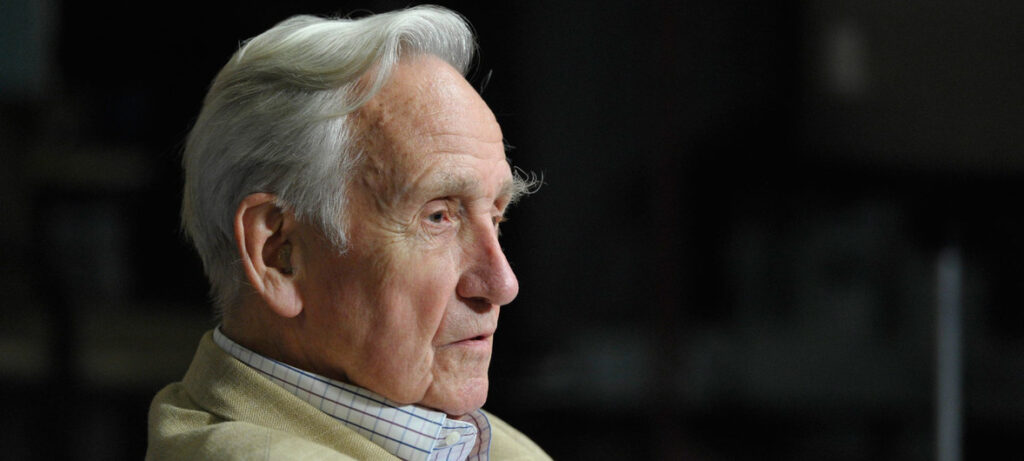
Legacy of Sir Brian Urquhart offers lessons for challenges facing UN

Jake Sherman

August 3, 2020

Today, February 28, 2019, is the 100th birthday of Sir Brian Urquhart, whose distinguished career at the United Nations began at its creation and lasted until the final years of the Cold War. As an adviser to five secretaries-general, his influence over the first generation of UN peacekeeping missions was without peer. A committed multilateralist, Sir Brian was clear-eyed about the idealism of the UN as a mechanism to address international crises—and the reasons it often failed.

Originally posted on International Peace Institute (IPI)’s
official website on February 28, 2019

His centennial is an apt moment to reflect on his legacy and how his experiences at the UN continue to inform contemporary challenges facing the organization. Two aspects of Sir Brian’s legacy stand out: his ability to find imaginative solutions to crises despite fundamental differences among the five permanent members—the “P5”—of the Security Council, and his reputation for impartiality and loyalty to the ideals of the organization he served for over four decades.

After a six year stint in the British Army during World War II, Sir Brian achieved his strong desire to join “whatever world body would succeed the League of Nations,” becoming the UN’s second staff member in 1946. As an aide to the Nobel Peace Prize Laureate Ralph Bunche—and one of the few early staff with military experience—Sir Brian planned the UN’s early missions almost singlehandedly, including its first peacekeeping operation following the Suez crisis in 1956.

The use of the blue helmet—arguably the most iconic symbol of the UN—was his idea to distinguish peacekeepers from other military forces. During the years of East-West struggle, Sir Brian’s peacekeepers adhered to principles of impartiality, consent of the parties, and non-use of force. He viewed strong political support from the P5 as essential for peacekeeping’s success, at times even securing the participation of both US and Soviet military observers.

But despite early signs of progress, the ink on the UN charter had barely dried before competition between the United States and Soviet Union killed the spirit of collective responsibility for maintaining international peace on which the UN Charter was based. Throughout the Cold War, the P5 tended to prevent the Council from taking up major crises in which they were involved. Sir Brian observed that if the Council didn’t function with unanimity as intended, the next best scenario was that its most powerful members would use it as a last resort. De-escalation of crises in the Middle East—often to prevent more direct US and Soviet participation—was a rare, but recurring exception to deadlock.

Sir Brian supervised UN peacekeeping for nearly two decades, overseeing operations in Cyprus, Lebanon, Namibia, as well as the UN’s first foray in the Congo, which prefigured today’s multidimensional missions, and their attending challenges. Shortly after his retirement, the collapse of the Soviet Union overturned the political order, and with it the stasis in the Council, which deployed peacekeeping missions with a widening set of civilian, military, and policing tasks at an unprecedented pace. More than 110,000 civilian, military, and police staff now serve in 14 peacekeeping operations.

Today, however, peacekeeping appears to be in increasing trouble. Complex, costly missions in the Central African Republic (CAR) and the Democratic Republic of Congo (DRC) face a shifting constellation of armed groups and criminal gangs. In the case of the mission in Mali, terrorist groups continually target UN peacekeepers. Stalled political processes, obstructionist host governments, and widespread targeting of civilians, particularly women, also challenge missions, especially in Darfur and South Sudan. Longstanding buffer missions in Cyprus and Western Sahara—the thin “blue line” practiced by Sir Brian—face deepening skepticism from the current US administration. There are also worrying signs of contentiousness over the renewal of peacekeeping mandates, as negotiations over the DRC, CAR, and Western Sahara suggest.

Similar to the political environment in which Sir Brian operated, UN peacekeeping must once again navigate a Security Council divided by great power animosity. It has proven unable to halt violence in Syria and Yemen or outright territorial seizure in Ukraine due to the direct involvement of permanent members. Ideological differences over human rights and competing visions of the inviolability of state sovereignty have paralyzed action over Burundi, Myanmar, and Venezuela.

Under President Donald Trump, the United States has relinquished its political leadership and questioned the value of the UN and multilateralism itself, while Russia and China challenge the liberal norms on which they are based. Echoing Sir Brian, Richard Gowan recently suggested that as competition worsens, the least bad outcome would be for the US, China, and Russia to maintain the Security Council as a mechanism to manage their competition in the face of common security threats, like nuclear proliferation, counterterrorism, and managing armed conflict. Nonetheless, the Council has found moments of consensus—on chemical weapons in Syria (if fleetingly), the tightening of sanctions on North Korea, and in most cases, continuing the mandates of peacekeeping missions.

In a deeply divided, cost-conscious Security Council, the future of UN peacekeeping may become less ambitious. Established functions like security and justice sector reform and human rights promotion could be increasingly debated. Now one peacemaker among many, the UN will also need to contend with parallel operations by regional organizations and other actors that may have a comparative advantage. More UN missions are likely to resemble those familiar to Sir Brian: monitoring and verification missions like those deployed in Colombia and, more recently, in Hodeidah, Yemen. Yet both these examples, deployed as more politically-palatable “special political missions,” also demonstrate the kind of innovation championed by Urquhart. In the former, unarmed military and police observers were sent as a political mission to avoid government sensitivities about “peacekeeping,” while in the latter, the observers are being deployed under the existing mediator’s office to support a truce and enable delivery of humanitarian assistance.

Beyond his role in shaping UN peacekeeping, Sir Brian championed what it meant to serve the UN. Throughout his years of service, Urquhart embodied political independence and loyalty to the UN Charter, epitomizing the ideals of an international civil servant promoted by his one-time boss, Dag Hammarskjöld. The impartiality of the UN and its staff is essential for the credibility of the organization, whether mediating a peace agreement or calling out human rights violations. Sir Brian could be withering in his assessment of the UN’s failings, including the tendency of its intergovernmental meetings towards tedious rhetoric, its bureaucracy towards parochialism, and its member states towards resistance to reform.

While politicization of the UN’s top jobs has been a longstanding concern, there are now worrying signs that national loyalty is seeping into rank and file appointments today. Sir Brian argued that the role of the UN was to look equally at all the problems facing the most people. It cannot do this if it is beholden only to its most powerful members. In a related problem, few senior UN officials running missions demonstrate a willingness to honestly assess their progress to the Security Council out of concern that they may run afoul of its members and harm their prospects for future employment.

To improve its responsiveness to current political and development challenges, on January 1, the United Nations underwent its biggest reorganization since the creation of the Departments of Peacekeeping Operations and Political Affairs in 1992. Championed by Secretary-General António Guterres, the reforms aim to break down silos to better prevent and resolve political crises. One of the most tangible outcomes is expected to be better political analysis and reporting to the Security Council. The reforms should also provide more efficient support to field operations mandated to enable peace agreements and protect civilians in war zones.

While it remains to be seen whether the reforms will transform the organizational culture and promote cooperation, their approval by member states was a strong endorsement of the need for change. So far, however, member states appear less able to follow through on their own political commitments to Secretary-General Guterres’ Action for Peacekeeping initiative, launched in March 2018 to spur governments to address challenges outside the UN’s control, like better coordinating political processes, adequately training and equipping troops, and allocating resources.

The UN has always faced a gap between its aspiration and performance. Yet, as Sir Brian observed, the UN is the only global design for the daunting task of managing both conflict and progress. In the struggle to narrow the gap, setbacks need to be met with intensified efforts to find creative solutions. “If we fail to do this,” he wrote, “coming generations will pay a terrible price.” Facing a future marked by rising global disorder, we should all heed his message and his legacy.

If you liked this article, reward TFF with a dollar or five…
Jake Sherman is Director of the Brian Urquhart Center for Peace Operations at the International Peace Institute (IPI). Among other things, he has previously served at the United States Mission to the United Nations and  for the U.S. Agency for International Development Office of Transition Initiatives as the Regional Team Leader for Afghanistan and Pakistan

Note
We are very proud that Sir Brian has been a friend of the founders since 1983 and was a TFF Associate from 1986 and 20 years ahead.


Related Posts

Tony Robinson October 4, 2026 Violence is easy to recognise when someone is being beaten, shot or killed. It becomes more difficult when nobody is holding a weapon. Poverty, discrimination, exploitation and repression can restrict a human life just as effectively, although they do so in very different ways and with very different consequences. Simply adding more categories to an ever-growing list of forms of violence does not really solve the problem. The more interesting question is what all these different situations have in common and why it makes sense to describe them using the same word. Human beings do not simply react to what happens around them. They remember the past, imagine things that do not yet exist, make plans and undertake projects. Workers organise because they imagine different working conditions; people migrate because they imagine another life somewhere else; social movements emerge because people refuse to accept the...
It’s a matter of principles, courage, vision and pulling together – while the militarist world is falling apart… Peter Langille October 3, 2026 “Here, then, is the problem which we present to you, stark and dreadful and inescapable: Shall we put an end to the human race; or shall mankind renounce war?”The Bertrand Russell—Albert Einstein Manifesto, July 9, 1955 ⁕ The forecast for what’s ahead is worrisome. The sharp rise in armed conflicts over the past three years is adding to what was already the highest level in over seventy years. Genocides, which should be prevented are supported. A shared climate emergency that jeopardises survival is ignored. Diverse polls now suggest that people are war-weary, worried and interested in a more effective United Nations. And, there are viable policy options for a more secure world! Yet governments are doubling-down, betting on more war and investing heavily. If current trends persist,...
Johan Galtung 1930-2024October 2015 Published here on October 3, 2026 Let us focus on Civilization for conflict analysis and remedies. Major forms of disorder use violence; war is state organized violence. The most belligerent states are the United States of America and Israel, both with civilization roots. National Evangelism, the US Protestant Christian civilization– more national than evangelical–justifies US warfare as exceptionalism of a people chosen by God, with a manifest destiny to run the world. Orthodox Judaism justifies Israeli warfare to conquer and expand from Nile to Euphrates as a religious right and duty to the Eternal One. The third most belligerent country, the UK, no longer believes it is God-chosen but chosen by the USA; not quite the same but something. But the root cause of global disorder lies in the Occident–with Islam–seeing itself as the single, universal civilization valid for all at all times, all others being...

Recent Articles

Tony Robinson October 4, 2026 Violence is easy to recognise when someone is being beaten, shot or killed. It becomes more difficult when nobody is holding a weapon. Poverty, discrimination, exploitation and repression can restrict a human life just as effectively, although they do so in very different ways and with very different consequences. Simply adding more categories to an ever-growing list of forms of violence does not really solve the problem. The more interesting question is what all these different situations have in common and why it makes sense to describe them using the same word. Human beings do not simply react to what happens around them. They remember the past, imagine things that do not yet exist, make plans and undertake projects. Workers organise because they imagine different working conditions; people migrate because they imagine another life somewhere else; social movements emerge because people refuse to accept the...
It’s a matter of principles, courage, vision and pulling together – while the militarist world is falling apart… Peter Langille October 3, 2026 “Here, then, is the problem which we present to you, stark and dreadful and inescapable: Shall we put an end to the human race; or shall mankind renounce war?”The Bertrand Russell—Albert Einstein Manifesto, July 9, 1955 ⁕ The forecast for what’s ahead is worrisome. The sharp rise in armed conflicts over the past three years is adding to what was already the highest level in over seventy years. Genocides, which should be prevented are supported. A shared climate emergency that jeopardises survival is ignored. Diverse polls now suggest that people are war-weary, worried and interested in a more effective United Nations. And, there are viable policy options for a more secure world! Yet governments are doubling-down, betting on more war and investing heavily. If current trends persist,...
Johan Galtung 1930-2024October 2015 Published here on October 3, 2026 Let us focus on Civilization for conflict analysis and remedies. Major forms of disorder use violence; war is state organized violence. The most belligerent states are the United States of America and Israel, both with civilization roots. National Evangelism, the US Protestant Christian civilization– more national than evangelical–justifies US warfare as exceptionalism of a people chosen by God, with a manifest destiny to run the world. Orthodox Judaism justifies Israeli warfare to conquer and expand from Nile to Euphrates as a religious right and duty to the Eternal One. The third most belligerent country, the UK, no longer believes it is God-chosen but chosen by the USA; not quite the same but something. But the root cause of global disorder lies in the Occident–with Islam–seeing itself as the single, universal civilization valid for all at all times, all others being...

TFF on Substack

Discover and subscribe to more peace materials on TFF Substack

Most Popular

Tony Robinson October 4, 2026 Violence is easy to recognise when someone is being beaten, shot or killed. It becomes more difficult when nobody is holding a weapon. Poverty, discrimination, exploitation and repression can restrict a human life just as effectively, although they do so in very different ways and with very different consequences. Simply adding more categories to an ever-growing list of forms of violence does not really solve the problem. The more interesting question is what all these different situations have in common and why it makes sense to describe them using the same word. Human beings do not simply react to what happens around them. They remember the past, imagine things that do not yet exist, make plans and undertake projects. Workers organise because they imagine different working conditions; people migrate because they imagine another life somewhere else; social movements emerge because people refuse to accept the...
It’s a matter of principles, courage, vision and pulling together – while the militarist world is falling apart… Peter Langille October 3, 2026 “Here, then, is the problem which we present to you, stark and dreadful and inescapable: Shall we put an end to the human race; or shall mankind renounce war?”The Bertrand Russell—Albert Einstein Manifesto, July 9, 1955 ⁕ The forecast for what’s ahead is worrisome. The sharp rise in armed conflicts over the past three years is adding to what was already the highest level in over seventy years. Genocides, which should be prevented are supported. A shared climate emergency that jeopardises survival is ignored. Diverse polls now suggest that people are war-weary, worried and interested in a more effective United Nations. And, there are viable policy options for a more secure world! Yet governments are doubling-down, betting on more war and investing heavily. If current trends persist,...
Johan Galtung 1930-2024October 2015 Published here on October 3, 2026 Let us focus on Civilization for conflict analysis and remedies. Major forms of disorder use violence; war is state organized violence. The most belligerent states are the United States of America and Israel, both with civilization roots. National Evangelism, the US Protestant Christian civilization– more national than evangelical–justifies US warfare as exceptionalism of a people chosen by God, with a manifest destiny to run the world. Orthodox Judaism justifies Israeli warfare to conquer and expand from Nile to Euphrates as a religious right and duty to the Eternal One. The third most belligerent country, the UK, no longer believes it is God-chosen but chosen by the USA; not quite the same but something. But the root cause of global disorder lies in the Occident–with Islam–seeing itself as the single, universal civilization valid for all at all times, all others being...
Read More
Living-Peace-Sign-Budapest-copy
Tony Robinson October 4, 2026 Violence is easy to recognise when someone is being beaten, shot or killed. It becomes more difficult when nobody is holding a weapon. Poverty, discrimination, exploitation and repression can restrict a human life just as effectively, although they do so in very different ways and with very different consequences. Simply adding more categories to an ever-growing list of forms of violence does not really solve the problem. The more interesting question is what all these different situations have in common and why it makes sense to describe them using the same word. Human beings do not simply react to what happens around them. They remember the past, imagine things that do not yet exist, make plans and undertake projects. Workers organise because they imagine different working conditions; people migrate because they imagine another life somewhere else; social movements emerge because people refuse to accept the...
b54a1f10-8c65-4f0b-9dd5-4abc0a7d04cc_2659x2659
It’s a matter of principles, courage, vision and pulling together – while the militarist world is falling apart… Peter Langille October 3, 2026 “Here, then, is the problem which we present to you, stark and dreadful and inescapable: Shall we put an end to the human race; or shall mankind renounce war?”The Bertrand Russell—Albert Einstein Manifesto, July 9, 1955 ⁕ The forecast for what’s ahead is worrisome. The sharp rise in armed conflicts over the past three years is adding to what was already the highest level in over seventy years. Genocides, which should be prevented are supported. A shared climate emergency that jeopardises survival is ignored. Diverse polls now suggest that people are war-weary, worried and interested in a more effective United Nations. And, there are viable policy options for a more secure world! Yet governments are doubling-down, betting on more war and investing heavily. If current trends persist,...
010
Johan Galtung 1930-2024October 2015 Published here on October 3, 2026 Let us focus on Civilization for conflict analysis and remedies. Major forms of disorder use violence; war is state organized violence. The most belligerent states are the United States of America and Israel, both with civilization roots. National Evangelism, the US Protestant Christian civilization– more national than evangelical–justifies US warfare as exceptionalism of a people chosen by God, with a manifest destiny to run the world. Orthodox Judaism justifies Israeli warfare to conquer and expand from Nile to Euphrates as a religious right and duty to the Eternal One. The third most belligerent country, the UK, no longer believes it is God-chosen but chosen by the USA; not quite the same but something. But the root cause of global disorder lies in the Occident–with Islam–seeing itself as the single, universal civilization valid for all at all times, all others being...
Screenshot 2026-10-02 011738
Jan ObergPhD, director, The Transnational Foundation for Peace and Future Research, TFFLund, Sweden October 2, 2026 This is my full original manuscript. The Chinese Academy of Social Science, CASS, makes two publications out if it. 1. China’s Five-year plan emphasized the capabilities of basic research and original innovation. It is regarded as the goal of the future social development, which, as required, should be significantly enhanced. Can you comment on the importance of original innovation in research and academic study? I believe it is easier to define “original innovation” in the natural sciences than in social sciences. The breaking points of what constitutes something new, or innovative, are not quite as sharp in the latter. But in both fields it is about opening up something that was closed, unseen, unexplored before – making manifest what was earlier latent. Innovations come in many forms and shapes – naming something that was not...
arctic-circle-map
The agreement is catastrophic both because of what it says and what it doesn’t mention. It reduces further the major asset of security policies: Freedom of action. Jan Oberg TFF director September 25, 2026 A couple of hours before the agreement was signed on September 22, 2026, I published the following 13 hypotheses about what it would most likely contain on TFF Substack (in English). I was wrong on only the first point. Contrary to what Trump had written on his Truth Social platform, it does not appear to come into force immediately. In fact, it turned out to be worse than even I had anticipated. After these hypotheses now come a number of reflections in light of what the agreement actually contains, and does not contain, as well as the way in which it has generally been presented by major media outlets and by the public-service broadcaster DR. My...
girl-5894831_1280
Below are TFF-related media mentions, comments, videos and social media posts published elsewhere but not on this homepage. We happen to catch and list only a fraction. Regarding video comments and debates, we recommend that you go to the TFF Video Channel on Substack where many of them are reproduced. Jan Oberg is a contributor to China Daily – 52 million daily clicks – and Global Times, CGTN and CCTV (the national television), China Investment, Xinhua News Agency and several others. Articles and videos on these media very often multiply into countless Chinese (and Western media) that re-post them from these main media. Thanks to The China Academy, his analyses, interviews and comments are frequently posted on YouTube channels such as Thinkers Forum and Wave Media. These videos are often re-posted on Bilibili (China’s YouTube), the China Content Center on TikTok, and on the Chinese edition of TikTok, Douyin.com. This means reaching hundreds of millions of viewers worldwide over a year. While there are too many to catch on all these...



