
Hong Kong in the crosshairs of global power and ideological struggle

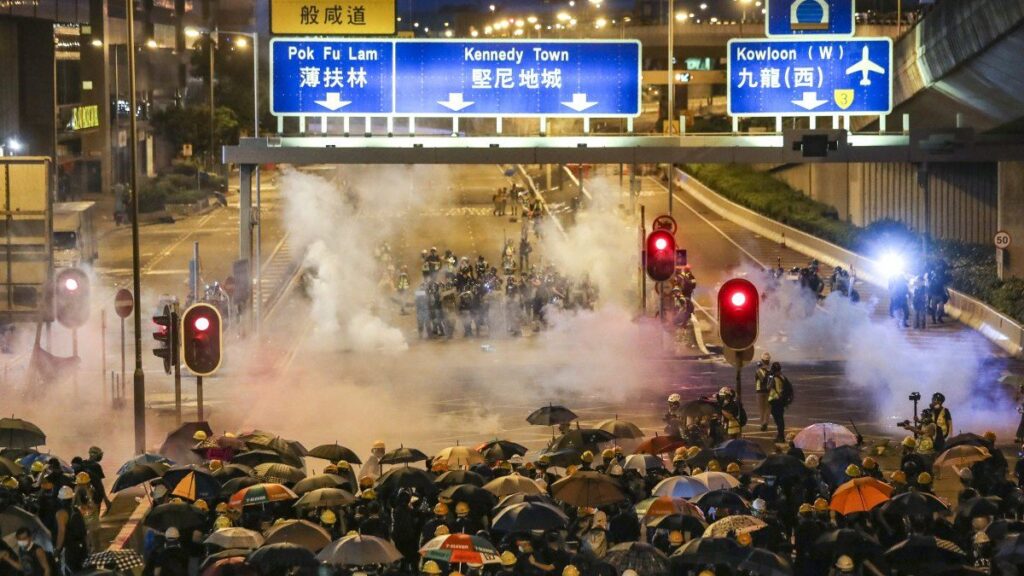
Riot police fire tear gas at protesters as they head towards the central government’s liaison office in Sai Ying Pun on Sunday. Photo: Sam Tsang in SCMS

By Kevin Zeese and Margaret Flowers
Directors of Popular Resistance

August 20, 2019

Hong Kong is one of the most extreme examples of big finance, neoliberal capitalism in the world. As a result, many people in Hong Kong are suffering from great economic insecurity in a city with 93 billionaires, second-most of any city.

Hong Kong is suffering the effects of being colonized by Britain for more than 150 years following the Opium Wars. The British put in place a capitalist economic system and Hong Kong has had no history of self-rule. When Britain left, it negotiated an agreement that prevents China from changing Hong Kong’s political and economic systems for 50 years by making Hong Kong a Special Administrative Region (SAR).

China cannot solve the suffering of the people of Hong Kong. This ‘One Country, Two Systems’ approach means the extreme capitalism of Hong Kong exists alongside, but separate from, China’s socialized system. Hong Kong has an unusual political system. For example, half the seats in the legislature are required to represent business interests meaning corporate interests vote on legislation.

Originally published at Countercurrents

Hong Kong is a center for big finance and also a center of financial crimes. Between 2013 and 2017, the number of suspicious transactions reported to law enforcement agencies rocketed from 32,907 to 92,115. There has been a small number of prosecutions, which dropped from a high of 167 in 2014 to 103 in 2017. Convictions dropped to only one person sentenced to more than six years behind bars in 2017.

The problem is neither the extradition bill that was used to ignite protests nor China, the problems are Hong Kong’s economy and governance.

The Extradition Bill

The stated cause of the recent protests is an extradition bill proposed because there is no legal way to prevent criminals from escaping charges when they flee to Hong Kong. The bill was proposed by the Hong Kong government in February 2019 to establish a mechanism to transfer fugitives in Hong Kong to Taiwan, Macau or Mainland China.

Extradition laws are a legal norm between countries and within countries (e.g. between states), and since Hong Kong is part of China, it is pretty basic. In fact, in 1998, a pro-democracy legislator, Martin Lee, proposed a law similar to the one he now opposes to ensure a person is prosecuted and tried at the place of the offense.

The push for the bill came in 2018 when a Hong Kong resident Chan Tong-kai allegedly killed his pregnant girlfriend, Poon Hiu-wing, in Taiwan, then returned to Hong Kong. Chan admitted he killed Poon to Hong Kong police, but the police were unable to charge him for murder or extradite him to Taiwan because no agreement was in place.

The proposed law covered  46 types of crimes that are recognized as serious offenses across the globe. These include murder, rape, and sexual offenses, assaults, kidnapping, immigration violations, and drug offenses as well as property offenses like robbery, burglary and arson and other traditional criminal offenses. It also included business and financial crimes.

Months before the street protests, the business community expressed opposition to the law. Hong Kong’s two pro-business parties urged the government to exempt white-collar crimes from the list of offenses covered by any future extradition agreement. There was escalating pressure from the city’s business heavyweights.  The American Chamber of Commerce, AmCham, a fifty-year-old organization that represents over 1,200 US companies doing business in Hong Kong, opposed the proposal.

AmCham said it would damage the city’s reputation: “Any change in extradition arrangements that substantially expands the possibility of arrest and rendition … of international business executives residing in or transiting through Hong Kong as a result of allegations of economic crime made by the mainland government … would undermine perceptions of Hong Kong as a safe and secure haven for international business operations.”

Kurt Tong, the top US diplomat in Hong Kong, said in March that the proposal could complicate relations between Washington and Hong Kong. Indeed, the Center for International Private Enterprise, an arm of NED said the proposed law would undermine economic freedom, cause capital flight and threaten Hong Kong’s status as a hub for global commerce. They pointed to a bipartisan letter signed by eight members of Congress, including Senators Marco Rubio, Tom Cotton, and Steve Daines and Members of the House of Representatives, Jim McGovern, Ben McAdams, Chris Smith, Tom Suozzi, and Brian Mast opposing the bill.

Proponents of the bill responded by exempting nine of the economic crimes and made extradition only for crimes punishable by at least seven years in prison. These changes did not satisfy big business advocates.

The Mass Protests and US Role 

From this attention to the law, opposition grew with the formation of a coalition to organize protests. As Alexander Rubinstein reports, “the coalition cited by Hong Kong media, including the South China Morning Post and the Hong Kong Free Press, as organizers of the anti-extradition law demonstrations is called the Civil Human Rights Front. That organization’s website lists the NED-funded HKHRM [Human Rights Monitor], Hong Kong Confederation of Trade Unions, the Hong Kong Journalists Association, the Civic Party, the Labour Party, and the Democratic Party as members of the coalition.” HKHRM alone received more than $1.9 million in funds from the NED between 1995 and 2013. Major protests began in June.

Building the anti-China movement in Hong Kong has been a long-term, NED project since 1996. In 2012, NED invested $460,000 through its National Democratic Institute, to build the anti-China movement (aka pro-democracy movement), particularly among university students. Two years later, the mass protests of Occupy Central occurred. In a 2016 Open Letter to Kurt Tong, these NED grants and others were pointed out and Tong was asked if the US was funding a Hong Kong independence movement.

During the current protests, organizers were photographed meeting with Julie Eadeh, the political unit chief of US Consulate General, in a Hong Kong hotel. They also met with China Hawks in Washington, DC including Vice President Pence, Secretary of State Pompeo, National Security Adviser John Bolton, Senator Marco Rubio and Rep. Eliot Engel, chairman of the House Foreign Affairs Committee. Larry Diamond, a co-editor of the NED’s publication and a co-chair of research, has been openly encouraging the protesters. He delivered a video message of support during their rally this weekend.

Protests have included many elements of US color revolutions with tactics such as violence — attacks on bystanders, media, police and emergency personnel. Similar tactics were used in Ukraine, Nicaragua, and Venezuela, e.g. violent street barricades. US officials and media criticized the government’s response to the violent protests, even though they have been silent on the extreme police violence against the Yellow Vests in France. Demonstrators also use swarming techniques and sophisticated social media messaging targeting people in the US.

Mass protests have continued. On July 9, Chief Executive Carrie Lam pronounced the bill dead and suspended it. Protesters are now calling for the bill to be withdrawn, Lam to resign and police to be investigated. For more on the protests and US involvement, listen to our interview with K. J. Noh on Clearing the FOG.

What Is Driving Discontent in Hong Kong?

The source of unrest in Hong Kong is the economic insecurity stemming from capitalism. In 1997, Britain and China agreed to leave “the previous capitalist system” in place for 50 years.

Hong Kong has been ranked as the world’s freest economy in the Heritage’s Index of Economic Freedom since 1995 when the index began. In 1990, Milton Friedman described Hong Kong as the best example of a free-market economy. Its ranking is based on low taxes, light regulations, strong property rights, business freedom, and openness to global commerce.

Graeme Maxton writes in the South China Morning Post: “The only way to restore order is through a radical change in Hong Kong’s economic policies. After decades of doing almost nothing, and letting the free market rule, it is time for the Hong Kong government to do what it is there for; to govern in the interests of the majority.”

The issue is not the extradition proposal, Carrie Lam or China. What we are witnessing is an unrestricted neo-liberal economy, described as a free market on steroids. Hong Kong’s economy relative to China’s gross domestic product (GDP) has fallen from a peak of 27 percent in 1993 to less than 3 percent in 2017. During this time, China has had tremendous growth, including in nearby market-friendly Shenzen, while Hong Kong has not.

As Sara Flounders writes, “For the last 10 years wages have been stagnant in Hong Kong while rents have increased 300 percent; it is the most expensive city in the world. In Shenzhen, wages have increased 8 percent every year, and more than 1 million new, public, green housing units at low rates are nearing completion.”

Hong Kong has the world’s highest rents, a widening wealth gap and a poverty rate of 20 percent. In China, the poverty rate fell from 88 percent in 1981 to 0.7 percent in 2015, according to the World Bank.

Hong Kong In The Chinese Context

Ellen Brown writes in “Neoliberalism Has Met Its Match in China,” that the Chinese government owns 80 percent of banks, which make favorable loans to businesses, and subsidizes worker costs. The US views China subsidizing its economy as an unfair trade advantage, while China sees long-term, planned growth as smarter than short-term profits for shareholders.

The Chinese model of state-controlled capitalism (some call it a form of socialism) has lifted 800 million people out of poverty and built a middle class of over 420 million people, growing from four percent in 2002, to 31 percent. The top twelve Chinese companies on the Fortune 500 are all state-owned and state-subsidized including oil, solar energy, telecommunications, engineering, construction companies, banks, and the auto industry. China has the second-largest GDP, and the largest economy based on Purchasing Power Parity GDP, according to the CIA, IMF and World Bank.

China does have significant problems. There are thousands of documented demonstrations, strikes and labor actions in China annually, serious environmental challenges, inequality and social control through the use of surveillance technology. How China responds to these challenges is a test for their governance.

China describes itself as having an intraparty democracy. The eight other legal “democratic parties” that are allowed to participate in the political system cooperate with but do not compete with the Communist Party. There are also local elections for candidates focused on grassroots issues. China views western democracy and economics as flawed and does not try to emulate them but is creating its own system.

China is led by engineers and scientists, not by lawyers and business people. It approaches policy decisions through research and experimentation. Every city and every district is involved in some sort of experimentation including free trade zones, poverty reduction, and education reform. “There are pilot schools, pilot cities, pilot hospitals, pilot markets, pilot everything under the sun, the whole China is basically a giant portfolio of experiments, with mayors and provincial governors as Primary Investigators.” In this system, Hong Kong could be viewed as an experiment in neoliberal capitalism.

The Communist Party knows that to keep its hold on power, it must combat inequalities and shift the economy towards a more efficient and more ecological model. Beijing has set a date of 2050 to become a “socialist society” and to achieve that, it seeks improvements in social, labor and environmental fields.

Where does Hong Kong fit into these long-term plans? With 2047 as the year for the end of the agreement with the UK, US and western powers are working toward preserving their capitalist dystopia of Hong Kong and manufacturing consensus for long-term conflict with China.

How this conflict of economic and political systems turns out depends on whether China can confront its contradictions, whether Hong Kongers can address the source of their problems and whether US empire can continue its dollar, political and military dominance. Today’s conflicts in Hong Kong are rooted in all of these realities.

Originally published at Countercurrents

2 Responses

  1. Sounds Very corrupt ,,, reeks like a sewage… and China building up fast other financial centres that very soon will be a lot more important than HK, will starve out the HK as an important finance hub… and the billionaire will inevitably flee… that is the Sun Tsu art of war…

Related Posts

Launched on November 17, 2024Updated with new materials regularly TFF Board members Thore Vest. Everywhere, the delegation was met with a sincere wish to develop knowledge, dialogue, cooperative projects, and initiatives based on citizens’ diplomacy – in general, but with the West in particular. For more, see “Report from the Nordic delegation to China’s Xinjiang Province, September 7-15, 2024.” While the delegation was in Xinjiang, various ideas were already being discussed from the local to the top level, i.e., with the governor and party leaders of Xinjiang. The two TFF Associates suggested that TFF set up a special section – in addition to its “China and Silk” – where various quality materials about Xinjiang would regularly be published to promote public education about Xinjiang, particularly its contemporary development – worldwide but in the West in particular. This is now a reality – as can be seen below – but it...
Photo Jan Oberg China has recently garnered significant attention due to its advancements in various technological fields, such as quantum physics and artificial intelligence. In media discussions and my lectures on China, it is common to encounter objections asserting that the West, particularly the United States, is certainly ahead of China. These assertions appear to be more emotional than factual. However, a more fundamental consideration is whether this question holds any significance. Cultural Perspective One aspect that Westerners often overlook is the cultural variation in understanding the relationship between abstract academic insights and practical applications of those insights. To comprehend the origin and significance of discussions on technological superiority, it is essential to acknowledge cultural and social differences between China and the West. I have explored this topic before in some of my previous articles published on the TFF website. Particularism On the cultural dimension universalist – particularist, China exhibits...
Foreword The Board of The Transnational Foundation in Sweden has decided to publish an easy-to-read, scholarly anthology that addresses one of the most important – and potentially dangerous – issues of our time: Why are the political, economic, and medialised Western images of China so consistently negative – and what can you do to understand China better? These images may be expressions of a political will to present only various shades of grey and black with the aim of building a consciousness about China as an enemy and not a partner. They may also be seen as a sort of world-dominating ethos of ignorance based upon the assumption that “we’ve-got-nothing-to-learn-from-others,’ we are the teacher. Another possibility is that the West, deep down, feels that it is getting relatively weaker from a macro-historical perspective and comforts itself with denial and accusations against “the other” of being the reason for its manifest...

Recent Articles

Tony Robinson October 4, 2026 Violence is easy to recognise when someone is being beaten, shot or killed. It becomes more difficult when nobody is holding a weapon. Poverty, discrimination, exploitation and repression can restrict a human life just as effectively, although they do so in very different ways and with very different consequences. Simply adding more categories to an ever-growing list of forms of violence does not really solve the problem. The more interesting question is what all these different situations have in common and why it makes sense to describe them using the same word. Human beings do not simply react to what happens around them. They remember the past, imagine things that do not yet exist, make plans and undertake projects. Workers organise because they imagine different working conditions; people migrate because they imagine another life somewhere else; social movements emerge because people refuse to accept the...
It’s a matter of principles, courage, vision and pulling together – while the militarist world is falling apart… Peter Langille October 3, 2026 “Here, then, is the problem which we present to you, stark and dreadful and inescapable: Shall we put an end to the human race; or shall mankind renounce war?”The Bertrand Russell—Albert Einstein Manifesto, July 9, 1955 ⁕ The forecast for what’s ahead is worrisome. The sharp rise in armed conflicts over the past three years is adding to what was already the highest level in over seventy years. Genocides, which should be prevented are supported. A shared climate emergency that jeopardises survival is ignored. Diverse polls now suggest that people are war-weary, worried and interested in a more effective United Nations. And, there are viable policy options for a more secure world! Yet governments are doubling-down, betting on more war and investing heavily. If current trends persist,...
Johan Galtung 1930-2024October 2015 Published here on October 3, 2026 Let us focus on Civilization for conflict analysis and remedies. Major forms of disorder use violence; war is state organized violence. The most belligerent states are the United States of America and Israel, both with civilization roots. National Evangelism, the US Protestant Christian civilization– more national than evangelical–justifies US warfare as exceptionalism of a people chosen by God, with a manifest destiny to run the world. Orthodox Judaism justifies Israeli warfare to conquer and expand from Nile to Euphrates as a religious right and duty to the Eternal One. The third most belligerent country, the UK, no longer believes it is God-chosen but chosen by the USA; not quite the same but something. But the root cause of global disorder lies in the Occident–with Islam–seeing itself as the single, universal civilization valid for all at all times, all others being...

TFF on Substack

Discover and subscribe to more peace materials on TFF Substack

Most Popular

Tony Robinson October 4, 2026 Violence is easy to recognise when someone is being beaten, shot or killed. It becomes more difficult when nobody is holding a weapon. Poverty, discrimination, exploitation and repression can restrict a human life just as effectively, although they do so in very different ways and with very different consequences. Simply adding more categories to an ever-growing list of forms of violence does not really solve the problem. The more interesting question is what all these different situations have in common and why it makes sense to describe them using the same word. Human beings do not simply react to what happens around them. They remember the past, imagine things that do not yet exist, make plans and undertake projects. Workers organise because they imagine different working conditions; people migrate because they imagine another life somewhere else; social movements emerge because people refuse to accept the...
It’s a matter of principles, courage, vision and pulling together – while the militarist world is falling apart… Peter Langille October 3, 2026 “Here, then, is the problem which we present to you, stark and dreadful and inescapable: Shall we put an end to the human race; or shall mankind renounce war?”The Bertrand Russell—Albert Einstein Manifesto, July 9, 1955 ⁕ The forecast for what’s ahead is worrisome. The sharp rise in armed conflicts over the past three years is adding to what was already the highest level in over seventy years. Genocides, which should be prevented are supported. A shared climate emergency that jeopardises survival is ignored. Diverse polls now suggest that people are war-weary, worried and interested in a more effective United Nations. And, there are viable policy options for a more secure world! Yet governments are doubling-down, betting on more war and investing heavily. If current trends persist,...
Johan Galtung 1930-2024October 2015 Published here on October 3, 2026 Let us focus on Civilization for conflict analysis and remedies. Major forms of disorder use violence; war is state organized violence. The most belligerent states are the United States of America and Israel, both with civilization roots. National Evangelism, the US Protestant Christian civilization– more national than evangelical–justifies US warfare as exceptionalism of a people chosen by God, with a manifest destiny to run the world. Orthodox Judaism justifies Israeli warfare to conquer and expand from Nile to Euphrates as a religious right and duty to the Eternal One. The third most belligerent country, the UK, no longer believes it is God-chosen but chosen by the USA; not quite the same but something. But the root cause of global disorder lies in the Occident–with Islam–seeing itself as the single, universal civilization valid for all at all times, all others being...
Read More
Living-Peace-Sign-Budapest-copy
Tony Robinson October 4, 2026 Violence is easy to recognise when someone is being beaten, shot or killed. It becomes more difficult when nobody is holding a weapon. Poverty, discrimination, exploitation and repression can restrict a human life just as effectively, although they do so in very different ways and with very different consequences. Simply adding more categories to an ever-growing list of forms of violence does not really solve the problem. The more interesting question is what all these different situations have in common and why it makes sense to describe them using the same word. Human beings do not simply react to what happens around them. They remember the past, imagine things that do not yet exist, make plans and undertake projects. Workers organise because they imagine different working conditions; people migrate because they imagine another life somewhere else; social movements emerge because people refuse to accept the...
b54a1f10-8c65-4f0b-9dd5-4abc0a7d04cc_2659x2659
It’s a matter of principles, courage, vision and pulling together – while the militarist world is falling apart… Peter Langille October 3, 2026 “Here, then, is the problem which we present to you, stark and dreadful and inescapable: Shall we put an end to the human race; or shall mankind renounce war?”The Bertrand Russell—Albert Einstein Manifesto, July 9, 1955 ⁕ The forecast for what’s ahead is worrisome. The sharp rise in armed conflicts over the past three years is adding to what was already the highest level in over seventy years. Genocides, which should be prevented are supported. A shared climate emergency that jeopardises survival is ignored. Diverse polls now suggest that people are war-weary, worried and interested in a more effective United Nations. And, there are viable policy options for a more secure world! Yet governments are doubling-down, betting on more war and investing heavily. If current trends persist,...
010
Johan Galtung 1930-2024October 2015 Published here on October 3, 2026 Let us focus on Civilization for conflict analysis and remedies. Major forms of disorder use violence; war is state organized violence. The most belligerent states are the United States of America and Israel, both with civilization roots. National Evangelism, the US Protestant Christian civilization– more national than evangelical–justifies US warfare as exceptionalism of a people chosen by God, with a manifest destiny to run the world. Orthodox Judaism justifies Israeli warfare to conquer and expand from Nile to Euphrates as a religious right and duty to the Eternal One. The third most belligerent country, the UK, no longer believes it is God-chosen but chosen by the USA; not quite the same but something. But the root cause of global disorder lies in the Occident–with Islam–seeing itself as the single, universal civilization valid for all at all times, all others being...
Screenshot 2026-10-02 011738
Jan ObergPhD, director, The Transnational Foundation for Peace and Future Research, TFFLund, Sweden October 2, 2026 This is my full original manuscript. The Chinese Academy of Social Science, CASS, makes two publications out if it. 1. China’s Five-year plan emphasized the capabilities of basic research and original innovation. It is regarded as the goal of the future social development, which, as required, should be significantly enhanced. Can you comment on the importance of original innovation in research and academic study? I believe it is easier to define “original innovation” in the natural sciences than in social sciences. The breaking points of what constitutes something new, or innovative, are not quite as sharp in the latter. But in both fields it is about opening up something that was closed, unseen, unexplored before – making manifest what was earlier latent. Innovations come in many forms and shapes – naming something that was not...
arctic-circle-map
The agreement is catastrophic both because of what it says and what it doesn’t mention. It reduces further the major asset of security policies: Freedom of action. Jan Oberg TFF director September 25, 2026 A couple of hours before the agreement was signed on September 22, 2026, I published the following 13 hypotheses about what it would most likely contain on TFF Substack (in English). I was wrong on only the first point. Contrary to what Trump had written on his Truth Social platform, it does not appear to come into force immediately. In fact, it turned out to be worse than even I had anticipated. After these hypotheses now come a number of reflections in light of what the agreement actually contains, and does not contain, as well as the way in which it has generally been presented by major media outlets and by the public-service broadcaster DR. My...
girl-5894831_1280
Below are TFF-related media mentions, comments, videos and social media posts published elsewhere but not on this homepage. We happen to catch and list only a fraction. Regarding video comments and debates, we recommend that you go to the TFF Video Channel on Substack where many of them are reproduced. Jan Oberg is a contributor to China Daily – 52 million daily clicks – and Global Times, CGTN and CCTV (the national television), China Investment, Xinhua News Agency and several others. Articles and videos on these media very often multiply into countless Chinese (and Western media) that re-post them from these main media. Thanks to The China Academy, his analyses, interviews and comments are frequently posted on YouTube channels such as Thinkers Forum and Wave Media. These videos are often re-posted on Bilibili (China’s YouTube), the China Content Center on TikTok, and on the Chinese edition of TikTok, Douyin.com. This means reaching hundreds of millions of viewers worldwide over a year. While there are too many to catch on all these...




