At 70: A few problems with the human rights concept

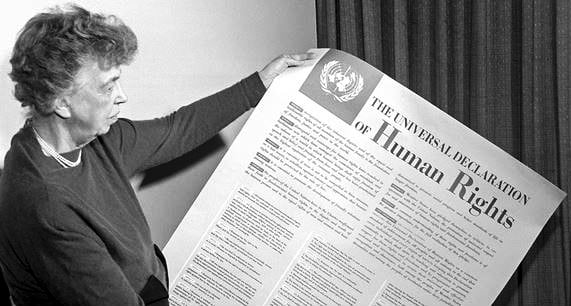
Today the Universal Declaration of Human Rights turns 70. All reason to celebrate. Without the norms embedded in this extremely important document, humankind would be much worse off.

Because normativity is important even though it is only words. It enables us to make those who violate human rights accountable. And that is, in general terms, an extremely important aspect of the UN and its Charter.

So too the norm expressed in its Article 1 – that peace shall be established by peaceful means and only when all such means have been tried an found in vain, can the UN member states take to violent means. As a last resort.

That said, the only two problems I have with the human rights philosophy and concept are:

  1. The word “human” – the implicit idea that only humans have right, not all the other creatures on earth. That is, it is a very anthropocentric concept. We need something much more inclusive and holistic today.
  2. The word “rights” – people constantly claiming their rights is good but it’s not enough. Gandhi said it a very long time ago: “There are no rights without duties.”

One could also formulate it this way: Human beings have duties vis-a-vis those whose rights are not embedded in any declaration, i.e. other living creatures, be it trees, rivers or microorganisms, in short: Mother Earth. And these creatures cannot speak up and claim their rights – for which reason we shall have to show empathy and use our imagination to “hear” them.

We need to see it as our duty to care – care both for the non-human beings and, most importantly, caring for the yet unborn, that is for future generations.

This means giving up the contractual thinking so fundamental in the Western worldview or social cosmology.

When it comes to the yet unborn, we have to do something to make their lives possible and even good even though they cannot claim these rights and even though we do not have a ‘contract’ – a quid pro quo – with them.

The question “what did future generations ever do for us/me” is of course meaningless. But we need anyhow to think beyond ourselves in time and space, all of us: Care for the rights of the non-human beings and for the not yet born human beings.

Other serious problems

It goes without saying that there are many more problems with the human rights concept and policies today. To mention a few:

  1. How universal can they be, given the world has so many and different cultures, ways of thinking and historical experiences? Is it at all realistic to argue that they can be universal?
  2. To which extent can one argue that the Declaration came out as basically Western product and with too much focus on the individual?
  3. How destructive has it been for the whole idea that, since about the intervention in Yugoslavia, human rights have been (mis)used as an argument, or justification, for the concept and policy of humanitarian intervention and the Responsibility To Protect (R2P) – advocating the legitimate use of military force in the name of human rights protection – even though these interventions have, more often than not, caused gross human rights violation and been conducted without a UN Security Council mandate?
  4. The whole intimacy between government and human rights NGO – where the N stands more for Near- than Non-Governmental, e.g. the rotation of government officials into human rights organisations and vice versa – in other words, the fundamental politicization of human rights to such an extent that the commitment to human rights become purely political and selective, a weapon in the (propaganda) for oneself and against designated enemies. 

So what about implementation?

That said – admittedly in the more philosophical realm – it is good to also discuss how we can, much more fully, implement the present human rights norms.

You just need to let your eyes run down over the Declaration’s 30 points in summary above to see how far the world still is from the ideals – and how the West that has been championing this Declaration has itself become increasingly authoritarian over time, excusing itself predominantly by referring to its global war on terror.

For the Western world, human rights have always been predominantly about freedoms to speak, assemble and travel etc. – whereas the rights in the economic sphere – such as the right to a job and the right to have enough to survive on, even the right to life –  have always been secondary. 

This of course has to do with global, Western-driven capitalism which is not exactly a human rights promoting system, just look at the ongoing marginalisation, suffering, poverty and misery of millions of people. And when China has championed these rights the last 40 years, the West points out that it systematically violates human right, the rights of course as the West sees them.

Or look at the wars and human- and system-caused environmental problems that cause the number of IDPs (Internally Displaces Persons), refugees, asylum seekers and migrants (different concepts!) increase, now so tragically approaching 70 million fellow human beings.

A new ethics of global care

We, therefore, need a new ethics of global care – norm systems like Christianity talking about what you as an individual should and should not do to your neighbour are way too narrow in time and space in our globalising world and in the future.

Fortunately, there are some good attempts at re-thinking rights and duties such as The Earth Charter Initiative and The People’s Charter to Create A Nonviolent World – but they have not been integrated enough in the general discourse and neither have they been institutionalised nor made legally binding by governments.

While humanity can see progress here and there in terms of civilisation – which means respecting the equal human rights of everybody – there is certainly a very long way to go to improve both the way we think and speak about these things and the way the right, all of them, are realised in daily lives on the ground around our troubled Earth.

Note
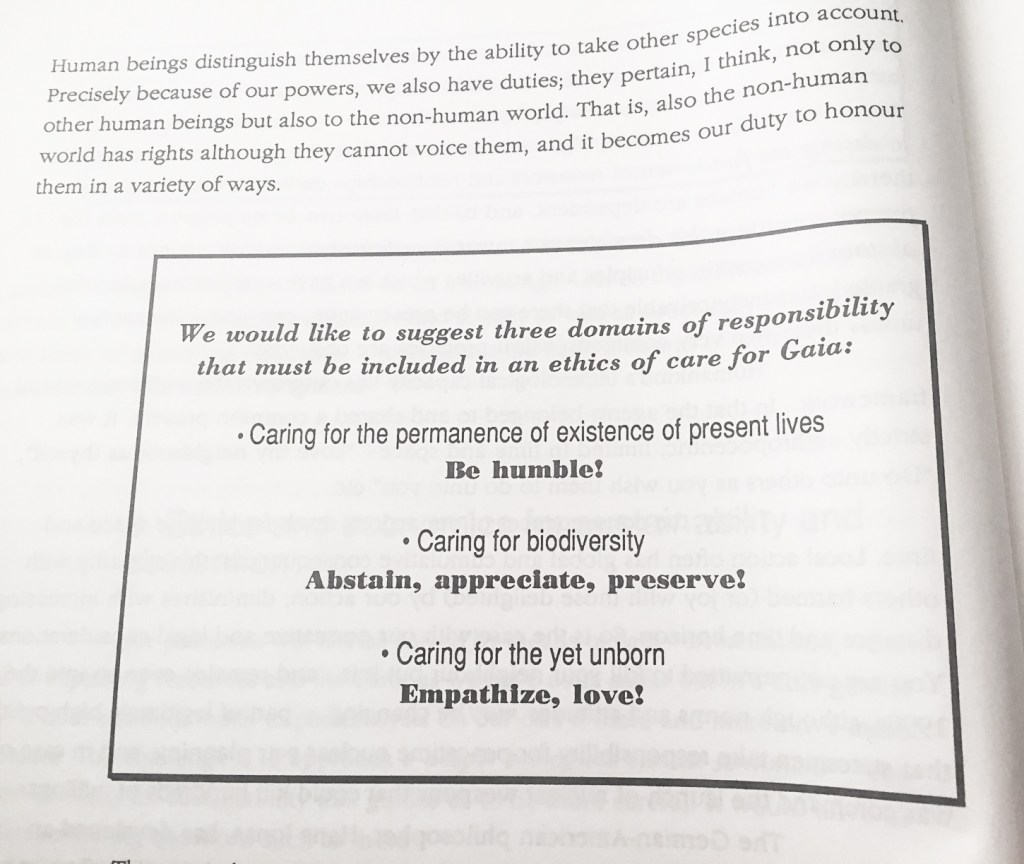
1. I have written about these matters some 25 years ago in “Alternatives To World Disorder In the 1990s. Sustainability, Nonviolence, Global Ethics And Democracy,” General Education Series, Institute of Asian Cultural Studies, International Christian University, ICU, Tokyo, 1991.

Here’s a photo of one of the summaries about global ethics:


Peace & future researcher + ‌Art Photographer

One Response

  1. This is a very important and timely warning. It is good to be reminded of the provisions of the Human Rights Charter, firstly to see how many of its provisions remain unenforced, and secondly to see how they need to be amended and broadened. Sadly, it seems that these principles have been often used by powerful countries as weapons against other countries but not against themselves. Just see how many Western leaders have been tried for their war crimes and human rights violations. As Churchill said: “History will be kind to me, because I write history”. To be fair, most Western countries have been forced to observe some of the human rights principles in their own countries as the result of public pressure, but they have got away with murder in other countries, as we have seen in the cases of illegal wars and war crimes in Afghanistan, Iraq, Syria, Libya, Yemen, etc. and in their support for saw-wielding dictators when it has suited their interests. We need some form of mechanism with some teeth to make sure that these principles are observed in relation to other countries too. Your other point about the need to go beyond human rights, and to make sure that we pay attention to the requirements of the world around us is also very important. In the desertification, deforestation, the loss of fish stocks, the slaughter of hundreds of millions of animals each year in a cruel way for human consumption, chicken farms, the loss of habitat for many species due to the use of herbicide and industrial farming, etc. we have seen a total disregard for nature and its impact ultimately on our own lives. More and more evidence is being produced that animals are sentient beings and, in fact, there is an organic link between us and the whole of nature. This is an area that needs urgent attention for the future of life, including human life, on earth.

Related Posts

Tony Robinson October 4, 2026 Violence is easy to recognise when someone is being beaten, shot or killed. It becomes more difficult when nobody is holding a weapon. Poverty, discrimination, exploitation and repression can restrict a human life just as effectively, although they do so in very different ways and with very different consequences. Simply adding more categories to an ever-growing list of forms of violence does not really solve the problem. The more interesting question is what all these different situations have in common and why it makes sense to describe them using the same word. Human beings do not simply react to what happens around them. They remember the past, imagine things that do not yet exist, make plans and undertake projects. Workers organise because they imagine different working conditions; people migrate because they imagine another life somewhere else; social movements emerge because people refuse to accept the...
It’s a matter of principles, courage, vision and pulling together – while the militarist world is falling apart… Peter Langille October 3, 2026 “Here, then, is the problem which we present to you, stark and dreadful and inescapable: Shall we put an end to the human race; or shall mankind renounce war?”The Bertrand Russell—Albert Einstein Manifesto, July 9, 1955 ⁕ The forecast for what’s ahead is worrisome. The sharp rise in armed conflicts over the past three years is adding to what was already the highest level in over seventy years. Genocides, which should be prevented are supported. A shared climate emergency that jeopardises survival is ignored. Diverse polls now suggest that people are war-weary, worried and interested in a more effective United Nations. And, there are viable policy options for a more secure world! Yet governments are doubling-down, betting on more war and investing heavily. If current trends persist,...
Johan Galtung 1930-2024October 2015 Published here on October 3, 2026 Let us focus on Civilization for conflict analysis and remedies. Major forms of disorder use violence; war is state organized violence. The most belligerent states are the United States of America and Israel, both with civilization roots. National Evangelism, the US Protestant Christian civilization– more national than evangelical–justifies US warfare as exceptionalism of a people chosen by God, with a manifest destiny to run the world. Orthodox Judaism justifies Israeli warfare to conquer and expand from Nile to Euphrates as a religious right and duty to the Eternal One. The third most belligerent country, the UK, no longer believes it is God-chosen but chosen by the USA; not quite the same but something. But the root cause of global disorder lies in the Occident–with Islam–seeing itself as the single, universal civilization valid for all at all times, all others being...

Recent Articles

Tony Robinson October 4, 2026 Violence is easy to recognise when someone is being beaten, shot or killed. It becomes more difficult when nobody is holding a weapon. Poverty, discrimination, exploitation and repression can restrict a human life just as effectively, although they do so in very different ways and with very different consequences. Simply adding more categories to an ever-growing list of forms of violence does not really solve the problem. The more interesting question is what all these different situations have in common and why it makes sense to describe them using the same word. Human beings do not simply react to what happens around them. They remember the past, imagine things that do not yet exist, make plans and undertake projects. Workers organise because they imagine different working conditions; people migrate because they imagine another life somewhere else; social movements emerge because people refuse to accept the...
It’s a matter of principles, courage, vision and pulling together – while the militarist world is falling apart… Peter Langille October 3, 2026 “Here, then, is the problem which we present to you, stark and dreadful and inescapable: Shall we put an end to the human race; or shall mankind renounce war?”The Bertrand Russell—Albert Einstein Manifesto, July 9, 1955 ⁕ The forecast for what’s ahead is worrisome. The sharp rise in armed conflicts over the past three years is adding to what was already the highest level in over seventy years. Genocides, which should be prevented are supported. A shared climate emergency that jeopardises survival is ignored. Diverse polls now suggest that people are war-weary, worried and interested in a more effective United Nations. And, there are viable policy options for a more secure world! Yet governments are doubling-down, betting on more war and investing heavily. If current trends persist,...
Johan Galtung 1930-2024October 2015 Published here on October 3, 2026 Let us focus on Civilization for conflict analysis and remedies. Major forms of disorder use violence; war is state organized violence. The most belligerent states are the United States of America and Israel, both with civilization roots. National Evangelism, the US Protestant Christian civilization– more national than evangelical–justifies US warfare as exceptionalism of a people chosen by God, with a manifest destiny to run the world. Orthodox Judaism justifies Israeli warfare to conquer and expand from Nile to Euphrates as a religious right and duty to the Eternal One. The third most belligerent country, the UK, no longer believes it is God-chosen but chosen by the USA; not quite the same but something. But the root cause of global disorder lies in the Occident–with Islam–seeing itself as the single, universal civilization valid for all at all times, all others being...

TFF on Substack

Discover and subscribe to more peace materials on TFF Substack

Most Popular

Tony Robinson October 4, 2026 Violence is easy to recognise when someone is being beaten, shot or killed. It becomes more difficult when nobody is holding a weapon. Poverty, discrimination, exploitation and repression can restrict a human life just as effectively, although they do so in very different ways and with very different consequences. Simply adding more categories to an ever-growing list of forms of violence does not really solve the problem. The more interesting question is what all these different situations have in common and why it makes sense to describe them using the same word. Human beings do not simply react to what happens around them. They remember the past, imagine things that do not yet exist, make plans and undertake projects. Workers organise because they imagine different working conditions; people migrate because they imagine another life somewhere else; social movements emerge because people refuse to accept the...
It’s a matter of principles, courage, vision and pulling together – while the militarist world is falling apart… Peter Langille October 3, 2026 “Here, then, is the problem which we present to you, stark and dreadful and inescapable: Shall we put an end to the human race; or shall mankind renounce war?”The Bertrand Russell—Albert Einstein Manifesto, July 9, 1955 ⁕ The forecast for what’s ahead is worrisome. The sharp rise in armed conflicts over the past three years is adding to what was already the highest level in over seventy years. Genocides, which should be prevented are supported. A shared climate emergency that jeopardises survival is ignored. Diverse polls now suggest that people are war-weary, worried and interested in a more effective United Nations. And, there are viable policy options for a more secure world! Yet governments are doubling-down, betting on more war and investing heavily. If current trends persist,...
Johan Galtung 1930-2024October 2015 Published here on October 3, 2026 Let us focus on Civilization for conflict analysis and remedies. Major forms of disorder use violence; war is state organized violence. The most belligerent states are the United States of America and Israel, both with civilization roots. National Evangelism, the US Protestant Christian civilization– more national than evangelical–justifies US warfare as exceptionalism of a people chosen by God, with a manifest destiny to run the world. Orthodox Judaism justifies Israeli warfare to conquer and expand from Nile to Euphrates as a religious right and duty to the Eternal One. The third most belligerent country, the UK, no longer believes it is God-chosen but chosen by the USA; not quite the same but something. But the root cause of global disorder lies in the Occident–with Islam–seeing itself as the single, universal civilization valid for all at all times, all others being...
Read More
Living-Peace-Sign-Budapest-copy
Tony Robinson October 4, 2026 Violence is easy to recognise when someone is being beaten, shot or killed. It becomes more difficult when nobody is holding a weapon. Poverty, discrimination, exploitation and repression can restrict a human life just as effectively, although they do so in very different ways and with very different consequences. Simply adding more categories to an ever-growing list of forms of violence does not really solve the problem. The more interesting question is what all these different situations have in common and why it makes sense to describe them using the same word. Human beings do not simply react to what happens around them. They remember the past, imagine things that do not yet exist, make plans and undertake projects. Workers organise because they imagine different working conditions; people migrate because they imagine another life somewhere else; social movements emerge because people refuse to accept the...
b54a1f10-8c65-4f0b-9dd5-4abc0a7d04cc_2659x2659
It’s a matter of principles, courage, vision and pulling together – while the militarist world is falling apart… Peter Langille October 3, 2026 “Here, then, is the problem which we present to you, stark and dreadful and inescapable: Shall we put an end to the human race; or shall mankind renounce war?”The Bertrand Russell—Albert Einstein Manifesto, July 9, 1955 ⁕ The forecast for what’s ahead is worrisome. The sharp rise in armed conflicts over the past three years is adding to what was already the highest level in over seventy years. Genocides, which should be prevented are supported. A shared climate emergency that jeopardises survival is ignored. Diverse polls now suggest that people are war-weary, worried and interested in a more effective United Nations. And, there are viable policy options for a more secure world! Yet governments are doubling-down, betting on more war and investing heavily. If current trends persist,...
010
Johan Galtung 1930-2024October 2015 Published here on October 3, 2026 Let us focus on Civilization for conflict analysis and remedies. Major forms of disorder use violence; war is state organized violence. The most belligerent states are the United States of America and Israel, both with civilization roots. National Evangelism, the US Protestant Christian civilization– more national than evangelical–justifies US warfare as exceptionalism of a people chosen by God, with a manifest destiny to run the world. Orthodox Judaism justifies Israeli warfare to conquer and expand from Nile to Euphrates as a religious right and duty to the Eternal One. The third most belligerent country, the UK, no longer believes it is God-chosen but chosen by the USA; not quite the same but something. But the root cause of global disorder lies in the Occident–with Islam–seeing itself as the single, universal civilization valid for all at all times, all others being...
Screenshot 2026-10-02 011738
Jan ObergPhD, director, The Transnational Foundation for Peace and Future Research, TFFLund, Sweden October 2, 2026 This is my full original manuscript. The Chinese Academy of Social Science, CASS, makes two publications out if it. 1. China’s Five-year plan emphasized the capabilities of basic research and original innovation. It is regarded as the goal of the future social development, which, as required, should be significantly enhanced. Can you comment on the importance of original innovation in research and academic study? I believe it is easier to define “original innovation” in the natural sciences than in social sciences. The breaking points of what constitutes something new, or innovative, are not quite as sharp in the latter. But in both fields it is about opening up something that was closed, unseen, unexplored before – making manifest what was earlier latent. Innovations come in many forms and shapes – naming something that was not...
arctic-circle-map
The agreement is catastrophic both because of what it says and what it doesn’t mention. It reduces further the major asset of security policies: Freedom of action. Jan Oberg TFF director September 25, 2026 A couple of hours before the agreement was signed on September 22, 2026, I published the following 13 hypotheses about what it would most likely contain on TFF Substack (in English). I was wrong on only the first point. Contrary to what Trump had written on his Truth Social platform, it does not appear to come into force immediately. In fact, it turned out to be worse than even I had anticipated. After these hypotheses now come a number of reflections in light of what the agreement actually contains, and does not contain, as well as the way in which it has generally been presented by major media outlets and by the public-service broadcaster DR. My...
girl-5894831_1280
Below are TFF-related media mentions, comments, videos and social media posts published elsewhere but not on this homepage. We happen to catch and list only a fraction. Regarding video comments and debates, we recommend that you go to the TFF Video Channel on Substack where many of them are reproduced. Jan Oberg is a contributor to China Daily – 52 million daily clicks – and Global Times, CGTN and CCTV (the national television), China Investment, Xinhua News Agency and several others. Articles and videos on these media very often multiply into countless Chinese (and Western media) that re-post them from these main media. Thanks to The China Academy, his analyses, interviews and comments are frequently posted on YouTube channels such as Thinkers Forum and Wave Media. These videos are often re-posted on Bilibili (China’s YouTube), the China Content Center on TikTok, and on the Chinese edition of TikTok, Douyin.com. This means reaching hundreds of millions of viewers worldwide over a year. While there are too many to catch on all these...