Trump’s Withdrawal from Iran Nuclear Deal: Overwhelmingly false arguments


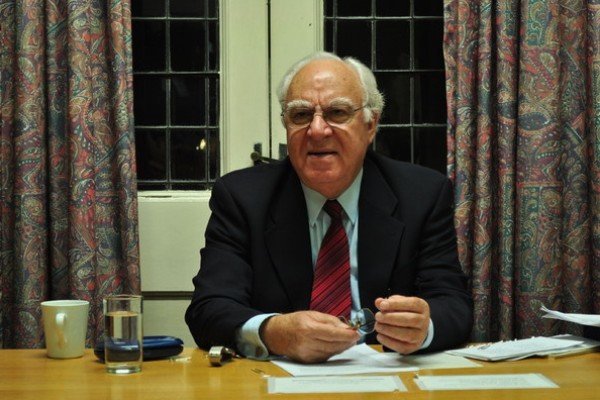
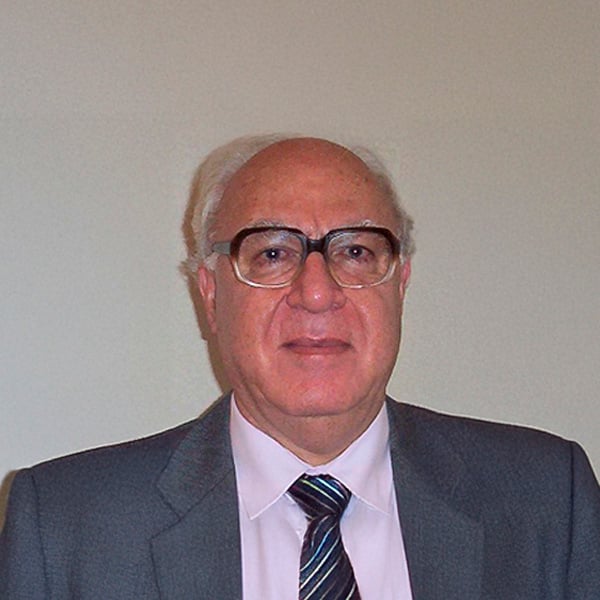
Farhang Jahanpour

Against the advice of practically the whole world, including many American scientists, politicians and diplomats, and contrary to the Security Council Resolution 2231 that has given the Iran Nuclear Deal (the Joint Comprehensive Plan of Action or JCPOA) the backing of international law, last night President Trump withdrew the United States from the agreement.

Not only did he withdraw America from the deal, but he also threatened to impose sanctions on all countries and companies that trade with Iran. He also issued a warning that he would do to Iran what that country has never experienced before.

That statement by itself is in clear violation of International law.

His short statement that was meant to justify his action was full of clear errors and inaccuracies and the reversals of known facts.

He implied that Iran had violated the terms of the agreement. This is not true.

In the short time since the signing of the agreement, on ten separate occasions the IAEA has certified that Iran has fully complied with the terms of the deal.

He said that the IAEA inspectors were barred from visiting some sites. This is not true. The IAEA is able to inspect both military and non-military sites, and in fact has done so on numerous occasions.

He said that the so-called “sunset clauses” meant that Iran could rush to make a bomb after they expire. This is not true.

Unlike Israel, Iran has been a member of the NPT and has also joined the “Additional Protocol”, which requires continuous, unannounced inspections of all her nuclear sites, and she has also given an undertaking never to produce nuclear weapons.

All nuclear experts have testified that the agreement blocks all possible paths to Iran’s manufacturing of nuclear weapons, and this does not stop when Iran is again allowed to enrich uranium to which she is entitled under the NPT terms.


President Trump has just signed his order to withdraw the US from the Iran nuclear deal. The signature is not to be overlooked…


President Trump was wrong to say that Iran was rushing to build intercontinental ballistic missiles capable of carrying nuclear weapons.

Iran has limited the range of her missiles to 2,000 kilometres, which is much shorter than the range of Israeli or Saudi missiles. They are incapable of hitting any part of Europe, let alone the United States.

They are not designed to carry nuclear weapons, and in any case Iran does not have nuclear warheads. They are almost Iran’s only defensive mechanism against the threats of her much better armed neighbours, not to mention the United States.

President Trump was wrong to claim that Iran was spreading terrorism in Syria, Yemen, Lebanon, etc.

Iran has been fighting against ISIS and other terrorists in Iraq and Syria at the invitation of the governments of those countries.

All experts agree that the mantra of “Iran-backed Houthis” is false propaganda.

Iran’s contacts with the Houthis and influence over them is minimal, and it is Saudi Arabia and the UAE, with American support, that are bombing the poor Yemeni people, killing and wounding tens of thousands of innocent people and creating the world’s greatest humanitarian catastrophe there.

American allies in the region have also been the ones who have supported the Al-Nusra Front and other terrorist groups in Syria, Iraq and elsewhere.

Their main problem with Iran is that she has been successful in defeating the terrorists that have been nurtured by those regional countries with American support.

As for Lebanon, Hezbollah – that was the only Arab force to challenge Israel and force Israeli troops to end their occupation of Southern Lebanon and leave – has just won the largest number of seats in the Lebanese Parliament. It seems that some people have a problem with democracy.

President Trump was wrong to say that Iran was supporting Al Qaeda and the Taliban.

Iran was fighting against them and helped the United States to defeat the Taliban in Afghanistan.

Saudi Arabia and the UAE were the two countries that helped create the Taliban and were the only countries in the region to recognise it, apart from Pakistan. One can go on and on.

Above all, President Trump’s decision was a slap in the face for all his allies who meekly went to Washington and massaged his ego in the vain hope of preventing him from taking this dangerous decision.

• • •


In a bizarre way, President Trump is undermining the interests of the European countries that wish to have normal trading relations with Iran.

The question is whether the European Union and all other European countries will meekly surrender to US bullying or for once will show some resolve in their own interests and the interests of the world.

Above all, what is really at stake is international law.

Are we moving away from a law-based international order towards the law of the jungle where might makes right, or are we trying to create a world with equal opportunities for all, without a hegemon ruling over the destinies of mankind.

We have seen the disastrous consequences of trying to appease a dictator, and soon realised that there was no end to the demands of a power-hungry despot, and all of us were caught up in the flames of an all-consuming war, which this time may be the final war.

At best, even if the war is limited to Iran and the Middle East, Europe will have to bear the brunt of the disaster with another major country in chaos and millions of refugees seeking shelter.

Let us not close our eyes to impending doom and make a mistake. A war against Iran will not be like the Iraq war, it will be much worse.

• • •


President Trump is creating an artificial crisis where none existed. He may not like the Iranian government and might prefer his administrations’ friends, the terrorist Mojahedin-e Khalq [MKO], to be in power in Tehran.

His aides John Bolton, Mike Pompeo, and Rudy Giuliani have repeatedly spoken at that cultish group’s Saudi-funded meetings. Apart from the fact that MKO is hated by the vast majority of Iranian people, the cost of a regime change in Iran is going to be huge for Iran and for the entire region.

Iran took part in long and complex talks with all the leading world powers, reached an agreement and has abided by its side of the bargain.

The way forward is to repeat that procedure on a rational and fair basis and address other issues of disagreement with Iran.

What the Middle East needs is not more wars, but a collective security agreement that would bring peace to that part of the world that has suffered more than its fair share. This would mean, above all, to resolve the long-lasting Arab-Israeli conflict.

Millions of stateless Palestinians whose country has been occupied and where illegal settlements have continued to expand have been under the longest period of occupation in modern history.

Israel cannot go on bombing all her neighbours, as she is doing in Syria at the moment, in order to subjugate them forever, and force them to accept her illegal expansion in the region.

Sooner or later, those who live by the sword will die by the sword. For the sake of the long-term peace of Israel, the Israelis need to turn to peace and reconciliation instead of to war and aggression.

That is the only solution that can guarantee Israel’s continued existence in the Middle East.

• • •


For the sake of the peace of the world and for their own interests, Europeans should shake off this post-Second World War attitude of subservience to the United States. It is time Europe declared her independence.

As the friends of the United States, they should tell the US Administration that they are not going to go along with this ill-begotten, illegal decision, taken by the neoconservative hawks in Washington, egged on by Israel and Saudi Arabia.

They should join hands with Russia and China to find a fair and realistic solution to the Arab-Israeli conflict and find a workable settlement for the problems of the Middle East as a whole.

We are marking the 100th anniversary of the colonialist Sykes-Picot designs to partition the Middle East. Some neo-colonialists in the United States seem to think that it is possible to revive the 19th century empires and dominate Asia and Africa again. That was a rotten system that ended up in the flames of war.

In the modern world, the repetition of that system is inconceivable. This is why we had the United Nations Charter to which all countries have verbally subscribed.

It is time to turn back to the ideals of the United Nations and to look forward to a world of dignity and prosperity for all, not only for a chosen, exceptional few.
Related Posts

A Message from Jan Oberg November 6, 2026 Over the past fifty years, I have devoted roughly 175,000 hours to research and public education for a more peaceful world: thinking, researching, writing, organising, publishing, debating, maintaining websites, corresponding, reaching out, leading a foundation, work in conflict and war zones, professorships, teaching courses and giving public lectures and doing media work. In short, ten hours a day, seven days a week, for half a century. The focus was on international political peace – analysing and trying to stop wars, address underlying conflicts and making alternative peace plans – at the desk and on the ground. Important as that has been and remains, it is only one kind of peace and it is now in a tragic militarist state compared with what it could have been.  Lately, however, I have found myself thinking about a concept from economics as well as everyday...
Photo above: Carl Fredrik Reuterswärd’s Non-Violence outside UN Headquarters in New York. Kirill Levin, CC BY-NC-SA 2. Jan Oberg November 3, 2026 I am happy to be published in Horizons which is produced by the Center for International Relations and Sustainable Development, CIRSD, in Belgrade. My contribution brings out a radical re-thinking of what concepts such as defence, security, deterrence – and peace – may mean if we want to create a more peaceful world. It also summarises a few things I have been working with the last few decades. Please read it here Og her er den på dansk, takket være Johnny Baltzersens lynhurtige oversættelse
UNITE-tillid, DREAM-velstand og andre konstruktive komponenter Normally we publish articles in English here. But this is a translation of a very important TFF document that should reach as many as possible in Denmark since this country’s government has been one of the most hardline in Europe and, up till now at least, has refused to use diplomacy and, instead, spent tremendous sums on arming Ukraine with the express goal of defeating Russia. Thus this – unique – article is in Danish. Vi er Johnny Baltzersen og hans Fælles Sikkerhed – Fælles Fremtid på Substack overmåde taknemmelige for at have oversat og publiceret TFF’s 2025-portfølje for fredsidéer med henblik på Ukraines fremtid. Vi håber den nu kan nå mange flere danskere – som også vil sprede den og skabe debat – nu den danske regerings og folketingspartiernes politik på dette område siden 2022 står nu – forudsigeligt – ved vejs ende....

Recent Articles

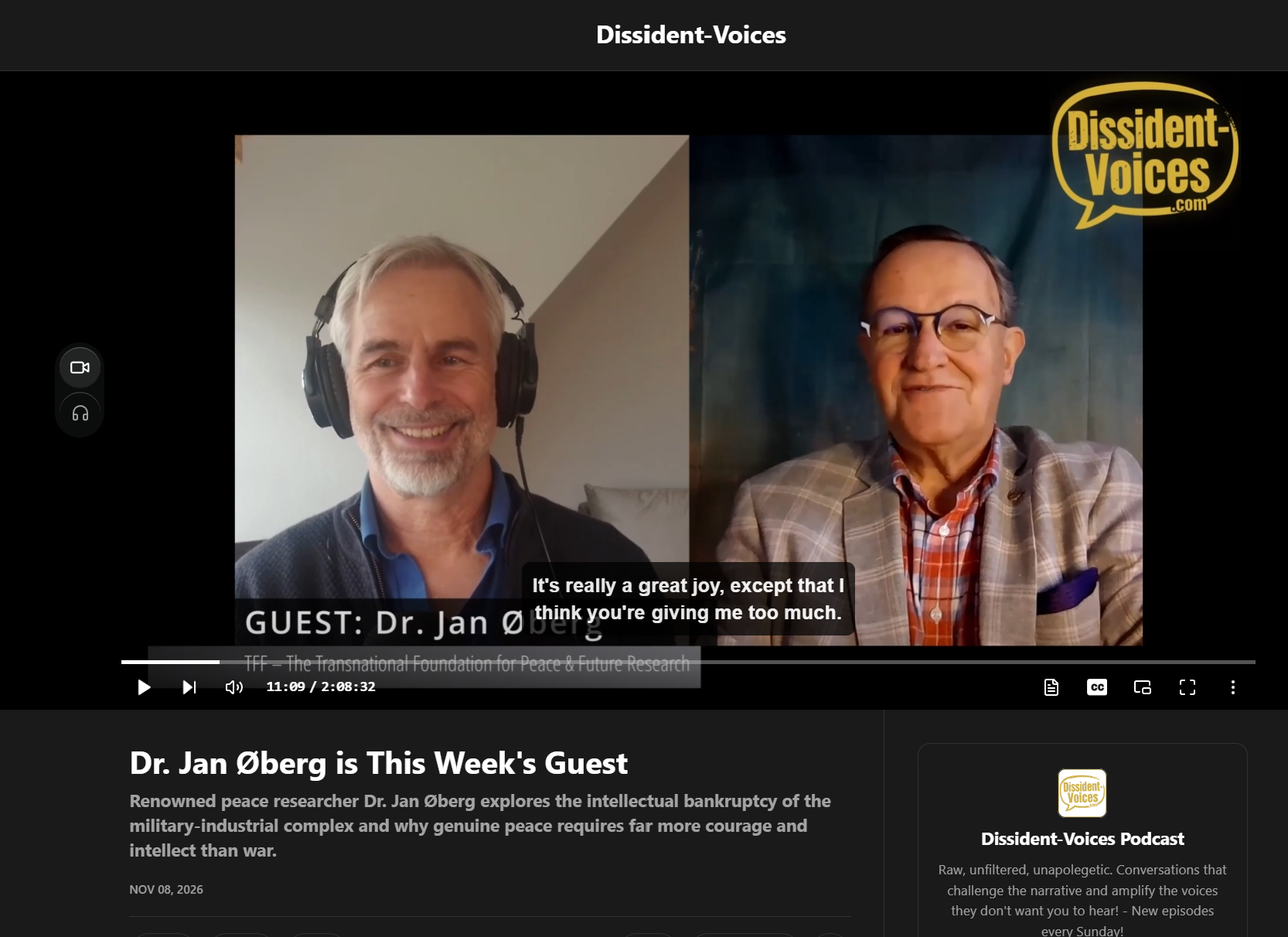
Serious but also a lot of laughs and positive energy. Because peace is also about conviviality and enchantment… Jan Oberg, TFF director November 16, 2026 This is a long (129 minutes) conversation with me. We cover very many, also personal, issues that makes a somewhat unusual media event. I am very grateful to Flemming Blicher for giving me this opportunity. I can’t remember any channel or editor who spent as much time as he did preparing it – including also asking me to answer a series of pre-interview questions, which are now posted under the conversation. If you sympathise with its content, please share it. Watch it here
A Message from Jan Oberg November 6, 2026 Over the past fifty years, I have devoted roughly 175,000 hours to research and public education for a more peaceful world: thinking, researching, writing, organising, publishing, debating, maintaining websites, corresponding, reaching out, leading a foundation, work in conflict and war zones, professorships, teaching courses and giving public lectures and doing media work. In short, ten hours a day, seven days a week, for half a century. The focus was on international political peace – analysing and trying to stop wars, address underlying conflicts and making alternative peace plans – at the desk and on the ground. Important as that has been and remains, it is only one kind of peace and it is now in a tragic militarist state compared with what it could have been.  Lately, however, I have found myself thinking about a concept from economics as well as everyday...
Photo above: Carl Fredrik Reuterswärd’s Non-Violence outside UN Headquarters in New York. Kirill Levin, CC BY-NC-SA 2. Jan Oberg November 3, 2026 I am happy to be published in Horizons which is produced by the Center for International Relations and Sustainable Development, CIRSD, in Belgrade. My contribution brings out a radical re-thinking of what concepts such as defence, security, deterrence – and peace – may mean if we want to create a more peaceful world. It also summarises a few things I have been working with the last few decades. Please read it here Og her er den på dansk, takket være Johnny Baltzersens lynhurtige oversættelse

TFF on Substack

Discover and subscribe to more peace materials on TFF Substack

Most Popular

Serious but also a lot of laughs and positive energy. Because peace is also about conviviality and enchantment… Jan Oberg, TFF director November 16, 2026 This is a long (129 minutes) conversation with me. We cover very many, also personal, issues that makes a somewhat unusual media event. I am very grateful to Flemming Blicher for giving me this opportunity. I can’t remember any channel or editor who spent as much time as he did preparing it – including also asking me to answer a series of pre-interview questions, which are now posted under the conversation. If you sympathise with its content, please share it. Watch it here
A Message from Jan Oberg November 6, 2026 Over the past fifty years, I have devoted roughly 175,000 hours to research and public education for a more peaceful world: thinking, researching, writing, organising, publishing, debating, maintaining websites, corresponding, reaching out, leading a foundation, work in conflict and war zones, professorships, teaching courses and giving public lectures and doing media work. In short, ten hours a day, seven days a week, for half a century. The focus was on international political peace – analysing and trying to stop wars, address underlying conflicts and making alternative peace plans – at the desk and on the ground. Important as that has been and remains, it is only one kind of peace and it is now in a tragic militarist state compared with what it could have been.  Lately, however, I have found myself thinking about a concept from economics as well as everyday...
Photo above: Carl Fredrik Reuterswärd’s Non-Violence outside UN Headquarters in New York. Kirill Levin, CC BY-NC-SA 2. Jan Oberg November 3, 2026 I am happy to be published in Horizons which is produced by the Center for International Relations and Sustainable Development, CIRSD, in Belgrade. My contribution brings out a radical re-thinking of what concepts such as defence, security, deterrence – and peace – may mean if we want to create a more peaceful world. It also summarises a few things I have been working with the last few decades. Please read it here Og her er den på dansk, takket være Johnny Baltzersens lynhurtige oversættelse
Read More
Screenshot 2026-11-10 174455
Serious but also a lot of laughs and positive energy. Because peace is also about conviviality and enchantment… Jan Oberg, TFF director November 16, 2026 This is a long (129 minutes) conversation with me. We cover very many, also personal, issues that makes a somewhat unusual media event. I am very grateful to Flemming Blicher for giving me this opportunity. I can’t remember any channel or editor who spent as much time as he did preparing it – including also asking me to answer a series of pre-interview questions, which are now posted under the conversation. If you sympathise with its content, please share it. Watch it here
AbstractVision_2017_#1_800 (kopia)
A Message from Jan Oberg November 6, 2026 Over the past fifty years, I have devoted roughly 175,000 hours to research and public education for a more peaceful world: thinking, researching, writing, organising, publishing, debating, maintaining websites, corresponding, reaching out, leading a foundation, work in conflict and war zones, professorships, teaching courses and giving public lectures and doing media work. In short, ten hours a day, seven days a week, for half a century. The focus was on international political peace – analysing and trying to stop wars, address underlying conflicts and making alternative peace plans – at the desk and on the ground. Important as that has been and remains, it is only one kind of peace and it is now in a tragic militarist state compared with what it could have been.  Lately, however, I have found myself thinking about a concept from economics as well as everyday...
knotted gun
Photo above: Carl Fredrik Reuterswärd’s Non-Violence outside UN Headquarters in New York. Kirill Levin, CC BY-NC-SA 2. Jan Oberg November 3, 2026 I am happy to be published in Horizons which is produced by the Center for International Relations and Sustainable Development, CIRSD, in Belgrade. My contribution brings out a radical re-thinking of what concepts such as defence, security, deterrence – and peace – may mean if we want to create a more peaceful world. It also summarises a few things I have been working with the last few decades. Please read it here Og her er den på dansk, takket være Johnny Baltzersens lynhurtige oversættelse
TFFPortfolioVign
UNITE-tillid, DREAM-velstand og andre konstruktive komponenter Normally we publish articles in English here. But this is a translation of a very important TFF document that should reach as many as possible in Denmark since this country’s government has been one of the most hardline in Europe and, up till now at least, has refused to use diplomacy and, instead, spent tremendous sums on arming Ukraine with the express goal of defeating Russia. Thus this – unique – article is in Danish. Vi er Johnny Baltzersen og hans Fælles Sikkerhed – Fælles Fremtid på Substack overmåde taknemmelige for at have oversat og publiceret TFF’s 2025-portfølje for fredsidéer med henblik på Ukraines fremtid. Vi håber den nu kan nå mange flere danskere – som også vil sprede den og skabe debat – nu den danske regerings og folketingspartiernes politik på dette område siden 2022 står nu – forudsigeligt – ved vejs ende....
JoGSS-Silent
Jan Oberg TFF director October 28, 2026 Exactly one month has now passed since I published my criticism of the introduction to the special issue on Johan Galtung published by the Journal of Global Security Studies, JoGSS, and of Tor Egil Førland’s chapter about Galtung which serves as a preview to his forthcoming biography of Galtung to be published by PRIO. See the original on The Transnational here and the same article on TFF Substack with many general and critical comments and, in particular, the people who decided to withdraw from the biography project in protest. The special issue itself was extraordinary. It was devoted to the intellectual legacy of one of the founders of peace research and contained a number of strong assessments of his personality, scholarship, intellectual trajectory, and public role. Such assessments are, of course, entirely legitimate. No scholar is beyond criticism, and neither was Johan Galtung....
Screenshot 2026-10-26 115647
An aspect of Iran’s culture and civilisation you’ve probably never heard about. Don’t be surprised if the US and Israel also try to bomb them. Jan ObergTFF director October 26, 2026 Today – under the “USraeli” threat of new “annihilating” bombings – opens the 7th International Conference on Peace and Conflict Resolution at Tehran’s University. As far as I can tell, this is the only permanent, advanced peace research institution in West Asia/the Middle East. Perhaps more countries in that region could be inspired? I mean, how many military “security” institutes and military academies do they have? Many peace research institutes and university departments have been established since the 1950s in the West. They are now all under attack; some have closed down, some have gone mainstream, yet others kept the name but do nothing to research peace and disseminate results or advice; instead, they cooperate with militarism’s platforms such...