Dislike! Facebook bans article about Google working with Pentagon


Intro

This short article documents how Facebook – in a non-dialoguing way – practices censorship. This and many other cases was a major reason that TFF launched The Transnational – a new multidimensional peace platform and try to push the debate about our issues out of Facebook and over to our own platform (hosted by WordPress.com) so that Facebook cannot influence over and above our heads, what it wants to disseminate and what not. 


I come across an article that I find both worrying and trustworthy, “Google is helping Pentagon building AI for drones” in the Gizmodo online magazine. Like I do several times a day, I post it to Facebook (my profile, public figure page and TFF’s page), to Google+ and to Twitter. In one go, via a service called Sendible.

About 30 minutes later this arrives:
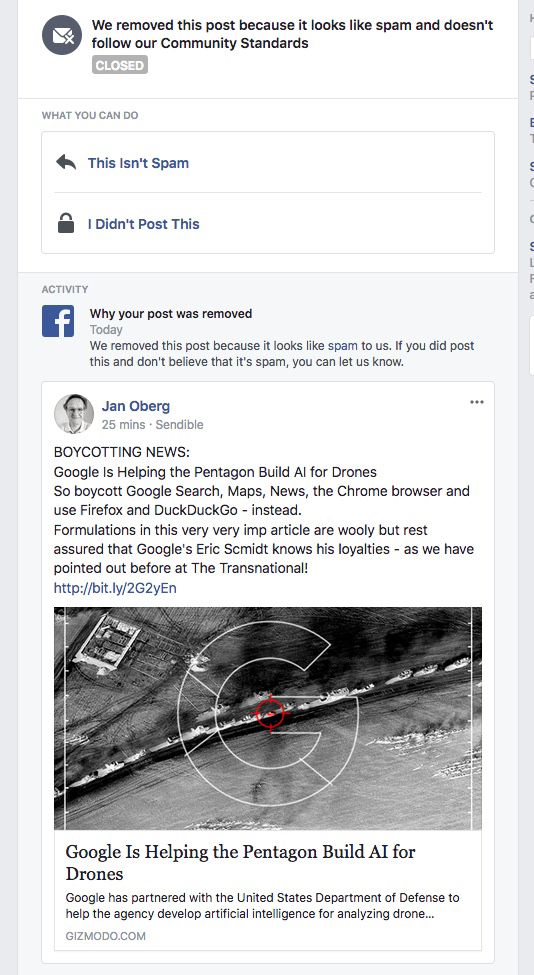


Screenshot


I of course click “This isn’t Spam” and begin write in a field for replies when suddenly in the midst of a sentence it’s closed. All I have gotten off to Facebook is that I don’t consider it spam.

Almost three days later, they have not come back so it has been evaluated by humans and they obviously maintain that this is spam according to Facebook’s “Community Standards”.

Facebook also took down the post from people who had shared it – while neither Twitter nor Google+ touched it – the latter being particularly interesting.

It belongs to the story that I had found the Gizmodo article as a link inside a BBC article about this Google news. Hardly a spam article…

Now, how does Facebook define spam?

That is spelled out here: “Spam involves contacting people with unwanted content or requests. This includes sending bulk messages, excessively posting links or images to people’s timelines and sending friend requests to people you don’t know personally.

Spam is sometimes spread through clicking on bad links or installing malicious software. On other occasions, scammers gain access to people’s Facebook accounts, which are then used to send out spam.”

It should be pretty obvious that the post about the Gizmodo article can not possibly be categorized as spam.

The Community Standard page starts out: “Our mission is to give people the power to share and make the world more open and connected.” Well, without a word of explanation, Facebook here actively prevents sharing, openness and connections.

Facebook is by far, history’s biggest media and social media with about 2 billion users. Unlike other media, it doesn’t have to follow normal journalistic practices and doesn’t have an editorial board to which one can complain. It seeks monopoly, argues that it has the copyright to everything you publish and that it’s entitled to snoop in our privacy, everything we do and say being stored.

And I have no recollection that I have ever had an exchange with a human being at Facebook, only standard messages that they may not respond – as this one above. Always “we cannot respond to everyone but trust we read your message…” However:

“Facebook brought in $10.3 billion over the last three months, a 47 percent increase from the year prior. It also now has more than 2.07 billion monthly active users. Facebook employs 23,165 people, a 47 percent increase from the year prior” – Mashable wrote in November 2017.

A company with such a global reach and fantasy profit margins ought not get away with just telling us that it doesn’t have (enough) staff to take care of us clients, should it?

So why was this censored – because censorship is the word?

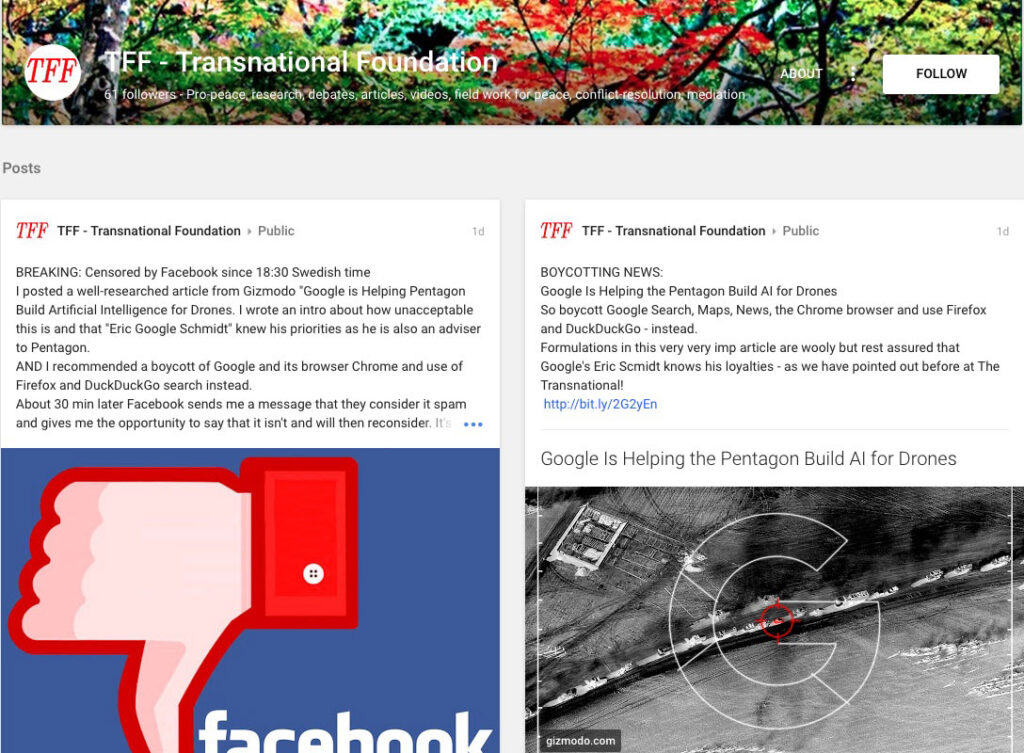
Was it the text I wrote? Hardly – why would Facebook go out of its way to show loyalty to Eric Schmidt and Google (while Google+ itself doesn’t bother with the exact same post). Here are the posts about it on Google+


Was it the picture – the photography from the air and Gizmodo’s insertion of the G (for Google) in the middle as if using Google for military targeting? Well, could be – but that is exactly what it is about. However, neither the aerial photo nor the stylized “G” can be judged to be classified military information.

Another possibility is that they see Russian agents, infiltrators and fake news-makers in every corner.

If you don’t know anything about security politics, this was an article, clearly negative to Google’s work with Pentagon, so it must by definition be a pro-Putin/Russian activity. And better be on the right side (although wrong), right?

What else? I don’t have a clue.

Facebook has lots of security-cleared people as staff and it is known that it, like Google and YouTube, complies with 95% of the complaints from the Israeli government which means taking down posts it doesn’t like, according to Fortune/Reuters in 2016. So it could be that it is either practicing censorship about certain selected, sensitive or controversial military issues (not because it is a violation of security per se but) because it is urged to not boost sensitive, debate-provoking issues by, say, the US government too.

Another, realted, possibility is that some youngster who doesn’t have a clue about international politics, defence matters etc. “evaluated” this post and wanted to be on the safe side and not make it free for re-posting.

We’re living in the post-literate and post-truth era, or “Zeitgeist”. Perhaps we should invent a new word for correct/truthful information being blocked because ignorant people judge that it is propaganda? It results in the same censorship but deliberate censorship with political motives and blocking truthful materials because of being uneducated or overly loyal are two different things.

In conclusion, the whole thing is unacceptable, non-social and authoritarian. It can also be seen as an example of how human intelligence has already given up vis-a-vis artificial intelligence.

TFF and I will never be dependent on Facebook but we’ll keep using it until it has lost its appeal worldwide. If it continues changing algorithms, play political games, block truthful stuff and diminish the organic reach in order to force us all to pay more for boosting – well, then it will probably not take so long. And in the meantime more and more people begin to use the Russian VK and the Chinese WeChat (allegedly already 900 million users) either as a supplement or as an alternative. And there are many alternatives – see here and here for examples.

People aren’t stupid. We see what you do, Facebook!
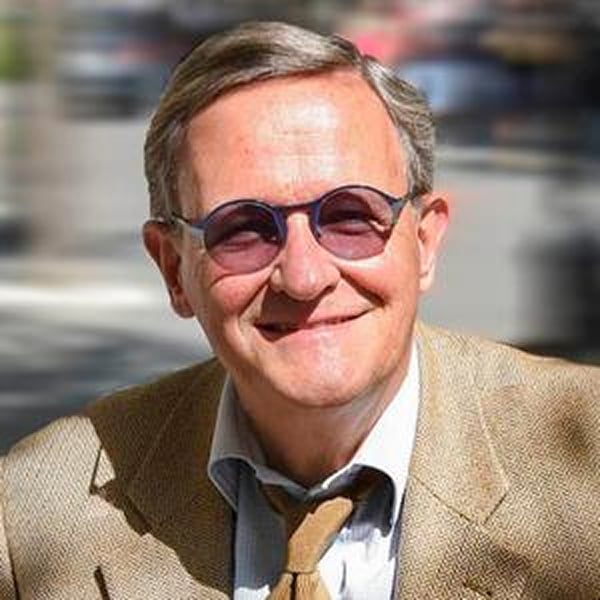


PhD, Peace & future researcher + ‌Art Photographer, Professor Emeritus and media commentator

4 Responses

  1. I was one of the people who couldn’t share your article. Here’s what I think > The effort to regulate social media has to come from the government. Facebook ban articles in order to protect the interests of United States. We can’t have information being controlled by one single country. But it would be very hard to convince the tech-zombies to leave facebook by their own wish. People accept what they perceive as good: and facebook is an excellent platform for pathological narcissists that won’t give up using facebook to “promote” themselves. Many of them don’t even care about spreading lies and hate.. Even so, it is still unbelievable that other websites can be shut down on the basis of hate speech (for example), but not facebook. The best you can do is to “report” a post, but no guarantee it is going to be removed. Besides, it is crystal clear that facebook has become a tool for political unrest, as seen on Arab Spring and many other fake “revolutions” that we see across the world. Heavy social-engenering, this is what facebook is. The approach to the Pentagon is being exposed now, but is definitely not something we shouldn’t expect from Silicon Valley as a whole. If governments care to have social media for its population, at least we should be able to “nationalise” them – as in the case of China. (I am not suggesting that China is the best example, but I admire the fact that at least they try to protect their citizens against this sort of dangerous manipulation).

  2. Jan Oberg… Migrate to joindiaspora.org it is free software as in freedom. I have researched this extensively. Until truly decentralized solutions come up within a year or two, this is the best. Drop proprietory software listed on the stock exchanges. Much like JP-Politiken AS, as an example.

  3. Dear Nascimento Andrade – many thanks for your thoughtful comment. Well, not everybody on Facebook are narcissist – – – 🙂 The problematic thing with Facebook and similar social media is that there are also many good features and it opens opportunities for unication across the globe that I could never have dreamt about when I was younger. Secondly and in all fairness: the terrible fact is that terrorist groups and others soon found out what they could use social media to achieve. I myself are quite humble when it comes to what can be done to not practise censorship but also block certain types of activities on these media. My bottom line of course goes when it is obvious, as you also feel, that people like us – for peace – are censored and it is also, as I hint, a huge problem that there are no laws guiding this field, no legal responsibility. It’s a small thing in the bigger scheme of things that an article I posted (and not by me) was taken down – but I am left powerless, no place I can argue my case and FB doesn’t bother to interact. This doesn’t belong to a democratic society with checks and balances. I guess it’s all gone too fast, even for FB itself – only 14 years old. That is why I hope my posting here can crate some constructive debate because I believe that these social media are here to stay – although they may decrease and FB probably has reached a peak. When it comes to your mention of China: How do you mean that that is doing a better job and do you think that, say, Facebook ought to be taken over by the US or, saym, the UN or somebody and not be a private corporate media? Best – Jan

  4. Many thanks, Tobias. I’ll take a look and I’m sure many others will. It very valuable that we help each other find truly independent non-commercial alternatives – like I also avoid Google Search and don’t use Chrome but Firefox. My best – Jan

Related Posts

A Message from Jan Oberg November 6, 2026 Over the past fifty years, I have devoted roughly 175,000 hours to research and public education for a more peaceful world: thinking, researching, writing, organising, publishing, debating, maintaining websites, corresponding, reaching out, leading a foundation, work in conflict and war zones, professorships, teaching courses and giving public lectures and doing media work. In short, ten hours a day, seven days a week, for half a century. The focus was on international political peace – analysing and trying to stop wars, address underlying conflicts and making alternative peace plans – at the desk and on the ground. Important as that has been and remains, it is only one kind of peace and it is now in a tragic militarist state compared with what it could have been.  Lately, however, I have found myself thinking about a concept from economics as well as everyday...
Photo above: Carl Fredrik Reuterswärd’s Non-Violence outside UN Headquarters in New York. Kirill Levin, CC BY-NC-SA 2. Jan Oberg November 3, 2026 I am happy to be published in Horizons which is produced by the Center for International Relations and Sustainable Development, CIRSD, in Belgrade. My contribution brings out a radical re-thinking of what concepts such as defence, security, deterrence – and peace – may mean if we want to create a more peaceful world. It also summarises a few things I have been working with the last few decades. Please read it here Og her er den på dansk, takket være Johnny Baltzersens lynhurtige oversættelse
UNITE-tillid, DREAM-velstand og andre konstruktive komponenter Normally we publish articles in English here. But this is a translation of a very important TFF document that should reach as many as possible in Denmark since this country’s government has been one of the most hardline in Europe and, up till now at least, has refused to use diplomacy and, instead, spent tremendous sums on arming Ukraine with the express goal of defeating Russia. Thus this – unique – article is in Danish. Vi er Johnny Baltzersen og hans Fælles Sikkerhed – Fælles Fremtid på Substack overmåde taknemmelige for at have oversat og publiceret TFF’s 2025-portfølje for fredsidéer med henblik på Ukraines fremtid. Vi håber den nu kan nå mange flere danskere – som også vil sprede den og skabe debat – nu den danske regerings og folketingspartiernes politik på dette område siden 2022 står nu – forudsigeligt – ved vejs ende....

Recent Articles

Serious but also a lot of laughs and positive energy. Because peace is also about conviviality and enchantment… Jan Oberg, TFF director November 16, 2026 This is a long (129 minutes) conversation with me. We cover very many, also personal, issues that makes a somewhat unusual media event. I am very grateful to Flemming Blicher for giving me this opportunity. I can’t remember any channel or editor who spent as much time as he did preparing it – including also asking me to answer a series of pre-interview questions, which are now posted under the conversation. If you sympathise with its content, please share it. Watch it here
A Message from Jan Oberg November 6, 2026 Over the past fifty years, I have devoted roughly 175,000 hours to research and public education for a more peaceful world: thinking, researching, writing, organising, publishing, debating, maintaining websites, corresponding, reaching out, leading a foundation, work in conflict and war zones, professorships, teaching courses and giving public lectures and doing media work. In short, ten hours a day, seven days a week, for half a century. The focus was on international political peace – analysing and trying to stop wars, address underlying conflicts and making alternative peace plans – at the desk and on the ground. Important as that has been and remains, it is only one kind of peace and it is now in a tragic militarist state compared with what it could have been.  Lately, however, I have found myself thinking about a concept from economics as well as everyday...
Photo above: Carl Fredrik Reuterswärd’s Non-Violence outside UN Headquarters in New York. Kirill Levin, CC BY-NC-SA 2. Jan Oberg November 3, 2026 I am happy to be published in Horizons which is produced by the Center for International Relations and Sustainable Development, CIRSD, in Belgrade. My contribution brings out a radical re-thinking of what concepts such as defence, security, deterrence – and peace – may mean if we want to create a more peaceful world. It also summarises a few things I have been working with the last few decades. Please read it here Og her er den på dansk, takket være Johnny Baltzersens lynhurtige oversættelse

TFF on Substack

Discover and subscribe to more peace materials on TFF Substack

Most Popular

Serious but also a lot of laughs and positive energy. Because peace is also about conviviality and enchantment… Jan Oberg, TFF director November 16, 2026 This is a long (129 minutes) conversation with me. We cover very many, also personal, issues that makes a somewhat unusual media event. I am very grateful to Flemming Blicher for giving me this opportunity. I can’t remember any channel or editor who spent as much time as he did preparing it – including also asking me to answer a series of pre-interview questions, which are now posted under the conversation. If you sympathise with its content, please share it. Watch it here
A Message from Jan Oberg November 6, 2026 Over the past fifty years, I have devoted roughly 175,000 hours to research and public education for a more peaceful world: thinking, researching, writing, organising, publishing, debating, maintaining websites, corresponding, reaching out, leading a foundation, work in conflict and war zones, professorships, teaching courses and giving public lectures and doing media work. In short, ten hours a day, seven days a week, for half a century. The focus was on international political peace – analysing and trying to stop wars, address underlying conflicts and making alternative peace plans – at the desk and on the ground. Important as that has been and remains, it is only one kind of peace and it is now in a tragic militarist state compared with what it could have been.  Lately, however, I have found myself thinking about a concept from economics as well as everyday...
Photo above: Carl Fredrik Reuterswärd’s Non-Violence outside UN Headquarters in New York. Kirill Levin, CC BY-NC-SA 2. Jan Oberg November 3, 2026 I am happy to be published in Horizons which is produced by the Center for International Relations and Sustainable Development, CIRSD, in Belgrade. My contribution brings out a radical re-thinking of what concepts such as defence, security, deterrence – and peace – may mean if we want to create a more peaceful world. It also summarises a few things I have been working with the last few decades. Please read it here Og her er den på dansk, takket være Johnny Baltzersens lynhurtige oversættelse
Read More
Screenshot 2026-11-10 174455
Serious but also a lot of laughs and positive energy. Because peace is also about conviviality and enchantment… Jan Oberg, TFF director November 16, 2026 This is a long (129 minutes) conversation with me. We cover very many, also personal, issues that makes a somewhat unusual media event. I am very grateful to Flemming Blicher for giving me this opportunity. I can’t remember any channel or editor who spent as much time as he did preparing it – including also asking me to answer a series of pre-interview questions, which are now posted under the conversation. If you sympathise with its content, please share it. Watch it here
AbstractVision_2017_#1_800 (kopia)
A Message from Jan Oberg November 6, 2026 Over the past fifty years, I have devoted roughly 175,000 hours to research and public education for a more peaceful world: thinking, researching, writing, organising, publishing, debating, maintaining websites, corresponding, reaching out, leading a foundation, work in conflict and war zones, professorships, teaching courses and giving public lectures and doing media work. In short, ten hours a day, seven days a week, for half a century. The focus was on international political peace – analysing and trying to stop wars, address underlying conflicts and making alternative peace plans – at the desk and on the ground. Important as that has been and remains, it is only one kind of peace and it is now in a tragic militarist state compared with what it could have been.  Lately, however, I have found myself thinking about a concept from economics as well as everyday...
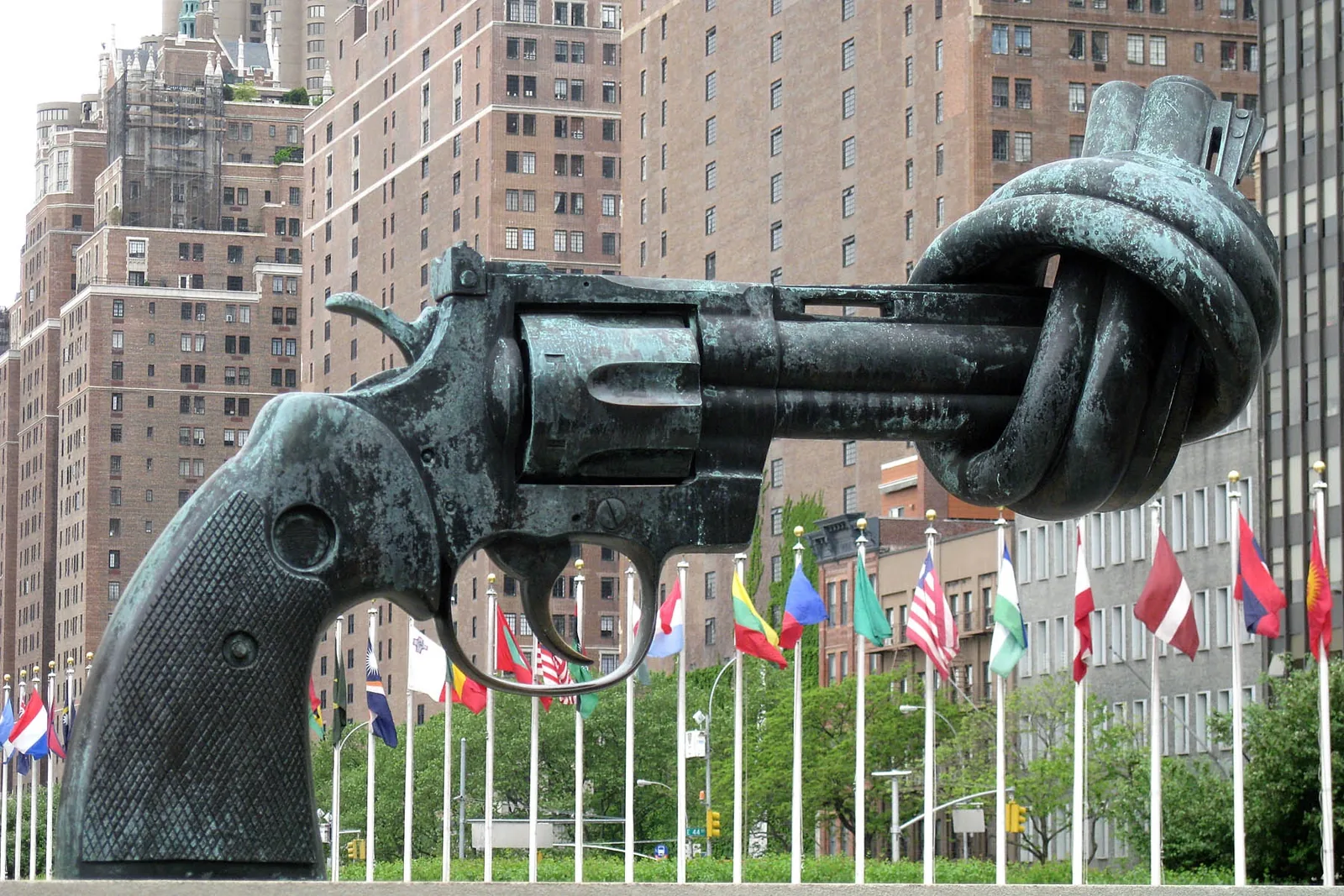
knotted gun
Photo above: Carl Fredrik Reuterswärd’s Non-Violence outside UN Headquarters in New York. Kirill Levin, CC BY-NC-SA 2. Jan Oberg November 3, 2026 I am happy to be published in Horizons which is produced by the Center for International Relations and Sustainable Development, CIRSD, in Belgrade. My contribution brings out a radical re-thinking of what concepts such as defence, security, deterrence – and peace – may mean if we want to create a more peaceful world. It also summarises a few things I have been working with the last few decades. Please read it here Og her er den på dansk, takket være Johnny Baltzersens lynhurtige oversættelse
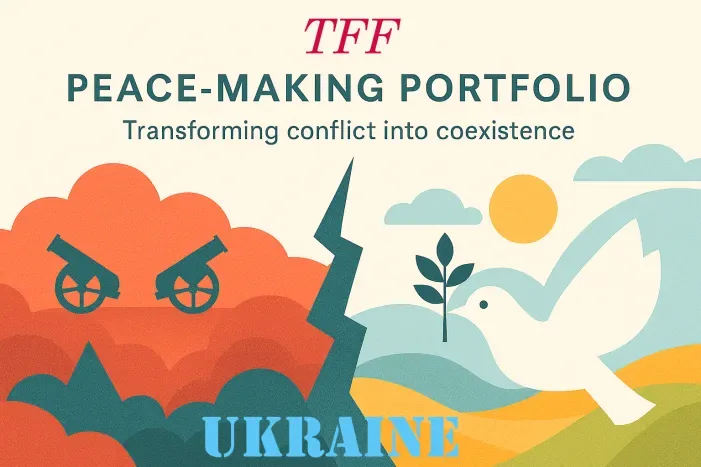
TFFPortfolioVign
UNITE-tillid, DREAM-velstand og andre konstruktive komponenter Normally we publish articles in English here. But this is a translation of a very important TFF document that should reach as many as possible in Denmark since this country’s government has been one of the most hardline in Europe and, up till now at least, has refused to use diplomacy and, instead, spent tremendous sums on arming Ukraine with the express goal of defeating Russia. Thus this – unique – article is in Danish. Vi er Johnny Baltzersen og hans Fælles Sikkerhed – Fælles Fremtid på Substack overmåde taknemmelige for at have oversat og publiceret TFF’s 2025-portfølje for fredsidéer med henblik på Ukraines fremtid. Vi håber den nu kan nå mange flere danskere – som også vil sprede den og skabe debat – nu den danske regerings og folketingspartiernes politik på dette område siden 2022 står nu – forudsigeligt – ved vejs ende....
JoGSS-Silent
Jan Oberg TFF director October 28, 2026 Exactly one month has now passed since I published my criticism of the introduction to the special issue on Johan Galtung published by the Journal of Global Security Studies, JoGSS, and of Tor Egil Førland’s chapter about Galtung which serves as a preview to his forthcoming biography of Galtung to be published by PRIO. See the original on The Transnational here and the same article on TFF Substack with many general and critical comments and, in particular, the people who decided to withdraw from the biography project in protest. The special issue itself was extraordinary. It was devoted to the intellectual legacy of one of the founders of peace research and contained a number of strong assessments of his personality, scholarship, intellectual trajectory, and public role. Such assessments are, of course, entirely legitimate. No scholar is beyond criticism, and neither was Johan Galtung....
Screenshot 2026-10-26 115647
An aspect of Iran’s culture and civilisation you’ve probably never heard about. Don’t be surprised if the US and Israel also try to bomb them. Jan ObergTFF director October 26, 2026 Today – under the “USraeli” threat of new “annihilating” bombings – opens the 7th International Conference on Peace and Conflict Resolution at Tehran’s University. As far as I can tell, this is the only permanent, advanced peace research institution in West Asia/the Middle East. Perhaps more countries in that region could be inspired? I mean, how many military “security” institutes and military academies do they have? Many peace research institutes and university departments have been established since the 1950s in the West. They are now all under attack; some have closed down, some have gone mainstream, yet others kept the name but do nothing to research peace and disseminate results or advice; instead, they cooperate with militarism’s platforms such...