EU countries in tough spot with U.S. demands on the nuclear deal with Iran, the JCPOA

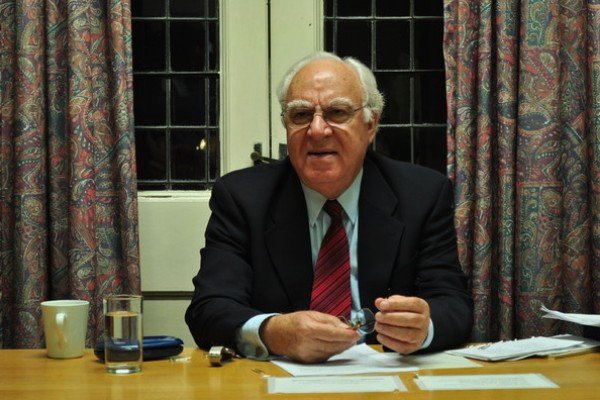
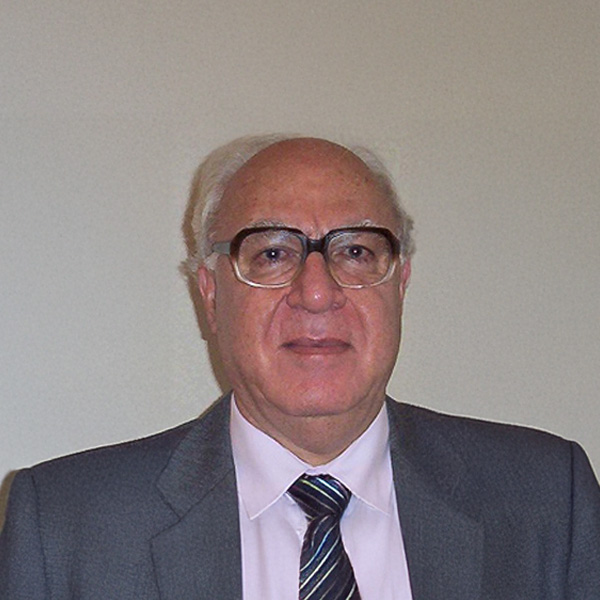
TEHRAN – Farhang Jahanpour, an adjunct professor in the Department of Continuing Education at the University of Oxford and a Middle East expert, says that all other signatories to the JCPOA, including the European Troika (the UK, France and Germany) have stated that they are for the nuclear accord, since Iran has remained committed to the deal. (JCPOA = Joint Comprehensive Plan of Action = the deal about nuclear technology between Iran and the five UN Security Council members + Germany + EU. You can read it here.)

“Nevertheless, EU countries are in a difficult position with the American demands,” Jahanpour tells the Tehran Times in an exclusive interview.

Jahanpour, also a former senior research fellow at Harvard University and TFF Board member, says that Europe is playing a double game with Iran.

“On the one hand, they [European countries] have stated openly that they support the JCPOA and have advised the U.S. to do the same. On the other hand, the Trump Administration is very critical of that agreement and has called on its European allies to fix it, so that President Trump can waive the sanctions.”

Following is the full text of the interview with Professor Farhang Jahanpour:

Q: Newly-leaked documents of the U.S. State Department show that the stance of the U.S. government towards the Iran nuclear deal has softened somewhat. According to these documents, the U.S. has outlined a course of action in which three European countries, Britain, France and Germany, would be “totally committed to improving” the Joint Comprehensive Plan of Action (JCPOA). In return, President Trump would extend Iran sanctions relief, keeping the Obama-era nuclear deal alive.  What does this mean exactly?

A: I believe that one cannot rely too much on leaked documents, especially as the openly-stated stances of most U.S. officials are very hostile towards Iran. What one can say is that there is some disagreement among various U.S. officials about how to deal with the nuclear agreement. Many senior U.S. officials believe that as the JCPOA is an international agreement that has also been endorsed by the EU and the Security Council, it would be wrong for America to violate it, as no country would any longer trust any agreement reached with the United States.

In a panel discussion at the recent Munich Security Conference in Germany, the former Secretary of State John Kerry spoke eloquently about the false statements that are made regarding the nuclear agreement. He stressed that there are no sunset clauses, that even after an initial period when Iran has agreed to stop  enrichment activities, as a confidence-building measure Iran would still remain a member of the NPT, and as Iran has also joined the Additional Protocol it will remain under stringent inspection by the International Atomic Energy Agency, like other NPT members. Therefore, the propaganda against the nuclear agreement is not well founded.


Q:  Citing a senior U.S. official, Reuters has reported that there was some hope to “Fix the Iran Deal” by reaching an agreement on modifying some of the JCPOA’s contents, endorsing a supplementary agreement or referring it to the UN Security Council. If European countries accept U.S. demands, is there a possibility that nuclear talks with Iran, Russia and China will resume?

A: All other signatories to the JCPOA, including the European Troika (UK, France and Germany) have stated repeatedly that they are in favour of honouring the agreement, especially as Iran has complied fully with all commitments. Nevertheless, EU countries are in a difficult position vis-à-vis the American demands. On the one hand, they have stated openly that they support the JCPOA and have advised the U.S. to do the same. On the other hand, the Trump Administration is very critical of that agreement and has called on its European allies to fix it, so that President Trump can waive the sanctions.

The point is that even if the EU were to join the United States to undermine the agreement, China and Russia would continue to support it. So, the three EU countries are between a rock and a hard place. On the one hand, they wish to protect this international agreement, while on the other hand, if they ultimately have to choose between Iran and the United States, they would have to opt for America.

However, as Iranian Deputy Foreign Minister Abbas Araghchi said in a speech at Chatham House in London on 22 February 2018 and in a long interview with the BBC, the reason why EU countries wish to abide by the agreement is not merely for economic reasons, but it is mainly due to the fact that this is the best and the strictest non-proliferation agreement reached between the West and any country, and it can serve as a blueprint for future agreements with other countries that want to develop nuclear energy. He added that the violation of this agreement would mean the belittling of an international agreement, which would erode trust between countries.

He further said that Iran will withdraw from the nuclear deal if there is no economic benefit and if major banks continue to shun dealing with Iran. The whole point about the agreement was that Iran would accept major restrictions on her nuclear programme in return for the lifting of the sanctions and reaping its economic benefits, but big banks have continued to stay away for fear of falling foul of remaining U.S. sanctions. This is against both the letter and the spirit of the agreement.


Q:   Some believe that there are three possible solutions to the Iran deal: 1. Modifying the current agreement, 2. Holding talks to reach a supplementary agreement, or 3. Following up with a new Security Council Resolution in order to add new changes. In your opinion, which one of these options is the most likely outcome?

A: Iranian officials have stated strongly that they are against any modification to this agreement or any supplementary agreement, because this is a complex agreement that was reached after many years of intense talks between Iran and the P5+1, with the help of some of the greatest experts from Iran and the West. If you try to amend it and change any part of it, the whole agreement would unravel. There really is no quick fix approach to the nuclear agreement.
When one listens to U.S. critics of the nuclear deal, it is clear that their objection is not precisely to the clauses of the agreement, but that they are unhappy about a whole host of other issues, including Iran’s missile programme and what they call Iran’s “behaviour” in the region. These are separate issues and should be addressed separately.

Iranian Foreign Minister Mr. Zarif has repeatedly said that the nuclear deal was supposed to serve as a base for future agreements and not as a ceiling. However, if Iran were to take part in new talks on other issues the most important requirement would be that Iran should be able to trust the other side. The violation of the JCPOA has greatly eroded trust in the West, and there is a need for a new approach and a restoration of trust.


Q: So, what kind of agreement do you think can resolve the issue?

A: As everyone knows, the entire Middle East is like a tinderbox. Most Middle Eastern countries have suffered enormously as the result of foreign invasions or civil wars during the past few decades. The problems in Afghanistan, Iraq, Libya, Syria and Yemen have not been resolved and there is a danger of new wars between Israel and her neighbours while the conflict between Israel and the Palestinians is still unresolved.

Under these circumstances, any true statesman should try to resolve some of these problems and bring calm to the Middle East, while also respecting the national interests of different countries. Instability in the region will not only affect the Middle East but will cause major problems for Europe and beyond. The present course of action will only lead to a regional war that might develop into a global war.

Therefore, all major powers and especially the United Nations should try to find a regional solution that will prevent a global conflict. It should be clear to all the regional countries that no one country can rule the region, and that even the hegemony of the superpowers is coming to an end.

The Middle East needs a regional security pact that would bring all the countries together in order to resolve their differences through dialogue and compromise, rather than through the use of force. None of the conflicts in the region has a military solution.

It would be better for the United States to join the EU, Russia and China and the countries in the Middle East to establish, if not an actual union, at least some form of compromise enabling them to concentrate on peace and reconstruction rather than on new conflicts. When the French foreign minister visits Iran in March, Iranian officials should stress the need for a comprehensive regional agreement, rather than tampering with the JCPOA.
Originally published by Tehran Times

Related Posts

A Message from Jan Oberg November 6, 2026 Over the past fifty years, I have devoted roughly 175,000 hours to research and public education for a more peaceful world: thinking, researching, writing, organising, publishing, debating, maintaining websites, corresponding, reaching out, leading a foundation, work in conflict and war zones, professorships, teaching courses and giving public lectures and doing media work. In short, ten hours a day, seven days a week, for half a century. The focus was on international political peace – analysing and trying to stop wars, address underlying conflicts and making alternative peace plans – at the desk and on the ground. Important as that has been and remains, it is only one kind of peace and it is now in a tragic militarist state compared with what it could have been.  Lately, however, I have found myself thinking about a concept from economics as well as everyday...
Photo above: Carl Fredrik Reuterswärd’s Non-Violence outside UN Headquarters in New York. Kirill Levin, CC BY-NC-SA 2. Jan Oberg November 3, 2026 I am happy to be published in Horizons which is produced by the Center for International Relations and Sustainable Development, CIRSD, in Belgrade. My contribution brings out a radical re-thinking of what concepts such as defence, security, deterrence – and peace – may mean if we want to create a more peaceful world. It also summarises a few things I have been working with the last few decades. Please read it here Og her er den på dansk, takket være Johnny Baltzersens lynhurtige oversættelse
UNITE-tillid, DREAM-velstand og andre konstruktive komponenter Normally we publish articles in English here. But this is a translation of a very important TFF document that should reach as many as possible in Denmark since this country’s government has been one of the most hardline in Europe and, up till now at least, has refused to use diplomacy and, instead, spent tremendous sums on arming Ukraine with the express goal of defeating Russia. Thus this – unique – article is in Danish. Vi er Johnny Baltzersen og hans Fælles Sikkerhed – Fælles Fremtid på Substack overmåde taknemmelige for at have oversat og publiceret TFF’s 2025-portfølje for fredsidéer med henblik på Ukraines fremtid. Vi håber den nu kan nå mange flere danskere – som også vil sprede den og skabe debat – nu den danske regerings og folketingspartiernes politik på dette område siden 2022 står nu – forudsigeligt – ved vejs ende....

Recent Articles

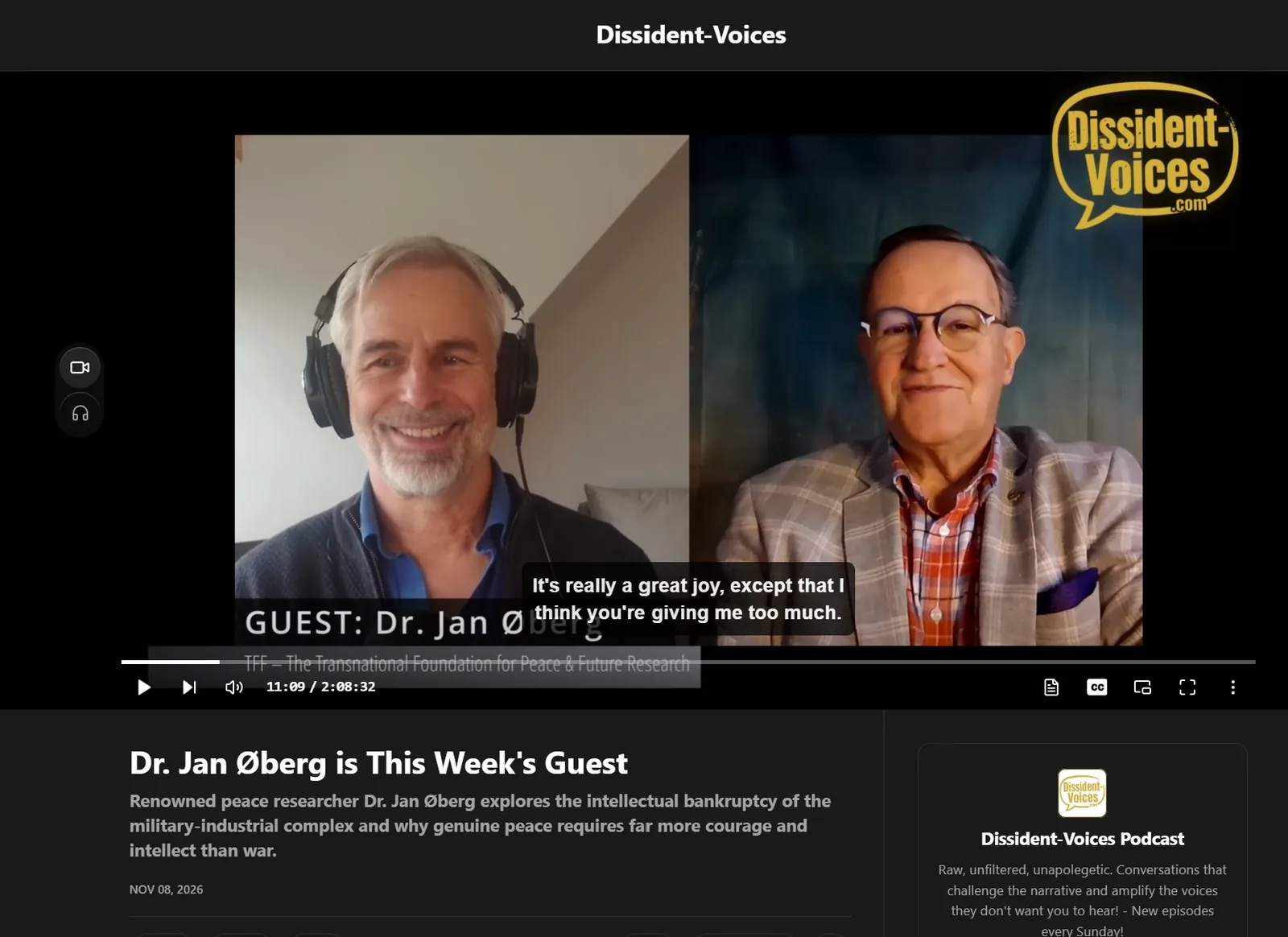
Serious but also a lot of laughs and positive energy. Because peace is also about conviviality and enchantment… Jan Oberg, TFF director November 16, 2026 This is a long (129 minutes) conversation with me. We cover very many, also personal, issues that makes a somewhat unusual media event. I am very grateful to Flemming Blicher for giving me this opportunity. I can’t remember any channel or editor who spent as much time as he did preparing it – including also asking me to answer a series of pre-interview questions, which are now posted under the conversation. If you sympathise with its content, please share it. Watch it here
A Message from Jan Oberg November 6, 2026 Over the past fifty years, I have devoted roughly 175,000 hours to research and public education for a more peaceful world: thinking, researching, writing, organising, publishing, debating, maintaining websites, corresponding, reaching out, leading a foundation, work in conflict and war zones, professorships, teaching courses and giving public lectures and doing media work. In short, ten hours a day, seven days a week, for half a century. The focus was on international political peace – analysing and trying to stop wars, address underlying conflicts and making alternative peace plans – at the desk and on the ground. Important as that has been and remains, it is only one kind of peace and it is now in a tragic militarist state compared with what it could have been.  Lately, however, I have found myself thinking about a concept from economics as well as everyday...
Photo above: Carl Fredrik Reuterswärd’s Non-Violence outside UN Headquarters in New York. Kirill Levin, CC BY-NC-SA 2. Jan Oberg November 3, 2026 I am happy to be published in Horizons which is produced by the Center for International Relations and Sustainable Development, CIRSD, in Belgrade. My contribution brings out a radical re-thinking of what concepts such as defence, security, deterrence – and peace – may mean if we want to create a more peaceful world. It also summarises a few things I have been working with the last few decades. Please read it here Og her er den på dansk, takket være Johnny Baltzersens lynhurtige oversættelse

TFF on Substack

Discover and subscribe to more peace materials on TFF Substack

Most Popular

Serious but also a lot of laughs and positive energy. Because peace is also about conviviality and enchantment… Jan Oberg, TFF director November 16, 2026 This is a long (129 minutes) conversation with me. We cover very many, also personal, issues that makes a somewhat unusual media event. I am very grateful to Flemming Blicher for giving me this opportunity. I can’t remember any channel or editor who spent as much time as he did preparing it – including also asking me to answer a series of pre-interview questions, which are now posted under the conversation. If you sympathise with its content, please share it. Watch it here
A Message from Jan Oberg November 6, 2026 Over the past fifty years, I have devoted roughly 175,000 hours to research and public education for a more peaceful world: thinking, researching, writing, organising, publishing, debating, maintaining websites, corresponding, reaching out, leading a foundation, work in conflict and war zones, professorships, teaching courses and giving public lectures and doing media work. In short, ten hours a day, seven days a week, for half a century. The focus was on international political peace – analysing and trying to stop wars, address underlying conflicts and making alternative peace plans – at the desk and on the ground. Important as that has been and remains, it is only one kind of peace and it is now in a tragic militarist state compared with what it could have been.  Lately, however, I have found myself thinking about a concept from economics as well as everyday...
Photo above: Carl Fredrik Reuterswärd’s Non-Violence outside UN Headquarters in New York. Kirill Levin, CC BY-NC-SA 2. Jan Oberg November 3, 2026 I am happy to be published in Horizons which is produced by the Center for International Relations and Sustainable Development, CIRSD, in Belgrade. My contribution brings out a radical re-thinking of what concepts such as defence, security, deterrence – and peace – may mean if we want to create a more peaceful world. It also summarises a few things I have been working with the last few decades. Please read it here Og her er den på dansk, takket være Johnny Baltzersens lynhurtige oversættelse
Read More
Screenshot 2026-11-10 174455
Serious but also a lot of laughs and positive energy. Because peace is also about conviviality and enchantment… Jan Oberg, TFF director November 16, 2026 This is a long (129 minutes) conversation with me. We cover very many, also personal, issues that makes a somewhat unusual media event. I am very grateful to Flemming Blicher for giving me this opportunity. I can’t remember any channel or editor who spent as much time as he did preparing it – including also asking me to answer a series of pre-interview questions, which are now posted under the conversation. If you sympathise with its content, please share it. Watch it here
AbstractVision_2017_#1_800 (kopia)
A Message from Jan Oberg November 6, 2026 Over the past fifty years, I have devoted roughly 175,000 hours to research and public education for a more peaceful world: thinking, researching, writing, organising, publishing, debating, maintaining websites, corresponding, reaching out, leading a foundation, work in conflict and war zones, professorships, teaching courses and giving public lectures and doing media work. In short, ten hours a day, seven days a week, for half a century. The focus was on international political peace – analysing and trying to stop wars, address underlying conflicts and making alternative peace plans – at the desk and on the ground. Important as that has been and remains, it is only one kind of peace and it is now in a tragic militarist state compared with what it could have been.  Lately, however, I have found myself thinking about a concept from economics as well as everyday...
knotted gun
Photo above: Carl Fredrik Reuterswärd’s Non-Violence outside UN Headquarters in New York. Kirill Levin, CC BY-NC-SA 2. Jan Oberg November 3, 2026 I am happy to be published in Horizons which is produced by the Center for International Relations and Sustainable Development, CIRSD, in Belgrade. My contribution brings out a radical re-thinking of what concepts such as defence, security, deterrence – and peace – may mean if we want to create a more peaceful world. It also summarises a few things I have been working with the last few decades. Please read it here Og her er den på dansk, takket være Johnny Baltzersens lynhurtige oversættelse
TFFPortfolioVign
UNITE-tillid, DREAM-velstand og andre konstruktive komponenter Normally we publish articles in English here. But this is a translation of a very important TFF document that should reach as many as possible in Denmark since this country’s government has been one of the most hardline in Europe and, up till now at least, has refused to use diplomacy and, instead, spent tremendous sums on arming Ukraine with the express goal of defeating Russia. Thus this – unique – article is in Danish. Vi er Johnny Baltzersen og hans Fælles Sikkerhed – Fælles Fremtid på Substack overmåde taknemmelige for at have oversat og publiceret TFF’s 2025-portfølje for fredsidéer med henblik på Ukraines fremtid. Vi håber den nu kan nå mange flere danskere – som også vil sprede den og skabe debat – nu den danske regerings og folketingspartiernes politik på dette område siden 2022 står nu – forudsigeligt – ved vejs ende....
JoGSS-Silent
Jan Oberg TFF director October 28, 2026 Exactly one month has now passed since I published my criticism of the introduction to the special issue on Johan Galtung published by the Journal of Global Security Studies, JoGSS, and of Tor Egil Førland’s chapter about Galtung which serves as a preview to his forthcoming biography of Galtung to be published by PRIO. See the original on The Transnational here and the same article on TFF Substack with many general and critical comments and, in particular, the people who decided to withdraw from the biography project in protest. The special issue itself was extraordinary. It was devoted to the intellectual legacy of one of the founders of peace research and contained a number of strong assessments of his personality, scholarship, intellectual trajectory, and public role. Such assessments are, of course, entirely legitimate. No scholar is beyond criticism, and neither was Johan Galtung....
Screenshot 2026-10-26 115647
An aspect of Iran’s culture and civilisation you’ve probably never heard about. Don’t be surprised if the US and Israel also try to bomb them. Jan ObergTFF director October 26, 2026 Today – under the “USraeli” threat of new “annihilating” bombings – opens the 7th International Conference on Peace and Conflict Resolution at Tehran’s University. As far as I can tell, this is the only permanent, advanced peace research institution in West Asia/the Middle East. Perhaps more countries in that region could be inspired? I mean, how many military “security” institutes and military academies do they have? Many peace research institutes and university departments have been established since the 1950s in the West. They are now all under attack; some have closed down, some have gone mainstream, yet others kept the name but do nothing to research peace and disseminate results or advice; instead, they cooperate with militarism’s platforms such...