US Nuclear Posture Review gives strong arguments for a prohibition of all nuclear weapons


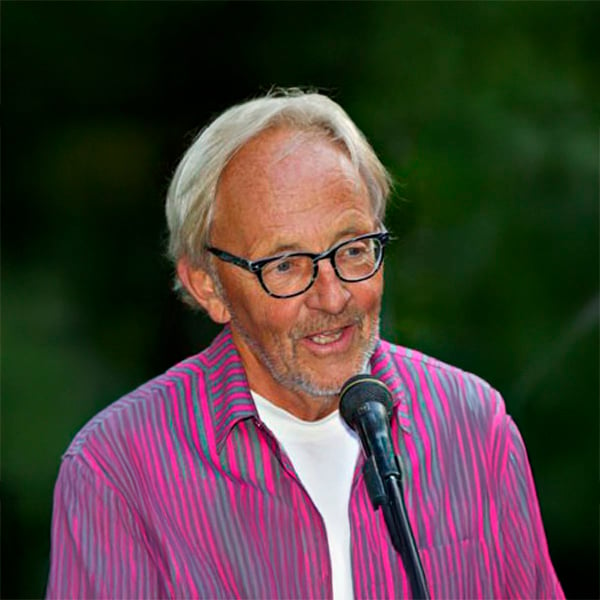
By Gunnar Westberg

February 16, 2018


This is how I would summarize the new US Nuclear Posture Review, issued last week by the Trump administration:

• We can fight and win a nuclear exchange
• We are prepared to use nuclear weapons against a conventional attack, e.g. a cyberattack
• We may consider using nuclear weapons against a nuclear-weapons-free country
• We care not to mention our obligations under NPT Art VI
• We have never heard of the climate effects of nuclear war.


In January 2017, President Donald Trump ordered a new Nuclear Posture Review (NPR). The report is now available. It is 75 pages long. Most of the material repeats earlier NPRs.

I will here concentrate on the new aspects.


“Escalate to de-escalate”

Russian military writers have discussed the possibility of using “small” nuclear weapons if the country is attacked by an adversary with considerable conventional superiority.

These “small” – Hiroshima-sized? – nukes would serve as a warning: We are prepared to defend ourselves with nuclear weapons. Such a discussion is to be expected considering the inferiority of Russia in conventional weapons. President Putin has hinted at such possibilities.

However, no change in deployment, activation, upgrading, or maintenance of the “tactical” nuclear weapons in storage has been done, as far as we know, and no evidence is given in the NPR.

A major problem is that there are frequent allegations in the NPR about the strategy of Russia, the main enemy, with no references – you do not know if the NPR relies on explicit statements by Russian military leaders or just refers to discussions in Russian publications, or other unnamed sources.

The use of small nukes to “escalate to deescalate” now seems to be a US, instead of a Russian, proposal. This is an unnecessary and irresponsible development.

The superior US conventional arsenal should make the use of “small” nukes unnecessary, and it is, in any case, very dangerous.

“Small nukes” for submarines are also considered, both a missile and a cruise missile. This is a dangerous development as the target country will not know that a “small” weapon is coming, and massive retaliation may seem to be the choice. You have no time to evaluate, you cannot wait for the impact.

Development of such a bomb – the B61-12 – has already been under way for several years. This is going to be a bomb with a dial, which can be set anywhere from 50 kt to less than 1 kt. The weapon is going to be targetable, probably earth-penetrating, suitable for attack on protected command centers, intended for use in Europe.

B61-12 is a new weapon, and thus, like the submarine-based new nukes, breaks the US pledge not to develop any new nuclear weapons.

It is interesting that apart from the new B61-12, no production plans for these new warheads are mentioned. We can only hope that the development of these weapons will not start for several years, preferably never.


Use against conventional targets

There are several statements in the NPR that nuclear weapons can be actively used, as deterrent against or retaliation for a non-nuclear attack. Thus, serious damage to US civilian infrastructure could be a reason for nuclear retaliation.

This is possibly the most irresponsible and irrational part of the new policy.

The USA would then use nuclear weapons against a country which – supposedly – has launched a cyber-attack. Such a policy should be unthinkable. That it is illegal is obvious.

The enormous superiority of the United States in conventional warfare against any possible adversary should make the use of nuclear weapons unwarranted, both against non-nuclear-weapon states or against nuclear-weapon states who have not used their nukes against the US. Why else have this superiority?

There is a fairly large amount of loose talk about new strategies, new weapons, new principles in the NPR. Much talk, less workshop.

Let us hope that Russia and China agree with this interpretation and do not start an arms race. Loose talk from the Pentagon, just as from President Putin, is dangerous. One day your enemy may take you at your word.

Nowhere in the NPR is the vast conventional military superiority of the USA and NATO over Russia mentioned. Nowhere is there a report that the Russian military spending at present is only about one eighth of that of the US, and has been rapidly decreasing for two years.
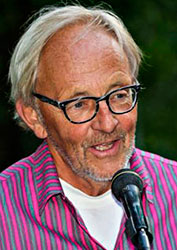
Gunnar Westberg

Nowhere in this document are climate effects of nuclear war considered!

President Reagan had said that “a nuclear war cannot be won and must never be fought.” The victor in a large nuclear war is committing suicide, starving to death with the rest of humanity.

This document is dangerous, irresponsible, and naïve. It pretends that we should prepare for a “nuclear exchange,” a small scale nuclear war that could be contained.

It treats nuclear weapons and nuclear war as just weapons and war, not as means of genocide and omnicide and the possible extermination of humankind.

This document and this policy are the responsibility of the administration of Donald Trump, but are the product of the Military-Industrial Complex of the USA. This thinking was there before Trump and will remain after him.

This NPR shows that the prohibition of all nuclear weapons is even more important than we knew a few months ago.

The nuclear threshold is getting lower, the risk of a large nuclear war is increasing.

[Many useful links to expert views on the new NPR, gathered by the Federation of American Scientists, can be found here.]

•

Recommended reading about nuclear weapons and the NPR in particular here on The Transnational.

Statement on the NPR by Lawyers Committee on Nuclear Weapons here.
Medical education and professional career

Related Posts

A Message from Jan Oberg November 6, 2026 Over the past fifty years, I have devoted roughly 175,000 hours to research and public education for a more peaceful world: thinking, researching, writing, organising, publishing, debating, maintaining websites, corresponding, reaching out, leading a foundation, work in conflict and war zones, professorships, teaching courses and giving public lectures and doing media work. In short, ten hours a day, seven days a week, for half a century. The focus was on international political peace – analysing and trying to stop wars, address underlying conflicts and making alternative peace plans – at the desk and on the ground. Important as that has been and remains, it is only one kind of peace and it is now in a tragic militarist state compared with what it could have been.  Lately, however, I have found myself thinking about a concept from economics as well as everyday...
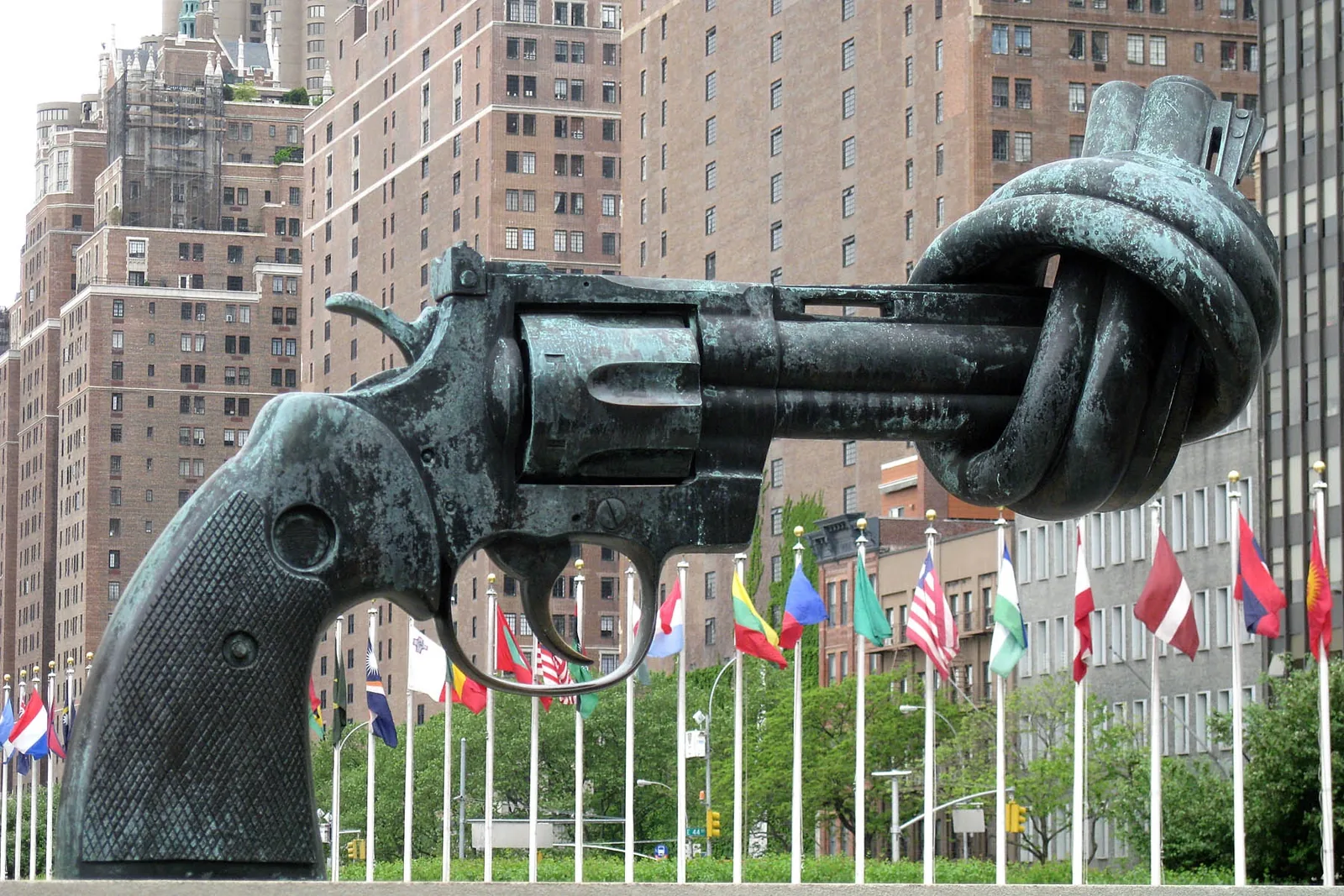
Photo above: Carl Fredrik Reuterswärd’s Non-Violence outside UN Headquarters in New York. Kirill Levin, CC BY-NC-SA 2. Jan Oberg November 3, 2026 I am happy to be published in Horizons which is produced by the Center for International Relations and Sustainable Development, CIRSD, in Belgrade. My contribution brings out a radical re-thinking of what concepts such as defence, security, deterrence – and peace – may mean if we want to create a more peaceful world. It also summarises a few things I have been working with the last few decades. Please read it here Og her er den på dansk, takket være Johnny Baltzersens lynhurtige oversættelse
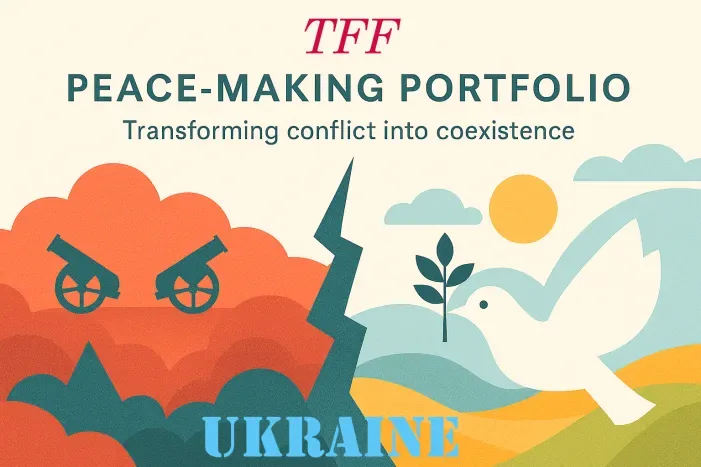
UNITE-tillid, DREAM-velstand og andre konstruktive komponenter Normally we publish articles in English here. But this is a translation of a very important TFF document that should reach as many as possible in Denmark since this country’s government has been one of the most hardline in Europe and, up till now at least, has refused to use diplomacy and, instead, spent tremendous sums on arming Ukraine with the express goal of defeating Russia. Thus this – unique – article is in Danish. Vi er Johnny Baltzersen og hans Fælles Sikkerhed – Fælles Fremtid på Substack overmåde taknemmelige for at have oversat og publiceret TFF’s 2025-portfølje for fredsidéer med henblik på Ukraines fremtid. Vi håber den nu kan nå mange flere danskere – som også vil sprede den og skabe debat – nu den danske regerings og folketingspartiernes politik på dette område siden 2022 står nu – forudsigeligt – ved vejs ende....

Recent Articles

Serious but also a lot of laughs and positive energy. Because peace is also about conviviality and enchantment… Jan Oberg, TFF director November 16, 2026 This is a long (129 minutes) conversation with me. We cover very many, also personal, issues that makes a somewhat unusual media event. I am very grateful to Flemming Blicher for giving me this opportunity. I can’t remember any channel or editor who spent as much time as he did preparing it – including also asking me to answer a series of pre-interview questions, which are now posted under the conversation. If you sympathise with its content, please share it. Watch it here
A Message from Jan Oberg November 6, 2026 Over the past fifty years, I have devoted roughly 175,000 hours to research and public education for a more peaceful world: thinking, researching, writing, organising, publishing, debating, maintaining websites, corresponding, reaching out, leading a foundation, work in conflict and war zones, professorships, teaching courses and giving public lectures and doing media work. In short, ten hours a day, seven days a week, for half a century. The focus was on international political peace – analysing and trying to stop wars, address underlying conflicts and making alternative peace plans – at the desk and on the ground. Important as that has been and remains, it is only one kind of peace and it is now in a tragic militarist state compared with what it could have been.  Lately, however, I have found myself thinking about a concept from economics as well as everyday...
Photo above: Carl Fredrik Reuterswärd’s Non-Violence outside UN Headquarters in New York. Kirill Levin, CC BY-NC-SA 2. Jan Oberg November 3, 2026 I am happy to be published in Horizons which is produced by the Center for International Relations and Sustainable Development, CIRSD, in Belgrade. My contribution brings out a radical re-thinking of what concepts such as defence, security, deterrence – and peace – may mean if we want to create a more peaceful world. It also summarises a few things I have been working with the last few decades. Please read it here Og her er den på dansk, takket være Johnny Baltzersens lynhurtige oversættelse

TFF on Substack

Discover and subscribe to more peace materials on TFF Substack

Most Popular

Serious but also a lot of laughs and positive energy. Because peace is also about conviviality and enchantment… Jan Oberg, TFF director November 16, 2026 This is a long (129 minutes) conversation with me. We cover very many, also personal, issues that makes a somewhat unusual media event. I am very grateful to Flemming Blicher for giving me this opportunity. I can’t remember any channel or editor who spent as much time as he did preparing it – including also asking me to answer a series of pre-interview questions, which are now posted under the conversation. If you sympathise with its content, please share it. Watch it here
A Message from Jan Oberg November 6, 2026 Over the past fifty years, I have devoted roughly 175,000 hours to research and public education for a more peaceful world: thinking, researching, writing, organising, publishing, debating, maintaining websites, corresponding, reaching out, leading a foundation, work in conflict and war zones, professorships, teaching courses and giving public lectures and doing media work. In short, ten hours a day, seven days a week, for half a century. The focus was on international political peace – analysing and trying to stop wars, address underlying conflicts and making alternative peace plans – at the desk and on the ground. Important as that has been and remains, it is only one kind of peace and it is now in a tragic militarist state compared with what it could have been.  Lately, however, I have found myself thinking about a concept from economics as well as everyday...
Photo above: Carl Fredrik Reuterswärd’s Non-Violence outside UN Headquarters in New York. Kirill Levin, CC BY-NC-SA 2. Jan Oberg November 3, 2026 I am happy to be published in Horizons which is produced by the Center for International Relations and Sustainable Development, CIRSD, in Belgrade. My contribution brings out a radical re-thinking of what concepts such as defence, security, deterrence – and peace – may mean if we want to create a more peaceful world. It also summarises a few things I have been working with the last few decades. Please read it here Og her er den på dansk, takket være Johnny Baltzersens lynhurtige oversættelse
Read More
Screenshot 2026-11-10 174455
Serious but also a lot of laughs and positive energy. Because peace is also about conviviality and enchantment… Jan Oberg, TFF director November 16, 2026 This is a long (129 minutes) conversation with me. We cover very many, also personal, issues that makes a somewhat unusual media event. I am very grateful to Flemming Blicher for giving me this opportunity. I can’t remember any channel or editor who spent as much time as he did preparing it – including also asking me to answer a series of pre-interview questions, which are now posted under the conversation. If you sympathise with its content, please share it. Watch it here
AbstractVision_2017_#1_800 (kopia)
A Message from Jan Oberg November 6, 2026 Over the past fifty years, I have devoted roughly 175,000 hours to research and public education for a more peaceful world: thinking, researching, writing, organising, publishing, debating, maintaining websites, corresponding, reaching out, leading a foundation, work in conflict and war zones, professorships, teaching courses and giving public lectures and doing media work. In short, ten hours a day, seven days a week, for half a century. The focus was on international political peace – analysing and trying to stop wars, address underlying conflicts and making alternative peace plans – at the desk and on the ground. Important as that has been and remains, it is only one kind of peace and it is now in a tragic militarist state compared with what it could have been.  Lately, however, I have found myself thinking about a concept from economics as well as everyday...
knotted gun
Photo above: Carl Fredrik Reuterswärd’s Non-Violence outside UN Headquarters in New York. Kirill Levin, CC BY-NC-SA 2. Jan Oberg November 3, 2026 I am happy to be published in Horizons which is produced by the Center for International Relations and Sustainable Development, CIRSD, in Belgrade. My contribution brings out a radical re-thinking of what concepts such as defence, security, deterrence – and peace – may mean if we want to create a more peaceful world. It also summarises a few things I have been working with the last few decades. Please read it here Og her er den på dansk, takket være Johnny Baltzersens lynhurtige oversættelse
TFFPortfolioVign
UNITE-tillid, DREAM-velstand og andre konstruktive komponenter Normally we publish articles in English here. But this is a translation of a very important TFF document that should reach as many as possible in Denmark since this country’s government has been one of the most hardline in Europe and, up till now at least, has refused to use diplomacy and, instead, spent tremendous sums on arming Ukraine with the express goal of defeating Russia. Thus this – unique – article is in Danish. Vi er Johnny Baltzersen og hans Fælles Sikkerhed – Fælles Fremtid på Substack overmåde taknemmelige for at have oversat og publiceret TFF’s 2025-portfølje for fredsidéer med henblik på Ukraines fremtid. Vi håber den nu kan nå mange flere danskere – som også vil sprede den og skabe debat – nu den danske regerings og folketingspartiernes politik på dette område siden 2022 står nu – forudsigeligt – ved vejs ende....
JoGSS-Silent
Jan Oberg TFF director October 28, 2026 Exactly one month has now passed since I published my criticism of the introduction to the special issue on Johan Galtung published by the Journal of Global Security Studies, JoGSS, and of Tor Egil Førland’s chapter about Galtung which serves as a preview to his forthcoming biography of Galtung to be published by PRIO. See the original on The Transnational here and the same article on TFF Substack with many general and critical comments and, in particular, the people who decided to withdraw from the biography project in protest. The special issue itself was extraordinary. It was devoted to the intellectual legacy of one of the founders of peace research and contained a number of strong assessments of his personality, scholarship, intellectual trajectory, and public role. Such assessments are, of course, entirely legitimate. No scholar is beyond criticism, and neither was Johan Galtung....
Screenshot 2026-10-26 115647
An aspect of Iran’s culture and civilisation you’ve probably never heard about. Don’t be surprised if the US and Israel also try to bomb them. Jan ObergTFF director October 26, 2026 Today – under the “USraeli” threat of new “annihilating” bombings – opens the 7th International Conference on Peace and Conflict Resolution at Tehran’s University. As far as I can tell, this is the only permanent, advanced peace research institution in West Asia/the Middle East. Perhaps more countries in that region could be inspired? I mean, how many military “security” institutes and military academies do they have? Many peace research institutes and university departments have been established since the 1950s in the West. They are now all under attack; some have closed down, some have gone mainstream, yet others kept the name but do nothing to research peace and disseminate results or advice; instead, they cooperate with militarism’s platforms such...