By David Swanson

• The case against Iraqing Iran includes the following points:

Threatening war is a violation of the U.N. Charter.

Waging war is a violation of the U.N. Charter and of the Kellogg-Briand Pact.

Waging war without Congress is a violation of the U.S. Constitution.

Have you seen Iraq lately?

Have you seen the entire region?

Via davidswanson.org

Have you seen Afghanistan? Libya? Syria? Yemen? Pakistan? Somalia?

War supporters said the U.S. urgently needed to attack Iran in 2007. It did not attack. The claims turned out to be lies. Even a National Intelligence Estimate in 2007 pushed back and admitted that Iran had no nuclear weapons program.

Having a nuclear weapons program is not a justification for war, legally, morally, or practically. The United States has nuclear weapons and no one would be justified in attacking the United States.

Dick and Liz Cheney’s book, Exceptional, tell us we must see a “moral difference between an Iranian nuclear weapon and an American one.” Must we, really? Either risks further proliferation, accidental use, use by a crazed leader, mass death and destruction, environmental disaster, retaliatory escalation, and apocalypse. One of those two nations has nuclear weapons, has used nuclear weapons, has provided the other with plans for nuclear weapons, has a policy of first-use of nuclear weapons, has leadership that sanctions the possession of nuclear weapons, and has frequently threated to use nuclear weapons. I don’t think those facts would make a nuclear weapon in the hands of the other country the least bit moral, but also not the least bit more immoral. Let’s focus on seeing an empirical difference between an Iranian nuclear weapon and an American one. One exists. The other doesn’t.

If you’re wondering, U.S. presidents who have made specific public or secret nuclear threats to other nations, that we know of, as documented in Daniel Ellsberg’s The Doomsday Machine, have included Harry Truman, Dwight Eisenhower, Richard Nixon, George H.W. Bush, Bill Clinton, and Donald Trump, while others, including Barack Obama, have frequently said things like “All options are on the table” in relation to Iran or another country.

War supporters said the U.S. urgently needed to attack Iran in 2015. It did not attack. The claims turned out to be lies. Even the claims of supporters of the nuclear agreement reinforced the lie that Iran had a nuclear weapons program in need of containment. There is no evidence that Iran has ever had a nuclear weapons program.

The long history of the United States lying about Iranian nuclear weapons is chronicled by Gareth Porter’s book Manufactured Crisis.

Proponents of war or steps toward war (sanctions was a step toward war on Iraq) may say we urgently need a war now, but they will have no argument for urgency, and their claims are thus far transparent lies.

davidswanson.org

The U.S. ambassador to the United Nations claims that Iranian weapons have been used in a war that the U.S.., Saudi Arabia, and allies are illegally and disastrously waging in Yemen. While that’s a problem that should be corrected, it is hard to find a war anywhere on the planet without U.S. weapons in it. In fact, a report that made news the same day as the ambassador’s claims, pointed to the long-known fact that many of the weapons used by ISIS had once belonged to the United States, many of them having been given by the U.S. to non-state fighters (aka terrorists) in Syria.

Fighting wars and arming others to fight wars/terrorism is a justification for indictment and prosecution, but not for war, legally, morally, or practically. The United States fights and arms wars, and no one would be justified in attacking the United States.

If Iran is guilty of a crime, and there is evidence to support that claim, the United States and the world should seek its prosecution. Instead, the United States is isolating itself by tearing down the rule of law. It is destroying its credibility by threatening to abandon an agreement. In a Gallup poll in 2013 and a Pew poll in 2017 the majority of nations polled had the United States receive the most votes as the greatest threat to peace on earth. In the Gallup poll, people within the U.S. chose Iran as the top threat to peace on earth — Iran which had not attacked another nation in centuries and spent less than 1% of what the U.S. spent on militarism. These views are clearly a function of what people are told through news media.

The history of U.S./Iranian relations matters here. The U.S. overthrew Iran’s democracy in 1953 and installed a brutal dictator / weapons customer.

The U.S. gave Iran nuclear energy technology in the 1970s.

The Trump White House has openly expressed a desire to claim that Iran has violated the 2015 nuclear agreement, but has produced no evidence.

The push to attack Iran has been on for so long that entire categories of arguments for it (such as that the Iranians are fueling the Iraqi resistance) have come and gone.

read more at davidswanson.org

Related Posts

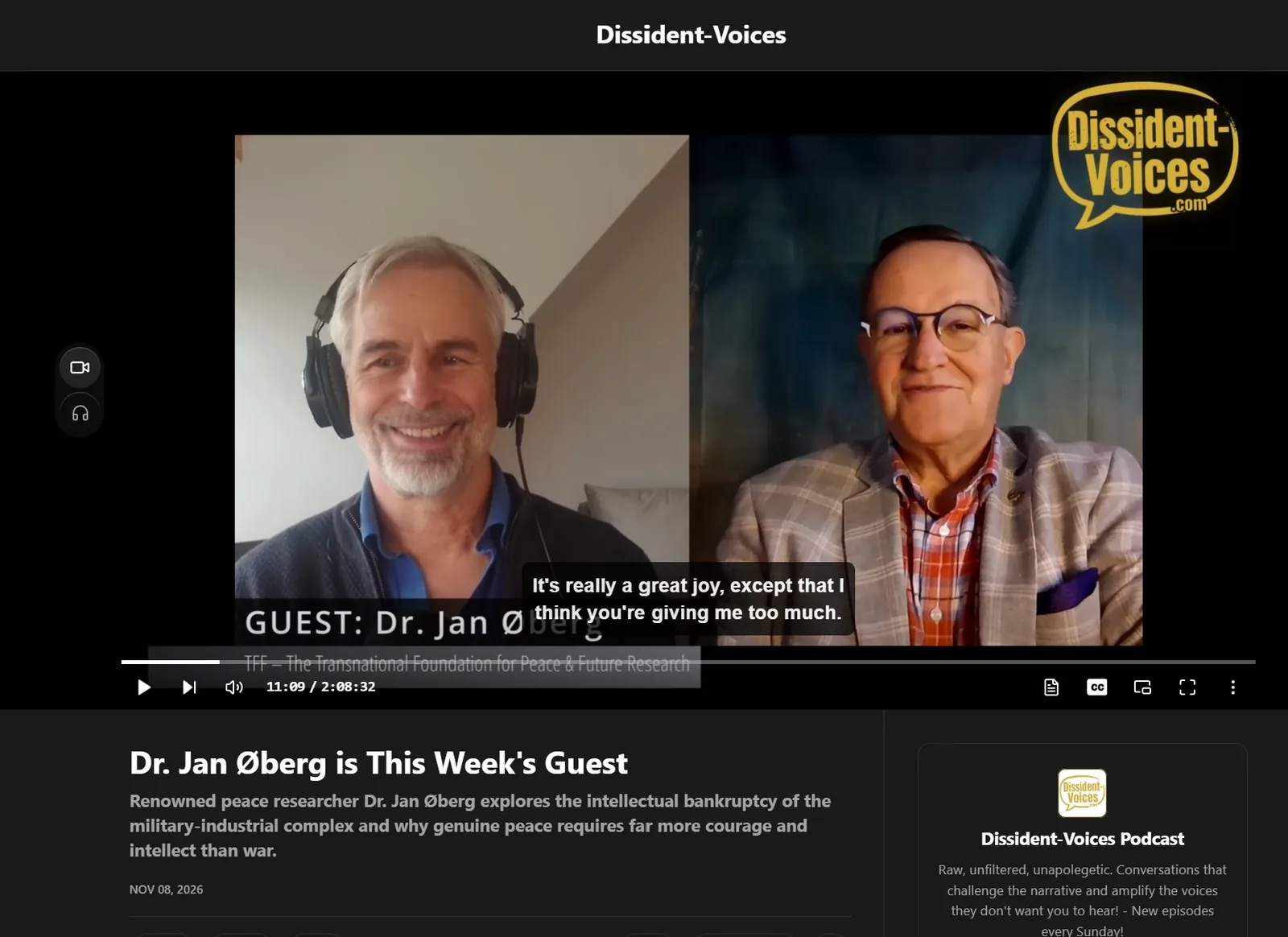
Serious but also a lot of laughs and positive energy. Because peace is also about conviviality and enchantment… Jan Oberg, TFF director November 16, 2026 This is a long (129 minutes) conversation with me. We cover very many, also personal, issues that makes a somewhat unusual media event. I am very grateful to Flemming Blicher for giving me this opportunity. I can’t remember any channel or editor who spent as much time as he did preparing it – including also asking me to answer a series of pre-interview questions, which are now posted under the conversation. If you sympathise with its content, please share it. Watch it here
A Message from Jan Oberg November 6, 2026 Over the past fifty years, I have devoted roughly 175,000 hours to research and public education for a more peaceful world: thinking, researching, writing, organising, publishing, debating, maintaining websites, corresponding, reaching out, leading a foundation, work in conflict and war zones, professorships, teaching courses and giving public lectures and doing media work. In short, ten hours a day, seven days a week, for half a century. The focus was on international political peace – analysing and trying to stop wars, address underlying conflicts and making alternative peace plans – at the desk and on the ground. Important as that has been and remains, it is only one kind of peace and it is now in a tragic militarist state compared with what it could have been.  Lately, however, I have found myself thinking about a concept from economics as well as everyday...
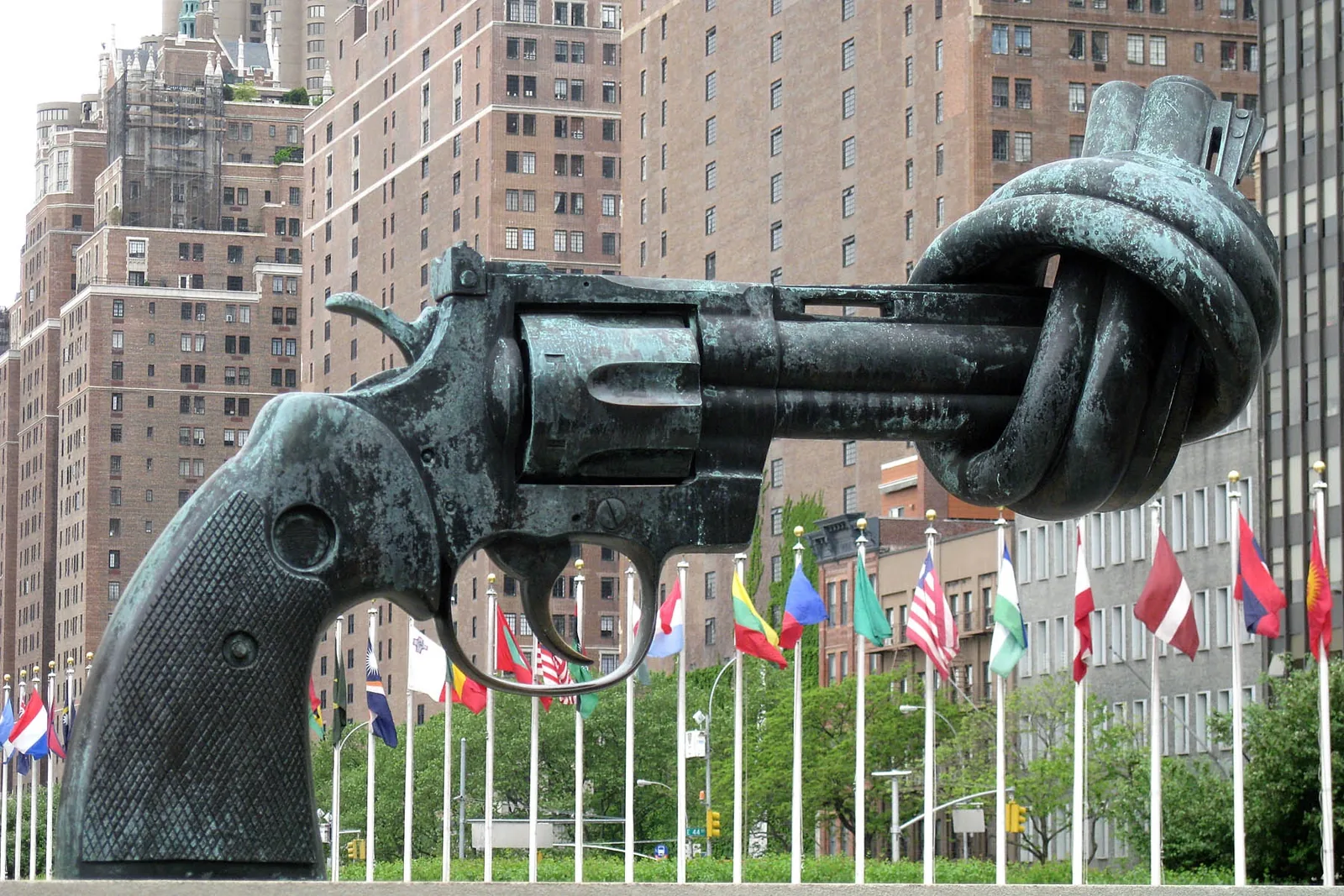
Photo above: Carl Fredrik Reuterswärd’s Non-Violence outside UN Headquarters in New York. Kirill Levin, CC BY-NC-SA 2. Jan Oberg November 3, 2026 I am happy to be published in Horizons which is produced by the Center for International Relations and Sustainable Development, CIRSD, in Belgrade. My contribution brings out a radical re-thinking of what concepts such as defence, security, deterrence – and peace – may mean if we want to create a more peaceful world. It also summarises a few things I have been working with the last few decades. Please read it here Og her er den på dansk, takket være Johnny Baltzersens lynhurtige oversættelse

Recent Articles

“The untiring insistence upon freedom and truth, the community of the worker and the intellectual (who are still stupidly warring here, as tyranny aims to keep them doing), and, finally, political democracy as a necessary and indispensable (though surely not sufficient) condition of economic democracy – that is what Budapest was defending.” Albert Camus November 19, 2026, marks the 70th anniversary of the arrest of Milovan Djilas (1911-1995, see photo above), one of – if not the – most consequential and historically significant dissidents of Eastern Europe – manifesting his civil courage way before Václav Havel, Adam Michnik, Aleksandr Solzhenitsyn, Andrei Sakharov, and Lech Wałęsa. Djilas had been a leading Yugoslav Partisan and communist revolutionary, one of Tito’s closest political associates, a senior member of the Yugoslav Communist Party leadership, and Vice-President of Yugoslavia. He was a prolific writer of politics, philsophy and history and a poet who spent years...
Serious but also a lot of laughs and positive energy. Because peace is also about conviviality and enchantment… Jan Oberg, TFF director November 16, 2026 This is a long (129 minutes) conversation with me. We cover very many, also personal, issues that makes a somewhat unusual media event. I am very grateful to Flemming Blicher for giving me this opportunity. I can’t remember any channel or editor who spent as much time as he did preparing it – including also asking me to answer a series of pre-interview questions, which are now posted under the conversation. If you sympathise with its content, please share it. Watch it here
A Message from Jan Oberg November 6, 2026 Over the past fifty years, I have devoted roughly 175,000 hours to research and public education for a more peaceful world: thinking, researching, writing, organising, publishing, debating, maintaining websites, corresponding, reaching out, leading a foundation, work in conflict and war zones, professorships, teaching courses and giving public lectures and doing media work. In short, ten hours a day, seven days a week, for half a century. The focus was on international political peace – analysing and trying to stop wars, address underlying conflicts and making alternative peace plans – at the desk and on the ground. Important as that has been and remains, it is only one kind of peace and it is now in a tragic militarist state compared with what it could have been.  Lately, however, I have found myself thinking about a concept from economics as well as everyday...

TFF on Substack

Discover and subscribe to more peace materials on TFF Substack

Most Popular

“The untiring insistence upon freedom and truth, the community of the worker and the intellectual (who are still stupidly warring here, as tyranny aims to keep them doing), and, finally, political democracy as a necessary and indispensable (though surely not sufficient) condition of economic democracy – that is what Budapest was defending.” Albert Camus November 19, 2026, marks the 70th anniversary of the arrest of Milovan Djilas (1911-1995, see photo above), one of – if not the – most consequential and historically significant dissidents of Eastern Europe – manifesting his civil courage way before Václav Havel, Adam Michnik, Aleksandr Solzhenitsyn, Andrei Sakharov, and Lech Wałęsa. Djilas had been a leading Yugoslav Partisan and communist revolutionary, one of Tito’s closest political associates, a senior member of the Yugoslav Communist Party leadership, and Vice-President of Yugoslavia. He was a prolific writer of politics, philsophy and history and a poet who spent years...
Serious but also a lot of laughs and positive energy. Because peace is also about conviviality and enchantment… Jan Oberg, TFF director November 16, 2026 This is a long (129 minutes) conversation with me. We cover very many, also personal, issues that makes a somewhat unusual media event. I am very grateful to Flemming Blicher for giving me this opportunity. I can’t remember any channel or editor who spent as much time as he did preparing it – including also asking me to answer a series of pre-interview questions, which are now posted under the conversation. If you sympathise with its content, please share it. Watch it here
A Message from Jan Oberg November 6, 2026 Over the past fifty years, I have devoted roughly 175,000 hours to research and public education for a more peaceful world: thinking, researching, writing, organising, publishing, debating, maintaining websites, corresponding, reaching out, leading a foundation, work in conflict and war zones, professorships, teaching courses and giving public lectures and doing media work. In short, ten hours a day, seven days a week, for half a century. The focus was on international political peace – analysing and trying to stop wars, address underlying conflicts and making alternative peace plans – at the desk and on the ground. Important as that has been and remains, it is only one kind of peace and it is now in a tragic militarist state compared with what it could have been.  Lately, however, I have found myself thinking about a concept from economics as well as everyday...
Read More
Milovan_Djilas.jpg
“The untiring insistence upon freedom and truth, the community of the worker and the intellectual (who are still stupidly warring here, as tyranny aims to keep them doing), and, finally, political democracy as a necessary and indispensable (though surely not sufficient) condition of economic democracy – that is what Budapest was defending.” Albert Camus November 19, 2026, marks the 70th anniversary of the arrest of Milovan Djilas (1911-1995, see photo above), one of – if not the – most consequential and historically significant dissidents of Eastern Europe – manifesting his civil courage way before Václav Havel, Adam Michnik, Aleksandr Solzhenitsyn, Andrei Sakharov, and Lech Wałęsa. Djilas had been a leading Yugoslav Partisan and communist revolutionary, one of Tito’s closest political associates, a senior member of the Yugoslav Communist Party leadership, and Vice-President of Yugoslavia. He was a prolific writer of politics, philsophy and history and a poet who spent years...
Screenshot 2026-11-10 174455
Serious but also a lot of laughs and positive energy. Because peace is also about conviviality and enchantment… Jan Oberg, TFF director November 16, 2026 This is a long (129 minutes) conversation with me. We cover very many, also personal, issues that makes a somewhat unusual media event. I am very grateful to Flemming Blicher for giving me this opportunity. I can’t remember any channel or editor who spent as much time as he did preparing it – including also asking me to answer a series of pre-interview questions, which are now posted under the conversation. If you sympathise with its content, please share it. Watch it here
AbstractVision_2017_#1_800 (kopia)
A Message from Jan Oberg November 6, 2026 Over the past fifty years, I have devoted roughly 175,000 hours to research and public education for a more peaceful world: thinking, researching, writing, organising, publishing, debating, maintaining websites, corresponding, reaching out, leading a foundation, work in conflict and war zones, professorships, teaching courses and giving public lectures and doing media work. In short, ten hours a day, seven days a week, for half a century. The focus was on international political peace – analysing and trying to stop wars, address underlying conflicts and making alternative peace plans – at the desk and on the ground. Important as that has been and remains, it is only one kind of peace and it is now in a tragic militarist state compared with what it could have been.  Lately, however, I have found myself thinking about a concept from economics as well as everyday...
knotted gun
Photo above: Carl Fredrik Reuterswärd’s Non-Violence outside UN Headquarters in New York. Kirill Levin, CC BY-NC-SA 2. Jan Oberg November 3, 2026 I am happy to be published in Horizons which is produced by the Center for International Relations and Sustainable Development, CIRSD, in Belgrade. My contribution brings out a radical re-thinking of what concepts such as defence, security, deterrence – and peace – may mean if we want to create a more peaceful world. It also summarises a few things I have been working with the last few decades. Please read it here Og her er den på dansk, takket være Johnny Baltzersens lynhurtige oversættelse
TFFPortfolioVign
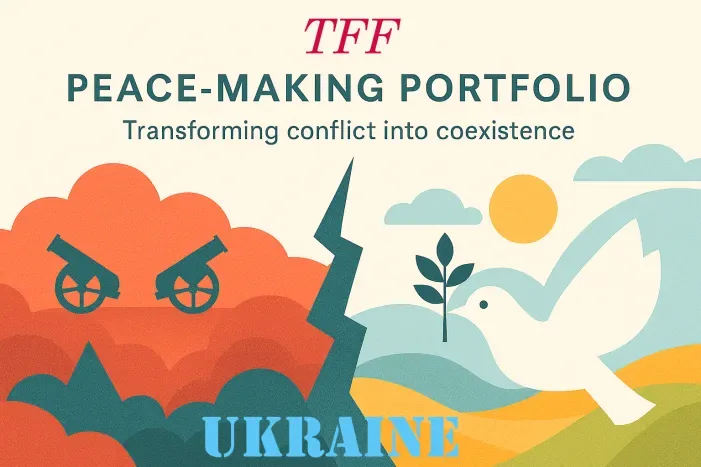
UNITE-tillid, DREAM-velstand og andre konstruktive komponenter Normally we publish articles in English here. But this is a translation of a very important TFF document that should reach as many as possible in Denmark since this country’s government has been one of the most hardline in Europe and, up till now at least, has refused to use diplomacy and, instead, spent tremendous sums on arming Ukraine with the express goal of defeating Russia. Thus this – unique – article is in Danish. Vi er Johnny Baltzersen og hans Fælles Sikkerhed – Fælles Fremtid på Substack overmåde taknemmelige for at have oversat og publiceret TFF’s 2025-portfølje for fredsidéer med henblik på Ukraines fremtid. Vi håber den nu kan nå mange flere danskere – som også vil sprede den og skabe debat – nu den danske regerings og folketingspartiernes politik på dette område siden 2022 står nu – forudsigeligt – ved vejs ende....
JoGSS-Silent
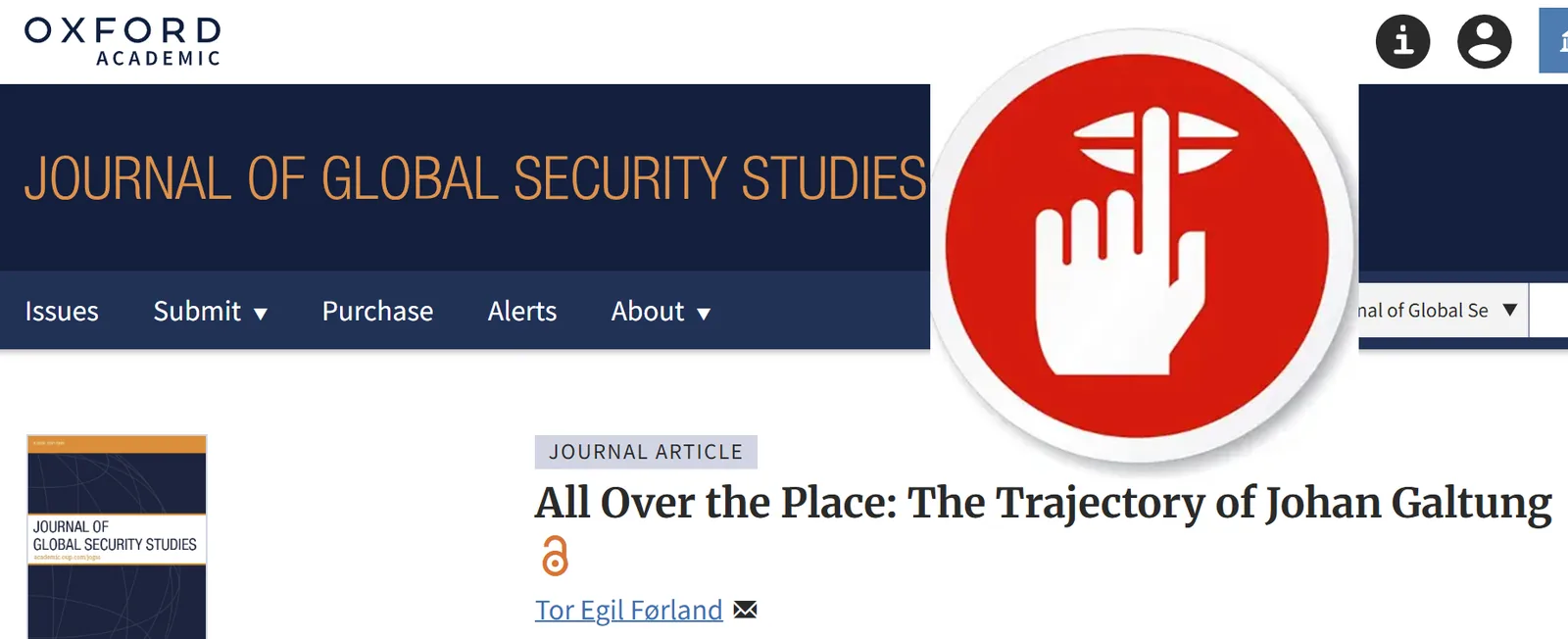
Jan Oberg TFF director October 28, 2026 Exactly one month has now passed since I published my criticism of the introduction to the special issue on Johan Galtung published by the Journal of Global Security Studies, JoGSS, and of Tor Egil Førland’s chapter about Galtung which serves as a preview to his forthcoming biography of Galtung to be published by PRIO. See the original on The Transnational here and the same article on TFF Substack with many general and critical comments and, in particular, the people who decided to withdraw from the biography project in protest. The special issue itself was extraordinary. It was devoted to the intellectual legacy of one of the founders of peace research and contained a number of strong assessments of his personality, scholarship, intellectual trajectory, and public role. Such assessments are, of course, entirely legitimate. No scholar is beyond criticism, and neither was Johan Galtung....