By Stephen Zunes

In another resolution apparently designed to prepare for war against Iran, the U.S. House of Representatives, in an overwhelmingly bipartisan 401–11 vote, has passed a resolution (HR 568) urging the president to oppose any policy toward Iran “that would rely on containment as an option in response to the Iranian nuclear threat.”

With its earlier decision to pass a bill that effectively sought to ban any negotiations between the United States and Iran, a huge bipartisan majority of Congress has essentially told the president that nothing short of war or the threat of war is an acceptable policy. Indeed, the rush to pass this bill appears to have been designed to undermine the ongoing international negotiations on Iran’s nuclear program. According to Iranian-American analyst Jamal Abdi, a prominent critic of both the Iranian regime and U.S. policy, the motivation for the resolution may be to “poison those talks by signaling to Iran that the President is weak, domestically isolated, and unable to deliver at the negotiating table because a hawkish Congress will overrule him.”

President Obama’s “red line” on Iran — the point at which his administration would consider taking military action against the country — has been the reactionary regime’s actual procurement of nuclear weapons. The language of this resolution, however, significantly lowers the bar by declaring it unacceptable for Iran simply to have “nuclear weapons capability” — not necessarily any actual weapons or an active nuclear weapons program. Some members of Congress have argued that since Iranians have the expertise and technological capacity to develop nuclear weapons, they already have “nuclear weapons capability.” The hawkish Senator Joe Lieberman (I-CT) has argued that “everybody will determine for themselves what [capability] means.”

In case there was any doubt about the intent of Congress in using this language, when Senator Rand Paul (R-KY) offered a clarifying amendment to a similar clause in a recent Senate resolution — declaring that “nothing in the Act shall be construed as a declaration of war or an authorization of the use of force against Iran” — both its Republican and Democratic sponsors summarily rejected the amendment.

Colonel Lawrence Wilkerson, former chief of staff for Secretary of State Colin Powell, noted how “this resolution reads like the same sheet of music that got us into the Iraq war, and could be the precursor for a war with Iran. It’s effectively a thinly-disguised effort to bless war.”

As the liberal Zionist group Americans for Peace Now observed, the legislation suggests that “unless sanctions imminently result in Iran voluntarily shutting down its entire nuclear program (and somehow deleting the nuclear know-how from the brains of its scientists), military force will be the only option available to the Obama Administration and will be inevitable in the near term.”

Though it is not legally binding, the resolution does limit the president’s options politically. As pundit and former Capitol Hill staffer M. J. Rosenberg has noted, the bill was “designed to tie the president’s hands on Iran policy.” And, as with the case of Iraq, the language of such non-binding resolutions can easily be incorporated into binding legislation, citing the precedent of what had been passed previously.

The End of Containment

There is enormous significance to the resolution’s insistence that containment, which has been the basis of U.S. defense policy for decades, should no longer be U.S. policy in dealing with potential threats. Although deterrence may have been an acceptable policy in response to the thousands of powerful Soviet nuclear weapons mounted on intercontinental ballistic missile systems aimed at the United States, the view today is that deterrence is somehow inadequate for dealing with a developing country capable of developing small and crude nuclear devices but lacking long-range delivery systems.

Indeed, this broad bipartisan consensus against deterrence marks the triumph of the neoconservative first-strike policy, once considered on the extreme fringes when first articulated in the 1980s.

This dangerous embrace of neoconservative military policy is now so widely accepted by both parties in Congress that the vote on the resolution was taken under a procedure known as “suspension of the rules,” which is designed for non-controversial bills passed quickly with little debate. Indeed, given the serious implications of this legislation, it is striking that there was not a single congressional hearing prior to the vote.

The resolution also demonstrates that the vast majority of Democrats, like Republicans, have embraced the concept of “full-spectrum dominance,” the Bush-era doctrine that not only should the United States prevent the emergence of another rival global superpower such as China, but it should also resist the emergence of even a regional power, such as Iran, that could potentially deter unilateral U.S. military actions or other projections of American domination.

Limiting the President

It is unprecedented for Congress to so vigorously seek to limit a president’s non-military options in foreign policy. For example, in 1962, even the most right-wing Republicans in Congress did not push for legislation insisting that President Kennedy rule out options other than attacking Cuba or the Soviet Union during the Cuban missile crisis. What might be motivating Congress is the fact that, in electing Barack Obama in 2008, the American people brought into the White House an outspoken opponent of the U.S. invasion of Iraq who not only withdrew U.S. combat forces from that country but promised to “change the mindset” – the idea that the United States could unilaterally make war against oil-rich Middle Eastern countries that did not accept U.S. domination – that made the Iraq war possible. Both Democratic and Republican hawks, therefore, appear determined to force this moderate president to accept their neoconservative agenda.

Deterrence, when dealing with a nuclear-armed party, is indeed a risky strategy. The international community does have an interest in preventing Iran from developing nuclear weapons, as well as in forcing India, Pakistan, and Israel to disarm their already-existing arsenals. All reasonable diplomatic means should be pursued to create and maintain a nuclear-free zone in that volatile region.

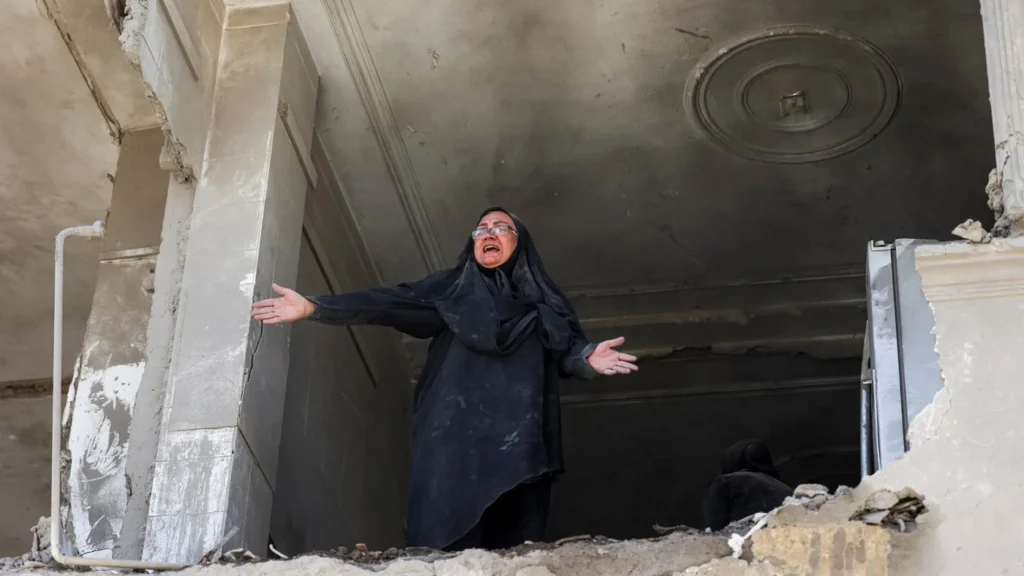
However, the idea that deterrence against Iran would not work because the country’s clerical leadership, which controls the armed forces, would decide to launch an unprovoked nuclear attack against Israel or the United States — and therefore invite massive nuclear retaliation that would cause the physical destruction of their entire country — is utterly ridiculous. The far more realistic risk to worry about is the enormous devastation that would result from a U.S. war on Iran.

The real “threat” from Iran is if that country achieves nuclear capability, it would then have a deterrent to a U.S. attack that was unavailable to its immediate neighbors to the east (Afghanistan) and west (Iraq), both of which were invaded by U.S.-led forces. Both Democrats and Republicans appear to be united in their belief that no country should stand in the way of the unilateral projection of military force by the United States or its allies.

Indeed, this resolution is not about the national security of the United States, nor is it about the security of Israel. It is about continuing U.S. hegemony over the world’s most oil-rich region.
Related Posts

Jan Oberg TFF director October 13, 2026 According to Alfred Nobel’s will, the Nobel Peace Prize shall be awarded: ”to the person who has done the most or best to advance fellowship among nations, the abolition or reduction of standing armies, and the establishment and promotion of peace congresses.” Further down, he also expresses how the prize for the “champions of peace” shall be decided: “that for champions of peace by a committee of five persons to be selected by the Norwegian Storting. Alfred Nobel’s will is remarkably short and clear. But few seem to have read it. Nobel did not say that the committee itself should consist of members of parliament. He entrusted the Storting with appointing five persons. In principle, it could have selected diplomats, mediators, peace researchers, conflict-resolution specialists, or other individuals with recognised expertise in matters of peace from around the world. Instead, the Storting gradually...
Small and different + among the 10% most active + 9,000 texts + 150 Associates + 60 000 a day — and a stubborn belief that peace is smarter and must be secured by peaceful means. In 2026, the Transnational Foundation for Peace and Future Research (TFF) turns 40. On Monday, October 5, 2026, a new TFF homepage will go live — a new gateway to more than 9,000 articles, analyses, research papers and other contributions produced over four decades of independent peace research. But this is not simply a new website. For four decades, TFF has worked from a simple conviction: peace is smarter than militarism and can be brought about by peaceful means. This is not merely an aspiration. It is the principle expressed in the UN Charter and the Gandhian tradition that has guided our work from the beginning. TFF is a research-based, independent and people-financed foundation....
It’s a matter of principles, courage, vision and pulling together – while the militarist world is falling apart… Peter Langille October 3, 2026 “Here, then, is the problem which we present to you, stark and dreadful and inescapable: Shall we put an end to the human race; or shall mankind renounce war?”The Bertrand Russell—Albert Einstein Manifesto, July 9, 1955 ⁕ The forecast for what’s ahead is worrisome. The sharp rise in armed conflicts over the past three years is adding to what was already the highest level in over seventy years. Genocides, which should be prevented are supported. A shared climate emergency that jeopardises survival is ignored. Diverse polls now suggest that people are war-weary, worried and interested in a more effective United Nations. And, there are viable policy options for a more secure world! Yet governments are doubling-down, betting on more war and investing heavily. If current trends persist,...

Recent Articles

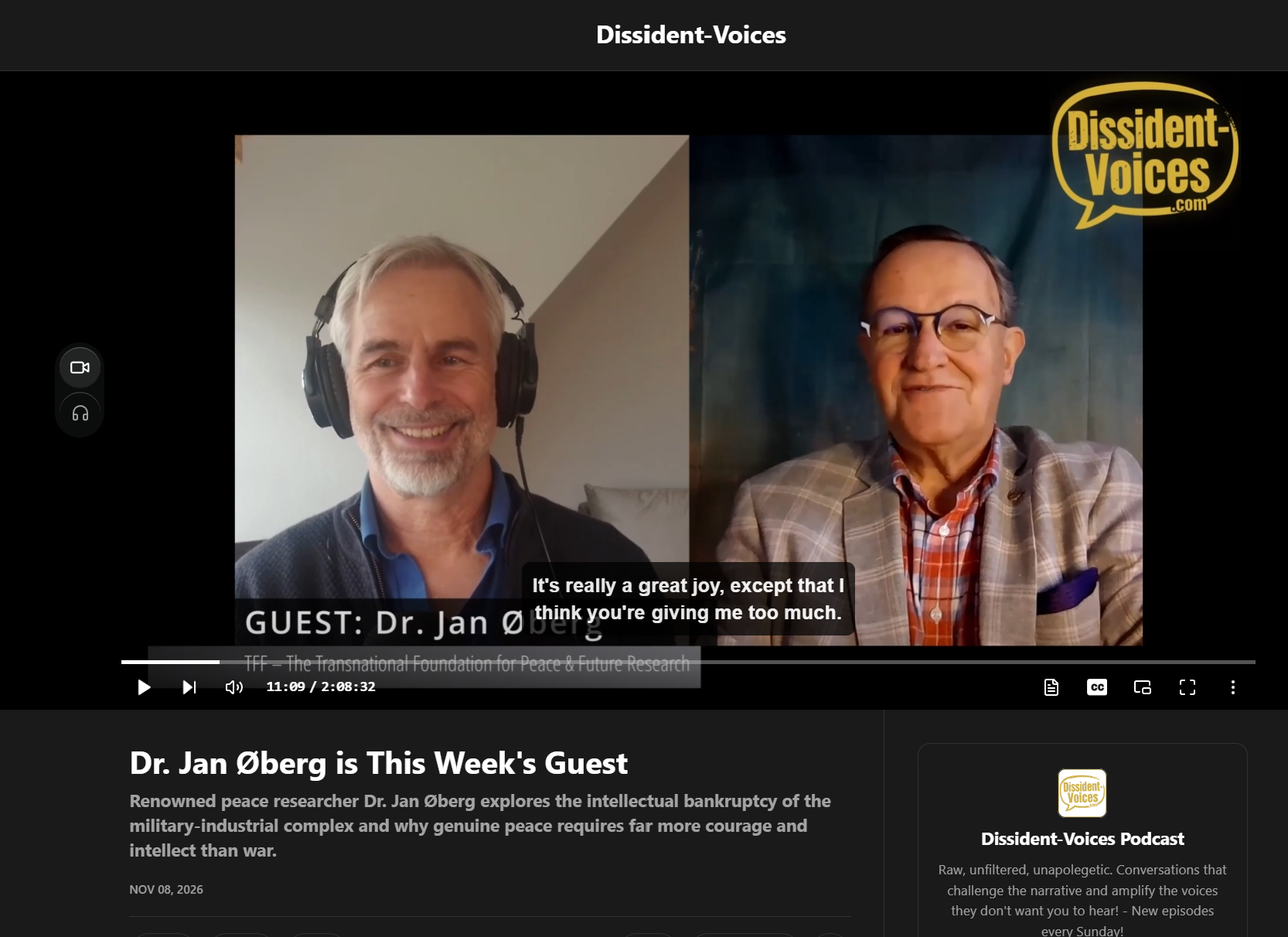
Serious but also a lot of laughs and positive energy. Because peace is also about conviviality and enchantment… Jan Oberg, TFF director November 16, 2026 This is a long (129 minutes) conversation with me. We cover very many, also personal, issues that makes a somewhat unusual media event. I am very grateful to Flemming Blicher for giving me this opportunity. I can’t remember any channel or editor who spent as much time as he did preparing it – including also asking me to answer a series of pre-interview questions, which are now posted under the conversation. If you sympathise with its content, please share it. Watch it here
A Message from Jan Oberg November 6, 2026 Over the past fifty years, I have devoted roughly 175,000 hours to research and public education for a more peaceful world: thinking, researching, writing, organising, publishing, debating, maintaining websites, corresponding, reaching out, leading a foundation, work in conflict and war zones, professorships, teaching courses and giving public lectures and doing media work. In short, ten hours a day, seven days a week, for half a century. The focus was on international political peace – analysing and trying to stop wars, address underlying conflicts and making alternative peace plans – at the desk and on the ground. Important as that has been and remains, it is only one kind of peace and it is now in a tragic militarist state compared with what it could have been.  Lately, however, I have found myself thinking about a concept from economics as well as everyday...
Photo above: Carl Fredrik Reuterswärd’s Non-Violence outside UN Headquarters in New York. Kirill Levin, CC BY-NC-SA 2. Jan Oberg November 3, 2026 I am happy to be published in Horizons which is produced by the Center for International Relations and Sustainable Development, CIRSD, in Belgrade. My contribution brings out a radical re-thinking of what concepts such as defence, security, deterrence – and peace – may mean if we want to create a more peaceful world. It also summarises a few things I have been working with the last few decades. Please read it here Og her er den på dansk, takket være Johnny Baltzersens lynhurtige oversættelse

TFF on Substack

Discover and subscribe to more peace materials on TFF Substack

Most Popular

Serious but also a lot of laughs and positive energy. Because peace is also about conviviality and enchantment… Jan Oberg, TFF director November 16, 2026 This is a long (129 minutes) conversation with me. We cover very many, also personal, issues that makes a somewhat unusual media event. I am very grateful to Flemming Blicher for giving me this opportunity. I can’t remember any channel or editor who spent as much time as he did preparing it – including also asking me to answer a series of pre-interview questions, which are now posted under the conversation. If you sympathise with its content, please share it. Watch it here
A Message from Jan Oberg November 6, 2026 Over the past fifty years, I have devoted roughly 175,000 hours to research and public education for a more peaceful world: thinking, researching, writing, organising, publishing, debating, maintaining websites, corresponding, reaching out, leading a foundation, work in conflict and war zones, professorships, teaching courses and giving public lectures and doing media work. In short, ten hours a day, seven days a week, for half a century. The focus was on international political peace – analysing and trying to stop wars, address underlying conflicts and making alternative peace plans – at the desk and on the ground. Important as that has been and remains, it is only one kind of peace and it is now in a tragic militarist state compared with what it could have been.  Lately, however, I have found myself thinking about a concept from economics as well as everyday...
Photo above: Carl Fredrik Reuterswärd’s Non-Violence outside UN Headquarters in New York. Kirill Levin, CC BY-NC-SA 2. Jan Oberg November 3, 2026 I am happy to be published in Horizons which is produced by the Center for International Relations and Sustainable Development, CIRSD, in Belgrade. My contribution brings out a radical re-thinking of what concepts such as defence, security, deterrence – and peace – may mean if we want to create a more peaceful world. It also summarises a few things I have been working with the last few decades. Please read it here Og her er den på dansk, takket være Johnny Baltzersens lynhurtige oversættelse
Read More
Screenshot 2026-11-10 174455
Serious but also a lot of laughs and positive energy. Because peace is also about conviviality and enchantment… Jan Oberg, TFF director November 16, 2026 This is a long (129 minutes) conversation with me. We cover very many, also personal, issues that makes a somewhat unusual media event. I am very grateful to Flemming Blicher for giving me this opportunity. I can’t remember any channel or editor who spent as much time as he did preparing it – including also asking me to answer a series of pre-interview questions, which are now posted under the conversation. If you sympathise with its content, please share it. Watch it here
AbstractVision_2017_#1_800 (kopia)
A Message from Jan Oberg November 6, 2026 Over the past fifty years, I have devoted roughly 175,000 hours to research and public education for a more peaceful world: thinking, researching, writing, organising, publishing, debating, maintaining websites, corresponding, reaching out, leading a foundation, work in conflict and war zones, professorships, teaching courses and giving public lectures and doing media work. In short, ten hours a day, seven days a week, for half a century. The focus was on international political peace – analysing and trying to stop wars, address underlying conflicts and making alternative peace plans – at the desk and on the ground. Important as that has been and remains, it is only one kind of peace and it is now in a tragic militarist state compared with what it could have been.  Lately, however, I have found myself thinking about a concept from economics as well as everyday...
knotted gun
Photo above: Carl Fredrik Reuterswärd’s Non-Violence outside UN Headquarters in New York. Kirill Levin, CC BY-NC-SA 2. Jan Oberg November 3, 2026 I am happy to be published in Horizons which is produced by the Center for International Relations and Sustainable Development, CIRSD, in Belgrade. My contribution brings out a radical re-thinking of what concepts such as defence, security, deterrence – and peace – may mean if we want to create a more peaceful world. It also summarises a few things I have been working with the last few decades. Please read it here Og her er den på dansk, takket være Johnny Baltzersens lynhurtige oversættelse
TFFPortfolioVign
UNITE-tillid, DREAM-velstand og andre konstruktive komponenter Normally we publish articles in English here. But this is a translation of a very important TFF document that should reach as many as possible in Denmark since this country’s government has been one of the most hardline in Europe and, up till now at least, has refused to use diplomacy and, instead, spent tremendous sums on arming Ukraine with the express goal of defeating Russia. Thus this – unique – article is in Danish. Vi er Johnny Baltzersen og hans Fælles Sikkerhed – Fælles Fremtid på Substack overmåde taknemmelige for at have oversat og publiceret TFF’s 2025-portfølje for fredsidéer med henblik på Ukraines fremtid. Vi håber den nu kan nå mange flere danskere – som også vil sprede den og skabe debat – nu den danske regerings og folketingspartiernes politik på dette område siden 2022 står nu – forudsigeligt – ved vejs ende....
JoGSS-Silent
Jan Oberg TFF director October 28, 2026 Exactly one month has now passed since I published my criticism of the introduction to the special issue on Johan Galtung published by the Journal of Global Security Studies, JoGSS, and of Tor Egil Førland’s chapter about Galtung which serves as a preview to his forthcoming biography of Galtung to be published by PRIO. See the original on The Transnational here and the same article on TFF Substack with many general and critical comments and, in particular, the people who decided to withdraw from the biography project in protest. The special issue itself was extraordinary. It was devoted to the intellectual legacy of one of the founders of peace research and contained a number of strong assessments of his personality, scholarship, intellectual trajectory, and public role. Such assessments are, of course, entirely legitimate. No scholar is beyond criticism, and neither was Johan Galtung....
Screenshot 2026-10-26 115647
An aspect of Iran’s culture and civilisation you’ve probably never heard about. Don’t be surprised if the US and Israel also try to bomb them. Jan ObergTFF director October 26, 2026 Today – under the “USraeli” threat of new “annihilating” bombings – opens the 7th International Conference on Peace and Conflict Resolution at Tehran’s University. As far as I can tell, this is the only permanent, advanced peace research institution in West Asia/the Middle East. Perhaps more countries in that region could be inspired? I mean, how many military “security” institutes and military academies do they have? Many peace research institutes and university departments have been established since the 1950s in the West. They are now all under attack; some have closed down, some have gone mainstream, yet others kept the name but do nothing to research peace and disseminate results or advice; instead, they cooperate with militarism’s platforms such...