
Jan Oberg

November 28, 2025

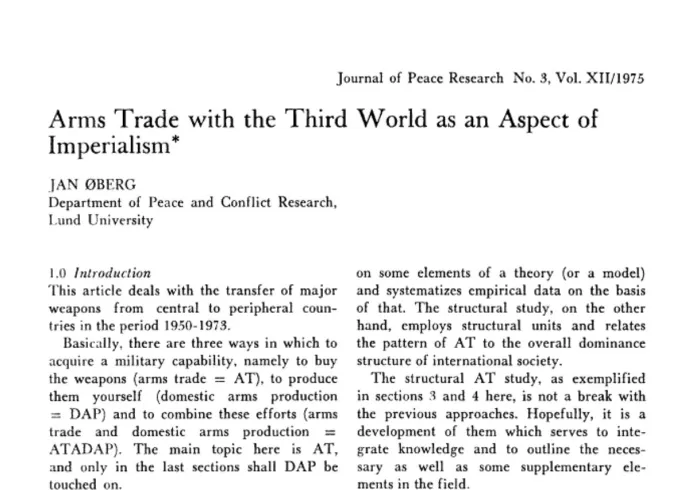
It is hardly of any importance to the world, but it is to me as a peace scholar, TFF co-founder and director: On September 1, 2025, it was 50 years since I got my first article published in what was the flagship of peace and conflict research, The Journal of Peace Research, JPR, published out PRIO, Peace Research Institute Oslo – both founded by one of my mentors, Johan Galtung (1930-2024).

See it here and here.

I was 24 at the time, and it meant everything to me to achieve the honour and recognition of being published in that distinguished journal. While I had begun to follow peace studies at Lund University, courses directed by my other mentor, Håkan Wiberg (1942-2010), in 1972 – I had not dared call myself a peace scholar. I was working towards my PhD in sociology, and sociology was still my primary focus.

In 1974, Wiberg suggested I take some courses at the IUC – Inter-University Centre – in Dubrovnik, Yugoslavia, whose director at the time was Johan Galtung. I think that settled my fate and “career” choice. Since the publication of this article, I have seen myself as a peace and conflict researcher or a peace and future researcher. After my PhD in 1983, I also became a docent in peace research, i.e. wrote a second PhD-size book.

Håkan , more than anyone, assisted me in writing this arms trade article, but I vividly remember the very important contributions to it also made by Johan, Ulrich Albrecht, and Raimo Väyrynen.

I’ve asked AI CoPilot what it could say about this article now 50 years later. What I got was this:

“Øberg’s framing of the arms trade as a “feudal pattern” of dependency was cited in later works examining how a few supplier states (US, USSR, UK, France) dominated weapons flows to the Global South.
His work was often referenced alongside SIPRI’s 1975 study The Arms Trade with the Third World, which provided empirical data while Øberg offered a more theoretical critique of imperialism.
Scholars in peace research and international relations used Øberg’s article to highlight the structural inequalities embedded in arms transfers, linking them to broader debates on
dependency theory and imperialism.
In the late 1970s and early 1980s, peace researchers and political economists cited Øberg when discussing: Militarization of the Third World and its impact on development. The political economy of arms trade, especially in relation to dependency and imperialism. Comparative studies of US vs. Soviet arms exports. His article was part of a wave of critical scholarship that treated arms trade not just as a technical issue, but as a structural instrument of global dominance. It helped establish a critical tradition in peace research that continues to inform debates on arms control, disarmament, and the ethics of weapons exports.”

Quite nice to read!

I shall abstain here from reflecting on the world’s arms trade today and the global militarism that has become rampant in all four corners of the world, but predominantly in the Western-NATO minority world. It is tragic beyond words that those of us who tried to warn the world about the trends that lead to violence and war have either not been good or numerous enough or not been listened to, or both.

I shall also refrain from comments on what happened to academic peace research in the Nordic countries – where it had one of it centres worldwide – and how most of it has either been closed down or transformed into security and geopolitical military research. That is what happened also to SIPRI, as I have written in a couple of articles.

I spent a lot of time in SIPRI’s arms trade data collection department to be able to write the mentioned article. Those were the days when SIPRI did peace research, and I had the honour of meeting both its then-director Frank Barnaby and its founding mother, Alva Myrdal. They would rotate in their graves if they knew that today’s SIPRI is financed mainly by NATO countries and, on top of all its publications, calls itself The source on global security where it used to say peace.

Many peace people have been killed because they were for peace and challenged every aspect of militarism. So too organisations and virtually all centres for true peace research – which is an academic endeavour to reduce all types of violence and to suggest ways to channel the saved human and other resources into a more peaceful world for all. Simple – and dangerous – as that!


PhD, Peace & future researcher + ‌Art Photographer, Professor Emeritus and media commentator

2 Responses

  1. Nice read, I am not much younger than you and obtained my degree in 1986 at the School of Peace Studies at Bradford University. It is only in the last few years that I have been able to put my previous training to good use through serving as a UN Observer. Unfortunately the UN is now under attack and Irarely hear any of the staff at the School of Peace Studies being interviewed by the press as in the past.

  2. Peace activists can be seen as marketers or promoters of peace. slogan /slō′gən/ noun: A phrase expressing the aims or nature of an enterprise, organization, or candidate; a motto. A phrase used repeatedly, as in advertising or promotion. My top gift wish this Christmas is the world peace activist community adopts and puts to use the straightforward slogan: “War is stupid.”, which could – would – then develop into an enlargement of global debate regarding the wisdom or stupidity of war. One can envision future articles, podcasts, even corporate media headlines, such as the following, based on the journalistic questions of who, what, when, where and why. “Who are the World’s Most Stupid, Dangerous War Mongers?” “What Drives People into Launching Stupid Wars?” “When Did People First Become Cheerleaders for Stupid Wars?” “Where is it Written Wars are NOT Stupid?” … and the most direct, “Why Are There Still Stupid Wars?” Etc., etc., etc. … “It does not require many words to speak the truth.” – Chief Joseph “War is stupid.” … Spread the word. Peace.

Related Posts

Photo above: Carl Fredrik Reuterswärd’s Non-Violence outside UN Headquarters in New York. Kirill Levin, CC BY-NC-SA 2. Jan Oberg November 3, 2026 I am happy to be published in Horizons which is produced by the Center for International Relations and Sustainable Development, CIRSD, in Belgrade. My contribution brings out a radical re-thinking of what concepts such as defence, security, deterrence – and peace – may mean if we want to create a more peaceful world. It also summarises a few things I have been working with the last few decades. Please read it here Og her er den på dansk, takket være Johnny Baltzersens lynhurtige oversættelse
UNITE-tillid, DREAM-velstand og andre konstruktive komponenter Normally we publish articles in English here. But this is a translation of a very important TFF document that should reach as many as possible in Denmark since this country’s government has been one of the most hardline in Europe and, up till now at least, has refused to use diplomacy and, instead, spent tremendous sums on arming Ukraine with the express goal of defeating Russia. Thus this – unique – article is in Danish. Vi er Johnny Baltzersen og hans Fælles Sikkerhed – Fælles Fremtid på Substack overmåde taknemmelige for at have oversat og publiceret TFF’s 2025-portfølje for fredsidéer med henblik på Ukraines fremtid. Vi håber den nu kan nå mange flere danskere – som også vil sprede den og skabe debat – nu den danske regerings og folketingspartiernes politik på dette område siden 2022 står nu – forudsigeligt – ved vejs ende....
Jan Oberg TFF director October 28, 2026 Exactly one month has now passed since I published my criticism of the introduction to the special issue on Johan Galtung published by the Journal of Global Security Studies, JoGSS, and of Tor Egil Førland’s chapter about Galtung which serves as a preview to his forthcoming biography of Galtung to be published by PRIO. See the original on The Transnational here and the same article on TFF Substack with many general and critical comments and, in particular, the people who decided to withdraw from the biography project in protest. The special issue itself was extraordinary. It was devoted to the intellectual legacy of one of the founders of peace research and contained a number of strong assessments of his personality, scholarship, intellectual trajectory, and public role. Such assessments are, of course, entirely legitimate. No scholar is beyond criticism, and neither was Johan Galtung....

Recent Articles

Photo above: Carl Fredrik Reuterswärd’s Non-Violence outside UN Headquarters in New York. Kirill Levin, CC BY-NC-SA 2. Jan Oberg November 3, 2026 I am happy to be published in Horizons which is produced by the Center for International Relations and Sustainable Development, CIRSD, in Belgrade. My contribution brings out a radical re-thinking of what concepts such as defence, security, deterrence – and peace – may mean if we want to create a more peaceful world. It also summarises a few things I have been working with the last few decades. Please read it here Og her er den på dansk, takket være Johnny Baltzersens lynhurtige oversættelse
UNITE-tillid, DREAM-velstand og andre konstruktive komponenter Normally we publish articles in English here. But this is a translation of a very important TFF document that should reach as many as possible in Denmark since this country’s government has been one of the most hardline in Europe and, up till now at least, has refused to use diplomacy and, instead, spent tremendous sums on arming Ukraine with the express goal of defeating Russia. Thus this – unique – article is in Danish. Vi er Johnny Baltzersen og hans Fælles Sikkerhed – Fælles Fremtid på Substack overmåde taknemmelige for at have oversat og publiceret TFF’s 2025-portfølje for fredsidéer med henblik på Ukraines fremtid. Vi håber den nu kan nå mange flere danskere – som også vil sprede den og skabe debat – nu den danske regerings og folketingspartiernes politik på dette område siden 2022 står nu – forudsigeligt – ved vejs ende....
Jan Oberg TFF director October 28, 2026 Exactly one month has now passed since I published my criticism of the introduction to the special issue on Johan Galtung published by the Journal of Global Security Studies, JoGSS, and of Tor Egil Førland’s chapter about Galtung which serves as a preview to his forthcoming biography of Galtung to be published by PRIO. See the original on The Transnational here and the same article on TFF Substack with many general and critical comments and, in particular, the people who decided to withdraw from the biography project in protest. The special issue itself was extraordinary. It was devoted to the intellectual legacy of one of the founders of peace research and contained a number of strong assessments of his personality, scholarship, intellectual trajectory, and public role. Such assessments are, of course, entirely legitimate. No scholar is beyond criticism, and neither was Johan Galtung....

TFF on Substack

Discover and subscribe to more peace materials on TFF Substack

Most Popular

Photo above: Carl Fredrik Reuterswärd’s Non-Violence outside UN Headquarters in New York. Kirill Levin, CC BY-NC-SA 2. Jan Oberg November 3, 2026 I am happy to be published in Horizons which is produced by the Center for International Relations and Sustainable Development, CIRSD, in Belgrade. My contribution brings out a radical re-thinking of what concepts such as defence, security, deterrence – and peace – may mean if we want to create a more peaceful world. It also summarises a few things I have been working with the last few decades. Please read it here Og her er den på dansk, takket være Johnny Baltzersens lynhurtige oversættelse
UNITE-tillid, DREAM-velstand og andre konstruktive komponenter Normally we publish articles in English here. But this is a translation of a very important TFF document that should reach as many as possible in Denmark since this country’s government has been one of the most hardline in Europe and, up till now at least, has refused to use diplomacy and, instead, spent tremendous sums on arming Ukraine with the express goal of defeating Russia. Thus this – unique – article is in Danish. Vi er Johnny Baltzersen og hans Fælles Sikkerhed – Fælles Fremtid på Substack overmåde taknemmelige for at have oversat og publiceret TFF’s 2025-portfølje for fredsidéer med henblik på Ukraines fremtid. Vi håber den nu kan nå mange flere danskere – som også vil sprede den og skabe debat – nu den danske regerings og folketingspartiernes politik på dette område siden 2022 står nu – forudsigeligt – ved vejs ende....
Jan Oberg TFF director October 28, 2026 Exactly one month has now passed since I published my criticism of the introduction to the special issue on Johan Galtung published by the Journal of Global Security Studies, JoGSS, and of Tor Egil Førland’s chapter about Galtung which serves as a preview to his forthcoming biography of Galtung to be published by PRIO. See the original on The Transnational here and the same article on TFF Substack with many general and critical comments and, in particular, the people who decided to withdraw from the biography project in protest. The special issue itself was extraordinary. It was devoted to the intellectual legacy of one of the founders of peace research and contained a number of strong assessments of his personality, scholarship, intellectual trajectory, and public role. Such assessments are, of course, entirely legitimate. No scholar is beyond criticism, and neither was Johan Galtung....
Read More
knotted gun
Photo above: Carl Fredrik Reuterswärd’s Non-Violence outside UN Headquarters in New York. Kirill Levin, CC BY-NC-SA 2. Jan Oberg November 3, 2026 I am happy to be published in Horizons which is produced by the Center for International Relations and Sustainable Development, CIRSD, in Belgrade. My contribution brings out a radical re-thinking of what concepts such as defence, security, deterrence – and peace – may mean if we want to create a more peaceful world. It also summarises a few things I have been working with the last few decades. Please read it here Og her er den på dansk, takket være Johnny Baltzersens lynhurtige oversættelse
TFFPortfolioVign
UNITE-tillid, DREAM-velstand og andre konstruktive komponenter Normally we publish articles in English here. But this is a translation of a very important TFF document that should reach as many as possible in Denmark since this country’s government has been one of the most hardline in Europe and, up till now at least, has refused to use diplomacy and, instead, spent tremendous sums on arming Ukraine with the express goal of defeating Russia. Thus this – unique – article is in Danish. Vi er Johnny Baltzersen og hans Fælles Sikkerhed – Fælles Fremtid på Substack overmåde taknemmelige for at have oversat og publiceret TFF’s 2025-portfølje for fredsidéer med henblik på Ukraines fremtid. Vi håber den nu kan nå mange flere danskere – som også vil sprede den og skabe debat – nu den danske regerings og folketingspartiernes politik på dette område siden 2022 står nu – forudsigeligt – ved vejs ende....
JoGSS-Silent
Jan Oberg TFF director October 28, 2026 Exactly one month has now passed since I published my criticism of the introduction to the special issue on Johan Galtung published by the Journal of Global Security Studies, JoGSS, and of Tor Egil Førland’s chapter about Galtung which serves as a preview to his forthcoming biography of Galtung to be published by PRIO. See the original on The Transnational here and the same article on TFF Substack with many general and critical comments and, in particular, the people who decided to withdraw from the biography project in protest. The special issue itself was extraordinary. It was devoted to the intellectual legacy of one of the founders of peace research and contained a number of strong assessments of his personality, scholarship, intellectual trajectory, and public role. Such assessments are, of course, entirely legitimate. No scholar is beyond criticism, and neither was Johan Galtung....
Screenshot 2026-10-26 115647
An aspect of Iran’s culture and civilisation you’ve probably never heard about. Don’t be surprised if the US and Israel also try to bomb them. Jan ObergTFF director October 26, 2026 Today – under the “USraeli” threat of new “annihilating” bombings – opens the 7th International Conference on Peace and Conflict Resolution at Tehran’s University. As far as I can tell, this is the only permanent, advanced peace research institution in West Asia/the Middle East. Perhaps more countries in that region could be inspired? I mean, how many military “security” institutes and military academies do they have? Many peace research institutes and university departments have been established since the 1950s in the West. They are now all under attack; some have closed down, some have gone mainstream, yet others kept the name but do nothing to research peace and disseminate results or advice; instead, they cooperate with militarism’s platforms such...
Screenshot 2026-10-15 141837
Let’s discuss using AI to create peace – in contrast to boring geopolitics devoid of creative healing and visions. Jan Oberg TFF director October 15, 2026 I asked VEED to create a short video exemplifying how peace is preferable to war, then chose the lady as a template. Simple as that. In less than a minute, it produced this video, which any peace-loving person would appreciate. The only problem is that human intelligence (HI), at least the one that exists among Western decision-makers, isn’t half as moral or smart as AI. I have used AI to dialogue about peace and peace plans, creative conflict resolution and visions of a better future for humankind. It so happens that I am having more stimulating, intelligent, creative and moral discussions with AI than I could possibly have with any EU or NATO leader today. Yes, AI has very problematic and dangerous aspects; used...
girl-5894831_1280
Below are TFF-related media mentions, comments, videos and social media posts published elsewhere but not on this homepage. We happen to catch and list only a fraction. Regarding video comments and debates, we recommend that you go to the TFF Video Channel on Substack where many of them are reproduced. Jan Oberg is a contributor to China Daily – 52 million daily clicks – and Global Times, CGTN and CCTV (the national television), China Investment, Xinhua News Agency and several others. Articles and videos on these media very often multiply into countless Chinese (and Western media) that re-post them from these main media. Thanks to The China Academy, his analyses, interviews and comments are frequently posted on YouTube channels such as Thinkers Forum and Wave Media. These videos are often re-posted on Bilibili (China’s YouTube), the China Content Center on TikTok, and on the Chinese edition of TikTok, Douyin.com. This means reaching hundreds of millions of viewers worldwide over a year. While there are too many to catch on all these...




