NATO Rutte’s Berlin Speech: Not About Russia, But About the End of Rational Politics

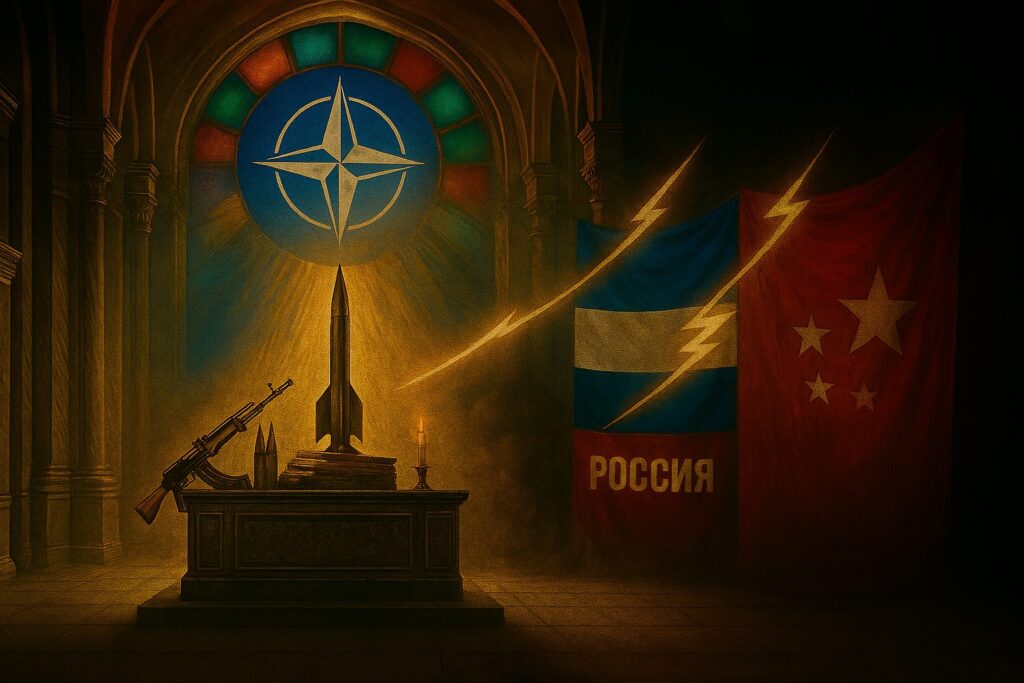
Inside NATO’s cathedral of fear, weapons become sacraments and projection becomes liturgy. From the stained-glass altar, thunderous light strikes Russia and China — not as analysis, but as ritual. This is not about Putin. It is about the West’s collapse into psycho-political theatre.

Jan Oberg

December 12, 2025

Mark Rutte’s Berlin speech in December 2025 has been hailed as a wake‑up call for NATO. But the deeper truth is this: Rutte’s speech is not about Russia and China at all. It is about NATO itself, and about the fundamental transformation of politics into psycho‑political theatre where rational policy has become impossible. The “red threat” he invoked is less an empirical reality than a stage device in a liturgical performance.

From Policy to Performance

Compared with a good month ago, Rutte’s purpose is alarm/urgency instead of agreement/consensus. His tone is existential/dramatic instead of pragmatic/institutional. His focus was on the survival of Europe instead of the credibility of NATO, and hinting that more than 5% of GNP may be needed. His threat perception is now that “Russia is already at our doorstep,” and that China is behind it, where it was a more general enemy image and Ukraine focus in November 2025. Significantly and amateurishly, he condescendingly calls Putin “this guy.” These are very significant escalatory changes.

Watch the full speech here, delivered about 13 minutes after that of the German foreign minister, Wadephul, which is an intellectual bottom feeder in poor English. And here is NATO’s transcript of Rutte’s speech, should you prefer to study it more closely.

Politics once meant rational calculation: weighing interests, negotiating compromises, balancing costs and probabilities. That paradigm has collapsed. In its place stands a new order: politics as performance. Leaders no longer persuade with evidence; they dramatise with sermons. Rutte’s Berlin speech exemplifies this shift. His words were not analytical but eschatological: “Russia is already at our door. NATO and Europe could be Putin’s next target.” This is not policy analysis; it is liturgy. (See postscript below, too).

NATO as Church

The speech revealed NATO’s metamorphosis into a church‑like institution.

  • Doctrine: NATO embodies goodness; Russia embodies evil.
  • Congregation: The Military‑Industrial‑Media‑Academic Complex, MIMC, causes and repeats the creed.
  • Rituals: Summits, communiqués, budget votes, press conferences, and speeches function as sacred ceremonies.
  • Eschatology: The apocalypse — Russia’s attack — is always imminent, never arriving, sustaining endless vigilance and ever larger military expenditures. Never peace. That is not the purpose.

In this church, Rutte plays the priest. His sermon is not about Russia’s actual capabilities or intentions; it is about reaffirming NATO’s faith in its own innocence and moral superiority. The congregation responds with offerings: pledges of 5% GDP for defence, tithes to the military‑industrial altar.

Psycho‑Pathological Rhetoric

Rutte’s rhetoric falls squarely into a tradition that includes Saddam Hussein, George W. Bush, and Adolf Hitler. Each claimed to be surrounded by enemies, each insisted on the necessity of defence, and each justified aggression by projecting evil onto the other side. The formula is always the same: we are threatened all the way around, and we must defend ourselves — no matter the reality.

Hitler invoked Versailles and “Jewish Bolshevism” to justify expansion. Saddam invoked imperialism and Zionism to justify repression and war. Bush invoked weapons of mass destruction to justify the invasion. Rutte invokes Putin to justify NATO’s expansion and militarisation. The psycho‑pathological script is identical: paranoia, projection, eschatology, and self‑sanctification.

And here lies the danger: there is an increasing risk that the Rutte‑type of performance, whether intended or not, will have the same consequence for Europe as Hitler’s did. Once politics becomes theatre of paranoia, escalation is not a possibility but a destiny.

The Absurd Stage

The absurdity of this transformation is striking. It resembles Ionesco’s The Chairs, where the stage fills with empty chairs until there is no room left for the characters themselves. In NATO’s theatre, the “chairs” are weapons, budgets, and warnings — multiplying endlessly until politics itself disappears. The room is filled with arsenals, slogans, and rituals, leaving no space for rational analysis or genuine diplomacy.

Groupthink thrives in this closed theatre. Leaders, media, and academics repeat the same refrains, trapped inside the box of paranoia. The more they echo each other, the less reality intrudes. The absurdity is not comic but tragic: a self‑reinforcing ritual that consumes substance and replaces it with performance.

The Red Threat as Stage Device

The “red threat” is not a description of Russia’s actual power. NATO remains technologically superior, vastly richer, and more expansive than Russia. Yet Rutte insists NATO is fragile, vulnerable, at risk of annihilation. This inversion of reality is the hallmark of absurd theatre: the stronger actor plays the victim, the weaker is cast as omnipotent aggressor. The red threat is a stage device, a prop that sustains the liturgy of fear.

Why Politics Has Changed

Readers will ask: Why has politics changed so dramatically? The answer lies in the decline of the West itself. The United States, NATO, and the European Union are facing the long arc of imperial exhaustion. Economic stagnation, social fragmentation, and geopolitical overreach have eroded confidence. As substance weakens, performance intensifies. The sermon replaces the policy because the empire no longer has coherent strategies to offer.

Rutte’s speech is therefore not only a symptom of NATO’s paranoia but of the West’s decline. The liturgical theatre of threat and innocence is the last refuge of a system that senses its own fragility. The louder the sermons, the weaker the empire beneath them.

The Existential Change

The tragic fact is that Rutte’s speech demonstrates the end of rational politics. There is no longer space for cohesive, analytical policy. What remains is performance: sermons of paranoia, rituals of spending, choruses of media repetition. Politics has mutated into psycho‑religious theatre, where leaders preach, congregations respond, and the apocalypse is always imminent.

Thus, the speech is not about Russia and China at all. It is about NATO’s transformation into a church of paranoia and projection in which the sermon itself is the policy. The red threat is not a geopolitical reality but a liturgical necessity. And in this theatre — absurd, pathological, and imperial in decline — substance has vanished; only performance remains.

Post‑script

The tragic transformation of politics described above makes it rather meaningless for an organisation like TFF to continue publishing rational analyses, as if today’s world were still guided by reason, concepts from peace research, international relations, or political science. With few exceptions, the omnipresent geo‑politico‑military day-to-day commentators do not seem to have noticed this change and speak now into a vacuum — into something that once existed but no longer does.

As TFF turns 40 on January 1, 2026, we therefore move in new directions – or do the same with new means and perspectives: toward idea‑producing visions and conceptual innovations that humanity will need in the multi‑nodal, networking world that will emerge after the fall of the US/Western empire and its institutions.

Our basic mission remains the same: Promoting the UN norm of making peace by peaceful means. But either you adapt the methods and perspectives to the ways of the world or you perish – or stop. TFF does not stop. We believe in the fundamental – superior – values of nonviolence, educated conflict-management and peacemaking over primitive and kakistocratic urges of militarism and pathological war-mongering in the name of fake peace.

◩
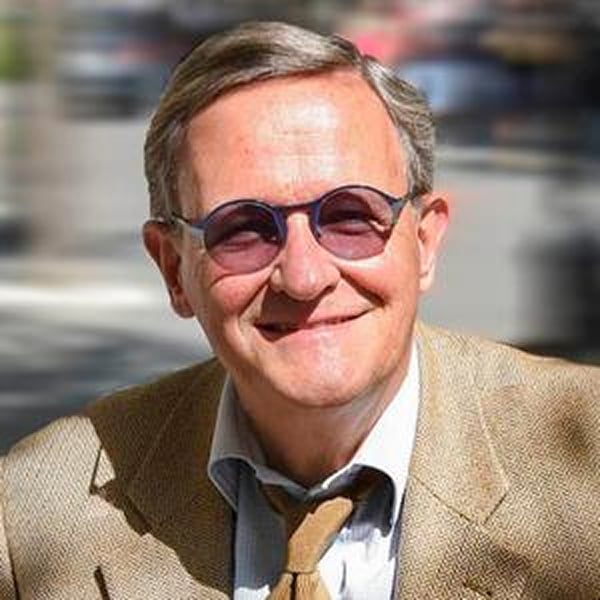
PhD, Peace & future researcher + ‌Art Photographer, Professor Emeritus and media commentator

One Response

  1. . Comparison with a cult is obvious. . There is a continuity from the Roman military campaign that began 2000 years ago, on the initiative of the Flavius family; formulated in the Bible’s “New Testament”, to what is unfolding in the West today. . It is originally based on divine emperors and tyrannical monetism. It is easy to recognize the power structures throughout the period, up to the present day. The pathological character of leaders emerge throughout the period, for example in Rutte (but also in the previous Na†o secretaries, Anders Fogh Rasmussen and Jens Stoltenberg, who both lead the war forward under new auspices). . Today, “the god” is called “mammon” and tyrannical monotheism, alias “the unipolar world order”, or the “security council” of the UN or “the international community” (consisting of the “collective west’s” share of the total world population, only 12%!) . This is expressed through the Christian tradition, with a passivated civilian population and outward aggression from central leadership. The idea of perfection – “the one true god”, the infallibility of the leaders and the 99% of the civilian population, “born in sin”. Based on the idea of perfection, there is a risk of looking at the outside world as “something less than perfect”; simply because it is different. From here, it is not far to the missionary, the creation of reality-distorted enemy images and foolish wars. . The Western project fulfills several of the criteria for a death cult, where the preferred solution is often to “eliminate the problem”, eliminate it – war – death – often called “the final solution”. . A grammatical amendment: na†o – then the context will be clearer. . It sounds exciting with the prospect of your new navigation principles. I’ve been thinking about the idea for a long time. I am convinced that it will bear new and nourishing fruit for your activities. . Respectfully O .

Related Posts

Jan Oberg TFF director October 13, 2026 According to Alfred Nobel’s will, the Nobel Peace Prize shall be awarded: ”to the person who has done the most or best to advance fellowship among nations, the abolition or reduction of standing armies, and the establishment and promotion of peace congresses.” Further down, he also expresses how the prize for the “champions of peace” shall be decided: “that for champions of peace by a committee of five persons to be selected by the Norwegian Storting. Alfred Nobel’s will is remarkably short and clear. But few seem to have read it. Nobel did not say that the committee itself should consist of members of parliament. He entrusted the Storting with appointing five persons. In principle, it could have selected diplomats, mediators, peace researchers, conflict-resolution specialists, or other individuals with recognised expertise in matters of peace from around the world. Instead, the Storting gradually...
Small and different + among the 10% most active + 9,000 texts + 150 Associates + 60 000 a day — and a stubborn belief that peace is smarter and must be secured by peaceful means. In 2026, the Transnational Foundation for Peace and Future Research (TFF) turns 40. On Monday, October 5, 2026, a new TFF homepage will go live — a new gateway to more than 9,000 articles, analyses, research papers and other contributions produced over four decades of independent peace research. But this is not simply a new website. For four decades, TFF has worked from a simple conviction: peace is smarter than militarism and can be brought about by peaceful means. This is not merely an aspiration. It is the principle expressed in the UN Charter and the Gandhian tradition that has guided our work from the beginning. TFF is a research-based, independent and people-financed foundation....
It’s a matter of principles, courage, vision and pulling together – while the militarist world is falling apart… Peter Langille October 3, 2026 “Here, then, is the problem which we present to you, stark and dreadful and inescapable: Shall we put an end to the human race; or shall mankind renounce war?”The Bertrand Russell—Albert Einstein Manifesto, July 9, 1955 ⁕ The forecast for what’s ahead is worrisome. The sharp rise in armed conflicts over the past three years is adding to what was already the highest level in over seventy years. Genocides, which should be prevented are supported. A shared climate emergency that jeopardises survival is ignored. Diverse polls now suggest that people are war-weary, worried and interested in a more effective United Nations. And, there are viable policy options for a more secure world! Yet governments are doubling-down, betting on more war and investing heavily. If current trends persist,...

Recent Articles

Serious but also a lot of laughs and positive energy. Because peace is also about conviviality and enchantment… Jan Oberg, TFF director November 16, 2026 This is a long (129 minutes) conversation with me. We cover very many, also personal, issues that makes a somewhat unusual media event. I am very grateful to Flemming Blicher for giving me this opportunity. I can’t remember any channel or editor who spent as much time as he did preparing it – including also asking me to answer a series of pre-interview questions, which are now posted under the conversation. If you sympathise with its content, please share it. Watch it here
A Message from Jan Oberg November 6, 2026 Over the past fifty years, I have devoted roughly 175,000 hours to research and public education for a more peaceful world: thinking, researching, writing, organising, publishing, debating, maintaining websites, corresponding, reaching out, leading a foundation, work in conflict and war zones, professorships, teaching courses and giving public lectures and doing media work. In short, ten hours a day, seven days a week, for half a century. The focus was on international political peace – analysing and trying to stop wars, address underlying conflicts and making alternative peace plans – at the desk and on the ground. Important as that has been and remains, it is only one kind of peace and it is now in a tragic militarist state compared with what it could have been.  Lately, however, I have found myself thinking about a concept from economics as well as everyday...
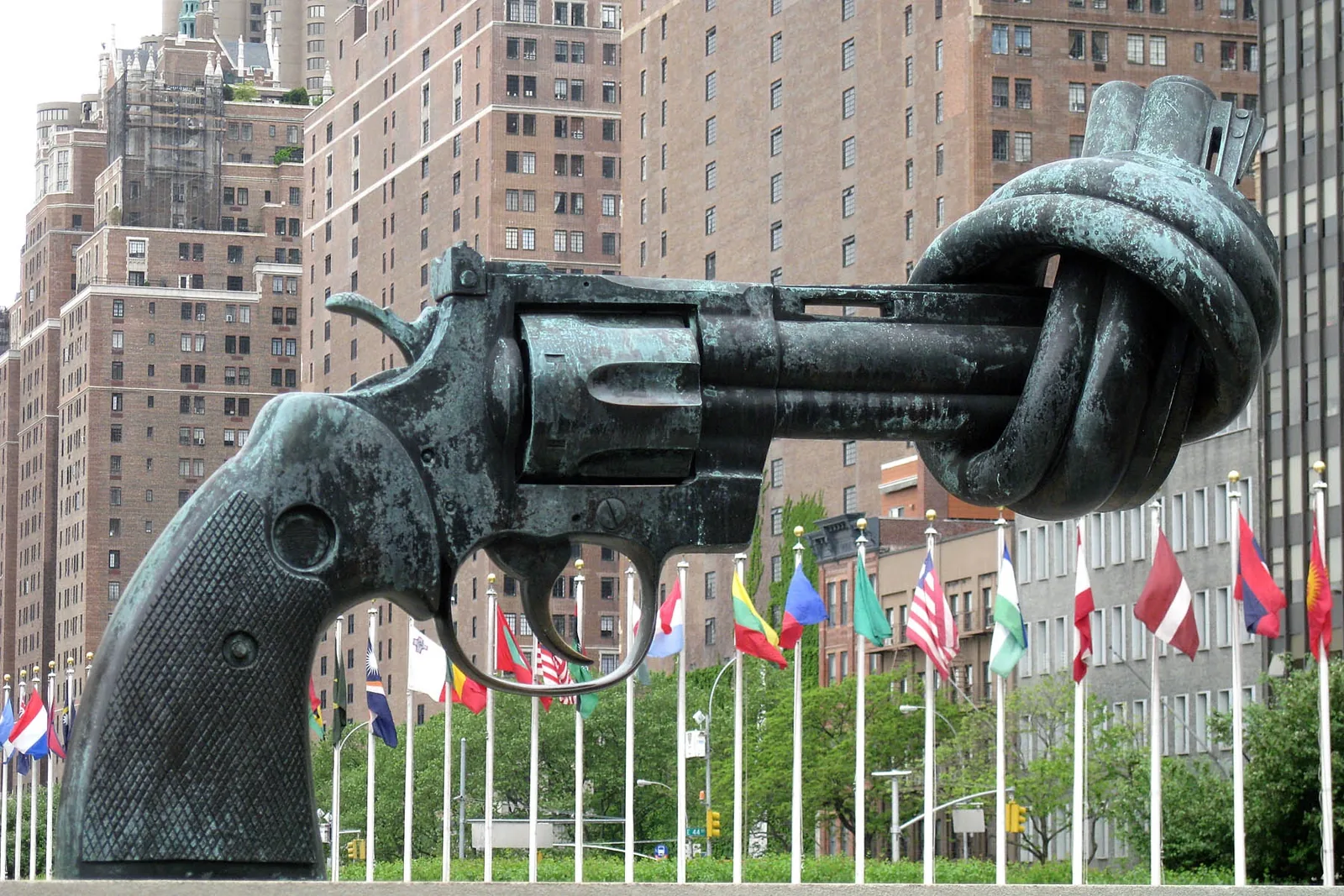
Photo above: Carl Fredrik Reuterswärd’s Non-Violence outside UN Headquarters in New York. Kirill Levin, CC BY-NC-SA 2. Jan Oberg November 3, 2026 I am happy to be published in Horizons which is produced by the Center for International Relations and Sustainable Development, CIRSD, in Belgrade. My contribution brings out a radical re-thinking of what concepts such as defence, security, deterrence – and peace – may mean if we want to create a more peaceful world. It also summarises a few things I have been working with the last few decades. Please read it here Og her er den på dansk, takket være Johnny Baltzersens lynhurtige oversættelse

TFF on Substack

Discover and subscribe to more peace materials on TFF Substack

Most Popular

Serious but also a lot of laughs and positive energy. Because peace is also about conviviality and enchantment… Jan Oberg, TFF director November 16, 2026 This is a long (129 minutes) conversation with me. We cover very many, also personal, issues that makes a somewhat unusual media event. I am very grateful to Flemming Blicher for giving me this opportunity. I can’t remember any channel or editor who spent as much time as he did preparing it – including also asking me to answer a series of pre-interview questions, which are now posted under the conversation. If you sympathise with its content, please share it. Watch it here
A Message from Jan Oberg November 6, 2026 Over the past fifty years, I have devoted roughly 175,000 hours to research and public education for a more peaceful world: thinking, researching, writing, organising, publishing, debating, maintaining websites, corresponding, reaching out, leading a foundation, work in conflict and war zones, professorships, teaching courses and giving public lectures and doing media work. In short, ten hours a day, seven days a week, for half a century. The focus was on international political peace – analysing and trying to stop wars, address underlying conflicts and making alternative peace plans – at the desk and on the ground. Important as that has been and remains, it is only one kind of peace and it is now in a tragic militarist state compared with what it could have been.  Lately, however, I have found myself thinking about a concept from economics as well as everyday...
Photo above: Carl Fredrik Reuterswärd’s Non-Violence outside UN Headquarters in New York. Kirill Levin, CC BY-NC-SA 2. Jan Oberg November 3, 2026 I am happy to be published in Horizons which is produced by the Center for International Relations and Sustainable Development, CIRSD, in Belgrade. My contribution brings out a radical re-thinking of what concepts such as defence, security, deterrence – and peace – may mean if we want to create a more peaceful world. It also summarises a few things I have been working with the last few decades. Please read it here Og her er den på dansk, takket være Johnny Baltzersens lynhurtige oversættelse
Read More
Screenshot 2026-11-10 174455
Serious but also a lot of laughs and positive energy. Because peace is also about conviviality and enchantment… Jan Oberg, TFF director November 16, 2026 This is a long (129 minutes) conversation with me. We cover very many, also personal, issues that makes a somewhat unusual media event. I am very grateful to Flemming Blicher for giving me this opportunity. I can’t remember any channel or editor who spent as much time as he did preparing it – including also asking me to answer a series of pre-interview questions, which are now posted under the conversation. If you sympathise with its content, please share it. Watch it here
AbstractVision_2017_#1_800 (kopia)
A Message from Jan Oberg November 6, 2026 Over the past fifty years, I have devoted roughly 175,000 hours to research and public education for a more peaceful world: thinking, researching, writing, organising, publishing, debating, maintaining websites, corresponding, reaching out, leading a foundation, work in conflict and war zones, professorships, teaching courses and giving public lectures and doing media work. In short, ten hours a day, seven days a week, for half a century. The focus was on international political peace – analysing and trying to stop wars, address underlying conflicts and making alternative peace plans – at the desk and on the ground. Important as that has been and remains, it is only one kind of peace and it is now in a tragic militarist state compared with what it could have been.  Lately, however, I have found myself thinking about a concept from economics as well as everyday...
knotted gun
Photo above: Carl Fredrik Reuterswärd’s Non-Violence outside UN Headquarters in New York. Kirill Levin, CC BY-NC-SA 2. Jan Oberg November 3, 2026 I am happy to be published in Horizons which is produced by the Center for International Relations and Sustainable Development, CIRSD, in Belgrade. My contribution brings out a radical re-thinking of what concepts such as defence, security, deterrence – and peace – may mean if we want to create a more peaceful world. It also summarises a few things I have been working with the last few decades. Please read it here Og her er den på dansk, takket være Johnny Baltzersens lynhurtige oversættelse
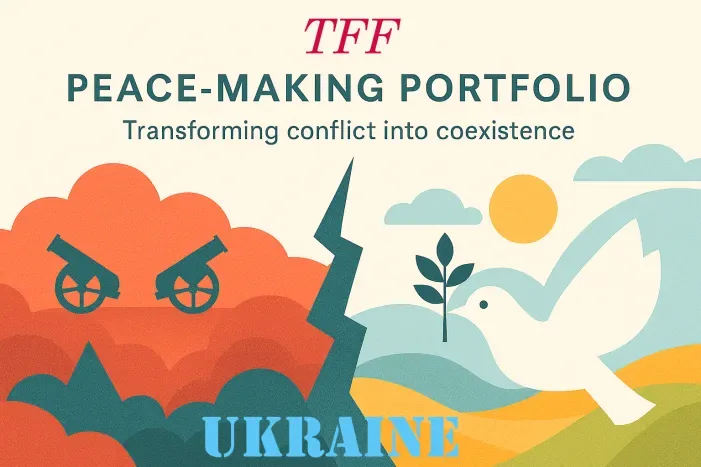
TFFPortfolioVign
UNITE-tillid, DREAM-velstand og andre konstruktive komponenter Normally we publish articles in English here. But this is a translation of a very important TFF document that should reach as many as possible in Denmark since this country’s government has been one of the most hardline in Europe and, up till now at least, has refused to use diplomacy and, instead, spent tremendous sums on arming Ukraine with the express goal of defeating Russia. Thus this – unique – article is in Danish. Vi er Johnny Baltzersen og hans Fælles Sikkerhed – Fælles Fremtid på Substack overmåde taknemmelige for at have oversat og publiceret TFF’s 2025-portfølje for fredsidéer med henblik på Ukraines fremtid. Vi håber den nu kan nå mange flere danskere – som også vil sprede den og skabe debat – nu den danske regerings og folketingspartiernes politik på dette område siden 2022 står nu – forudsigeligt – ved vejs ende....
JoGSS-Silent
Jan Oberg TFF director October 28, 2026 Exactly one month has now passed since I published my criticism of the introduction to the special issue on Johan Galtung published by the Journal of Global Security Studies, JoGSS, and of Tor Egil Førland’s chapter about Galtung which serves as a preview to his forthcoming biography of Galtung to be published by PRIO. See the original on The Transnational here and the same article on TFF Substack with many general and critical comments and, in particular, the people who decided to withdraw from the biography project in protest. The special issue itself was extraordinary. It was devoted to the intellectual legacy of one of the founders of peace research and contained a number of strong assessments of his personality, scholarship, intellectual trajectory, and public role. Such assessments are, of course, entirely legitimate. No scholar is beyond criticism, and neither was Johan Galtung....
Screenshot 2026-10-26 115647
An aspect of Iran’s culture and civilisation you’ve probably never heard about. Don’t be surprised if the US and Israel also try to bomb them. Jan ObergTFF director October 26, 2026 Today – under the “USraeli” threat of new “annihilating” bombings – opens the 7th International Conference on Peace and Conflict Resolution at Tehran’s University. As far as I can tell, this is the only permanent, advanced peace research institution in West Asia/the Middle East. Perhaps more countries in that region could be inspired? I mean, how many military “security” institutes and military academies do they have? Many peace research institutes and university departments have been established since the 1950s in the West. They are now all under attack; some have closed down, some have gone mainstream, yet others kept the name but do nothing to research peace and disseminate results or advice; instead, they cooperate with militarism’s platforms such...