
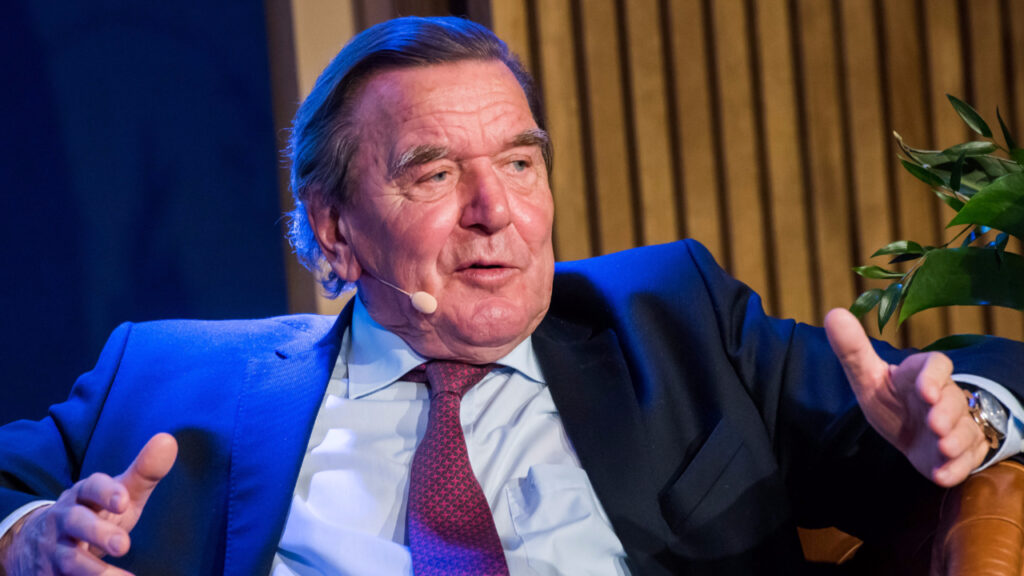
Gerhard Schroeder’s revelations about why negotiations broke down last spring are even more depressing than you might think. Why did the US/NATO world want the war to continue when it could have been stopped long ago?
Tarik Cyril Amar*
October 26, 2023
In a much-cited interview, ex-German chancellor Gerhard Schroeder has stated that a compromise peace to end the war in Ukraine was well within reach when negotiators met in Istanbul last spring. This deal would have meant an end to NATO’s long march east, Ukrainian neutrality, international security guarantees, and domestic arrangements to reintegrate the separatist territories in the Donbass.
Ending the war so quickly would have made a great difference, as even a few basic figures will show. While key data remains secret and estimates are contested, it is certain that Europe’s largest conflict since World War II has led to several hundred thousand military casualties. Figures for fully documented civilian casualties are much lower, but the UN cautions that they must be under-counts.
Originally published by RT – Russia Today – on October 25, 2023 here.
The global body also says there are more than 6.2 million recorded Ukrainian refugees globally (almost all of them in Russia and Western and Central Europe) and 5.1 million internally displaced persons.
According to the World Bank, Ukraine’s GDP dropped by almost a third in 2022, pushing a quarter of the country’s population below the poverty line. Insofar as the country’s economic outlook has since slightly improved, this is due to the massive infusion of Western funds, which are surely making corruption even worse. As of March, the cost of reconstruction was estimated at $411 billion over ten years.
Some of this devastation had already occurred when the Istanbul talks collapsed. Yet most of it was still to come. So was an ever-more abysmal deterioration of the West’s relations with the rest of the world in general and an increased risk of global war.
Schroeder is a lifelong, savvy politician with a ruthless streak. He has been criticized for his good relationship with Russia. Skeptics may doubt his reliability or impartiality. Yet, whatever you think about the ex-chancellor, there is no sound reason not to believe him on this matter. He has plausible insider knowledge about the negotiations. At the time, he was helping make contact between Kiev and Moscow (at Ukraine’s request), and he refers to his conversations with the Ukrainian chief negotiator Rustem Umerov (now minister of defense), Russian President Vladimir Putin, and other representatives of Russia.
Schroeder’s comments also largely converge with other evidence. Last year, Ukrainskaya Pravda – under no suspicion of favoring Russia – reported that a peace deal had been reached but was abandoned at the last minute after the intervention of then-British Prime Minister Boris Johnson. Russian Foreign Minister Sergey Lavrov has endorsed these claims, even while Ukrainskaya Pravda has withdrawn them, certainly under political pressure.
The foreign policy expert – and former adviser of President Trump – Fiona Hill, who has never shown partiality for Russia, has provided further evidence in an article in Foreign Affairs. Naftali Bennett, the former Israeli prime minister and a key international mediator in spring 2022, later revealed that the West, with Washington in the lead, blocked his efforts.
Details vary, but in essence, Schroeder’s recent statement chimes with all of the above. With so much evidence accumulating, the jury is no longer out. At the very least, there was a substantial opportunity for a compromise peace agreed by Russia and Ukraine last spring.
We must also acknowledge that it was not scuppered by events in Ukraine, not even the killing of civilians in Bucha (which Kiev and the West blame on Russia but Moscow claims was “entirely staged” by Ukraine). Instead, it was scuppered by Washington’s decision not to allow Kiev – and the world – take this offramp. Tragically for Ukraine, it was a proxy that was deemed too valuable to be allowed to retire. None of this absolves the Zelensky government of its responsibility for obeying Washington. In a bitter irony, a leader who won’t tire of invoking Ukraine’s sovereignty and “agency” failed to assert them when he could have saved his country.
If there is growing clarity about what happened back then, two important questions remain: Why was the US unwilling to let the war end? And what does all of this mean for the present moment and, possibly, the future?
Regarding Washington’s motives in spring 2022, Bennett is probably right: The Biden administration was optimistic that it could keep “striking” and even defeat Russia in Ukraine. Continuing the war seemed advantageous to it: Russia would at least suffer a serious geopolitical setback, its military, economy, government, and international standing would be weakened, and the US would prove that, as Biden used to say, it “was back.” By diminishing Russia’s power, the US would also have undermined the partnership between Moscow and Beijing, injuring the single most important geopolitical element of the emerging multipolar order. In addition, delivering such a blow to the old Cold War nemesis and the modern-day challenger would have made up for the embarrassing rout the US had suffered a year before in Afghanistan.
Those who find it hard to square the above analysis with Biden’s early promises to end America’s “forever wars” need to consider two things: Politicians habitually break promises, and Washington did not expect this war to last. Instead, it wagered on Moscow’s relatively quick defeat (clearly before the next election cycle), perhaps even collapse, to be brought about by a combination of Ukrainians, equipped and often trained by the West, some foreign “advisers” and “volunteers,” economic warfare, international isolation, and domestic tension in Russia.
This American optimism was misplaced, as we now know and as could have been understood even then. I know because I did. But let’s set aside a discussion of how America’s leadership got it so wrong. Hubris is common in history and yet always hard to explain; there will be time for that.
Concerning inferences that we can draw for the present and future, they are discouraging, even frightening. It would be wishful thinking to assume that Washington will learn from its errors, at least under this administration. Current American steps regarding Ukraine, but even more so in the Middle East, allow for two interpretations: the US is building up its forces either to “merely” shield Israeli aggression from outside interference or to prepare for a larger war that would probably involve Iran and Syria at least.
It is crucial to understand that in both cases the Americans are doubling down instead of becoming more cautious, because the latter policy would involve bringing in other states as partners (most EU vassals do not count in that respect, as they merely replicate the American line) instead of either locking them out or even threatening them with attack. That much we can observe empirically, without the need for any information – or speculation – about how the administration is coming to its reckless decisions.
Finally, the war in Ukraine has illustrated and entrenched another fact that is reason for pessimism. Asked whether he thinks that what was possible in spring 2022 would still be feasible now, Schroeder said yes, as long as Germany and France would take the initiative. Yet, there he is likely to be wrong. Apart from the fact that Moscow may no longer be willing to make the same compromise, neither Berlin nor Paris have demonstrated the capacity to play an even conditionally independent role. Rather, they are – again, at least under their current governments – submissive toward the US to the point of literal self-harm. It’s a bleak outlook, but there it is: the US persists in a policy of war at any price, and the EU practices obedience at any price.
*About the author
Tarik Cyril Amar, a historian from Germany at Koc University in Istanbul working on Russia, Ukraine and Eastern Europe, the history of World War II, the cultural Cold War, and the politics of memory. He is the author of ‘A Disturbed Silence: Discourse on the Holocaust in the Soviet West as an Anti-Site of Memory’ in the book ‘The Holocaust in the East’, edited by Michael David-Fox, Peter Holquist and Alexander M. Martin. Follow Tarik on X @tarikcyrilamar
Please support TFF also when we bring you stuff you are not supposed to see, like this one behind the censorship wall set up by the West on Russian media.



One Response
US, CANADA, UKRAINE AND RUSSIA 2022 DISPUTES – HISTORICAL BACKGROUND AND SEQUEL TO FR. PETER MORELLO’S COMMENTS: (1) US, Canada, Ukraine and Russia are Caucasian-European nations by ethnic majority and nominally Christian nations by religious majority; (2) Ukraine and Russia are also Slavic nations and neighbors with similar laws (limits) on abortion and LGBT; (3) Russia was US’ supporter in the American Revolution at great cost to herself – the island of Menorca; (4) Russia was US’ supporter in the Civil War when US’ opponents were Britain and France, prompting US Secretary of Navy, Gideon Welles to say “God bless the Russians”; (5) US (western Alaska) and Russia are neighbors, and Canada (northwestern Yukon) is closer to Russia than to Britain and France or Mexico; (6) US and Russia were never at war, not counting the Cold War or proxy wars, as compared, for example, with the “G7” nations; (7) US, Canada, NATO and Ukraine have disputes with Russia since the 1999 NATO bombing of Yugoslavia and militarization of countries neighboring Russia which was invaded over the centuries by NATO members Britain, France, Germany, (Mussolini’s) Italy, Romania, Lithuania-Poland, Turkey and by others including Sweden and the Mongols who inflicted on Ukraine and Russia death and destruction with hardly any parallels in world’s history – Germany also helped Lenin to impose psychopathic and deadly Marxism on Ukraine and Russia in 1917, while Ukraine and Russia, mostly by themselves, prevented Poland’s annihilation by Nazis and saved Europe from Nazi Germany and Mongols; (8) Ukraine and Russia have a border dispute, and a military conflict-war since the violations of the February 21, 2014 all-Ukrainian political agreement in Kiev and the violations of the 2014-2015 Minsk Peace Agreement signed by Ukraine, Russia, Germany and France (in the future, a joint venture by the Minsk signatories in securing Ukrainian segment of “Pan-European” gas pipeline might be a “win-win”) – by February 23, 2022 the war took some 15,000 lives and produced thousands of refugees as well as widespread material destruction in eastern Ukraine; on February 24, 2022 Russia escalated the war and invaded Ukraine resulting in many more deaths, refugees and material destruction across Ukraine; (9) US and Russia can destroy each other and the world with their nuclear weapons in an hour; (10) the irreplaceable way forward for resolving these issues are the eternally-valid biblical principles reflected in President Washington’s Farewell Address in which he called religion-morality the foundation of domestic well-being and peace with other nations and in President Lincoln’s last Inaugural Address “… with malice towards none, with charity for all … among ourselves and with all nations”, as well as in Pope Francis’ 2022 call for prayer and political talks centered on “human brotherhood instead of partisan interests”, all the while keeping in mind the 2022 Lenten message “Remember thou art dust and to dust thou shalt return” and “Repent and believe in the Gospel” which also includes “You shall not bear false witness against your neighbor” and the parable of “the speck and the log” – moral principles given to us by Jesus Christ, the Prince of Peace and the just Judge of the world, principles ignored at one’s great peril. See also https://www.catholicworldreport.com/2022/03/14/expel-evil-spirit-of-war-from-ukraine-with-prayer-and-fasting-urges-catholic-leader & https://paxchristiusa.org/2022/02/24/pax-christi-usas-statement-on-russians-invasion-of-ukraine .