Vijay Prashad: The West must stop blocking negotiations between Ukraine and Russia

Vijay Prashad

December 5th, 2022

Ukrainians have been paying a terrible price for the failure of ensuring sensible and reasonable negotiations from 2014 to February 2022 – which could have prevented the invasion by Russia in the first place, and once the war started, could have led to the end of this war.

Originally posted on People’s Dispatch homepage on October 25th 2022, here

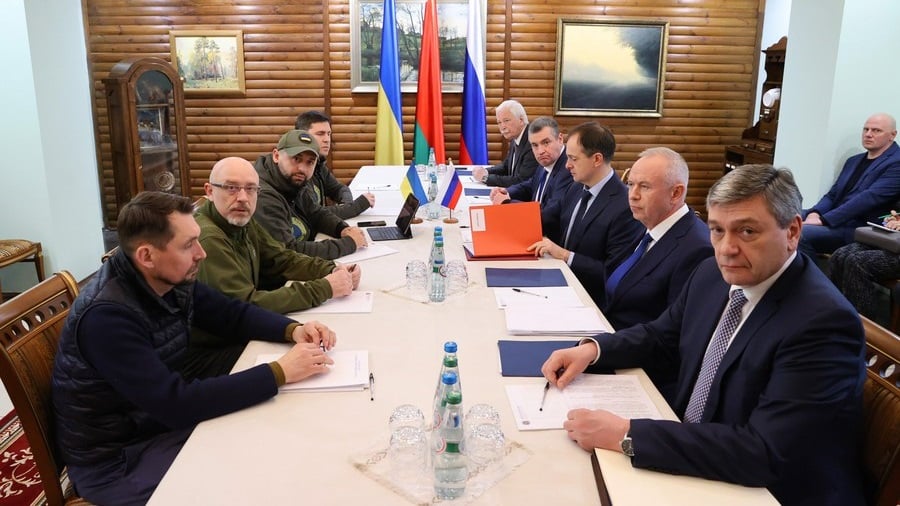
Russia invaded Ukraine on February 24, 2022. This war has been horrendous, though it does not compare with the terrible destruction wrought by the US bombardment of Iraq (“shock and awe”) in 2003. In the Gomel region of Belarus that borders Ukraine, Russian and Ukrainian diplomats met on February 28 to begin negotiations toward a ceasefire. These talks fell apart.

Then, in early March, the two sides met again in Belarus to hold a second and third round of talks. On March 10, the foreign ministers of Ukraine and Russia met in Antalya, Turkey, and finally, at the end of March, senior officials from Ukraine and Russia met in Istanbul, Turkey, thanks to the initiative of Turkey’s President Recep Tayyip Erdoğan.

On March 29, Turkey’s Foreign Minister Mevlüt Çavuşoğlu said, “We are pleased to see that the rapprochement between the parties has increased at every stage. Consensus and common understanding were reached on some issues.” By April, an agreement regarding a tentative interim deal was reached between Russia and Ukraine, according to an article in Foreign Affairs.

In early April, Russian forces began to withdraw from Ukraine’s northern Chernihiv Oblast, which meant that Russia halted military operations around Kyiv, Ukraine’s capital. The United States and the United Kingdom claimed that this withdrawal was a consequence of military failure, while the Russians said it was due to the interim deal. It is impossible to ascertain, with the available facts, which of these two views was correct.

Before the deal could go forward, then-UK Prime Minister Boris Johnson arrived in Kyiv on April 9. A Ukrainian media outlet – Ukrainska Pravda – reported that Johnson carried two messages to Ukraine’s President Volodymyr Zelensky: first, that Russian President Vladimir Putin “should be pressured, not negotiated with,” and second, that even if Ukraine signed agreements with the Kremlin, the West was not ready to do so. According to Ukrainska Pravda, soon after Johnson’s visit, “the bilateral negotiation process was paused.”

A few weeks later, US Secretary of State Antony Blinken and US Secretary of Defense Lloyd Austin visited Kyiv, and following the trip, Austin spoke at a news conference at an undisclosed location in Poland and said, “We want to see Russia weakened.” There is no direct evidence that Johnson, Blinken, and Austin directly pressured Zelensky to withdraw from the interim negotiations, but there is sufficient circumstantial evidence to suggest that this was the case.

The lack of willingness to allow Ukraine to negotiate with Russia predates these visits and was summarized in a March 10, 2022, article in the Washington Post where senior officials in US President Joe Biden’s administration stated that the current US strategy “is to ensure that the economic costs for Russia are severe and sustainable, as well as to continue supporting Ukraine militarily in its effort to inflict as many defeats on Russia as possible.”

Long before the Russian invasion of Ukraine, since 2014, the United States has – through the Ukraine Security Assistance Initiative of the US Department of Defense – spent more than $19 billion in providing training and equipment to the Ukrainian military ($17.6 billion since Russia invaded Ukraine on February 24, 2022). The total annual budget of the United Nations for 2022 is $3.12 billion, far less than the amount spent by the US on Ukraine today. The arming of Ukraine, the statements about weakening Russia by senior officials of the US government, and the refusal to initiate any kind of arms control negotiations prolong a war that is ugly and unnecessary.

Ukraine is not in Iowa

Ukraine and Russia are neighbors. You cannot change the geographical location of Ukraine and move it to Iowa in the United States. This means that Ukraine and Russia have to come to an agreement and find a solution to end the conflict between them. In 2019, Volodymyr Zelensky won by a landslide (73%) in the Ukrainian presidential election against Petro Poroshenko, the preferred candidate of the West. “We will not be able to avoid negotiations between Russia and Ukraine,” Zelensky said on a TV panel, “Pravo Na Vladu,” TSN news service reported, before he became president. In December 2019, Zelensky and Putin met in Paris, alongside then-Chancellor of Germany Angela Merkel and France’s President Emmanuel Macron (known as the “Normandy Four”). This initiative was driven by Macron and Merkel. As early as 2019, France’s President Emmanuel Macron argued that it was time for Europe to “rethink… our relationship with Russia” because “pushing Russia away from Europe is a profound strategic error.”

In March 2020, Zelensky said that he and Putin could work out an agreement within a year based on the Minsk II agreements of February 2015. “There are points in Minsk. If we move them around a bit, then what bad can that lead to? As soon as there are no people with weapons, the shooting will stop. That’s important,” Zelensky told the Guardian. In a December 2019 press conference, Putin said, “there is nothing more important than the Minsk Agreements.” At this point, Putin said that all he expected was that the Donbas region would be given special status in the Ukrainian constitution, and during the time of the expected Ukraine-Russia April 2020 meeting, the troops on both sides would have pulled back and agreed to “disengagement along the entire contact line.”

Role of Macron

It was clear to Macron by 2020 that the point of the negotiations was about more than just Minsk and Ukraine; it was about the creation of a “new security architecture” that did not isolate Russia – and was also not subservient to Washington. Macron developed these points in February 2021 in two directions and spoke about them during his interview with the Atlantic Council (a US think tank).

First, he said that NATO has “pushed our borders as far as possible to the eastern side,” but NATO’s expansion has “not succeeded in reducing the conflicts and threats there.” NATO’s eastward expansion, he made clear, was not going to increase Europe’s security. Second, Macron said that the US unilateral withdrawal from the Intermediate-Range Nuclear Forces Treaty in 2019 – and Russia’s mirroring that – leaves Europe unprotected “against these Russian missiles.”

He further said, “As a European, I want to open a discussion between the European Union and Russia.” Such a discussion would pioneer a post-Cold War understanding of security, which would leave the United States out of the conversation with Russia. None of these proposals from Macron could advance, not only because of hesitancy in Russia but also principally because they were not seen favorably by Washington.

Confusion existed about whether US President Joe Biden would be welcomed into the Normandy Four. In late 2020, Zelensky said he wanted Biden at the table, but a year later it became clear that Russia was not interested in having the United States be part of the Normandy Four. Putin said that the Normandy Four was “self-sufficient.”

Biden, meanwhile, chose to intensify threats and sanctions against Russia based on the claims of Kremlin interference in the United States 2016 and 2018 elections. By December 2021, there was no proper reciprocal dialogue between Biden and Putin. Putin told Finnish President Sauli Niinistö that there was a “need to immediately launch negotiations with the United States and NATO” on security guarantees. In a video call between Biden and Putin on December 7, 2021, the Kremlin told the US president that “Russia is seriously interested in obtaining reliable, legally fixed guarantees that rule out NATO expansion eastward and the deployment of offensive strike weapons systems in states adjacent to Russia.” No such guarantee was forthcoming from Washington. The talks fizzled out.

The record shows that Washington rejected Macron’s initiatives as well as entreaties from Putin and Zelensky to resolve issues through diplomatic dialogue. Up to four days before the Russian invasion, Macron continued his efforts to prevent an escalation of the conflict. By then, the appetite in Moscow for negotiations had dwindled, and Putin rejected Macron’s efforts.

An independent European foreign policy was simply not possible (as Macron had suggested and as the former leader of the Soviet Union Mikhail Gorbachev had proposed in 1989 while talking about his vision for a “common European home” that would stretch from northern Asia to Europe). Nor was an agreement with Russia feasible if it meant that Russian concerns were to be taken seriously by the West.

Ukrainians have been paying a terrible price for the failure of ensuring sensible and reasonable negotiations from 2014 to February 2022 – which could have prevented the invasion by Russia in the first place, and once the war started, could have led to the end of this war. All wars end in negotiations, but these negotiations to end wars should be permitted to restart.

This article was produced by Globetrotter.

Support TFF
Please support TFF’s work for peace through research and public education. We are all-volunteer, people-financed and do not accept money from governments or corporations. In other words, one of the very last free research think tanks in this world – and for a noble purpose: Peace by peaceful – intelligent – means. It is fast, easy and secure. Click here. Thanks!

Vijay Prashad is an Indian historian, editor, and journalist. He is a writing fellow and chief correspondent at Globetrotter. He is an editor of LeftWord Books and the director of Tricontinental: Institute for Social Research. He is a senior non-resident fellow at Chongyang Institute for Financial Studies, Renmin University of China. He has written more than 20 books, including The Darker Nations and The Poorer Nations. His latest books are Struggle Makes Us Human: Learning from Movements for Socialism and (with Noam Chomsky) The Withdrawal: Iraq, Libya, Afghanistan, and the Fragility of U.S. Power.

Related Posts

TFF’s comprehensive proposal for dialogue about true peace in Ukraine is due in a day or two Jan Oberg November 20, 2025 What is being whispered through diplomatic corridors today is not peace, but quackery. The alleged 28‑point plan drafted in Washington and Moscow is mentioned as a solution to the Ukraine war. It is being negotiated by US businessman, real estate developer and Trump ally, Steve Witkoff, and by Kirill Dmitriev, who is CEO of the Russian Direct Investment Fund and a close ally of Putin, according to India’s Economic Times. For presumably good reasons, their education, qualifications and experience in international conflict analysis and peace-making remain untold. They look like surgeons who have never opened a medical textbook. It is nothing more than a mirage: a framework of concessions imposed on Ukraine’s citizens, negotiated without Kyiv, and excluding Europe. Like Gaza, it promises “peace” while institutionalising injustice. If half of what is available about...
Drones over Nordic airports. No damage. No trace. No answers. Most assume Russia—but what if that’s not so? Why is there so much we are not told? This article explores the strategic ambiguity behind recent drone incursions and asks: Who else might benefit from sending drones into NATO airspace? From Ukraine’s surprising drone supremacy to Russia’s possible signalling, the silence itself may be the loudest message. These are the kinds of questions decent, intelligent investigative journalists and commentators could easily research. Why don’t they? Jan Oberg September 29, 2025 Did you, dear reader, know or think of this? That the most powerful weapon in today’s conflicts might be the one that leaves no trace – and no answers. Just enough fear to justify the next move? Recently, drones have repeatedly appeared over Nordic airports and near some military facilities. They cause no damage – for which reason the designation “hybrid attack” is...
This is the third appeal from TFF. The first and the second here. On August 22, 2025, the UN officially declared famine in Gaza. The world’s top authority on food security called for help and said starvation will spread further within the Strip unless fighting stops and much more aid is allowed in. More than half a million people in the Gaza Strip are facing catastrophic hunger conditions, while more than a million more are in a food emergency phase, the report states. This man-made catastrophic famine could have been prevented by a steady flow of humanitarian aid into the enclave, relief chief Tom Fletcher pointed out. “Yet food stacks up at borders because of systematic obstruction by Israel,” Mr. Fletcher said. “It is a famine within a few 100 meters of food in a fertile land.” The UN’s top aid official underscored that the famine in Gaza is “caused by cruelty, justified...

Recent Articles

Below are TFF-related media mentions, comments, videos and social media posts published elsewhere but not on this homepage. We happen to catch and list only a fraction. Regarding video comments and debates, we recommend that you go to the TFF Video Channel on Substack where many of them are reproduced. Jan Oberg is a contributor to China Daily – 52 million daily clicks – and Global Times, CGTN and CCTV (the national television), China Investment, Xinhua News Agency and several others. Articles and videos on these media very often multiply into countless Chinese (and Western media) that re-post them from these main media. Thanks to The China Academy, his analyses, interviews and comments are frequently posted on YouTube channels such as Thinkers Forum and Wave Media. These videos are often re-posted on Bilibili (China’s YouTube), the China Content Center on TikTok, and on the Chinese edition of TikTok, Douyin.com. This means reaching hundreds of millions of viewers worldwide over a year. While there are too many to catch on all these...
Jan Oberg TFF director October 13, 2026 According to Alfred Nobel’s will, the Nobel Peace Prize shall be awarded: ”to the person who has done the most or best to advance fellowship among nations, the abolition or reduction of standing armies, and the establishment and promotion of peace congresses.” Further down, he also expresses how the prize for the “champions of peace” shall be decided: “that for champions of peace by a committee of five persons to be selected by the Norwegian Storting. Alfred Nobel’s will is remarkably short and clear. But few seem to have read it. Nobel did not say that the committee itself should consist of members of parliament. He entrusted the Storting with appointing five persons. In principle, it could have selected diplomats, mediators, peace researchers, conflict-resolution specialists, or other individuals with recognised expertise in matters of peace from around the world. Instead, the Storting gradually...
The Quest for Humane Survival Richard Falk Professor emeritus, Princeton UniversityTFF Associate since 1986October 12, 2026 After decades of teaching and writing about international law in academic frameworks that were not institutionally situated within law school environments—at Princeton and the University of California, Santa Barbara—I found myself most receptive to the TWAIL outlook. It has been especially illuminating in clarifying the extent to which international law evolved as a dialogical critique of Europe’s efforts to legitimize its colonial undertakings. In particular, TWAIL has exposed how international law has functioned to legalize the subjugation of Third World peoples, securing conditions for exploitative investment and trade relations, the coercive enforcement of public debts, and an ideology of cultural superiority. TWAIL’s exposure of these economic legacies of colonialism has influenced my understanding of the history and development of international law, broadly conceived, as an ideological project of the Western sub-system of the world...

TFF on Substack

Discover and subscribe to more peace materials on TFF Substack

Most Popular

Below are TFF-related media mentions, comments, videos and social media posts published elsewhere but not on this homepage. We happen to catch and list only a fraction. Regarding video comments and debates, we recommend that you go to the TFF Video Channel on Substack where many of them are reproduced. Jan Oberg is a contributor to China Daily – 52 million daily clicks – and Global Times, CGTN and CCTV (the national television), China Investment, Xinhua News Agency and several others. Articles and videos on these media very often multiply into countless Chinese (and Western media) that re-post them from these main media. Thanks to The China Academy, his analyses, interviews and comments are frequently posted on YouTube channels such as Thinkers Forum and Wave Media. These videos are often re-posted on Bilibili (China’s YouTube), the China Content Center on TikTok, and on the Chinese edition of TikTok, Douyin.com. This means reaching hundreds of millions of viewers worldwide over a year. While there are too many to catch on all these...
Jan Oberg TFF director October 13, 2026 According to Alfred Nobel’s will, the Nobel Peace Prize shall be awarded: ”to the person who has done the most or best to advance fellowship among nations, the abolition or reduction of standing armies, and the establishment and promotion of peace congresses.” Further down, he also expresses how the prize for the “champions of peace” shall be decided: “that for champions of peace by a committee of five persons to be selected by the Norwegian Storting. Alfred Nobel’s will is remarkably short and clear. But few seem to have read it. Nobel did not say that the committee itself should consist of members of parliament. He entrusted the Storting with appointing five persons. In principle, it could have selected diplomats, mediators, peace researchers, conflict-resolution specialists, or other individuals with recognised expertise in matters of peace from around the world. Instead, the Storting gradually...
The Quest for Humane Survival Richard Falk Professor emeritus, Princeton UniversityTFF Associate since 1986October 12, 2026 After decades of teaching and writing about international law in academic frameworks that were not institutionally situated within law school environments—at Princeton and the University of California, Santa Barbara—I found myself most receptive to the TWAIL outlook. It has been especially illuminating in clarifying the extent to which international law evolved as a dialogical critique of Europe’s efforts to legitimize its colonial undertakings. In particular, TWAIL has exposed how international law has functioned to legalize the subjugation of Third World peoples, securing conditions for exploitative investment and trade relations, the coercive enforcement of public debts, and an ideology of cultural superiority. TWAIL’s exposure of these economic legacies of colonialism has influenced my understanding of the history and development of international law, broadly conceived, as an ideological project of the Western sub-system of the world...
Read More
girl-5894831_1280
Below are TFF-related media mentions, comments, videos and social media posts published elsewhere but not on this homepage. We happen to catch and list only a fraction. Regarding video comments and debates, we recommend that you go to the TFF Video Channel on Substack where many of them are reproduced. Jan Oberg is a contributor to China Daily – 52 million daily clicks – and Global Times, CGTN and CCTV (the national television), China Investment, Xinhua News Agency and several others. Articles and videos on these media very often multiply into countless Chinese (and Western media) that re-post them from these main media. Thanks to The China Academy, his analyses, interviews and comments are frequently posted on YouTube channels such as Thinkers Forum and Wave Media. These videos are often re-posted on Bilibili (China’s YouTube), the China Content Center on TikTok, and on the Chinese edition of TikTok, Douyin.com. This means reaching hundreds of millions of viewers worldwide over a year. While there are too many to catch on all these...
Nobel-Prize-Plaque
Jan Oberg TFF director October 13, 2026 According to Alfred Nobel’s will, the Nobel Peace Prize shall be awarded: ”to the person who has done the most or best to advance fellowship among nations, the abolition or reduction of standing armies, and the establishment and promotion of peace congresses.” Further down, he also expresses how the prize for the “champions of peace” shall be decided: “that for champions of peace by a committee of five persons to be selected by the Norwegian Storting. Alfred Nobel’s will is remarkably short and clear. But few seem to have read it. Nobel did not say that the committee itself should consist of members of parliament. He entrusted the Storting with appointing five persons. In principle, it could have selected diplomats, mediators, peace researchers, conflict-resolution specialists, or other individuals with recognised expertise in matters of peace from around the world. Instead, the Storting gradually...
law-419057_1280
The Quest for Humane Survival Richard Falk Professor emeritus, Princeton UniversityTFF Associate since 1986October 12, 2026 After decades of teaching and writing about international law in academic frameworks that were not institutionally situated within law school environments—at Princeton and the University of California, Santa Barbara—I found myself most receptive to the TWAIL outlook. It has been especially illuminating in clarifying the extent to which international law evolved as a dialogical critique of Europe’s efforts to legitimize its colonial undertakings. In particular, TWAIL has exposed how international law has functioned to legalize the subjugation of Third World peoples, securing conditions for exploitative investment and trade relations, the coercive enforcement of public debts, and an ideology of cultural superiority. TWAIL’s exposure of these economic legacies of colonialism has influenced my understanding of the history and development of international law, broadly conceived, as an ideological project of the Western sub-system of the world...
images-2
Advocates of nuclear disarmament are regularly dismissed by the champions of nuclear deterrence as naïve and unrealistic, utopian or even irresponsible. Yet this ‘doctrine’ of deterrence, regarded by France as the ‘cornerstone’ of its national security, is based on quasi-religious beliefs, a theory that cannot be proven, risky gambles and fragile assumptions. So much so that one might legitimately ask which side the ‘Care Bears’ are on. Marc FinaudVice-President of Initiatives for Nuclear Disarmament (IDN) October 9, 2026 This article was originally published on Pressenza When it comes to these things being treated as religious concepts, look here. Idealists and realists It was Hubert Védrine, François Mitterrand’s former Foreign Minister, who repeatedly coined the phrase: ‘Europeans are a sort of Care Bears who don’t realise they’re living in Jurassic Park’. He applies this reference to the cartoon for well-behaved children not only to what he regards as weakness or idealism...
8824b09f-33a5-43f9-9fd0-550f28cda24d_1536x1024
What the West Borrowed from Asia and What It Left Behind Jan Krikke October 8, 2026 The article was originally published here In the late 1960s, the musical Hair announced that the Age of Aquarius was dawning. Its opening anthem promised a transformation of human consciousness: an era of peace, harmony and understanding. Half a century later, a familiar echo of that promise is a meditation app offered by your employer. You can find it in the same list of benefits as the pension plan and the gym discount. How did a spiritual revolution become an employee benefit? The answer lies in the history of the movement known as New Age: where it came from, what it borrowed from Asia, and why the meaning of what it borrowed changed in the process. Two definitions will help. New Age is a loose label for a wide range of spiritual practices and...
Screenshot 2026-10-04 210142
Small and different + among the 10% most active + 9,000 texts + 150 Associates + 60 000 a day — and a stubborn belief that peace is smarter and must be secured by peaceful means. In 2026, the Transnational Foundation for Peace and Future Research (TFF) turns 40. On Monday, October 5, 2026, a new TFF homepage will go live — a new gateway to more than 9,000 articles, analyses, research papers and other contributions produced over four decades of independent peace research. But this is not simply a new website. For four decades, TFF has worked from a simple conviction: peace is smarter than militarism and can be brought about by peaceful means. This is not merely an aspiration. It is the principle expressed in the UN Charter and the Gandhian tradition that has guided our work from the beginning. TFF is a research-based, independent and people-financed foundation....