
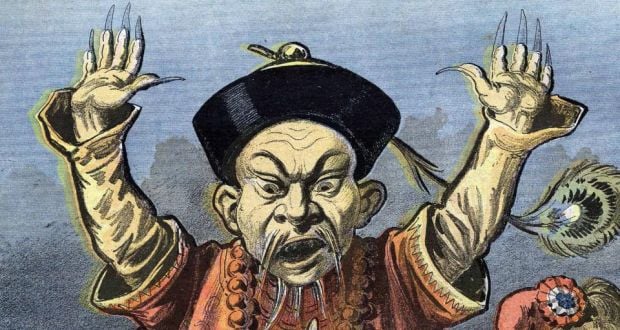
Leung Wing-Fai: Perceptions of the East – “Yellow Peril: An Archive of Anti-Asian Fear”

By Leung Wing-Fai

November 16, 2021

Review: Fascination mixed with fear is how many in the West culturally construct the East

Apocalyptic pollution, “Asian” flu, unfettered economic growth, boot camps for internet addiction, hacker attacks on western businesses and governments:– there is no shortage of fascination mixed with fear directed towards the culturally constructed East. Yellow Peril! An Archive of Anti-Asian Fear distils and presents a collection of accounts, images and essays related to this fear.

The phrase yellow peril (sometimes yellow terror or yellow spectre), coined by Kaiser Wilhelm II of Germany, in the 1880s, after a dream in which he saw the Buddha riding a dragon threatening to invade Europe, blends western anxieties about sex, racist fears of the alien other, and the Spenglerian belief that the West will become outnumbered and enslaved by the East.

These fears became increasingly reinscribed as ideology through popular cultural products. In the late 19th century in Europe, the threat to imperialism drove the yellow-peril narrative, while in the United States it emerged predominantly as a response to social factors such as cheap “coolie” labour and increased immigration.

“Yellow peril”, which refers to the skin colour of east Asians, developed into a vague form of xenophobia that taps into the racist notion that “they all look the same” and extends beyond individual countries to encompass a whole continent and “colour” of peoples.

But in a far-reaching and often enlightening analysis that reveals the very blurred lines of designation in this field, John Kuo Wei Tchen, one of the editors of this book, points out that the colour yellow was originally attributed to natives of India rather than to east Asians.

Tchen is associate professor at New York University, a historian by training, author of New York Before Chinatown: Orientalism and the Shaping of American Culture, 1776-1882 (2001) and cofounder of the New York-based Museum of Chinese in America.

Along with his coeditor, Dylan Yeats, he presents a cornucopia of snippets, illustrations and essays aptly collected as an archive demonstrating what they define as yellow perilism, a “practice rooted within a European Enlightenment and European colonialist worldview”.

Archival ordering

The book is divided into three main systematic and logical sections. “The Imagined West” traces a prehistory of yellow perilism through an outline of how the westerncentric worldview came to be, beginning with early maps that place Europe at the centre.

“Manifest Destinies” centres on the constructions of otherness that western nations perpetuated through social Darwinism, manifest destiny, white supremacy and projected fears. “Indispensable Enemies” focuses on the manifestations of yellow perilism in the American context up to the present day.

Some of the extracts are especially illuminating, such as Teddy Roosevelt’s endorsement of Jeremiah Curtain’s historical account The Mongols (1904), comparing “Mongols” to North American Comanches and Apaches, written while he was president of the United States.

By pointing to the relevance of The Mongols in terms of an ongoing struggle between East and West, the excerpt exposes an apparent American predisposition regarding the necessity of the West to defeat the imagined Asian enemy and to create a narrative history that rationalises state violence by accentuating the apparent brutality of the perceived other.

Yellow Peril! An Archive of Anti-Asian Fear is unique in presenting a carefully selected repository of anti-Asian images and writing, pop culture artefacts and political polemic, from a diverse and well-researched range of sources that includes excerpts spanning from Hegel and Marx to Jack London and WEB Du Bois.

Stressing that yellow peril is one of the longest-standing and most pervasive racist ideas in western culture, the book traces its history to medieval Europe.

Modern incarnations include Sax Rohmer’s enduring Edwardian literary yellow-peril villain, Dr Fu Manchu, an archetype now embedded in characterisations of villains from the emperor Ming the Merciless of the 1930s Flash Gordon comic strip through to the Mandarin in the 2013 film Iron Man 3.

Despite its reputation as a fading historical memory, a yellow-peril ideology persists, ranging from storylines in the 2004 reboot of the TV serial Battlestar Gallactica to campaign commercials from the 2012 US presidential election.

The collection nonetheless misses several related theoretical frameworks, such as Michel Foucault’s notion of biopolitics, which he discussed in his lectures Society Must Be Defended (1975-76), in that biopower is invoked to establish a continuum of regime, especially in the elimination of the biological threat to and the improvement of the racial species.

Yellow peril, with its focus on biological differences to explain developing civilisations, was part of the rise of eugenics, Darwinism and Nazism in Europe between the two World Wars.

Other theories, such as postcolonialism and linguistic profiling, are only tacitly referred to. These theoretical frames could have added more complexity to the understanding of the development and constitution of yellow perilism.

Michel Foucault

The book appears to be aimed at an interested general audience while attempting to be academically vigorous, although there seems to be uncertainty about the level at which the content is presented. Further explication and more detailed introduction to the excerpts would have been useful; for instance, are the definition and location of the Eurasian steppe common knowledge?

Specific elements are not fully or further developed, such as the physiological distinction of single eye flaps; neither does the book examine examples of yellow perilism that have occurred in countries such as Mexico, which may create problems for the phenomena mostly characterised as West-East relationships.

The collection offers considerable investment in visual references and analysis of political cartoons and advertising imagery, although at times the writing could be expanded, such as the discussion of processes of scapegoating and stereotyping. Some background to the definitions of terminology connected to such processes, and their alliance to psychology and sociology, would have been helpful to the readers.

An intellectually stimulating and ambitious book, Yellow Peril! An Archive of Anti-Asian Fear both benefits and suffers from its broad range. It excels as a fresh and light read with a wide variety of sources and topics, but its breadth prevents the analysis from delving deeper and from including more contrasting viewpoints.

With such a broad topic it is inevitably difficult to delimit the central writers and texts, but the editors have done an admirable job of compiling this wide range of materials into an attractive and accessible collection.

Originally published by Irish Times, August 14, 2014

Please help TFF remain truly independent and deliver more quality articles and themes like this. We are people-financed – and that means… by you! Thanks


Related Posts

Jan Oberg May 15, 2026 Go to this Fox News page and scroll the whole way down: President Donald Trump tells the world that his meeting with President Xi Jinping yielded a lot of very concrete political and economic results – of course, only where the Chinese side, according to him, agreed with him. He does not mention the Taiwan issue, but Secretary of State, Marco Rubio, says that it did not feature prominently in their talks and that the US policy on Taiwan has not changed. Then go to China Daily – or Global Times – and you will see that for the Chinese it is framework, principles, structure of cooperation etc. that matters – all embedded in the overall idea of “constructive bilateral relationship of strategic stability.” Nowhere is any concrete agreement or deal – all that Trump refers to – mentioned. At the general level, this gives you insights into the very different social...
Jan Oberg, TFF director April 9, 2026 I was recently invited to have a good, long talk about the world – and, of course, about peace too – with Boris Malagurski on his Weight of Chains Channel on YouTube. It was a real joy and seems to have been greatly appreciated by the viewers too. Mr Malagurski and I shall of course be grateful if you share this conversation in your circles – of course, only if you like what you see and hear 😉☮️ And remember that this one – like hundreds of others with TFF Associates – can be enjoyed at our TFF Video Collection.
A friendly quarrel while we agree that the US sanctions are a weapon of mass destruction and kill more people than wars do. And that we must talk much more about sanctions than we have so far. Jan Oberg, TFF director March 16, 2026 John Mearsheimer recently stated that U.S. sanctions murdered around 38 million people between 1971 and 2021 – see the video below. It is a dramatic figure, and it has spread quickly because it captures, in one sentence, the enormous human cost of modern sanctions. I share his concern about the destructive effects of economic coercion. But the specific number he cites — and the way he attributes it — deserves a friendly academic clarification. The figure comes from a 2023 Lancet Global Health article estimating the mortality effects of unilateral U.S. and EU sanctions over the past half‑century. This is the first point where Mearsheimer’s shorthand diverges from the text: the study...

Recent Articles

Below are TFF-related media mentions, comments, videos and social media posts published elsewhere but not on this homepage. We happen to catch and list only a fraction. Regarding video comments and debates, we recommend that you go to the TFF Video Channel on Substack where many of them are reproduced. Jan Oberg is a contributor to China Daily – 52 million daily clicks – and Global Times, CGTN and CCTV (the national television), China Investment, Xinhua News Agency and several others. Articles and videos on these media very often multiply into countless Chinese (and Western media) that re-post them from these main media. Thanks to The China Academy, his analyses, interviews and comments are frequently posted on YouTube channels such as Thinkers Forum and Wave Media. These videos are often re-posted on Bilibili (China’s YouTube), the China Content Center on TikTok, and on the Chinese edition of TikTok, Douyin.com. This means reaching hundreds of millions of viewers worldwide over a year. While there are too many to catch on all these...
Jan Oberg TFF director October 13, 2026 According to Alfred Nobel’s will, the Nobel Peace Prize shall be awarded: ”to the person who has done the most or best to advance fellowship among nations, the abolition or reduction of standing armies, and the establishment and promotion of peace congresses.” Further down, he also expresses how the prize for the “champions of peace” shall be decided: “that for champions of peace by a committee of five persons to be selected by the Norwegian Storting. Alfred Nobel’s will is remarkably short and clear. But few seem to have read it. Nobel did not say that the committee itself should consist of members of parliament. He entrusted the Storting with appointing five persons. In principle, it could have selected diplomats, mediators, peace researchers, conflict-resolution specialists, or other individuals with recognised expertise in matters of peace from around the world. Instead, the Storting gradually...
The Quest for Humane Survival Richard Falk Professor emeritus, Princeton UniversityTFF Associate since 1986October 12, 2026 After decades of teaching and writing about international law in academic frameworks that were not institutionally situated within law school environments—at Princeton and the University of California, Santa Barbara—I found myself most receptive to the TWAIL outlook. It has been especially illuminating in clarifying the extent to which international law evolved as a dialogical critique of Europe’s efforts to legitimize its colonial undertakings. In particular, TWAIL has exposed how international law has functioned to legalize the subjugation of Third World peoples, securing conditions for exploitative investment and trade relations, the coercive enforcement of public debts, and an ideology of cultural superiority. TWAIL’s exposure of these economic legacies of colonialism has influenced my understanding of the history and development of international law, broadly conceived, as an ideological project of the Western sub-system of the world...

TFF on Substack

Discover and subscribe to more peace materials on TFF Substack

Most Popular

Below are TFF-related media mentions, comments, videos and social media posts published elsewhere but not on this homepage. We happen to catch and list only a fraction. Regarding video comments and debates, we recommend that you go to the TFF Video Channel on Substack where many of them are reproduced. Jan Oberg is a contributor to China Daily – 52 million daily clicks – and Global Times, CGTN and CCTV (the national television), China Investment, Xinhua News Agency and several others. Articles and videos on these media very often multiply into countless Chinese (and Western media) that re-post them from these main media. Thanks to The China Academy, his analyses, interviews and comments are frequently posted on YouTube channels such as Thinkers Forum and Wave Media. These videos are often re-posted on Bilibili (China’s YouTube), the China Content Center on TikTok, and on the Chinese edition of TikTok, Douyin.com. This means reaching hundreds of millions of viewers worldwide over a year. While there are too many to catch on all these...
Jan Oberg TFF director October 13, 2026 According to Alfred Nobel’s will, the Nobel Peace Prize shall be awarded: ”to the person who has done the most or best to advance fellowship among nations, the abolition or reduction of standing armies, and the establishment and promotion of peace congresses.” Further down, he also expresses how the prize for the “champions of peace” shall be decided: “that for champions of peace by a committee of five persons to be selected by the Norwegian Storting. Alfred Nobel’s will is remarkably short and clear. But few seem to have read it. Nobel did not say that the committee itself should consist of members of parliament. He entrusted the Storting with appointing five persons. In principle, it could have selected diplomats, mediators, peace researchers, conflict-resolution specialists, or other individuals with recognised expertise in matters of peace from around the world. Instead, the Storting gradually...
The Quest for Humane Survival Richard Falk Professor emeritus, Princeton UniversityTFF Associate since 1986October 12, 2026 After decades of teaching and writing about international law in academic frameworks that were not institutionally situated within law school environments—at Princeton and the University of California, Santa Barbara—I found myself most receptive to the TWAIL outlook. It has been especially illuminating in clarifying the extent to which international law evolved as a dialogical critique of Europe’s efforts to legitimize its colonial undertakings. In particular, TWAIL has exposed how international law has functioned to legalize the subjugation of Third World peoples, securing conditions for exploitative investment and trade relations, the coercive enforcement of public debts, and an ideology of cultural superiority. TWAIL’s exposure of these economic legacies of colonialism has influenced my understanding of the history and development of international law, broadly conceived, as an ideological project of the Western sub-system of the world...
Read More
girl-5894831_1280
Below are TFF-related media mentions, comments, videos and social media posts published elsewhere but not on this homepage. We happen to catch and list only a fraction. Regarding video comments and debates, we recommend that you go to the TFF Video Channel on Substack where many of them are reproduced. Jan Oberg is a contributor to China Daily – 52 million daily clicks – and Global Times, CGTN and CCTV (the national television), China Investment, Xinhua News Agency and several others. Articles and videos on these media very often multiply into countless Chinese (and Western media) that re-post them from these main media. Thanks to The China Academy, his analyses, interviews and comments are frequently posted on YouTube channels such as Thinkers Forum and Wave Media. These videos are often re-posted on Bilibili (China’s YouTube), the China Content Center on TikTok, and on the Chinese edition of TikTok, Douyin.com. This means reaching hundreds of millions of viewers worldwide over a year. While there are too many to catch on all these...
Nobel-Prize-Plaque
Jan Oberg TFF director October 13, 2026 According to Alfred Nobel’s will, the Nobel Peace Prize shall be awarded: ”to the person who has done the most or best to advance fellowship among nations, the abolition or reduction of standing armies, and the establishment and promotion of peace congresses.” Further down, he also expresses how the prize for the “champions of peace” shall be decided: “that for champions of peace by a committee of five persons to be selected by the Norwegian Storting. Alfred Nobel’s will is remarkably short and clear. But few seem to have read it. Nobel did not say that the committee itself should consist of members of parliament. He entrusted the Storting with appointing five persons. In principle, it could have selected diplomats, mediators, peace researchers, conflict-resolution specialists, or other individuals with recognised expertise in matters of peace from around the world. Instead, the Storting gradually...
law-419057_1280
The Quest for Humane Survival Richard Falk Professor emeritus, Princeton UniversityTFF Associate since 1986October 12, 2026 After decades of teaching and writing about international law in academic frameworks that were not institutionally situated within law school environments—at Princeton and the University of California, Santa Barbara—I found myself most receptive to the TWAIL outlook. It has been especially illuminating in clarifying the extent to which international law evolved as a dialogical critique of Europe’s efforts to legitimize its colonial undertakings. In particular, TWAIL has exposed how international law has functioned to legalize the subjugation of Third World peoples, securing conditions for exploitative investment and trade relations, the coercive enforcement of public debts, and an ideology of cultural superiority. TWAIL’s exposure of these economic legacies of colonialism has influenced my understanding of the history and development of international law, broadly conceived, as an ideological project of the Western sub-system of the world...
images-2
Advocates of nuclear disarmament are regularly dismissed by the champions of nuclear deterrence as naïve and unrealistic, utopian or even irresponsible. Yet this ‘doctrine’ of deterrence, regarded by France as the ‘cornerstone’ of its national security, is based on quasi-religious beliefs, a theory that cannot be proven, risky gambles and fragile assumptions. So much so that one might legitimately ask which side the ‘Care Bears’ are on. Marc FinaudVice-President of Initiatives for Nuclear Disarmament (IDN) October 9, 2026 This article was originally published on Pressenza When it comes to these things being treated as religious concepts, look here. Idealists and realists It was Hubert Védrine, François Mitterrand’s former Foreign Minister, who repeatedly coined the phrase: ‘Europeans are a sort of Care Bears who don’t realise they’re living in Jurassic Park’. He applies this reference to the cartoon for well-behaved children not only to what he regards as weakness or idealism...
8824b09f-33a5-43f9-9fd0-550f28cda24d_1536x1024
What the West Borrowed from Asia and What It Left Behind Jan Krikke October 8, 2026 The article was originally published here In the late 1960s, the musical Hair announced that the Age of Aquarius was dawning. Its opening anthem promised a transformation of human consciousness: an era of peace, harmony and understanding. Half a century later, a familiar echo of that promise is a meditation app offered by your employer. You can find it in the same list of benefits as the pension plan and the gym discount. How did a spiritual revolution become an employee benefit? The answer lies in the history of the movement known as New Age: where it came from, what it borrowed from Asia, and why the meaning of what it borrowed changed in the process. Two definitions will help. New Age is a loose label for a wide range of spiritual practices and...
Screenshot 2026-10-04 210142
Small and different + among the 10% most active + 9,000 texts + 150 Associates + 60 000 a day — and a stubborn belief that peace is smarter and must be secured by peaceful means. In 2026, the Transnational Foundation for Peace and Future Research (TFF) turns 40. On Monday, October 5, 2026, a new TFF homepage will go live — a new gateway to more than 9,000 articles, analyses, research papers and other contributions produced over four decades of independent peace research. But this is not simply a new website. For four decades, TFF has worked from a simple conviction: peace is smarter than militarism and can be brought about by peaceful means. This is not merely an aspiration. It is the principle expressed in the UN Charter and the Gandhian tradition that has guided our work from the beginning. TFF is a research-based, independent and people-financed foundation....



