

TFF PressInfo # 391: Stockholm International Peace Research Institute, SIPRI, at 50. Now change name to SIMSI

/10/tff-pressinfo-390-ten-articles-on-the-new-cold-war/”>new Cold War are becoming ever more significant. And a good intellectual way to celebrate an important research institute’s 50th Anniversary, namely SIPRI – Stockholm International Peace Research Institute.

Now, what was this SIPRI supposed to be 50 years ago as the brainchild of, among others, brilliant visionary sociologist and social democratic politician Alva Myrdal who later became Sweden’s disarmament ambassador, wrote an impressive book on disarmament and security and received the Nobel Peace Prize in 1982?

If you go to its entry at Wikipedia, it is very clearly spelled out in 1966 (my italics):

“A Swedish Royal Commission chaired by Ambassador Alva Myrdal proposed in its 1966 report to establish an institute, later named the Stockholm International Peace Research Institute, SIPRI. The Institute’s research should seek to contribute to “the understanding of the preconditions for a stable peace and for peaceful solutions of international conflicts” and the Commission recommended that research be concentrated on armaments, their limitation and reduction, and arms control. The Commission also recommended that SIPRI work be of “an applied research character directed towards practical-political questions [which] should be carried on in a constant interchange with research of a more theoretical kind”.”

However, here is today’s research programs of SIPRI – also from Wikipedia:

• The SIPRI Yearbook
• Euro-Atlantic Security and Arms Control
• Armed Conflict and Conflict Management
• Non-Proliferation and Export Controls
• Chemical and Biological Warfare
• Military Expenditure and Arms Production
• Arms Transfers
• IT Projects: “Facts on International Relations and Security Trends” and “An Internet-Based Early Warning Indicators System for Preventive Policy”

The character of this program is pretty obvious:

SIPRI studies wars and arms and very little, if at all, peaceful solutions to international conflicts and the – theoretical – conditions of a stable peace.

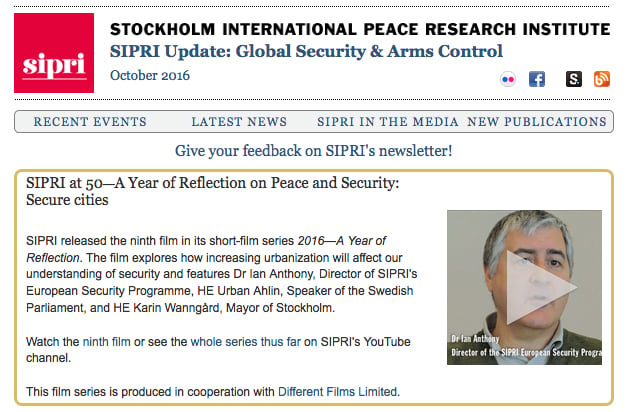
So here are some videos in which four members of the international Governing Board of SIPRI answer those questions.

Two of them are mainstream international relations scholars, one British, one Russian. One, the head of the Board, is a Swedish diplomat not known for his independent thinking – as also comes through here. He blames Russia for all Europe’s problems, for not accepting a rule-based international order and changing borders (as if it were the only one!) and believes that withdrawal from Crimea is the first step towards preventing a new cold war and that “the whole world has to say No to Georgia’s being divided by Russian aggression. See, now you understand it all much better!

The fourth is a German diplomat who is related to finance management and chairs the highly mainstream, militarist Munich Conference on Security Policy. He has recently argued, in diplomatic terms of course, that dictator al-Assad should have been removed earlier, that Russia should have been countered by a Western intervention in Syria and that we must save both “pax americana” and the liberal international order. See, a true peace-thinker!

None of the four board members have a background in academic peace research.

When I saw the videos I asked myself a couple of “anniversary” questions and here they are with my short answers:

• Do they talk in reasonably sharp intellectual terms?
No! It’s mainly some small-talk political commentary with no originality or theory. No perspective of history or of what the future may bring.

• Do they have any new and sparkling ideas about how to make peace?
No! Except what they in their narrow “school of thought” believe can be done by military means and by governments. None of them seem to have a concept of peace on which to base their words and more or less lofty personal wishes for the future: “I would like to see that..” which has also nothing to do with research.

• Is this anything but traditional international relations, geopolitical-military or political science commentary in what they say?
No! They share a government perspectives, no civil society aspects, no linking to democracy or identification of things that should be researched more. No re-searching mind. All seem quite tired if not re-tired.

• Does it have anything to do with peace research?
No! Words like conflict-resolution, nonviolence, peace-making, reconciliation, dialogue etc. don’t seem to be on their radar. The only thing in common seems to be the Russian, German and British voice advocating joint projects and a strengthening of the OSCE. The EU is mentioned once: that it should put peacekeeping troops on the ground in Aleppo (!). And the UN? The UN, the global movement for disarmament and security, the changing world order, development issues – not a word! Also not a word about peace education or the possible role of media in providing both war reports and peace stories.

My congratulations at the 50th Anniversary of SIPRI, this once so promising, innovative institution! I know it was promising because I interned at SIPRI on and off for weeks as a young student in the 1970s when it was at the Wennergren Center sky scraper – leadership sitting at the top floor, those doing newspaper clippings on the lower floors. I’ve written reviews of SIPRI’s amazing Yearbooks and many special studies, not the least in the Danish daily Politiken in the 1970s and 1980s.

I got the greatest respect for the meticulous data collecting – “bean counting” – from only open sources that SIPRI is still very good at. (But that isn’t peace research).

I vividly remember the seminars and the dynamic leadership of its scholar-director, amazing Frank Barnaby whose knowledge about nuclear weapons and nuclear policies and passion for nuclear abolition impressed everyone who met him and listened to his dark rusty voice. I silently wonder whether such a character would be invited to SIPRI today?

In all friendliness, I have a proposal to make for the next decades of this mainly government-financed and not exactly independent institute as it professes to be:

Since its work has so conspicuously little to do with peace thinking and re-search into the vast and fascinating field called world peace, perhaps it’s time to change name to Stockholm International Military Security Institute, SIMSI?


PhD, Peace & future researcher + ‌Art Photographer, Professor Emeritus and media commentator

Related Posts

UNITE-tillid, DREAM-velstand og andre konstruktive komponenter Normally we publish articles in English here. But this is a translation of a very important TFF document that should reach as many as possible in Denmark since this country’s government has been one of the most hardline in Europe and, up till now at least, has refused to use diplomacy and, instead, spent tremendous sums on arming Ukraine with the express goal of defeating Russia. Thus this – unique – article is in Danish. Vi er Johnny Baltzersen og hans Fælles Sikkerhed – Fælles Fremtid på Substack overmåde taknemmelige for at have oversat og publiceret TFF’s 2025-portfølje for fredsidéer med henblik på Ukraines fremtid. Vi håber den nu kan nå mange flere danskere – som også vil sprede den og skabe debat – nu den danske regerings og folketingspartiernes politik på dette område siden 2022 står nu – forudsigeligt – ved vejs ende....
Jan Oberg TFF director October 28, 2026 Exactly one month has now passed since I published my criticism of the introduction to the special issue on Johan Galtung published by the Journal of Global Security Studies, JoGSS, and of Tor Egil Førland’s chapter about Galtung which serves as a preview to his forthcoming biography of Galtung to be published by PRIO. See the original on The Transnational here and the same article on TFF Substack with many general and critical comments and, in particular, the people who decided to withdraw from the biography project in protest. The special issue itself was extraordinary. It was devoted to the intellectual legacy of one of the founders of peace research and contained a number of strong assessments of his personality, scholarship, intellectual trajectory, and public role. Such assessments are, of course, entirely legitimate. No scholar is beyond criticism, and neither was Johan Galtung....
An aspect of Iran’s culture and civilisation you’ve probably never heard about. Don’t be surprised if the US and Israel also try to bomb them. Jan ObergTFF director October 26, 2026 Today – under the “USraeli” threat of new “annihilating” bombings – opens the 7th International Conference on Peace and Conflict Resolution at Tehran’s University. As far as I can tell, this is the only permanent, advanced peace research institution in West Asia/the Middle East. Perhaps more countries in that region could be inspired? I mean, how many military “security” institutes and military academies do they have? Many peace research institutes and university departments have been established since the 1950s in the West. They are now all under attack; some have closed down, some have gone mainstream, yet others kept the name but do nothing to research peace and disseminate results or advice; instead, they cooperate with militarism’s platforms such...

Recent Articles

UNITE-tillid, DREAM-velstand og andre konstruktive komponenter Normally we publish articles in English here. But this is a translation of a very important TFF document that should reach as many as possible in Denmark since this country’s government has been one of the most hardline in Europe and, up till now at least, has refused to use diplomacy and, instead, spent tremendous sums on arming Ukraine with the express goal of defeating Russia. Thus this – unique – article is in Danish. Vi er Johnny Baltzersen og hans Fælles Sikkerhed – Fælles Fremtid på Substack overmåde taknemmelige for at have oversat og publiceret TFF’s 2025-portfølje for fredsidéer med henblik på Ukraines fremtid. Vi håber den nu kan nå mange flere danskere – som også vil sprede den og skabe debat – nu den danske regerings og folketingspartiernes politik på dette område siden 2022 står nu – forudsigeligt – ved vejs ende....
Jan Oberg TFF director October 28, 2026 Exactly one month has now passed since I published my criticism of the introduction to the special issue on Johan Galtung published by the Journal of Global Security Studies, JoGSS, and of Tor Egil Førland’s chapter about Galtung which serves as a preview to his forthcoming biography of Galtung to be published by PRIO. See the original on The Transnational here and the same article on TFF Substack with many general and critical comments and, in particular, the people who decided to withdraw from the biography project in protest. The special issue itself was extraordinary. It was devoted to the intellectual legacy of one of the founders of peace research and contained a number of strong assessments of his personality, scholarship, intellectual trajectory, and public role. Such assessments are, of course, entirely legitimate. No scholar is beyond criticism, and neither was Johan Galtung....
An aspect of Iran’s culture and civilisation you’ve probably never heard about. Don’t be surprised if the US and Israel also try to bomb them. Jan ObergTFF director October 26, 2026 Today – under the “USraeli” threat of new “annihilating” bombings – opens the 7th International Conference on Peace and Conflict Resolution at Tehran’s University. As far as I can tell, this is the only permanent, advanced peace research institution in West Asia/the Middle East. Perhaps more countries in that region could be inspired? I mean, how many military “security” institutes and military academies do they have? Many peace research institutes and university departments have been established since the 1950s in the West. They are now all under attack; some have closed down, some have gone mainstream, yet others kept the name but do nothing to research peace and disseminate results or advice; instead, they cooperate with militarism’s platforms such...

TFF on Substack

Discover and subscribe to more peace materials on TFF Substack

Most Popular

UNITE-tillid, DREAM-velstand og andre konstruktive komponenter Normally we publish articles in English here. But this is a translation of a very important TFF document that should reach as many as possible in Denmark since this country’s government has been one of the most hardline in Europe and, up till now at least, has refused to use diplomacy and, instead, spent tremendous sums on arming Ukraine with the express goal of defeating Russia. Thus this – unique – article is in Danish. Vi er Johnny Baltzersen og hans Fælles Sikkerhed – Fælles Fremtid på Substack overmåde taknemmelige for at have oversat og publiceret TFF’s 2025-portfølje for fredsidéer med henblik på Ukraines fremtid. Vi håber den nu kan nå mange flere danskere – som også vil sprede den og skabe debat – nu den danske regerings og folketingspartiernes politik på dette område siden 2022 står nu – forudsigeligt – ved vejs ende....
Jan Oberg TFF director October 28, 2026 Exactly one month has now passed since I published my criticism of the introduction to the special issue on Johan Galtung published by the Journal of Global Security Studies, JoGSS, and of Tor Egil Førland’s chapter about Galtung which serves as a preview to his forthcoming biography of Galtung to be published by PRIO. See the original on The Transnational here and the same article on TFF Substack with many general and critical comments and, in particular, the people who decided to withdraw from the biography project in protest. The special issue itself was extraordinary. It was devoted to the intellectual legacy of one of the founders of peace research and contained a number of strong assessments of his personality, scholarship, intellectual trajectory, and public role. Such assessments are, of course, entirely legitimate. No scholar is beyond criticism, and neither was Johan Galtung....
An aspect of Iran’s culture and civilisation you’ve probably never heard about. Don’t be surprised if the US and Israel also try to bomb them. Jan ObergTFF director October 26, 2026 Today – under the “USraeli” threat of new “annihilating” bombings – opens the 7th International Conference on Peace and Conflict Resolution at Tehran’s University. As far as I can tell, this is the only permanent, advanced peace research institution in West Asia/the Middle East. Perhaps more countries in that region could be inspired? I mean, how many military “security” institutes and military academies do they have? Many peace research institutes and university departments have been established since the 1950s in the West. They are now all under attack; some have closed down, some have gone mainstream, yet others kept the name but do nothing to research peace and disseminate results or advice; instead, they cooperate with militarism’s platforms such...
Read More
TFFPortfolioVign
UNITE-tillid, DREAM-velstand og andre konstruktive komponenter Normally we publish articles in English here. But this is a translation of a very important TFF document that should reach as many as possible in Denmark since this country’s government has been one of the most hardline in Europe and, up till now at least, has refused to use diplomacy and, instead, spent tremendous sums on arming Ukraine with the express goal of defeating Russia. Thus this – unique – article is in Danish. Vi er Johnny Baltzersen og hans Fælles Sikkerhed – Fælles Fremtid på Substack overmåde taknemmelige for at have oversat og publiceret TFF’s 2025-portfølje for fredsidéer med henblik på Ukraines fremtid. Vi håber den nu kan nå mange flere danskere – som også vil sprede den og skabe debat – nu den danske regerings og folketingspartiernes politik på dette område siden 2022 står nu – forudsigeligt – ved vejs ende....
JoGSS-Silent
Jan Oberg TFF director October 28, 2026 Exactly one month has now passed since I published my criticism of the introduction to the special issue on Johan Galtung published by the Journal of Global Security Studies, JoGSS, and of Tor Egil Førland’s chapter about Galtung which serves as a preview to his forthcoming biography of Galtung to be published by PRIO. See the original on The Transnational here and the same article on TFF Substack with many general and critical comments and, in particular, the people who decided to withdraw from the biography project in protest. The special issue itself was extraordinary. It was devoted to the intellectual legacy of one of the founders of peace research and contained a number of strong assessments of his personality, scholarship, intellectual trajectory, and public role. Such assessments are, of course, entirely legitimate. No scholar is beyond criticism, and neither was Johan Galtung....
Screenshot 2026-10-26 115647
An aspect of Iran’s culture and civilisation you’ve probably never heard about. Don’t be surprised if the US and Israel also try to bomb them. Jan ObergTFF director October 26, 2026 Today – under the “USraeli” threat of new “annihilating” bombings – opens the 7th International Conference on Peace and Conflict Resolution at Tehran’s University. As far as I can tell, this is the only permanent, advanced peace research institution in West Asia/the Middle East. Perhaps more countries in that region could be inspired? I mean, how many military “security” institutes and military academies do they have? Many peace research institutes and university departments have been established since the 1950s in the West. They are now all under attack; some have closed down, some have gone mainstream, yet others kept the name but do nothing to research peace and disseminate results or advice; instead, they cooperate with militarism’s platforms such...
Screenshot 2026-10-15 141837
Let’s discuss using AI to create peace – in contrast to boring geopolitics devoid of creative healing and visions. Jan Oberg TFF director October 15, 2026 I asked VEED to create a short video exemplifying how peace is preferable to war, then chose the lady as a template. Simple as that. In less than a minute, it produced this video, which any peace-loving person would appreciate. The only problem is that human intelligence (HI), at least the one that exists among Western decision-makers, isn’t half as moral or smart as AI. I have used AI to dialogue about peace and peace plans, creative conflict resolution and visions of a better future for humankind. It so happens that I am having more stimulating, intelligent, creative and moral discussions with AI than I could possibly have with any EU or NATO leader today. Yes, AI has very problematic and dangerous aspects; used...
girl-5894831_1280
Below are TFF-related media mentions, comments, videos and social media posts published elsewhere but not on this homepage. We happen to catch and list only a fraction. Regarding video comments and debates, we recommend that you go to the TFF Video Channel on Substack where many of them are reproduced. Jan Oberg is a contributor to China Daily – 52 million daily clicks – and Global Times, CGTN and CCTV (the national television), China Investment, Xinhua News Agency and several others. Articles and videos on these media very often multiply into countless Chinese (and Western media) that re-post them from these main media. Thanks to The China Academy, his analyses, interviews and comments are frequently posted on YouTube channels such as Thinkers Forum and Wave Media. These videos are often re-posted on Bilibili (China’s YouTube), the China Content Center on TikTok, and on the Chinese edition of TikTok, Douyin.com. This means reaching hundreds of millions of viewers worldwide over a year. While there are too many to catch on all these...
Nobel-Prize-Plaque
Jan Oberg TFF director October 13, 2026 According to Alfred Nobel’s will, the Nobel Peace Prize shall be awarded: ”to the person who has done the most or best to advance fellowship among nations, the abolition or reduction of standing armies, and the establishment and promotion of peace congresses.” Further down, he also expresses how the prize for the “champions of peace” shall be decided: “that for champions of peace by a committee of five persons to be selected by the Norwegian Storting. Alfred Nobel’s will is remarkably short and clear. But few seem to have read it. Nobel did not say that the committee itself should consist of members of parliament. He entrusted the Storting with appointing five persons. In principle, it could have selected diplomats, mediators, peace researchers, conflict-resolution specialists, or other individuals with recognised expertise in matters of peace from around the world. Instead, the Storting gradually...




