
John Jiggens

May 20, 2023

Imagine being Tony Blinken and facing the arduous responsibility as US Secretary of State to rule the globe! This seems a daunting task, but fortunately, Blinken doesn’t have to strain his brain too much because he has a manual already written to instruct him.

Originally published by “Pearls and Irritations”

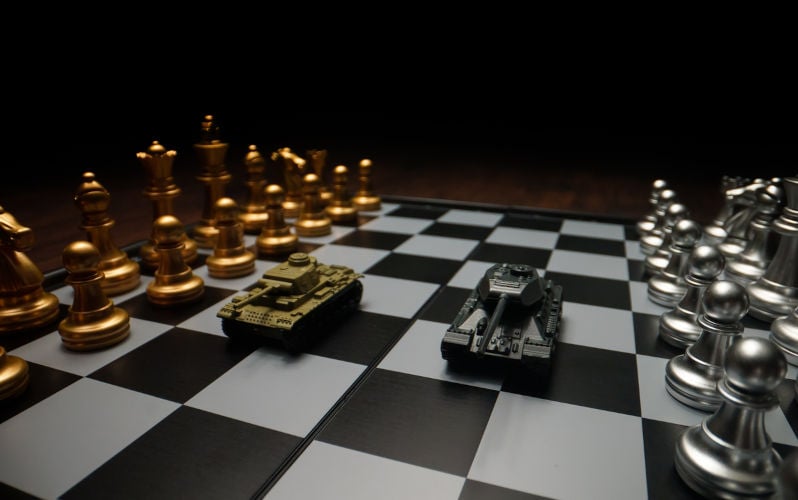
This manual is called The Grand Chessboard. It tutors you to imagine the world as a giant chessboard, and imagine the countries of the world and their people as pieces on that giant chessboard. Countries are seen as pawns in a game like chess, a game of empires. As hegemon the US manipulates the pawns and occasionally strategically sacrifices them to advance its position. As well as pawns, there are some very powerful pieces on the global chessboard and as the US advances through Eurasia, they oppose the US as it pushes into their spheres of influence.

Published in the first decade of the unipolar moment, The Grand Chessboard (1997) was written by Zbigniew Brzezinski, who had served as National Security Advisor to President Carter between 1977 and 1981, and later served as an advisor to President Obama (2009-2017). The collapse of the Soviet Union in 1991 at the end of the Cold War, an event known as the unipolar moment, left the USA as the sole global power, and The Grand Chessboard reeks of US hubris and triumphalism as it advances its strategy for a new American century, issues diktats that Russia must follow, and lays out its plan to make the US the hegemon of Eurasia, unaware that somewhere in the future, Nemesis is waiting.

Brzezinski ‘s strategy is derived from the geostrategic theories elaborated by the British geostrategist Sir Halford Mackinder in the first decades of the twentieth century. In Mackinder’s theory, the Old-World block of continents, Europe, Asia, and Africa, were referred to as the World Island, while the rest of the world beyond the World-Island was referred to as the Periphery. According to this theory, the most important areas of the World Island were Eastern Europe, especially Ukraine, which Mackinder called the Heartland. Mackinder’s famous dictum is that those who command Eastern Europe command the Heartland, and those who command the Heartland command the World Island, and those who command the World Island command the world.

So, Mackinder’s theory was a theory for world domination, empire, and world war. Both Adolf Hitler and his deputy Rudolph Hess were followers of Mackinder’s German disciple Karl Haushofer, and Mackinder’s theory was crucial to Germany’s strategy in the Second World War and is central to the current Russia-USA proxy war in Ukraine, which is the most dangerous of several current global conflicts, spread across Africa, Europe and Asia that many fear are leading the world to World War Three.

For the USA to achieve world domination, Brzezinski advocated the expansion of the EU and NATO into the area of the former Warsaw Pact and beyond into central Asia, flipping these countries, and bringing them into an anti-Russian alliance. An accompanying map in The Grand Chessboard shows the Eurasian section of the world island with a large area which is called the middle space, which is Russia, which is described as ‘the black hole of Eurasia’.

Brzezinski’s strategy is for NATO to push into this middle space. According to Brzezinski, this strategy was not driven by hostility towards Russia, nor by fear of Russia, nor by any desire to isolate Russia, but as the key to Brzezinski’s strategy is for NATO to absorb Ukraine and to push into the black hole of Eurasia, it was obviously perceived by Russian geostrategists as an existential threat to the Russian state.

Despite Russia’s protest about the planned expansion of NATO in 1999 to include several central European countries, Poland, Czechia, and Hungary, in The Grand Chessboard Brzezinski imperiously asserts Russia cannot be allowed to say no to Ukraine’s ultimate admission to NATO. Although he acknowledged that Russia would find it hard to acquiesce to Ukraine accession to NATO, at stake in NATO’s ongoing expansion was his long-range strategy for the US to become the hegemon of Eurasia. He writes:

“The expansion of NATO is essential. Indeed, a comprehensive U.S. policy for Eurasia as a whole will not be possible if the effort to widen NATO, having been launched by the United States, falls and falters. It would not be only a regional defeat but a global defeat as well.”

For this reason, Brzezinski declared Russia cannot prevent Ukraine’s membership in NATO. NATO has an Open-Door policy ─almost! The one country that the US won’t admit to NATO is Russia! This leaves Russia with what Brzezinski called ‘the dilemma of the one alternative for Russia,’ Using a condescending metaphor that casts Russia as the sick man of Europe, Brzezinski wrote: “Russia’s only strategic option is to go along with the expansion of NATO. Russia is much too weak to be a partner for America but still too strong to be simply its patient.”

He continues in the same vein:

“Although long-term Russo-Chinese and Russo-Iranian strategic alliances are not likely, it is obviously important for America to avoid policies that could distract Russia from making the needed geopolitical choice. America’s relations with China and Iran should be formulated with their impact on Russia’s geopolitical calculations kept in mind so Russia’s perpetual illusions regarding grand strategic options can only delay the historic choice that Russia must make in order to bring to an end its deep malaise.”

Realising NATO’s expansion into Eurasia was also a threat to them, an informal entente of China, Iran and North Korea has formed to support Russia and use Russia as their proxy in their wars with the US. Both China and North Korea are nuclear powers like Russia.

Since Russia sees Ukraine in NATO as an existential threat to the Russian state, and central to a US strategy to balkanise Russia, as Yugoslavia was in the 1990s, and because the USA regards the cessation of NATO expansion as a global defeat, the two nuclear-armed superpowers and their allies, already involved in a proxy war, teeter on the brink of nuclear escalation.

Why Ukraine is regarded as the most important among the post-Soviet states by the USA, is not simply because Ukraine possesses valuable natural resources. The reason Russia regards Ukraine in NATO as an existential threat is obvious when you look at a map of the grand chessboard around the Black Sea. Even if you are not Halford Mackinder or Karl Haushofer it is obvious that Ukraine’s accession to NATO turns the Black Sea into a NATO lake, extending the North Atlantic Treaty Organisation halfway across Eurasia. It also opens the door to ‘the black hole of Eurasia.’

When Ukraine and Russia were both republics of the Union of Soviet Socialist Republics, the USSR, large sections of western Russia, including Crimea and the territories around the Black Sea, were administered by the Soviet Socialist Republic of Ukraine. While they were both part of the USSR, this presented no problem, but when the USSR dissolved, and Russia and Ukraine became separate states, Ukraine’s possession of the northern littoral of the Black Sea became an opportunity for the USA war planners to present Russia with an existential threat by flipping Ukraine and inviting it into NATO.

With Turkey, Bulgaria, Romania already in NATO, the George Bush-imposed decision in 2008 to admit Ukraine and Georgia into NATO at the 2008 NATO Bucharest summit threatened to turn the Black Sea into a NATO lake. Shortly after this decision, Russia went to war with Georgia, and its current war aims in Ukraine are to recapture the littoral of the Black Sea and ensure Ukraine will never join NATO.

What Brzezinski understood was that Ukraine is a geostrategic pivot. In the lexicon of geostrategy, a geostrategic pivot is a country that has a unique geography, which gives it a special role, either denying access to important areas or denying resources to a significant player. In some cases a geostrategic pivot may act as a shield for an important state or even a region, which can have very important consequences. For example, a neutral Ukraine acts as a shield for Russia against NATO, while Ukraine in NATO is a US bulwark built on Russia’s border. This is the dispute behind the proxy war.

A rare critic of the war within the US bureaucracy, David Pyne, executive vice President of the Taskforce on National and Homeland Security, has called Biden’s Ukraine policy a policy of national suicide for Ukraine, using hundreds of thousands of Ukrainian lives as cannon fodder. It is ironic, he says, that the opponents of the war are attacked for opposing the war when they are the ones who champion Ukraine’s best interest.

Pyne estimates the costs of the war in Ukraine so far are: 500,000 Ukrainian troops who have been killed or wounded in battle; 14 million Ukrainians have become refugees, which is 30% of Ukraine’s population; 30% of its GDP has been lost, 50% of its businesses have been closed at some time, 50% of its critical infrastructure has been shut down. These costs will surely increase.

The proxy war in Ukraine is the latest US war in its pursuit of hegemony in Eurasia. According to the Cost of War project from The Watson Institute for International and Public Affairs at Brown University, U.S. post-9/11 wars in Iraq, Afghanistan, Yemen, Syria, and Pakistan have taken a tremendous human toll on those countries. As of September 2021, an estimated 432,093 civilians in these countries have died violent deaths as a result of the wars. As of May 2023, an estimated 3.6-3.8 million civilians have died indirectly in post-9/11 war zones. The total civilian death toll in these war zones could be at least 4.5-4.7 million and counting, though the precise mortality figure remains unknown. The number of combatants killed directly in the violence of the wars in Afghanistan, Pakistan, Iraq, Syria, Yemen and elsewhere are 905,00 – 940,000 direct deaths. The number of war refugees and displaced persons caused by these wars was 38 million. The U.S. federal price tag for the post-9/11 wars was over $8 trillion. The unbelievable amount of money needed to pay for the weapons and the wars to slaughter so many funds an enormous industry.

War: What is war good for?

The Military-Industrial complex, its politicians, and its mandarins in the Beltway!

The author
Dr John Jiggens is a citizen journalist. He was the founding editor of The Westender and The Cane Toad Times and currently works in the community newsroom at Bay-FM in Byron Bay. His PhD was Marijuana Australiana: Cannabis use, popular culture and the Americanisation of drug policy in Australia. He has published several books on the history of cannabis prohibition.


Related Posts

Officially, the drones were not identified. By simply thinking critically – which journalists and selected experts no longer do – there may be a good reason for that. And this article will never be mentioned in Denmark… Jan Oberg October 3, 2025 Drones over Denmark. No damage. No trace. No answers. Yet the headlines scream “Russian threat,” and Prime Minister Mette Frederiksen speaks with a certainty that defies logic: “We don’t know they were Russian—but we know Russia is the biggest threat to Europe.” It could be nobody else – unless you make an interest analysis which I did two days ago. This is not security policy. It’s theatre. And the audience is being played. Let’s rewind. These drones—unphotographed, untracked, unclaimed—appear and vanish like ghosts. Airports shut down. Panic spreads. Military budgets swell. And the narrative hardens: Russia is behind it. But what if that’s not just wrong but deliberately...
Drones over Nordic airports. No damage. No trace. No answers. Most assume Russia—but what if that’s not so? Why is there so much we are not told? This article explores the strategic ambiguity behind recent drone incursions and asks: Who else might benefit from sending drones into NATO airspace? From Ukraine’s surprising drone supremacy to Russia’s possible signalling, the silence itself may be the loudest message. These are the kinds of questions decent, intelligent investigative journalists and commentators could easily research. Why don’t they? Jan Oberg September 29, 2025 Did you, dear reader, know or think of this? That the most powerful weapon in today’s conflicts might be the one that leaves no trace – and no answers. Just enough fear to justify the next move? Recently, drones have repeatedly appeared over Nordic airports and near some military facilities. They cause no damage – for which reason the designation “hybrid attack” is...
By World BEYOND War A new report by the global peace group World BEYOND War finds that military bases used by foreign militaries are growing in number, as are public protests and advocacy against those bases. Of 1,247 foreign military bases in the world, 877 of them, by latest count, are U.S. bases outside of the United States. Eighteen other nations, combined, have 370 bases outside their borders. The full report is available at https://worldbeyondwar.org/basesreport2025 While U.S. bases are in 95 foreign countries all over the globe and virtually encircling the borders of Russia and China, the nation with the second-most foreign bases, Türkiye, has them all near Türkiye, with the exception of one base in Somalia, and the majority of them in Syria and Iraq where Türkiye has been waging wars. During U.S. wars in Iraq and Afghanistan, the United States added, and later closed, hundreds of bases. Türkiye and...

Recent Articles

Tony Robinson October 4, 2026 Violence is easy to recognise when someone is being beaten, shot or killed. It becomes more difficult when nobody is holding a weapon. Poverty, discrimination, exploitation and repression can restrict a human life just as effectively, although they do so in very different ways and with very different consequences. Simply adding more categories to an ever-growing list of forms of violence does not really solve the problem. The more interesting question is what all these different situations have in common and why it makes sense to describe them using the same word. Human beings do not simply react to what happens around them. They remember the past, imagine things that do not yet exist, make plans and undertake projects. Workers organise because they imagine different working conditions; people migrate because they imagine another life somewhere else; social movements emerge because people refuse to accept the...
It’s a matter of principles, courage, vision and pulling together – while the militarist world is falling apart… Peter Langille October 3, 2026 “Here, then, is the problem which we present to you, stark and dreadful and inescapable: Shall we put an end to the human race; or shall mankind renounce war?”The Bertrand Russell—Albert Einstein Manifesto, July 9, 1955 ⁕ The forecast for what’s ahead is worrisome. The sharp rise in armed conflicts over the past three years is adding to what was already the highest level in over seventy years. Genocides, which should be prevented are supported. A shared climate emergency that jeopardises survival is ignored. Diverse polls now suggest that people are war-weary, worried and interested in a more effective United Nations. And, there are viable policy options for a more secure world! Yet governments are doubling-down, betting on more war and investing heavily. If current trends persist,...
Johan Galtung 1930-2024October 2015 Published here on October 3, 2026 Let us focus on Civilization for conflict analysis and remedies. Major forms of disorder use violence; war is state organized violence. The most belligerent states are the United States of America and Israel, both with civilization roots. National Evangelism, the US Protestant Christian civilization– more national than evangelical–justifies US warfare as exceptionalism of a people chosen by God, with a manifest destiny to run the world. Orthodox Judaism justifies Israeli warfare to conquer and expand from Nile to Euphrates as a religious right and duty to the Eternal One. The third most belligerent country, the UK, no longer believes it is God-chosen but chosen by the USA; not quite the same but something. But the root cause of global disorder lies in the Occident–with Islam–seeing itself as the single, universal civilization valid for all at all times, all others being...

TFF on Substack

Discover and subscribe to more peace materials on TFF Substack

Most Popular

Tony Robinson October 4, 2026 Violence is easy to recognise when someone is being beaten, shot or killed. It becomes more difficult when nobody is holding a weapon. Poverty, discrimination, exploitation and repression can restrict a human life just as effectively, although they do so in very different ways and with very different consequences. Simply adding more categories to an ever-growing list of forms of violence does not really solve the problem. The more interesting question is what all these different situations have in common and why it makes sense to describe them using the same word. Human beings do not simply react to what happens around them. They remember the past, imagine things that do not yet exist, make plans and undertake projects. Workers organise because they imagine different working conditions; people migrate because they imagine another life somewhere else; social movements emerge because people refuse to accept the...
It’s a matter of principles, courage, vision and pulling together – while the militarist world is falling apart… Peter Langille October 3, 2026 “Here, then, is the problem which we present to you, stark and dreadful and inescapable: Shall we put an end to the human race; or shall mankind renounce war?”The Bertrand Russell—Albert Einstein Manifesto, July 9, 1955 ⁕ The forecast for what’s ahead is worrisome. The sharp rise in armed conflicts over the past three years is adding to what was already the highest level in over seventy years. Genocides, which should be prevented are supported. A shared climate emergency that jeopardises survival is ignored. Diverse polls now suggest that people are war-weary, worried and interested in a more effective United Nations. And, there are viable policy options for a more secure world! Yet governments are doubling-down, betting on more war and investing heavily. If current trends persist,...
Johan Galtung 1930-2024October 2015 Published here on October 3, 2026 Let us focus on Civilization for conflict analysis and remedies. Major forms of disorder use violence; war is state organized violence. The most belligerent states are the United States of America and Israel, both with civilization roots. National Evangelism, the US Protestant Christian civilization– more national than evangelical–justifies US warfare as exceptionalism of a people chosen by God, with a manifest destiny to run the world. Orthodox Judaism justifies Israeli warfare to conquer and expand from Nile to Euphrates as a religious right and duty to the Eternal One. The third most belligerent country, the UK, no longer believes it is God-chosen but chosen by the USA; not quite the same but something. But the root cause of global disorder lies in the Occident–with Islam–seeing itself as the single, universal civilization valid for all at all times, all others being...
Read More
Living-Peace-Sign-Budapest-copy
Tony Robinson October 4, 2026 Violence is easy to recognise when someone is being beaten, shot or killed. It becomes more difficult when nobody is holding a weapon. Poverty, discrimination, exploitation and repression can restrict a human life just as effectively, although they do so in very different ways and with very different consequences. Simply adding more categories to an ever-growing list of forms of violence does not really solve the problem. The more interesting question is what all these different situations have in common and why it makes sense to describe them using the same word. Human beings do not simply react to what happens around them. They remember the past, imagine things that do not yet exist, make plans and undertake projects. Workers organise because they imagine different working conditions; people migrate because they imagine another life somewhere else; social movements emerge because people refuse to accept the...
b54a1f10-8c65-4f0b-9dd5-4abc0a7d04cc_2659x2659
It’s a matter of principles, courage, vision and pulling together – while the militarist world is falling apart… Peter Langille October 3, 2026 “Here, then, is the problem which we present to you, stark and dreadful and inescapable: Shall we put an end to the human race; or shall mankind renounce war?”The Bertrand Russell—Albert Einstein Manifesto, July 9, 1955 ⁕ The forecast for what’s ahead is worrisome. The sharp rise in armed conflicts over the past three years is adding to what was already the highest level in over seventy years. Genocides, which should be prevented are supported. A shared climate emergency that jeopardises survival is ignored. Diverse polls now suggest that people are war-weary, worried and interested in a more effective United Nations. And, there are viable policy options for a more secure world! Yet governments are doubling-down, betting on more war and investing heavily. If current trends persist,...
010
Johan Galtung 1930-2024October 2015 Published here on October 3, 2026 Let us focus on Civilization for conflict analysis and remedies. Major forms of disorder use violence; war is state organized violence. The most belligerent states are the United States of America and Israel, both with civilization roots. National Evangelism, the US Protestant Christian civilization– more national than evangelical–justifies US warfare as exceptionalism of a people chosen by God, with a manifest destiny to run the world. Orthodox Judaism justifies Israeli warfare to conquer and expand from Nile to Euphrates as a religious right and duty to the Eternal One. The third most belligerent country, the UK, no longer believes it is God-chosen but chosen by the USA; not quite the same but something. But the root cause of global disorder lies in the Occident–with Islam–seeing itself as the single, universal civilization valid for all at all times, all others being...
Screenshot 2026-10-02 011738
Jan ObergPhD, director, The Transnational Foundation for Peace and Future Research, TFFLund, Sweden October 2, 2026 This is my full original manuscript. The Chinese Academy of Social Science, CASS, makes two publications out if it. 1. China’s Five-year plan emphasized the capabilities of basic research and original innovation. It is regarded as the goal of the future social development, which, as required, should be significantly enhanced. Can you comment on the importance of original innovation in research and academic study? I believe it is easier to define “original innovation” in the natural sciences than in social sciences. The breaking points of what constitutes something new, or innovative, are not quite as sharp in the latter. But in both fields it is about opening up something that was closed, unseen, unexplored before – making manifest what was earlier latent. Innovations come in many forms and shapes – naming something that was not...
arctic-circle-map
The agreement is catastrophic both because of what it says and what it doesn’t mention. It reduces further the major asset of security policies: Freedom of action. Jan Oberg TFF director September 25, 2026 A couple of hours before the agreement was signed on September 22, 2026, I published the following 13 hypotheses about what it would most likely contain on TFF Substack (in English). I was wrong on only the first point. Contrary to what Trump had written on his Truth Social platform, it does not appear to come into force immediately. In fact, it turned out to be worse than even I had anticipated. After these hypotheses now come a number of reflections in light of what the agreement actually contains, and does not contain, as well as the way in which it has generally been presented by major media outlets and by the public-service broadcaster DR. My...
girl-5894831_1280
Below are TFF-related media mentions, comments, videos and social media posts published elsewhere but not on this homepage. We happen to catch and list only a fraction. Regarding video comments and debates, we recommend that you go to the TFF Video Channel on Substack where many of them are reproduced. Jan Oberg is a contributor to China Daily – 52 million daily clicks – and Global Times, CGTN and CCTV (the national television), China Investment, Xinhua News Agency and several others. Articles and videos on these media very often multiply into countless Chinese (and Western media) that re-post them from these main media. Thanks to The China Academy, his analyses, interviews and comments are frequently posted on YouTube channels such as Thinkers Forum and Wave Media. These videos are often re-posted on Bilibili (China’s YouTube), the China Content Center on TikTok, and on the Chinese edition of TikTok, Douyin.com. This means reaching hundreds of millions of viewers worldwide over a year. While there are too many to catch on all these...



