
William Astore: The Last Good Guys? Five Reasons Why Washington Can’t Break Its War Addiction

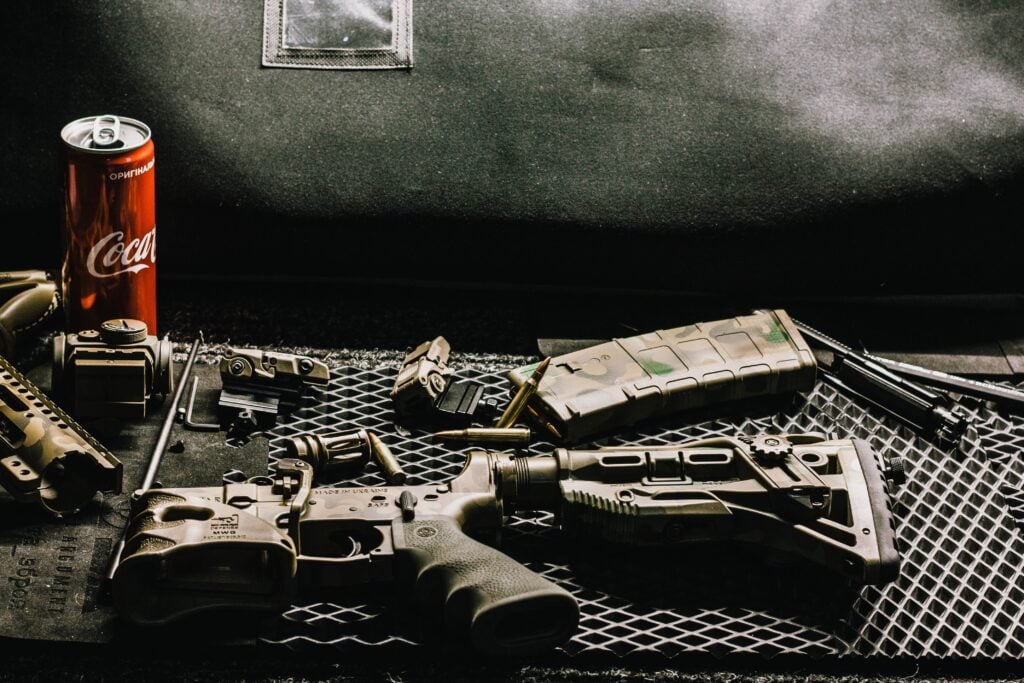
Photo by Mykola Makhlai on Unsplash

William J. Astore

May 27, 2022

Why has the United States already become so heavily invested in the Russia-Ukraine war? And why has it so regularly gotten involved, in some fashion, in so many other wars on this planet since it invaded Afghanistan in 2001? Those with long memories might echo the conclusion reached more than a century ago by radical social critic Randolph Bourne that “war is the health of the state” or recall the ancient warnings of this country’s founders like James Madison that democracy dies not in darkness but in the ghastly light thrown by too many bombs bursting in air for far too long.

Originally published at Tomdispatch & Juan Cole

In 1985, when I first went on active duty in the U.S. Air Force, a conflict between the Soviet Union and Ukraine would, of course, have been treated as a civil war between Soviet republics. In the context of the Cold War, the U.S. certainly wouldn’t have risked openly sending billions of dollars in weaponry directly to Ukraine to “weaken” Russia.

Back then, such obvious interference in a conflict between the USSR and Ukraine would have simply been an act of war. (Of course, even more ominously, back then, Ukraine also had nuclear weapons on its soil.)

With the collapse of the Soviet Union in 1991, everything changed. The Soviet sphere of influence gradually became the U.S. and NATO sphere of influence. Nobody asked Russia whether it truly cared, since that country was in serious decline.

Soon enough, even former Soviet republics on its doorstep became America’s to meddle in and sell arms to, no matter the Russian warnings about “red lines” vis-à-vis inviting Ukraine to join NATO. And yet here we are, with an awful war in Ukraine on our hands, as this country leads the world in sending weapons to Ukraine, including Javelin and Stinger missiles and artillery, while promoting some form of future victory, however costly, for Ukrainians.

Here’s what I wonder: Why in this century has America, the “leader of the free world” (as we used to say in the days of the first Cold War), also become the leader in promoting global warfare? And why don’t more Americans see a contradiction in that reality? If you’ll bear with me, I have what I think are at least five answers, however partial, to those questions:

* First and above all, war is — even if so many Americans don’t normally think of it that way — immensely profitable. When the Soviet Union collapsed, the U.S. military-industrial complex recognized a giant business opportunity.

During the Cold War, the world’s biggest arms merchants were the U.S. and the USSR. With the Soviet Union gone, so, too, was America’s main rival in selling arms everywhere. It was as if Jeff Bezos had witnessed the collapse of Walmart. Do you think he wouldn’t have taken advantage of the resulting retail vacuum?

Forget about the “peace dividends” Americans were promised then or downsizing the Pentagon budget in a major way. It was time for the big arms manufacturers to expand into markets that had long been dominated by the USSR.

Meanwhile, NATO chose to follow suit in its own fashion, expanding beyond the borders of a reunified Germany. Despite verbal promises to the contrary made to Soviet leaders like Mikhail Gorbachev, it expanded into Poland, Hungary, Estonia, Latvia, Lithuania, Bulgaria, and Romania, among other countries — that is, to the very borders of Russia itself, even as U.S. weapons contractors made a killing in supplying arms to such new NATO members.

In the spirit of management guru Stephen Covey, it may have been a purely “win-win” situation for NATO, the U.S., and its merchants of death then, but it’s proven to be a distinctly lose-lose situation for Russia and now especially for Ukraine as the war there drags on and on, while the destruction only mounts.

* Second, when it comes to promoting war globally, consider the U.S. military’s structure and mission. How could this country possibly return to anything like what, so long ago, was known as “isolationism” when it has at least 750 military bases scattered liberally on every continent except Antarctica? How could it not promote war in some fashion, when that unbelievably well-funded military’s mission is defined as projecting power globally across all “spectrums” of combat, including land, sea, air, space, and cyberspace?

What could you expect when its budget equals those of the next 11 militaries on this planet combined or when the Pentagon quite literally divides the whole world into U.S. military commands headed by four-star generals and admirals, each one a Roman-style proconsul? How could you not imagine that Washington’s top officials believe this country has a stake in conflicts everywhere under such circumstances? Such attitudes are an obvious product of such a structure and such a sense of armed global mission.

* Third, consider the power of the dominant narrative in Washington in these years. Despite the never-ending war-footing of this country, Americans are generally sold on the idea that we constitute a high-minded nation desirous of peace. In a cartoonish fashion, we’re always the good guys and enemies, like Putin’s Russia now, uniquely evil.

Conforming to and parroting this version of reality leads to career success, especially within the mainstream media. As Chris Hedges once so memorably put it: “The [U.S.] press goes limp in front of the military.” And those with the spine to challenge such a militarist narrative are demoted, ostracized, exiled, or even in rare cases imprisoned. Just ask whistleblowers and journalists like Chelsea Manning, Julian Assange, Daniel Hale, and Edward Snowden who have dared to challenge the American war story and paid a price for it.

* Fourth, war both unifies and distracts. In this century, it has helped unify the American people, however briefly, as they were repeatedly reminded to “support our troops” as “heroes” in the fight against “global terror.” At the same time, it’s distracted us from the class war in this country, where the poor and working-class (and, increasingly, a shrinking middle class as well) are most definitely losing out. As financier and billionaire Warren Buffett put the matter: “There’s class warfare, all right, but it’s my class, the rich class, that’s making war, and we’re winning.”

* Fifth, wars, ranging from the Afghan and Iraq ones to the never-ending global war on terror, including the present one in Ukraine, have served as distractions from another reality entirely: America’s national decline in this century and its ever-greater political dysfunction. (Think Donald Trump, who didn’t make it to the White House by accident, but at least in part because disastrous wars helped pave the way for him.)

Americans often equate war itself with masculine potency. (Putting on “big boy pants” was the phrase used unironically by officials in President George W. Bush’s administration to express their willingness to launch conflicts globally.) Yet by now, many of us do sense that we’re witnessing a seemingly inexorable national decline.

Exhibits include a rising number of mass shootings; mass death due to a poorly handled Covid-19 pandemic; massive drug-overdose deaths; increasing numbers of suicides, including among military veterans; and a growing mental health crisis among our young.

Political dysfunction feeds on and aggravates that decline, with Trumpism tapping into a reactionary nostalgia for a once “great” America that could be made “great again” — if the right people were put in their places, if not in their graves. Divisions and distractions serve to keep so many of us downtrodden and demobilized, desperate for a leader to ignite and unite us, even if it’s for a cause as shallow and false as the “stop the steal” Capitol riot on January 6, 2021.

Despite the evidence of decline and dysfunction all around us, many Americans continue to take pride and comfort in the idea that the U.S. military remains the finest fighting force in all of history — a claim advanced by presidents George W. Bush, Barack Obama, and Joe Biden, among so many other boosters.

All the World’s A Stage

About 15 years ago, I got involved in a heartfelt argument with a conservative friend about whether it was wise for this country to shrink its global presence, especially militarily. He saw us as a benevolent actor on the world stage. I saw us as overly ambitious, though not necessarily malevolent, as well as often misguided and in denial when it came to our flaws. I think of his rejoinder to me as the “empty stage” argument.

Basically, he suggested that all the world’s a stage and, should this country become too timid and abandon it, other far more dangerous actors could take our place, with everyone suffering. My response was that we should, at least, try to leave that stage in some fashion and see if we were missed. Wasn’t our own American stage ever big enough for us? And if this country were truly missed, it could always return, perhaps even triumphantly.

Of course, officials in Washington and the Pentagon do like to imagine themselves as leading “the indispensable nation” and are generally unwilling to test any other possibilities. Instead, like so many ham actors, all they want is to eternally mug and try to dominate every stage in sight.

In truth, the U.S. doesn’t really have to be involved in every war around and undoubtedly wouldn’t be if certain actors (corporate as well as individual) didn’t feel it was just so profitable. If my five answers above were ever taken seriously here, there might indeed be a wiser and more peaceful path forward for this country.

But that can’t happen if the forces that profit from the status quo — where bellum (war) is never ante- or post- but simply ongoing — remain so powerful. The question is, of course, how to take the profits of every sort out of war and radically downsize our military (especially its overseas “footprint”), so that it truly becomes a force for “national security,” rather than national insecurity.

Most of all, Americans need to resist the seductiveness of war, because endless war and preparations for more of the same have been a leading cause of national decline. One thing I know: Waving blue-and-yellow flags in solidarity with Ukraine and supporting “our” troops may feel good but it won’t make us good. In fact, it will only contribute to ever more gruesome versions of war.

A striking feature of the Russian invasion of Ukraine is that, after so many increasingly dim years, it’s finally allowed America’s war party to pose as the “good guys” again. After two decades of a calamitous “war on terror” and unmitigated disasters in Afghanistan, Iraq, Libya, Somalia, and so many other places,

Americans find themselves on the side of the underdog Ukrainians against that “genocidal” “war criminal” Vladimir Putin. That such a reading of the present situation might be uncritical and reductively one-sided should (but doesn’t) go without saying. That it’s seductive because it feeds both American nationalism and narcissism, while furthering a mythology of redemptive violence, should be scary indeed.

Yes, it’s high time to call a halt to the Pentagon’s unending ham-fisted version of a world tour. If only it were also time to try dreaming a different dream, a more pacific one of being perhaps a first among equals.

In the America of this moment, even that is undoubtedly asking too much. An Air Force buddy of mine once said to me that when you wage war long, you wage it wrong.

Unfortunately, when you choose the dark path of global dominance, you also choose a path of constant warfare and troubled times marked by the cruel risk of violent blowback (a phenomenon of which historian and critic Chalmers Johnson so presciently warned us in the years before 9/11).

Washington certainly feels it’s on the right side of history in this Ukraine moment. However, persistent warfare should never be confused with strength and certainly not with righteousness, especially on a planet haunted by a growing sense of impending doom.

Copyright 2022 William J. Astore

Originally published at Tomdispatch & Juan Cole

About the author

William J. Astore, a retired lieutenant colonel (USAF), has taught at the Air Force Academy, the Naval Postgraduate School, and the Pennsylvania College of Technology. His personal blog is BracingViews.com. He can be reached at wjastore@gmail.com.

Please help TFF remain truly independent by contributing if you benefited from this article

Related Posts

It’s a matter of principles, courage, vision and pulling together – while the militarist world is falling apart… Peter Langille October 3, 2026 “Here, then, is the problem which we present to you, stark and dreadful and inescapable: Shall we put an end to the human race; or shall mankind renounce war?”The Bertrand Russell—Albert Einstein Manifesto, July 9, 1955 ⁕ The forecast for what’s ahead is worrisome. The sharp rise in armed conflicts over the past three years is adding to what was already the highest level in over seventy years. Genocides, which should be prevented are supported. A shared climate emergency that jeopardises survival is ignored. Diverse polls now suggest that people are war-weary, worried and interested in a more effective United Nations. And, there are viable policy options for a more secure world! Yet governments are doubling-down, betting on more war and investing heavily. If current trends persist,...
Johan Galtung 1930-2024October 2015 Published here on October 3, 2026 Let us focus on Civilization for conflict analysis and remedies. Major forms of disorder use violence; war is state organized violence. The most belligerent states are the United States of America and Israel, both with civilization roots. National Evangelism, the US Protestant Christian civilization– more national than evangelical–justifies US warfare as exceptionalism of a people chosen by God, with a manifest destiny to run the world. Orthodox Judaism justifies Israeli warfare to conquer and expand from Nile to Euphrates as a religious right and duty to the Eternal One. The third most belligerent country, the UK, no longer believes it is God-chosen but chosen by the USA; not quite the same but something. But the root cause of global disorder lies in the Occident–with Islam–seeing itself as the single, universal civilization valid for all at all times, all others being...
How Oxford University Press allowed a personality‑driven narrative to masquerade as scholarship. Jan Oberg, dr hc, TFF director This article has also been published on TFF Substack where more readers react and withdraw their interviews from the project. A Special Issue in a scholarly journal is not an ordinary publication. It is a collective, curated […]

Recent Articles

Tony Robinson October 4, 2026 Violence is easy to recognise when someone is being beaten, shot or killed. It becomes more difficult when nobody is holding a weapon. Poverty, discrimination, exploitation and repression can restrict a human life just as effectively, although they do so in very different ways and with very different consequences. Simply adding more categories to an ever-growing list of forms of violence does not really solve the problem. The more interesting question is what all these different situations have in common and why it makes sense to describe them using the same word. Human beings do not simply react to what happens around them. They remember the past, imagine things that do not yet exist, make plans and undertake projects. Workers organise because they imagine different working conditions; people migrate because they imagine another life somewhere else; social movements emerge because people refuse to accept the...
It’s a matter of principles, courage, vision and pulling together – while the militarist world is falling apart… Peter Langille October 3, 2026 “Here, then, is the problem which we present to you, stark and dreadful and inescapable: Shall we put an end to the human race; or shall mankind renounce war?”The Bertrand Russell—Albert Einstein Manifesto, July 9, 1955 ⁕ The forecast for what’s ahead is worrisome. The sharp rise in armed conflicts over the past three years is adding to what was already the highest level in over seventy years. Genocides, which should be prevented are supported. A shared climate emergency that jeopardises survival is ignored. Diverse polls now suggest that people are war-weary, worried and interested in a more effective United Nations. And, there are viable policy options for a more secure world! Yet governments are doubling-down, betting on more war and investing heavily. If current trends persist,...
Johan Galtung 1930-2024October 2015 Published here on October 3, 2026 Let us focus on Civilization for conflict analysis and remedies. Major forms of disorder use violence; war is state organized violence. The most belligerent states are the United States of America and Israel, both with civilization roots. National Evangelism, the US Protestant Christian civilization– more national than evangelical–justifies US warfare as exceptionalism of a people chosen by God, with a manifest destiny to run the world. Orthodox Judaism justifies Israeli warfare to conquer and expand from Nile to Euphrates as a religious right and duty to the Eternal One. The third most belligerent country, the UK, no longer believes it is God-chosen but chosen by the USA; not quite the same but something. But the root cause of global disorder lies in the Occident–with Islam–seeing itself as the single, universal civilization valid for all at all times, all others being...

TFF on Substack

Discover and subscribe to more peace materials on TFF Substack

Most Popular

Tony Robinson October 4, 2026 Violence is easy to recognise when someone is being beaten, shot or killed. It becomes more difficult when nobody is holding a weapon. Poverty, discrimination, exploitation and repression can restrict a human life just as effectively, although they do so in very different ways and with very different consequences. Simply adding more categories to an ever-growing list of forms of violence does not really solve the problem. The more interesting question is what all these different situations have in common and why it makes sense to describe them using the same word. Human beings do not simply react to what happens around them. They remember the past, imagine things that do not yet exist, make plans and undertake projects. Workers organise because they imagine different working conditions; people migrate because they imagine another life somewhere else; social movements emerge because people refuse to accept the...
It’s a matter of principles, courage, vision and pulling together – while the militarist world is falling apart… Peter Langille October 3, 2026 “Here, then, is the problem which we present to you, stark and dreadful and inescapable: Shall we put an end to the human race; or shall mankind renounce war?”The Bertrand Russell—Albert Einstein Manifesto, July 9, 1955 ⁕ The forecast for what’s ahead is worrisome. The sharp rise in armed conflicts over the past three years is adding to what was already the highest level in over seventy years. Genocides, which should be prevented are supported. A shared climate emergency that jeopardises survival is ignored. Diverse polls now suggest that people are war-weary, worried and interested in a more effective United Nations. And, there are viable policy options for a more secure world! Yet governments are doubling-down, betting on more war and investing heavily. If current trends persist,...
Johan Galtung 1930-2024October 2015 Published here on October 3, 2026 Let us focus on Civilization for conflict analysis and remedies. Major forms of disorder use violence; war is state organized violence. The most belligerent states are the United States of America and Israel, both with civilization roots. National Evangelism, the US Protestant Christian civilization– more national than evangelical–justifies US warfare as exceptionalism of a people chosen by God, with a manifest destiny to run the world. Orthodox Judaism justifies Israeli warfare to conquer and expand from Nile to Euphrates as a religious right and duty to the Eternal One. The third most belligerent country, the UK, no longer believes it is God-chosen but chosen by the USA; not quite the same but something. But the root cause of global disorder lies in the Occident–with Islam–seeing itself as the single, universal civilization valid for all at all times, all others being...
Read More
Living-Peace-Sign-Budapest-copy
Tony Robinson October 4, 2026 Violence is easy to recognise when someone is being beaten, shot or killed. It becomes more difficult when nobody is holding a weapon. Poverty, discrimination, exploitation and repression can restrict a human life just as effectively, although they do so in very different ways and with very different consequences. Simply adding more categories to an ever-growing list of forms of violence does not really solve the problem. The more interesting question is what all these different situations have in common and why it makes sense to describe them using the same word. Human beings do not simply react to what happens around them. They remember the past, imagine things that do not yet exist, make plans and undertake projects. Workers organise because they imagine different working conditions; people migrate because they imagine another life somewhere else; social movements emerge because people refuse to accept the...
b54a1f10-8c65-4f0b-9dd5-4abc0a7d04cc_2659x2659
It’s a matter of principles, courage, vision and pulling together – while the militarist world is falling apart… Peter Langille October 3, 2026 “Here, then, is the problem which we present to you, stark and dreadful and inescapable: Shall we put an end to the human race; or shall mankind renounce war?”The Bertrand Russell—Albert Einstein Manifesto, July 9, 1955 ⁕ The forecast for what’s ahead is worrisome. The sharp rise in armed conflicts over the past three years is adding to what was already the highest level in over seventy years. Genocides, which should be prevented are supported. A shared climate emergency that jeopardises survival is ignored. Diverse polls now suggest that people are war-weary, worried and interested in a more effective United Nations. And, there are viable policy options for a more secure world! Yet governments are doubling-down, betting on more war and investing heavily. If current trends persist,...
010
Johan Galtung 1930-2024October 2015 Published here on October 3, 2026 Let us focus on Civilization for conflict analysis and remedies. Major forms of disorder use violence; war is state organized violence. The most belligerent states are the United States of America and Israel, both with civilization roots. National Evangelism, the US Protestant Christian civilization– more national than evangelical–justifies US warfare as exceptionalism of a people chosen by God, with a manifest destiny to run the world. Orthodox Judaism justifies Israeli warfare to conquer and expand from Nile to Euphrates as a religious right and duty to the Eternal One. The third most belligerent country, the UK, no longer believes it is God-chosen but chosen by the USA; not quite the same but something. But the root cause of global disorder lies in the Occident–with Islam–seeing itself as the single, universal civilization valid for all at all times, all others being...
Screenshot 2026-10-02 011738
Jan ObergPhD, director, The Transnational Foundation for Peace and Future Research, TFFLund, Sweden October 2, 2026 This is my full original manuscript. The Chinese Academy of Social Science, CASS, makes two publications out if it. 1. China’s Five-year plan emphasized the capabilities of basic research and original innovation. It is regarded as the goal of the future social development, which, as required, should be significantly enhanced. Can you comment on the importance of original innovation in research and academic study? I believe it is easier to define “original innovation” in the natural sciences than in social sciences. The breaking points of what constitutes something new, or innovative, are not quite as sharp in the latter. But in both fields it is about opening up something that was closed, unseen, unexplored before – making manifest what was earlier latent. Innovations come in many forms and shapes – naming something that was not...
arctic-circle-map
The agreement is catastrophic both because of what it says and what it doesn’t mention. It reduces further the major asset of security policies: Freedom of action. Jan Oberg TFF director September 25, 2026 A couple of hours before the agreement was signed on September 22, 2026, I published the following 13 hypotheses about what it would most likely contain on TFF Substack (in English). I was wrong on only the first point. Contrary to what Trump had written on his Truth Social platform, it does not appear to come into force immediately. In fact, it turned out to be worse than even I had anticipated. After these hypotheses now come a number of reflections in light of what the agreement actually contains, and does not contain, as well as the way in which it has generally been presented by major media outlets and by the public-service broadcaster DR. My...
girl-5894831_1280
Below are TFF-related media mentions, comments, videos and social media posts published elsewhere but not on this homepage. We happen to catch and list only a fraction. Regarding video comments and debates, we recommend that you go to the TFF Video Channel on Substack where many of them are reproduced. Jan Oberg is a contributor to China Daily – 52 million daily clicks – and Global Times, CGTN and CCTV (the national television), China Investment, Xinhua News Agency and several others. Articles and videos on these media very often multiply into countless Chinese (and Western media) that re-post them from these main media. Thanks to The China Academy, his analyses, interviews and comments are frequently posted on YouTube channels such as Thinkers Forum and Wave Media. These videos are often re-posted on Bilibili (China’s YouTube), the China Content Center on TikTok, and on the Chinese edition of TikTok, Douyin.com. This means reaching hundreds of millions of viewers worldwide over a year. While there are too many to catch on all these...




