
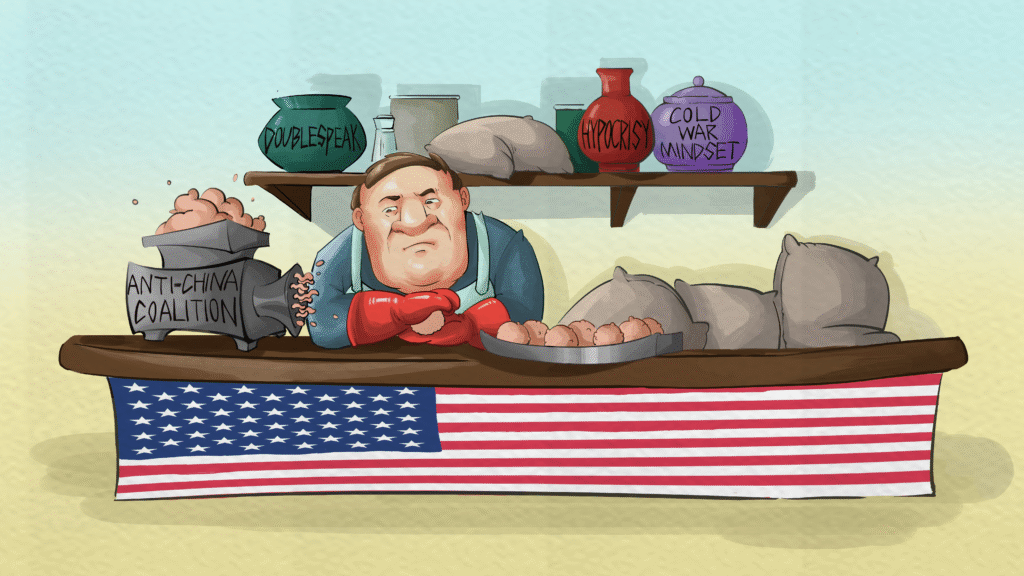
Designer: Yu Jiansu at CGTN.com

Martin Powers

September 4, 2020

Ann Arbor (Special to Informed Comment) – On the left, there is widespread agreement that Trump’s immigration policies are informed by white supremacist doctrines. His travel ban on Middle Eastern nations was racially charged, not to mention restricting aid to Puerto Ricans ravaged by a hurricane. Combined with the utter absence of sympathy for families of murdered Americans, it would appear that race connects the dots in this administration’s policy puzzle, yet Trump-team’s hysterical China-bashing is often accepted as a legitimate response to an existential threat. Can we be certain that race plays no part in that drama?

Originally posted on Informed Comment on August 29, 2020.

Many recognize crude name-calling, like “Kung-flu,” as racist, but apart from that, a common give-away is contempt for outstanding performance by members of supposedly inferior groups. Kamala Harris is too “ambitious” (for a woman of color), and a former waitress like AOC has no business in the Senate.

What these remarks really entail is that Kamala’s formidable intelligence, and AOC’s rapier wit, are an affront to those who regard women and people of color as inferior. As sociologist Herbert Blumer put it, the group to which each belongs “is not keeping to its place but threatens to claim the opportunities and privileges from which it has been excluded.”

As it happens Blumer was talking about Asians, who are just as likely to arouse indignation should they step out of place. If high-performance women are smeared as “ambitious,” high-performance China is labeled “aggressive,” because it has no business achieving things we were meant to achieve.

A respected, liberal statesperson recently wrote: “China has aggressively pushed the message that it responded decisively and responsibly to the mounting death toll while the United States dithered.” In other words, China had the effrontery to state the facts, facts that undermine U.S. claims for cultural superiority. How could the Chinese government show greater concern for its people when we are a Democracy, and they are Communists?

The administration regularly insinuates that Chinese are “untrustworthy,” even though America lied about Three-Mile Island, WMD’s, Abu Ghraib, and mass surveillance, and we elected a leader who has lied more than 20,000 times. Even so statements from China are routinely dismissed without fact-checking, for no other reason than that a Chinese person said it. Could race be a factor here?

We fail to recognize racism directed at China or its people because certain code words allow a speaker to rationalize bigotry as due to something other than race. In recent months the most common codes for China include “aggressive,” “Communist,” “totalitarian,” and “Hong Kong.” The mere mention of any of these can justify open hostility toward all things Chinese.

“Communist” is the current term for the centuries-old “Despotic Oriental” meme. During the Cold War, those of us in Chinese Studies were taught that the Chinese emperor had absolute authority over all aspects of government and people’s lives, except that this turns out to be false. Unlike European monarchs, China’s emperor had little to say about who was appointed to office, and even less to say about any individual’s chosen religion, artistic taste, or choice of job.

Despite the facts, the Despotic Oriental theme returns zombie-like in essays on contemporary China, where we learn that all enterprises are state-owned and controlled by an all-powerful, “totalitarian” center determining every aspect of people’s lives. Admittedly, many Chinese firms are state-owned, but according to the Economist, the reality of private “Chinese entrepreneurship is broad as well as deep.”

Back in 2014 the media began reporting that Huawei phones were spying on their users. In response Huawei, which is employee-owned, has repeatedly requested hard evidence to back those claims. They are still waiting.

Then Edward Snowden released documents showing that “while U.S. government officials openly suspected [meaning “accused”] Huawei of collaborating with Chinese intelligence, the NSA was covertly infiltrating the company’s servers.” More recently it appears that U.S. anxiety around China’s 5G technology might have more to do with the fact that, on Huawei phones, the U.S. “will no longer be able to require ‘back doors’ that the NSA can use to spy on us all.”

When it comes to China, the press might even repeat cringeworthy sentiments as if they were perfectly sound: “The Trump administration has long alleged TikTok may pose a national security threat, in large part due to its Chinese ownership.” We are meant to assume that ownership by a Chinese person is sufficient cause for concern, ignoring the fact that Trump has a personal grudge against TikTok, since it was credited with reducing the turnout in Tulsa. But let’s imagine if the Washington Post were to write: “The administration has always regarded Company X with suspicion, in large part due to its Black ownership.” Would we accept that argument as well?

Since pro-democracy demonstrators in Hong Kong began tossing petrol bombs into the underground last year, the word “Hong Kong” has become a magic bullet justifying multiple actions against the PRC. As the July issue of the Economist wrote “Any remaining illusions that China’s leaders respect rule of law when it really matters have been shattered by events in Hong Kong.” Those events, however, were not specified.

There is good reason to believe that, during clashes between Hong Kong police and protesters, egregious acts of brutality took place, and all such acts should be condemned, whether they occur in Hong Kong, Portland, Kenosha, or anywhere else.

What isn’t clear is, how did the author of that article convince herself that the U.S. still retains the standing to stand for “rule of law”? Can s/he have forgotten Trump’s impeachment trial where crucial evidence and witnesses were barred from court, and where jurors declared their decision before reviewing any evidence?

That spectacle, together with the administration’s criminally negligent handling of the pandemic, has inspired a spate of essays in the Washington Post, The Guardian, Slate, and elsewhere on the demise of American leadership. Granted, all those essays were critical of specific Chinese policies, but they agreed on the expiration of any grounds for American exceptionalism.

Perhaps most poignant was Mishra Pankaj’s essay showing why the U.S. and Britain are no longer qualified to “claim moral superiority over China, Russia and Iran. The early winners of modern history now seem to be its biggest losers, with their delegitimised political systems, grotesquely distorted economies and shattered social contracts.”

China Racism Hurts Americans

Knee-jerk assumptions about collectivist Orientals may have contributed to the mask wars and a good many lives lost. From experience, authorities in China determined that extensive use of masks, testing, and tracing could help to reduce the spread of the disease, but in March, media outlets suggested that Asians wear masks because they are fundamentally different from individualistic Westerners, for whom “facial expression is very important.” The idea that Asians might wear masks out of concern for others was not considered.

As recently as April American medical scientists remained skeptical of China’s methods, concluding that ordinary masks were basically useless because they did not block a high percentage of airborne pathogens. Claims like these only helped to bolster Trump’s culture wars, further sabotaging sane pandemic policy based on China’s earlier practice. Eventually of course, experts here conceded that less-than-perfect masks, testing, and tracing in fact offered our best chance to control the pandemic, but in the meantime how many Americans died needlessly?

Few would doubt that China poses challenges for America, but we can no longer pretend that American policies are always just, or that China is the evil empire. China used to provide a major market for American agriculture and the auto industry; now it doesn’t. President Trump determined that. China used to work closely with WHO sharing their massive data on Covid-19; now they don’t. President Trump determined that. China could offer critical help in mounting an effective response to climate disaster, but that would make no sense to Trump, who sees the world as a collection of races not keeping their places. Connect the dots.

At a time when no one can escape pandemic or global heating, policy may matter more than ideology. If a “Democratic” nation revokes emission standards, everyone will suffer. If a “Communist” country develops effective pandemic responses, everyone benefits so long as nations share ideas and data. Traditionally, liberals tend to embrace these kinds of common-sense strategies. Why should anyone opt for race over reason just because someone uttered the word “China”?

——-

Bonus Video added by Informed Comment:

6abc : “‘She punched me on my face’: Asian-American pregnant mother says attack was targeted”

Please help TFF remain truly independent by contributing if you benefited from this article

Martin Powers has written three books examining the theory and practice of administration in China. Two of these won the Levenson Prize for best book in pre-1900 Chinese Studies. Formerly Sally Michelson Davidson Professor and Director of the Center for Chinese Studies, he is currently Professor Emeritus at the University of Michigan. His most recent book is China and England: the preindustrial struggle for justice in word and image, Routledge, 2019.

Related Posts

Jan Oberg, TFF director April 9, 2026 I was recently invited to have a good, long talk about the world – and, of course, about peace too – with Boris Malagurski on his Weight of Chains Channel on YouTube. It was a real joy and seems to have been greatly appreciated by the viewers too. Mr Malagurski and I shall of course be grateful if you share this conversation in your circles – of course, only if you like what you see and hear 😉☮️ And remember that this one – like hundreds of others with TFF Associates – can be enjoyed at our TFF Video Collection.
A friendly quarrel while we agree that the US sanctions are a weapon of mass destruction and kill more people than wars do. And that we must talk much more about sanctions than we have so far. Jan Oberg, TFF director March 16, 2026 John Mearsheimer recently stated that U.S. sanctions murdered around 38 million people between 1971 and 2021 – see the video below. It is a dramatic figure, and it has spread quickly because it captures, in one sentence, the enormous human cost of modern sanctions. I share his concern about the destructive effects of economic coercion. But the specific number he cites — and the way he attributes it — deserves a friendly academic clarification. The figure comes from a 2023 Lancet Global Health article estimating the mortality effects of unilateral U.S. and EU sanctions over the past half‑century. This is the first point where Mearsheimer’s shorthand diverges from the text: the study...
By Jan ObergTFF co-founder and director February 11, 2026 PART 3 — ECONOMICS, TRADE & FINANCIAL SOVEREIGNTY A. Trade Measures & Market Signaling Economic pressure can be applied instantly and scaled without violence. Immediate Measures (within a week) Government boycott US goods and services  A very powerful signal which over time will be felt. Targeted tariffs on selected U.S. goods Symbolic but high-visibility sectors send a clear message. Suspend trade facilitation talks A peaceful pause that signals deep concern. Freeze U.S. participation in public procurement – military procurement in particular A nonviolent way to reduce influence. Competition law review of U.S. corporations A legal tool to scrutinise market dominance. Longer-Term Measures EU–Asia–Africa trade corridors Reducing reliance on U.S. markets. European supply chains for critical minerals Strategic autonomy in resource access. European Strategic Trade Authority Monitoring coercive practices globally. Euro-denominated commodity markets Weakening the dollar’s pricing monopoly. The EU must resume contacts and negotiations with Russia, focusing on energy cooperation To...

Recent Articles

Tony Robinson October 4, 2026 Violence is easy to recognise when someone is being beaten, shot or killed. It becomes more difficult when nobody is holding a weapon. Poverty, discrimination, exploitation and repression can restrict a human life just as effectively, although they do so in very different ways and with very different consequences. Simply adding more categories to an ever-growing list of forms of violence does not really solve the problem. The more interesting question is what all these different situations have in common and why it makes sense to describe them using the same word. Human beings do not simply react to what happens around them. They remember the past, imagine things that do not yet exist, make plans and undertake projects. Workers organise because they imagine different working conditions; people migrate because they imagine another life somewhere else; social movements emerge because people refuse to accept the...
It’s a matter of principles, courage, vision and pulling together – while the militarist world is falling apart… Peter Langille October 3, 2026 “Here, then, is the problem which we present to you, stark and dreadful and inescapable: Shall we put an end to the human race; or shall mankind renounce war?”The Bertrand Russell—Albert Einstein Manifesto, July 9, 1955 ⁕ The forecast for what’s ahead is worrisome. The sharp rise in armed conflicts over the past three years is adding to what was already the highest level in over seventy years. Genocides, which should be prevented are supported. A shared climate emergency that jeopardises survival is ignored. Diverse polls now suggest that people are war-weary, worried and interested in a more effective United Nations. And, there are viable policy options for a more secure world! Yet governments are doubling-down, betting on more war and investing heavily. If current trends persist,...
Johan Galtung 1930-2024October 2015 Published here on October 3, 2026 Let us focus on Civilization for conflict analysis and remedies. Major forms of disorder use violence; war is state organized violence. The most belligerent states are the United States of America and Israel, both with civilization roots. National Evangelism, the US Protestant Christian civilization– more national than evangelical–justifies US warfare as exceptionalism of a people chosen by God, with a manifest destiny to run the world. Orthodox Judaism justifies Israeli warfare to conquer and expand from Nile to Euphrates as a religious right and duty to the Eternal One. The third most belligerent country, the UK, no longer believes it is God-chosen but chosen by the USA; not quite the same but something. But the root cause of global disorder lies in the Occident–with Islam–seeing itself as the single, universal civilization valid for all at all times, all others being...

TFF on Substack

Discover and subscribe to more peace materials on TFF Substack

Most Popular

Tony Robinson October 4, 2026 Violence is easy to recognise when someone is being beaten, shot or killed. It becomes more difficult when nobody is holding a weapon. Poverty, discrimination, exploitation and repression can restrict a human life just as effectively, although they do so in very different ways and with very different consequences. Simply adding more categories to an ever-growing list of forms of violence does not really solve the problem. The more interesting question is what all these different situations have in common and why it makes sense to describe them using the same word. Human beings do not simply react to what happens around them. They remember the past, imagine things that do not yet exist, make plans and undertake projects. Workers organise because they imagine different working conditions; people migrate because they imagine another life somewhere else; social movements emerge because people refuse to accept the...
It’s a matter of principles, courage, vision and pulling together – while the militarist world is falling apart… Peter Langille October 3, 2026 “Here, then, is the problem which we present to you, stark and dreadful and inescapable: Shall we put an end to the human race; or shall mankind renounce war?”The Bertrand Russell—Albert Einstein Manifesto, July 9, 1955 ⁕ The forecast for what’s ahead is worrisome. The sharp rise in armed conflicts over the past three years is adding to what was already the highest level in over seventy years. Genocides, which should be prevented are supported. A shared climate emergency that jeopardises survival is ignored. Diverse polls now suggest that people are war-weary, worried and interested in a more effective United Nations. And, there are viable policy options for a more secure world! Yet governments are doubling-down, betting on more war and investing heavily. If current trends persist,...
Johan Galtung 1930-2024October 2015 Published here on October 3, 2026 Let us focus on Civilization for conflict analysis and remedies. Major forms of disorder use violence; war is state organized violence. The most belligerent states are the United States of America and Israel, both with civilization roots. National Evangelism, the US Protestant Christian civilization– more national than evangelical–justifies US warfare as exceptionalism of a people chosen by God, with a manifest destiny to run the world. Orthodox Judaism justifies Israeli warfare to conquer and expand from Nile to Euphrates as a religious right and duty to the Eternal One. The third most belligerent country, the UK, no longer believes it is God-chosen but chosen by the USA; not quite the same but something. But the root cause of global disorder lies in the Occident–with Islam–seeing itself as the single, universal civilization valid for all at all times, all others being...
Read More
Living-Peace-Sign-Budapest-copy
Tony Robinson October 4, 2026 Violence is easy to recognise when someone is being beaten, shot or killed. It becomes more difficult when nobody is holding a weapon. Poverty, discrimination, exploitation and repression can restrict a human life just as effectively, although they do so in very different ways and with very different consequences. Simply adding more categories to an ever-growing list of forms of violence does not really solve the problem. The more interesting question is what all these different situations have in common and why it makes sense to describe them using the same word. Human beings do not simply react to what happens around them. They remember the past, imagine things that do not yet exist, make plans and undertake projects. Workers organise because they imagine different working conditions; people migrate because they imagine another life somewhere else; social movements emerge because people refuse to accept the...
b54a1f10-8c65-4f0b-9dd5-4abc0a7d04cc_2659x2659
It’s a matter of principles, courage, vision and pulling together – while the militarist world is falling apart… Peter Langille October 3, 2026 “Here, then, is the problem which we present to you, stark and dreadful and inescapable: Shall we put an end to the human race; or shall mankind renounce war?”The Bertrand Russell—Albert Einstein Manifesto, July 9, 1955 ⁕ The forecast for what’s ahead is worrisome. The sharp rise in armed conflicts over the past three years is adding to what was already the highest level in over seventy years. Genocides, which should be prevented are supported. A shared climate emergency that jeopardises survival is ignored. Diverse polls now suggest that people are war-weary, worried and interested in a more effective United Nations. And, there are viable policy options for a more secure world! Yet governments are doubling-down, betting on more war and investing heavily. If current trends persist,...
010
Johan Galtung 1930-2024October 2015 Published here on October 3, 2026 Let us focus on Civilization for conflict analysis and remedies. Major forms of disorder use violence; war is state organized violence. The most belligerent states are the United States of America and Israel, both with civilization roots. National Evangelism, the US Protestant Christian civilization– more national than evangelical–justifies US warfare as exceptionalism of a people chosen by God, with a manifest destiny to run the world. Orthodox Judaism justifies Israeli warfare to conquer and expand from Nile to Euphrates as a religious right and duty to the Eternal One. The third most belligerent country, the UK, no longer believes it is God-chosen but chosen by the USA; not quite the same but something. But the root cause of global disorder lies in the Occident–with Islam–seeing itself as the single, universal civilization valid for all at all times, all others being...
Screenshot 2026-10-02 011738
Jan Oberg PhD, director, The Transnational Foundation for Peace and Future Research, TFFLund, Sweden October 2, 2026 This is my full original manuscript. The Chinese Academy of Social Science, CASS, makes two publications out if it. 1. China’s Five-year plan emphasized the capabilities of basic research and original innovation. It is regarded as the goal of the future social development, which, as required, should be significantly enhanced. Can you comment on the importance of original innovation in research and academic study? I believe it is easier to define “original innovation” in the natural sciences than in social sciences. The breaking points of what constitutes something new, or innovative, are not quite as sharp in the latter. But in both fields it is about opening up something that was closed, unseen, unexplored before – making manifest what was earlier latent. Innovations come in many forms and shapes – naming something that was...
arctic-circle-map
The agreement is catastrophic both because of what it says and what it doesn’t mention. It reduces further the major asset of security policies: Freedom of action. Jan Oberg TFF director September 25, 2026 A couple of hours before the agreement was signed on September 22, 2026, I published the following 13 hypotheses about what it would most likely contain on TFF Substack (in English). I was wrong on only the first point. Contrary to what Trump had written on his Truth Social platform, it does not appear to come into force immediately. In fact, it turned out to be worse than even I had anticipated. After these hypotheses now come a number of reflections in light of what the agreement actually contains, and does not contain, as well as the way in which it has generally been presented by major media outlets and by the public-service broadcaster DR. My...
girl-5894831_1280
Below are TFF-related media mentions, comments, videos and social media posts published elsewhere but not on this homepage. We happen to catch and list only a fraction. Regarding video comments and debates, we recommend that you go to the TFF Video Channel on Substack where many of them are reproduced. Jan Oberg is a contributor to China Daily – 52 million daily clicks – and Global Times, CGTN and CCTV (the national television), China Investment, Xinhua News Agency and several others. Articles and videos on these media very often multiply into countless Chinese (and Western media) that re-post them from these main media. Thanks to The China Academy, his analyses, interviews and comments are frequently posted on YouTube channels such as Thinkers Forum and Wave Media. These videos are often re-posted on Bilibili (China’s YouTube), the China Content Center on TikTok, and on the Chinese edition of TikTok, Douyin.com. This means reaching hundreds of millions of viewers worldwide over a year. While there are too many to catch on all these...




