
Vad är fred? En personlig och uppfordrande betraktelse

Fred är det när det inte är krig. Klart som korvspad?

När det är fred, sa min pappa till mig, då ska vi köpa det där pianot som du längtar efter. Jag var åtta år och slutet på det andra världskriget var nära. När det är fred, då köper jag jordbruksmaskiner för sparpengarna, och startar en affär. När det är fred, behöver bönderna sådana maskiner. Bara det blir fred, så…

Men innan dess hann fler bomber falla på vår by och min pappa blev skjuten, om med tysk eller rysk kula är ovisst. Och min storebror återvände inte från Ryssland.

Men så blev det ju fred i alla fall. Fast det var inte alls ett sådant jubel jag senare såg på film från Kungsgatan i Stockholm.

Den fred som kom då i maj 1945 till vår by i Österrike smög sig på lite peu à peu liksom. För mig var det ingen större skillnad egentligen, annat än att pappa var död, sparpengarna inte pappret värda de var tryckta på, vårt hus utan fönster, ingen elektrisk ström på ett år, lik som flöt på floden, så vi blev förbjudna att bada hela den sommaren. Och mycket lite mat.

Befriarna, ryssarna, som av befolkningen dock envist kallades för ockupationsmakt, skulle vi inkvartera. Vi hade skrämts med att de åt barn levande och länge fanns en stor rädsla hos mig och alla andra. Det visade sig snart att de var mycket snälla mot oss barn, och förmodligen överlevde vi hyggligt tack vare att de delade med sig av sina små matransoner. Att mamma fick vara “till lags” av och till anade jag, men slog bort som något som inte jag hade med att göra.

En lång inledning på ovanstående frågeställning: Vad är fred?

En åttaåring i Irak, i Afghanistan, i Tjetjenien och på många andra ställen där krig övergått i fred idag skulle nog kunna svara ungefär som jag för 60 år sedan. Det är det sorgliga och utmanande och ovärdiga.

Jag lärde mig många läxor med kroppen som barn.

Till exempel lärde jag mig att hunger känns som krig i magen. Med hungrande barn i Indien, i Bangladesh, i Afrika som jag senare i livet kom i kontakt med kände jag genast en stor gemenskap. Och vreden tog tag i mig. Detta är krig, tänkte jag. Fastän inga bomber faller. Låt gå att det verkligen fanns lite mat när jag var barn, men i Bangladesh år 1974 användes maten som vapen.

Ryssarna hade jag lärt mig frukta, tills jag träffade några. Varför skulle Österrike föra krig mot dom, undrade jag? Men när vi gick fredsmarschen till Minsk år 1982 och skrev positivt till våra tidningar om det, kallades vi hjärntvättade. Lurade av kommunisterna. De kan aldrig ha träffat någon ryss, tänkte jag. Kalla kriget kastade sin skugga.

Sverige på 50-talet upplevde jag med sina lugna gröna förorter, den sävliga vänligheten och en viss självgodhet: Var glad att du sluppit ut nu, flicka lilla.

Många analyser läste jag, många teorier tog jag till mig. Men alltid gnagde de outtalade frågorna: Jaha, och vad har du tänkt göra åt det?

Med mina barnerfarenheter i bagaget byggde jag sakta men säkert upp en grundmurad övertygelse om fredens beskaffenhet:

Freden finns i ett samhälle som strävar efter frihet från hunger, frihet från våld, frihet från hat och misstänksamhet mot “de andra”. Var finns detta idealsamhälle? Och vems är ansvaret att det byggs?

Mina svårigheter började med att jag ville förena det stora med det lilla. Det globala med det lokala. Otillräckligheten slog sina klor i mig.

Jag gick med i fredsrörelsen. Där vågade jag inte skratta, eftersom vi behandlade så allvarliga frågor. Jag gick med i kvinnorörelsen. Där blev jag så ledsen å alla förfördelade och våldtagna kvinnors vägnar så jag blev helt tillintetgjord. Jag gick med i miljörörelsen. Där skrämde Rachel Carsons bok Tyst Vår livet ur mig. Och alla domedagsprofetior slog mig till marken.

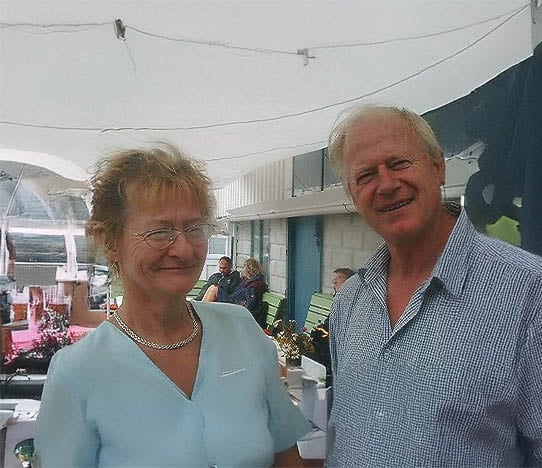
När kom vändningen? Den kom väl också peu à peu, som freden en gång i min barndom. Och med min älskade Ola. Då var vi helt plötsligt två som av hjärtans lust kunde skälla och gorma åt alla fähundar i världen. Vi överträffade varandra med att hitta träffande beskyllningar. Men mera än detta arbetade vi på alternativen. I stället för. Man blir så påhittig när man älskar. Man vill göra det så gott för sin älskade. Man är så villig att utöka sin välvilja till många fler, ja till hela världen.

Medvetet målar jag nu i rosenrött. Med den allvarliga undertonen: Det behövs mera kärleksfullhet. Samhällen där kärleken frodas, där den får en möjlighet, där den gödslas och vattnas och vårdas och omhuldas. Vems är ansvaret att ett sådant samhälle uppstår?

Min tredje och allvarligaste och viktigaste erfarenhet: Det kommer an på oss, på dig och på mig. Vi är kuggarna i livets hjul, vi är dess nav, vi är huvudpersonerna i våra och andras liv, vi är viktiga, vi är nödvändiga. Vi med vår brinnande önskan att livet måste bli bra för alla.

Gandhi myntade det underbara uttrycket: Fred är vägen. Och Bertha von Suttner (Nobels fredspris år 1905) uttryckte det så: Den (freden) är inte målet, utan det normala tillståndet av den mänskliga civilisationen. Och Johan Galtung talar om verktygen: Fred med fredliga medel. Konfliktlösning utan våld. Det er grundnormen i FN:s stadga.

Så, vad kan vi nu verkligen göra? I Sverige? Du och jag i fredsrörelsen, i kvinnorörelsen, i miljörörelsen?

Låta oss övertygas om att vapen inte skapar fred. Fredsforskarna har gett oss mängder med bevis. Vi, fotfolket ska sprida den kunskapen, vi ska inte bara sitta hemma på vår kammare och tycka och förfasa oss. Ut bland folket! Säga vad vi vet, bilda opinion, vara obekväma, demonstrera, anordna möten, seminarier. Folkbilda!

Mycket aktivt ska vi förändra de attityder som upprätthålls av patriarkatets våldskultur. Kvinnors rättigheter är mänskliga rättigheter! Visa i praktisk handling solidaritet med våldets offer, internationellt och här hemma. Acceptera inte tillvänjningen till våldet och våldsideologin!

Tillämpa en rättvis handel, i ord som i praktiken. Alla kan bojkotta Coca-Cola. Alla kan köpa rättvisemärkta varor..

På vårt café serverar vi rättvisemärkt kaffe, te och choklad, tårtor och kakor med fina namn som Mahatma Gandhis drömmar, bakelsen Rosa Luxemburg, mandeltårtan Amandla Mandela, med mera.

Och så sjunger vi: fredssånger, kvinnosånger, kampsånger, kärlekssånger. Fred med naturen och fred mellan könen.

Var med och bygg en fredlig värld!
Related Posts

LONDON – So far so good, at least on the wider level. While internally Iraq seems on the edge of chaos, the much heralded clash of civilizations between the Muslim and Judaeo-Christian worlds has yet to become apparent. We have anger and despair aplenty in the Arab and Muslim worlds. But very little rushing to the standard and there was no great pilgrimage of warriors to join the fight, as happened when the Soviet Union invaded Afghanistan twenty years ago, and then, having driven the Red Army out, were left to ferment in that mountainous redoubt. With the armaments supplied by the CIA the mujahidin were transformed into Al Qaeda that became, for a relatively brief moment as these things go, ‘the greatest threat to the homeland that America has ever known.’ Nevertheless a ‘Cold War’ between much of the Muslim world and the West is certainly in full swing. Winston...
The Challenge of Nuclear Weaponsin the Twenty-first CenturyA Path Forward The peoples and governments of the world face an urgent challenge relating to weaponry of mass destruction and particularly to nuclear weaponry.  At the crossroads of technology, terrorism, geopolitical ambition, and policies of preemption are new and potent dangers for humanity. Despite ending the nuclear standoff of the Cold War era, nuclear weaponry is again menacing the peoples of the world with catastrophic possibilities.  We recognize the need for any government to pursue its security interests in accordance with international law; and further, we recognize that distinctive threats to these interests now exist as a result of an active international terrorist network having declared war on the United States and its allies. Nonetheless, we reject the assessment of the current US administration that upgrading a reliance on nuclear weapons is in any sense justified as a response. We find it...
By Karin Wegestal MP, the Social Democratic Partyon behalf of the Swedish Committee for Solidarity with the Yugoslav People During the last decade, the Federal Republic of Yugoslavia has received more than 500,000 refugees from Croatia and Bosnia, and another 300,000 internally displaced persons, mainly from the province Kosovo and Metohia. For a country with about ten million inhabitants, such an influx of homeless people is obviously a very heavy burden – even under peaceful conditions. But in addition to that, the Federal Republic of Yugoslavia has been the subject to sanctions from the western powers for close to ten years and its infrastructure was badly hurt through Nato’s intense bombardment during 78 days in 1999. The result of all this is that Yugoslavia, once the most developed industrial country in Eastern Europe, is today the poorest country in Europe. In Serbia excluding Kosovo, with about ten million inhabitants and...

Recent Articles

Tony Robinson October 4, 2026 Violence is easy to recognise when someone is being beaten, shot or killed. It becomes more difficult when nobody is holding a weapon. Poverty, discrimination, exploitation and repression can restrict a human life just as effectively, although they do so in very different ways and with very different consequences. Simply adding more categories to an ever-growing list of forms of violence does not really solve the problem. The more interesting question is what all these different situations have in common and why it makes sense to describe them using the same word. Human beings do not simply react to what happens around them. They remember the past, imagine things that do not yet exist, make plans and undertake projects. Workers organise because they imagine different working conditions; people migrate because they imagine another life somewhere else; social movements emerge because people refuse to accept the...
It’s a matter of principles, courage, vision and pulling together – while the militarist world is falling apart… Peter Langille October 3, 2026 “Here, then, is the problem which we present to you, stark and dreadful and inescapable: Shall we put an end to the human race; or shall mankind renounce war?”The Bertrand Russell—Albert Einstein Manifesto, July 9, 1955 ⁕ The forecast for what’s ahead is worrisome. The sharp rise in armed conflicts over the past three years is adding to what was already the highest level in over seventy years. Genocides, which should be prevented are supported. A shared climate emergency that jeopardises survival is ignored. Diverse polls now suggest that people are war-weary, worried and interested in a more effective United Nations. And, there are viable policy options for a more secure world! Yet governments are doubling-down, betting on more war and investing heavily. If current trends persist,...
Johan Galtung 1930-2024October 2015 Published here on October 3, 2026 Let us focus on Civilization for conflict analysis and remedies. Major forms of disorder use violence; war is state organized violence. The most belligerent states are the United States of America and Israel, both with civilization roots. National Evangelism, the US Protestant Christian civilization– more national than evangelical–justifies US warfare as exceptionalism of a people chosen by God, with a manifest destiny to run the world. Orthodox Judaism justifies Israeli warfare to conquer and expand from Nile to Euphrates as a religious right and duty to the Eternal One. The third most belligerent country, the UK, no longer believes it is God-chosen but chosen by the USA; not quite the same but something. But the root cause of global disorder lies in the Occident–with Islam–seeing itself as the single, universal civilization valid for all at all times, all others being...

TFF on Substack

Discover and subscribe to more peace materials on TFF Substack

Most Popular

Tony Robinson October 4, 2026 Violence is easy to recognise when someone is being beaten, shot or killed. It becomes more difficult when nobody is holding a weapon. Poverty, discrimination, exploitation and repression can restrict a human life just as effectively, although they do so in very different ways and with very different consequences. Simply adding more categories to an ever-growing list of forms of violence does not really solve the problem. The more interesting question is what all these different situations have in common and why it makes sense to describe them using the same word. Human beings do not simply react to what happens around them. They remember the past, imagine things that do not yet exist, make plans and undertake projects. Workers organise because they imagine different working conditions; people migrate because they imagine another life somewhere else; social movements emerge because people refuse to accept the...
It’s a matter of principles, courage, vision and pulling together – while the militarist world is falling apart… Peter Langille October 3, 2026 “Here, then, is the problem which we present to you, stark and dreadful and inescapable: Shall we put an end to the human race; or shall mankind renounce war?”The Bertrand Russell—Albert Einstein Manifesto, July 9, 1955 ⁕ The forecast for what’s ahead is worrisome. The sharp rise in armed conflicts over the past three years is adding to what was already the highest level in over seventy years. Genocides, which should be prevented are supported. A shared climate emergency that jeopardises survival is ignored. Diverse polls now suggest that people are war-weary, worried and interested in a more effective United Nations. And, there are viable policy options for a more secure world! Yet governments are doubling-down, betting on more war and investing heavily. If current trends persist,...
Johan Galtung 1930-2024October 2015 Published here on October 3, 2026 Let us focus on Civilization for conflict analysis and remedies. Major forms of disorder use violence; war is state organized violence. The most belligerent states are the United States of America and Israel, both with civilization roots. National Evangelism, the US Protestant Christian civilization– more national than evangelical–justifies US warfare as exceptionalism of a people chosen by God, with a manifest destiny to run the world. Orthodox Judaism justifies Israeli warfare to conquer and expand from Nile to Euphrates as a religious right and duty to the Eternal One. The third most belligerent country, the UK, no longer believes it is God-chosen but chosen by the USA; not quite the same but something. But the root cause of global disorder lies in the Occident–with Islam–seeing itself as the single, universal civilization valid for all at all times, all others being...
Read More
Living-Peace-Sign-Budapest-copy
Tony Robinson October 4, 2026 Violence is easy to recognise when someone is being beaten, shot or killed. It becomes more difficult when nobody is holding a weapon. Poverty, discrimination, exploitation and repression can restrict a human life just as effectively, although they do so in very different ways and with very different consequences. Simply adding more categories to an ever-growing list of forms of violence does not really solve the problem. The more interesting question is what all these different situations have in common and why it makes sense to describe them using the same word. Human beings do not simply react to what happens around them. They remember the past, imagine things that do not yet exist, make plans and undertake projects. Workers organise because they imagine different working conditions; people migrate because they imagine another life somewhere else; social movements emerge because people refuse to accept the...
b54a1f10-8c65-4f0b-9dd5-4abc0a7d04cc_2659x2659
It’s a matter of principles, courage, vision and pulling together – while the militarist world is falling apart… Peter Langille October 3, 2026 “Here, then, is the problem which we present to you, stark and dreadful and inescapable: Shall we put an end to the human race; or shall mankind renounce war?”The Bertrand Russell—Albert Einstein Manifesto, July 9, 1955 ⁕ The forecast for what’s ahead is worrisome. The sharp rise in armed conflicts over the past three years is adding to what was already the highest level in over seventy years. Genocides, which should be prevented are supported. A shared climate emergency that jeopardises survival is ignored. Diverse polls now suggest that people are war-weary, worried and interested in a more effective United Nations. And, there are viable policy options for a more secure world! Yet governments are doubling-down, betting on more war and investing heavily. If current trends persist,...
010
Johan Galtung 1930-2024October 2015 Published here on October 3, 2026 Let us focus on Civilization for conflict analysis and remedies. Major forms of disorder use violence; war is state organized violence. The most belligerent states are the United States of America and Israel, both with civilization roots. National Evangelism, the US Protestant Christian civilization– more national than evangelical–justifies US warfare as exceptionalism of a people chosen by God, with a manifest destiny to run the world. Orthodox Judaism justifies Israeli warfare to conquer and expand from Nile to Euphrates as a religious right and duty to the Eternal One. The third most belligerent country, the UK, no longer believes it is God-chosen but chosen by the USA; not quite the same but something. But the root cause of global disorder lies in the Occident–with Islam–seeing itself as the single, universal civilization valid for all at all times, all others being...
Screenshot 2026-10-02 011738
Jan ObergPhD, director, The Transnational Foundation for Peace and Future Research, TFFLund, Sweden October 2, 2026 This is my full original manuscript. The Chinese Academy of Social Science, CASS, makes two publications out if it. 1. China’s Five-year plan emphasized the capabilities of basic research and original innovation. It is regarded as the goal of the future social development, which, as required, should be significantly enhanced. Can you comment on the importance of original innovation in research and academic study? I believe it is easier to define “original innovation” in the natural sciences than in social sciences. The breaking points of what constitutes something new, or innovative, are not quite as sharp in the latter. But in both fields it is about opening up something that was closed, unseen, unexplored before – making manifest what was earlier latent. Innovations come in many forms and shapes – naming something that was not...
arctic-circle-map
The agreement is catastrophic both because of what it says and what it doesn’t mention. It reduces further the major asset of security policies: Freedom of action. Jan Oberg TFF director September 25, 2026 A couple of hours before the agreement was signed on September 22, 2026, I published the following 13 hypotheses about what it would most likely contain on TFF Substack (in English). I was wrong on only the first point. Contrary to what Trump had written on his Truth Social platform, it does not appear to come into force immediately. In fact, it turned out to be worse than even I had anticipated. After these hypotheses now come a number of reflections in light of what the agreement actually contains, and does not contain, as well as the way in which it has generally been presented by major media outlets and by the public-service broadcaster DR. My...
girl-5894831_1280
Below are TFF-related media mentions, comments, videos and social media posts published elsewhere but not on this homepage. We happen to catch and list only a fraction. Regarding video comments and debates, we recommend that you go to the TFF Video Channel on Substack where many of them are reproduced. Jan Oberg is a contributor to China Daily – 52 million daily clicks – and Global Times, CGTN and CCTV (the national television), China Investment, Xinhua News Agency and several others. Articles and videos on these media very often multiply into countless Chinese (and Western media) that re-post them from these main media. Thanks to The China Academy, his analyses, interviews and comments are frequently posted on YouTube channels such as Thinkers Forum and Wave Media. These videos are often re-posted on Bilibili (China’s YouTube), the China Content Center on TikTok, and on the Chinese edition of TikTok, Douyin.com. This means reaching hundreds of millions of viewers worldwide over a year. While there are too many to catch on all these...





