UN’s Most Powerful Political Body Remains Paralyzed Battling a New Cold War

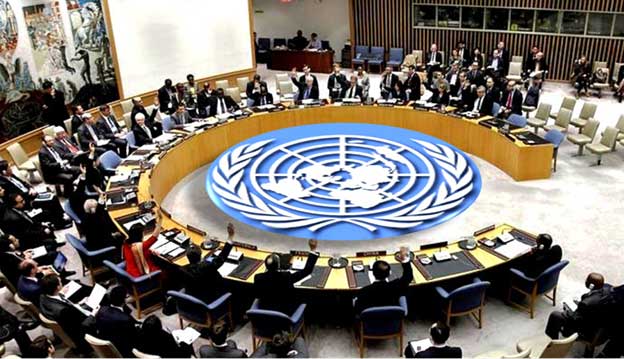
Photo credit: The United Nations

The UN Security Council is now the battleground
for a new Cold War between the US and China

Thalif Deen

April 23, 2021

UNITED NATIONS, Apr 14 2021 (IPS) – A new Cold War – this time, between the US and China —is threatening to paralyze the UN’s most powerful body, even as military conflicts and civil wars are sweeping across the world, mostly in Africa, the Middle East and Latin America.

The growing criticism against the Security Council is directed largely at its collective failures to resolve ongoing conflicts and political crises in several hot spots, including Syria, Yemen, Afghanistan, Iraq, Myanmar, Somalia, South Sudan, Ukraine and Libya — and its longstanding failure over Palestine.

The sharp divisions between China and Russia, on one side, and the Western powers on the other, are expected to continue, triggering the question: Has the Security Council outlived its usefulness or has it lost its political credibility?

The five big powers are increasingly throwing their protective arms around their allies, despite growing charges of war crimes, genocide and human rights violations against these countries.

Last week, Yasmine Ahmed, UK Director at Human Rights Watch, called on Britain “to step up as penholder on Myanmar and start negotiating a Security Council draft resolution on an arms embargo and targeted sanctions against the military”. See also this.

Over 580 people, including children, have been killed since the February 1 coup: “it is time for the Security Council to do more than issue statements and begin working towards substantive action,“ she warned.

But in most of these conflicts, including Myanmar, arms embargoes are very unlikely because the major arms suppliers to the warring parties are the five permanent members of the Security Council, namely the US, UK, France, Russia and China.

US President Joe Biden has described the growing new confrontation as a battle between democracies and autocracies.

In a recent analytical piece, the New York Times said China’s most striking alignment is with Russia, with both countries drawing closer after Russia’s annexation of Crimea in 2014. The two countries have also announced they will jointly build a research station on the moon, setting the stage to compete with US space programmes.

“The threat of a US-led coalition challenging China’s authoritarian policies has only bolstered Beijing’s ambition to be a global leader of nations that oppose Washington and its allies,” the Times said.

Ian Williams, President of the New York-based Foreign Press Association and author of ‘UNtold: The Real Story of the United Nations in Peace and War’, told IPS that in the early years, with a secure majority in the General Assembly (GA), the US could pretend virtue and eschew using the veto. The embattled Soviets resorted it over and over.

“But as with so much UN and international law, the Israeli exception had the US making up for lost time. Now the Russians have been catching up with vetoes for Serbia and Syria”.

China, he pointed out, avoided using the veto unless Taiwan or Tibet was mentioned. In the old days there was a hint of an ideological element — Third World and Socialism versus Imperialism.

“But now it is entirely transactional, veto holders looking after their clients and allies, so no one should entertain illusions about China and Russia acting in a progressive and constructive way. But the US is no position to point fingers about Syria while it protects Saudi Arabia and Israel”.

“We can hope that the majority of members will grow indignant enough to try to effect indignation. But sadly, historical experience suggests many governments have almost unlimited tolerance for mass murder in far-away countries of which they know little,” he noted, including Darfur, the Balkans, Rwanda and now Myanmar.

The breakthrough would be the US saying, end the Occupation and then inviting others to join in a reaffirmation of the Charter.

“But since I don’t really believe in the tooth fairy, I would have to settle for a coalition of the conscious-stricken in the GA united for peace – and international law and order”, said Williams, a senior analyst who has written for newspapers and magazines around the world, including the Australian, The Independent, New York Observer, The Financial Times and The Guardian.

Asked about the killings in Myanmar, and the lack of action in the UNSC, Secretary-General Antonio Guterres told reporters on March 29: “We need more unity in international community. We need more commitment in the international community to put pressure in order to make sure that the situation is reversed. I’m very worried. I see, with a lot of concern, the fact that, apparently, many of these trends look irreversible, but hope is the last thing we can give up on.”

Vijay Prashad, Executive Director, Tricontinental: Institute for Social Research, who has written extensively on international politics, told IPS the United Nations is an essential institution, a process, in many ways, rather than a fully-finished institution.

The agencies of the UN – including WHO, UNICEF, UNHCR, he said, provide vital service to the world’s peoples; “and we need to make these institutions more robust, and we need to ensure that they drive a public agenda that advances the UN Charter’s main goals (namely to maintain peace, to end hunger and illiteracy, to provide the basis for a rich life, in sum).”

The Security Council is a victim of the political battles in the world, he argued.

“There is no way to build a better framework to handle the major power differentials”., said Prashad, author of 30 books, including most recently ‘Washington Bullets’ (LeftWord, Monthly Review),

“It would be far better to empower the UN General Assembly, which is more democratic, but since the 1970s we have seen how the US – in particular – undermined the UNGA to take decision making almost exclusively to the UNSC”.

Ever since the fall of the USSR, he said, the UN Secretary-General has become subservient to the US government (“we saw this shockingly with the treatment of former Secretary-General Boutros Boutros-Ghali”).

The new ‘Group of Friends to Defend the UN Charter’, which includes China and Russia, is a positive development, said Prashad.

US Ambassador Linda Thomas-Greenfield told reporters on March 31: “And then in terms of working with my counterparts in the Security Council, I know that there are areas – and this is a discussion that I’ve had – with both my Russian and Chinese colleagues – we know that there are red lines”.

“There are areas where we have serious concerns, and we’ve been open and we’ve been frank about those concerns. In China, what is happening with the Uyghurs, for example. With Russia, in Syria, and there are many others. We know what the red lines are”, she added.

“We tried to bridge those gaps, but we also try to find those areas where we have common ground. We’ve been able to find common ground on Burma (Myanmar). With the Chinese, we’re working on climate change in, I think, a very positive way. We’re not in the exact same place, but it’s an area where we can have conversations with each other.”

“So as the top U.S. diplomat in New York, it is my responsibility to find common ground so that we can achieve common goals, but not to give either country a pass when they are breaking human rights values or pushing in directions that we find unacceptable,” she declared.

Meanwhile, harking back to a bygone era, during the height of the Cold War between the United States and the Soviet Union in the 1960s, the United Nations was the ideological battle ground where the Americans and the Soviets pummeled each other– either on the floor of the General Assembly hall or at the horse-shoe table of the UN Security Council.

Perhaps one of the most memorable war of words took place in October 1962 when the politically-feisty US Ambassador Adlai Stevenson (1961-65), a two-time Democratic US presidential candidate, challenged Soviet envoy Valerian Zorin over allegations that the USSR, perhaps under cover of darkness, had moved nuclear missiles into Cuba—and within annihilating distance of the United States.

Speaking at a tense Security Council meeting, Stevenson admonished Zorin: “I remind you that you didn’t deny the existence of these weapons. Instead, we heard that they had suddenly become defensive weapons. But today — again, if I heard you correctly — you now say they don’t exist, or that we haven’t proved they exist, with another fine flood of rhetorical scorn.”

“All right sir”, said Stevenson, “let me ask you one simple question. Do you, Ambassador Zorin, deny that the USSR has placed and is placing medium and intermediate range missiles and sites in Cuba?” “Yes or No? Don’t wait for the translation: Yes or No?”, Stevenson insisted with a tone of implied arrogance.

Speaking in Russian through a UN translator (who faithfully translated the US envoy’s sentiments into English), Zorin shot back: “I am not in an American courtroom, sir, and therefore I do not wish to answer a question that is put to me in the fashion in which a prosecutor does. In due course, sir, you will have your reply. Do not worry.”

Not to be outwitted, Stevenson howled back: “You are in the court of world opinion right now, and you can answer yes or no. You have denied that they exist. I want to know if …I’ve understood you correctly.”

When Zorin said he will provide the answer in “due course”, Stevenson famously declared: “I am prepared to wait for my answer until hell freezes over.”

Originally published by IPS News Agency

About the author

Thalif Deen, Senior Editor & Director, UN Bureau, Inter Press Service (IPS) News agency has been covering the United Nations since the late 1970s. Thalif Deen is the author of a newly-released book on the United Nations titled “No Comment – and Don’t Quote Me on That.” 

Please help TFF remain truly independent by contributing if you benefited from this article

Related Posts

The agreement is catastrophic both because of what it says and what it doesn’t mention. It reduces further the major asset of security policies: Freedom of action. Jan Oberg TFF director September 25, 2026 A couple of hours before the agreement was signed on September 22, 2026, I published the following 13 hypotheses about what it would most likely contain on TFF Substack (in English). I was wrong on only the first point. Contrary to what Trump had written on his Truth Social platform, it does not appear to come into force immediately. In fact, it turned out to be worse than even I had anticipated. After these hypotheses now come a number of reflections in light of what the agreement actually contains, and does not contain, as well as the way in which it has generally been presented by major media outlets and by the public-service broadcaster DR. My...
Jan Oberg May 15, 2026 Go to this Fox News page and scroll the whole way down: President Donald Trump tells the world that his meeting with President Xi Jinping yielded a lot of very concrete political and economic results – of course, only where the Chinese side, according to him, agreed with him. He does not mention the Taiwan issue, but Secretary of State, Marco Rubio, says that it did not feature prominently in their talks and that the US policy on Taiwan has not changed. Then go to China Daily – or Global Times – and you will see that for the Chinese it is framework, principles, structure of cooperation etc. that matters – all embedded in the overall idea of “constructive bilateral relationship of strategic stability.” Nowhere is any concrete agreement or deal – all that Trump refers to – mentioned. At the general level, this gives you insights into the very different social...
Jan Oberg, TFF director April 9, 2026 I was recently invited to have a good, long talk about the world – and, of course, about peace too – with Boris Malagurski on his Weight of Chains Channel on YouTube. It was a real joy and seems to have been greatly appreciated by the viewers too. Mr Malagurski and I shall of course be grateful if you share this conversation in your circles – of course, only if you like what you see and hear 😉☮️ And remember that this one – like hundreds of others with TFF Associates – can be enjoyed at our TFF Video Collection.

Recent Articles

Tony Robinson October 4, 2026 Violence is easy to recognise when someone is being beaten, shot or killed. It becomes more difficult when nobody is holding a weapon. Poverty, discrimination, exploitation and repression can restrict a human life just as effectively, although they do so in very different ways and with very different consequences. Simply adding more categories to an ever-growing list of forms of violence does not really solve the problem. The more interesting question is what all these different situations have in common and why it makes sense to describe them using the same word. Human beings do not simply react to what happens around them. They remember the past, imagine things that do not yet exist, make plans and undertake projects. Workers organise because they imagine different working conditions; people migrate because they imagine another life somewhere else; social movements emerge because people refuse to accept the...
It’s a matter of principles, courage, vision and pulling together – while the militarist world is falling apart… Peter Langille October 3, 2026 “Here, then, is the problem which we present to you, stark and dreadful and inescapable: Shall we put an end to the human race; or shall mankind renounce war?”The Bertrand Russell—Albert Einstein Manifesto, July 9, 1955 ⁕ The forecast for what’s ahead is worrisome. The sharp rise in armed conflicts over the past three years is adding to what was already the highest level in over seventy years. Genocides, which should be prevented are supported. A shared climate emergency that jeopardises survival is ignored. Diverse polls now suggest that people are war-weary, worried and interested in a more effective United Nations. And, there are viable policy options for a more secure world! Yet governments are doubling-down, betting on more war and investing heavily. If current trends persist,...
Johan Galtung 1930-2024October 2015 Published here on October 3, 2026 Let us focus on Civilization for conflict analysis and remedies. Major forms of disorder use violence; war is state organized violence. The most belligerent states are the United States of America and Israel, both with civilization roots. National Evangelism, the US Protestant Christian civilization– more national than evangelical–justifies US warfare as exceptionalism of a people chosen by God, with a manifest destiny to run the world. Orthodox Judaism justifies Israeli warfare to conquer and expand from Nile to Euphrates as a religious right and duty to the Eternal One. The third most belligerent country, the UK, no longer believes it is God-chosen but chosen by the USA; not quite the same but something. But the root cause of global disorder lies in the Occident–with Islam–seeing itself as the single, universal civilization valid for all at all times, all others being...

TFF on Substack

Discover and subscribe to more peace materials on TFF Substack

Most Popular

Tony Robinson October 4, 2026 Violence is easy to recognise when someone is being beaten, shot or killed. It becomes more difficult when nobody is holding a weapon. Poverty, discrimination, exploitation and repression can restrict a human life just as effectively, although they do so in very different ways and with very different consequences. Simply adding more categories to an ever-growing list of forms of violence does not really solve the problem. The more interesting question is what all these different situations have in common and why it makes sense to describe them using the same word. Human beings do not simply react to what happens around them. They remember the past, imagine things that do not yet exist, make plans and undertake projects. Workers organise because they imagine different working conditions; people migrate because they imagine another life somewhere else; social movements emerge because people refuse to accept the...
It’s a matter of principles, courage, vision and pulling together – while the militarist world is falling apart… Peter Langille October 3, 2026 “Here, then, is the problem which we present to you, stark and dreadful and inescapable: Shall we put an end to the human race; or shall mankind renounce war?”The Bertrand Russell—Albert Einstein Manifesto, July 9, 1955 ⁕ The forecast for what’s ahead is worrisome. The sharp rise in armed conflicts over the past three years is adding to what was already the highest level in over seventy years. Genocides, which should be prevented are supported. A shared climate emergency that jeopardises survival is ignored. Diverse polls now suggest that people are war-weary, worried and interested in a more effective United Nations. And, there are viable policy options for a more secure world! Yet governments are doubling-down, betting on more war and investing heavily. If current trends persist,...
Johan Galtung 1930-2024October 2015 Published here on October 3, 2026 Let us focus on Civilization for conflict analysis and remedies. Major forms of disorder use violence; war is state organized violence. The most belligerent states are the United States of America and Israel, both with civilization roots. National Evangelism, the US Protestant Christian civilization– more national than evangelical–justifies US warfare as exceptionalism of a people chosen by God, with a manifest destiny to run the world. Orthodox Judaism justifies Israeli warfare to conquer and expand from Nile to Euphrates as a religious right and duty to the Eternal One. The third most belligerent country, the UK, no longer believes it is God-chosen but chosen by the USA; not quite the same but something. But the root cause of global disorder lies in the Occident–with Islam–seeing itself as the single, universal civilization valid for all at all times, all others being...
Read More
Living-Peace-Sign-Budapest-copy
Tony Robinson October 4, 2026 Violence is easy to recognise when someone is being beaten, shot or killed. It becomes more difficult when nobody is holding a weapon. Poverty, discrimination, exploitation and repression can restrict a human life just as effectively, although they do so in very different ways and with very different consequences. Simply adding more categories to an ever-growing list of forms of violence does not really solve the problem. The more interesting question is what all these different situations have in common and why it makes sense to describe them using the same word. Human beings do not simply react to what happens around them. They remember the past, imagine things that do not yet exist, make plans and undertake projects. Workers organise because they imagine different working conditions; people migrate because they imagine another life somewhere else; social movements emerge because people refuse to accept the...
b54a1f10-8c65-4f0b-9dd5-4abc0a7d04cc_2659x2659
It’s a matter of principles, courage, vision and pulling together – while the militarist world is falling apart… Peter Langille October 3, 2026 “Here, then, is the problem which we present to you, stark and dreadful and inescapable: Shall we put an end to the human race; or shall mankind renounce war?”The Bertrand Russell—Albert Einstein Manifesto, July 9, 1955 ⁕ The forecast for what’s ahead is worrisome. The sharp rise in armed conflicts over the past three years is adding to what was already the highest level in over seventy years. Genocides, which should be prevented are supported. A shared climate emergency that jeopardises survival is ignored. Diverse polls now suggest that people are war-weary, worried and interested in a more effective United Nations. And, there are viable policy options for a more secure world! Yet governments are doubling-down, betting on more war and investing heavily. If current trends persist,...
010
Johan Galtung 1930-2024October 2015 Published here on October 3, 2026 Let us focus on Civilization for conflict analysis and remedies. Major forms of disorder use violence; war is state organized violence. The most belligerent states are the United States of America and Israel, both with civilization roots. National Evangelism, the US Protestant Christian civilization– more national than evangelical–justifies US warfare as exceptionalism of a people chosen by God, with a manifest destiny to run the world. Orthodox Judaism justifies Israeli warfare to conquer and expand from Nile to Euphrates as a religious right and duty to the Eternal One. The third most belligerent country, the UK, no longer believes it is God-chosen but chosen by the USA; not quite the same but something. But the root cause of global disorder lies in the Occident–with Islam–seeing itself as the single, universal civilization valid for all at all times, all others being...
Screenshot 2026-10-02 011738
Jan ObergPhD, director, The Transnational Foundation for Peace and Future Research, TFFLund, Sweden October 2, 2026 This is my full original manuscript. The Chinese Academy of Social Science, CASS, makes two publications out if it. 1. China’s Five-year plan emphasized the capabilities of basic research and original innovation. It is regarded as the goal of the future social development, which, as required, should be significantly enhanced. Can you comment on the importance of original innovation in research and academic study? I believe it is easier to define “original innovation” in the natural sciences than in social sciences. The breaking points of what constitutes something new, or innovative, are not quite as sharp in the latter. But in both fields it is about opening up something that was closed, unseen, unexplored before – making manifest what was earlier latent. Innovations come in many forms and shapes – naming something that was not...
arctic-circle-map
The agreement is catastrophic both because of what it says and what it doesn’t mention. It reduces further the major asset of security policies: Freedom of action. Jan Oberg TFF director September 25, 2026 A couple of hours before the agreement was signed on September 22, 2026, I published the following 13 hypotheses about what it would most likely contain on TFF Substack (in English). I was wrong on only the first point. Contrary to what Trump had written on his Truth Social platform, it does not appear to come into force immediately. In fact, it turned out to be worse than even I had anticipated. After these hypotheses now come a number of reflections in light of what the agreement actually contains, and does not contain, as well as the way in which it has generally been presented by major media outlets and by the public-service broadcaster DR. My...
girl-5894831_1280
Below are TFF-related media mentions, comments, videos and social media posts published elsewhere but not on this homepage. We happen to catch and list only a fraction. Regarding video comments and debates, we recommend that you go to the TFF Video Channel on Substack where many of them are reproduced. Jan Oberg is a contributor to China Daily – 52 million daily clicks – and Global Times, CGTN and CCTV (the national television), China Investment, Xinhua News Agency and several others. Articles and videos on these media very often multiply into countless Chinese (and Western media) that re-post them from these main media. Thanks to The China Academy, his analyses, interviews and comments are frequently posted on YouTube channels such as Thinkers Forum and Wave Media. These videos are often re-posted on Bilibili (China’s YouTube), the China Content Center on TikTok, and on the Chinese edition of TikTok, Douyin.com. This means reaching hundreds of millions of viewers worldwide over a year. While there are too many to catch on all these...