
UN Warns of an Impending Famine With Millions in Danger of Starvation

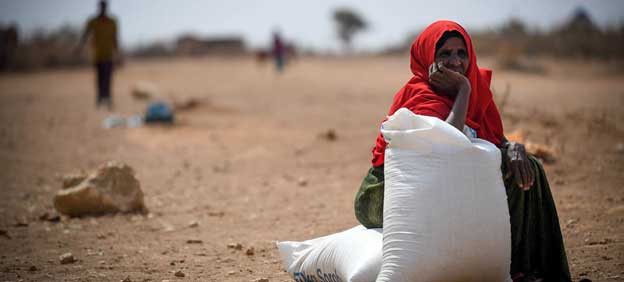
In 2019, Ethiopia experienced the fifth-worst food crisis worldwide. Credit: FAO/IFAD/WFP/Michael Tewelde

By Thalif Deen

December 14, 2020

UNITED NATIONS, Nov 27 2020 (IPS) – The numbers are staggering— as reflected in the ongoing coronavirus pandemic which has triggered a new round of food shortages, famine and starvation.

According to the Rome-based World Food Programme (WFP) 690 million people do not have enough to eat. while 130 million additional people risk being pushed to the brink of starvation by the end of the year.

“Hunger is an outrage in a world of plenty. An empty stomach is a gaping hole in the heart of a society,” Secretary-General Antonio Guterres said last week pointing out that famine is looming in several countries.

Originally published at Humans Wrong Watch

Striking a personal note, Guterres said he could have never imagined that hunger would rise again during his time in office as Secretary-General.

The WFP singled out 10 countries with the worst food crises in 2019: Yemen, Congo, Afghanistan, Venezuela, Ethiopia, South Sudan, Syria, Sudan, Nigeria and Haiti. The list is expected to increase by end of this year.

WFP Executive Director David Beasley told a meeting of the U.N. Security Council last April: “There are no famines yet. But I must warn you that if we don’t prepare and act now – to secure access, avoid funding shortfalls and disruptions to trade – we could be facing multiple famines of biblical proportions within a short few months.”

Against this grim scenario, resetting the future of food is possible, say the Barilla Foundation and Food Tank, which are jointly sponsoring an international online dialogue December 1 to “present concrete solutions to rethink our food systems – from farm to fork.”

The discussions are expected to help set the stage for the United Nations Food System Summit to be held in 2021.

The spread of COVID-19 has demonstrated the fragility of global food systems, “but it also offers opportunities to transform the way we produce, distribute and consume food.”

Guido Barilla, Chairman, Barilla Group and Barilla Foundation, said: “We need a positive movement to accelerate, empower, refine, and design a more sustainable future, and raising awareness in people – companies, citizens, institutions- that another future is possible.”

Danielle Nierenberg, President and Founder of Food Tank, told IPS the pandemic has had a huge impact on the world’s food and agricultural systems.

“Ironically, there will be record yields for many grains this year, but the disruptions in the supply chain caused by the pandemic as well as the global climate crisis and increasing conflict in several countries is leading to a hunger pandemic as well,” she pointed out.

Hunger, as many experts have pointed out, is not because the world doesn’t produce enough food, but a problem of distribution that has been exacerbated by concerns over health and lack of national leadership and political will in many countries, including the United States, to ensure that no one goes hungry, said Nierenberg.

Jeffrey Sachs, Professor and Director of the Center for Sustainable Development, Columbia University and Director, U.N. Sustainable Development Solutions Network, said: “Changing the food system is a complex challenge, but the first step is to know where we want to go, and that’s toward a healthy diet produced with sustainable agriculture.”

Abby Maxman, Oxfam America’s President & CEO, told IPS COVID-19 is the final straw for millions of people already struggling with the impacts of conflict, inequality, and climate change.

“The pandemic is fuelling hunger in the world’s worst hunger hotspots such as Venezuela and South Sudan, and it is creating new epicentres of hunger in countries such as India, South Africa, and Brazil where millions of people who were barely managing have been tipped over the edge by the pandemic,” she said.

She also pointed out that COVID-19 has exposed the weaknesses of a food system which prioritizes the profits of big food and agriculture companies over the needs of food producers and workers.

“We’re hearing the same refrain all around the world – families are very worried as they are forced to make impossible decisions – do they risk catching the disease as they go out to earn money to buy food? Or stay home and watch their children go hungry?”

It’s not actually a choice for most. Governments must contain the spread of this deadly disease but it is equally vital they take action to stop the pandemic killing as many – if not more – people from hunger, said Maxman.

The Advisory Board of the Barilla Foundation, described as an independent foundation that works on proposing concrete actions to solve issues around global food systems, has proposed a strategy to transform the food systems through shared and systemic solutions and a global collective commitment.

The online international dialogue is expected to highlight the critical role of farmers in feeding the world and managing natural resources, food business in progressing towards the 2030 Agenda, and chefs in re-designing food experiences.

The prospects of technology and innovation, the role of food as prevention and the most recent policy developments, including the EU Farm to Fork Strategy, will also be discussed.

Subscribe to TFF PressInfo
– updates & comments. It’s free, safe and about weekly

Asked if the availability of two vaccines by early next year will contribute to alleviate or end the food emergency, Nierenberg told IPS that while the vaccines are promising and will health ensure the health of millions and millions of people, the pandemic has shown us how fragile our food and economic systems are–it exposed a lot of cracks that were already there, but that has grown wider since the pandemic.

“We’ll need more than vaccines to make sure that food is considered a human right and that people around the globe have access to a living wage and safe, affordable, and accessible food,” she declared.

Oxfam America’s Maxman told IPS the exciting news about vaccines is providing hope of getting out of this global nightmare, but the scientific breakthrough is only part of the equation.

Equally important, she said, is making sure every single person on this planet can get it as soon as possible. But at the moment, rich countries, including the US, are already hoarding more than half of the vaccines to be developed by the companies with the leading five vaccine candidates.

“With only 4% of the world’s population, the US has already reserved almost 50% of the Pfizer’s total expected supply in 2021. That’s why Oxfam is calling for a people’s vaccine: a global public good, freely and fairly available to all, prioritizing those most in need here at home and around the world”.

To protect everyone no matter their wealth or nationality, corporations with the leading candidates for an effective COVID-19 vaccine must commit to openly sharing their vaccine technology to enable billions of doses to be made as soon as possible at the lowest possible price, Maxman declared.

Asked about the impact of waste, obesity and overconsumption, Nierenberg said: “I think NOW is the time for a real resetting of the food system”.

“It’s clear that agriculture needed to be revolutionized pre-pandemic—and we can’t return to the way things were”.

These unprecedented challenges, she noted, provide enormous opportunities to create a food system that can’t be broken—one that is truly regenerative and restorative, and that leaves no one behind.

“We can’t go back to “normal.” Normal left us vulnerable, and this crisis has widened the cracks in a food system already in need of repair. But this is our time to pivot. Right now, we can develop long-lasting solutions to nourish both people and the planet,” declared Nierenberg, recipient of the 2020 Julia Child Award and who spent two years volunteering for the Peace Corps in the Dominican Republic.

Maxman said: “The global food system is broken. We must rebuild a fairer, more resilient, and more sustainable food system”.

The fact that eight of the biggest food and drink companies paid out over $18 billion to shareholders even as the pandemic was spreading across the globe illustrates just how broken our food system is, she noted.

“In the short-term, governments need to make sure that local food systems can continue to function, people can access and afford to buy nutritious food, and producers can continue to grow and produce the food needed for local communities”.

But as countries recover from the crisis, governments must prioritize investing in small-scale producers, ensuring that women food producers do not face discrimination, taking steps to make sure food producers can adapt to climate change, and demanding that big food and beverage companies pay workers a living wage, she declared.

Originally published at Humans Wrong Watch

About the author

Thalif Deen, Director & Senior Editor, UN Bureau, Inter Press Service (IPS) news agency has been covering the United Nations since the late 1970s. Beginning with the Earth Summit in Rio de Janeiro in 1992, he has covered virtually every major U.N. conference: on population, human rights, the environment, sustainable development, food security, humanitarian aid, arms control and nuclear disarmament. He is a Fulbright scholar with a Master’s Degree (MSc) in Journalism from Columbia University, New York. Read more about Thalif Deen and find more of his articles here.

Please help TFF remain truly independent by contributing if you benefited from this article

Related Posts

Jan Oberg July 26, 2024 In its recent analysis – “How Four US Presidents Unleashed Economic Warfare Across the Globe” – The Washington Post illustrates what I have called “sanctionitis” – the disease of (over)using sanctions as a means to conduct foreign policy and cause great harm to the world economy, the US economy but also to millions of innocent people who suffer from the consequences of them. But the WP merely points out that sanctions are inefficient from a US point of view in that they have not achieved what was intended, indeed sometimes the opposite. It uses various kinds of pejoratives like “dictator” about leaders of states the US sees as enemies. It fails completely to point out that sanctions – particularly long-term sanctions – are, mostly, grossly immoral because of their humanitarian consequences. Be this as it may, something has happened when Washington Post does publish such...
Michael Gfoeller & David H. Rundell September 27, 2023 In 1919, John Maynard Keynes was a young economist with the British delegation negotiating the Versailles Treaty. Keynes strongly objected to the harsh economic treatment being meted out to Germany. He resigned and went home to write “The Economic Consequences of the Peace,” which accurately predicted how the treaty would sow the seeds for future conflict. Had Keynes been alive last year, he might well have written “The Economic Consequences of the War,” predicting how the economic sanctions being placed on Russia would, in fact, unravel Europe’s political order. Few products contribute more to economic prosperity and political stability than affordable food and energy. Increased energy costs retard every aspect of economic growth. Rising food costs act much like a regressive tax increase. By imposing economic sanctions on Russia, Europe destroyed its own access to inexpensive food and energy. One did...
US dependence on Chinese components means defense industry and critical infrastructure could soon be in the line of fire David P. Goldman, Asia Times September 20, 2023 America doesn’t have the factories or skilled labor to replace Chinese imports that support defense contractors and basic infrastructure, leaving the US economy vulnerable to harm in the event of an all-out trade war with China, corporate and government officials told Asia Times. That’s why Biden administration officials are unlikely to heed calls from China hawks to completely cut off China’s semiconductor sector from US technology. A group of 10 prominent House Republicans wrote to the US Commerce Department on September 14 demanding a shutoff of US exports of chip technology to China, claiming that the export controls imposed in October 2022 were ineffective. Originally published by Asia Times on September 16, 2023 The Republicans’ letter cited “recent reports that Huawei Technologies Co. (Huawei)...

Recent Articles

Tony Robinson October 4, 2026 Violence is easy to recognise when someone is being beaten, shot or killed. It becomes more difficult when nobody is holding a weapon. Poverty, discrimination, exploitation and repression can restrict a human life just as effectively, although they do so in very different ways and with very different consequences. Simply adding more categories to an ever-growing list of forms of violence does not really solve the problem. The more interesting question is what all these different situations have in common and why it makes sense to describe them using the same word. Human beings do not simply react to what happens around them. They remember the past, imagine things that do not yet exist, make plans and undertake projects. Workers organise because they imagine different working conditions; people migrate because they imagine another life somewhere else; social movements emerge because people refuse to accept the...
It’s a matter of principles, courage, vision and pulling together – while the militarist world is falling apart… Peter Langille October 3, 2026 “Here, then, is the problem which we present to you, stark and dreadful and inescapable: Shall we put an end to the human race; or shall mankind renounce war?”The Bertrand Russell—Albert Einstein Manifesto, July 9, 1955 ⁕ The forecast for what’s ahead is worrisome. The sharp rise in armed conflicts over the past three years is adding to what was already the highest level in over seventy years. Genocides, which should be prevented are supported. A shared climate emergency that jeopardises survival is ignored. Diverse polls now suggest that people are war-weary, worried and interested in a more effective United Nations. And, there are viable policy options for a more secure world! Yet governments are doubling-down, betting on more war and investing heavily. If current trends persist,...
Johan Galtung 1930-2024October 2015 Published here on October 3, 2026 Let us focus on Civilization for conflict analysis and remedies. Major forms of disorder use violence; war is state organized violence. The most belligerent states are the United States of America and Israel, both with civilization roots. National Evangelism, the US Protestant Christian civilization– more national than evangelical–justifies US warfare as exceptionalism of a people chosen by God, with a manifest destiny to run the world. Orthodox Judaism justifies Israeli warfare to conquer and expand from Nile to Euphrates as a religious right and duty to the Eternal One. The third most belligerent country, the UK, no longer believes it is God-chosen but chosen by the USA; not quite the same but something. But the root cause of global disorder lies in the Occident–with Islam–seeing itself as the single, universal civilization valid for all at all times, all others being...

TFF on Substack

Discover and subscribe to more peace materials on TFF Substack

Most Popular

Tony Robinson October 4, 2026 Violence is easy to recognise when someone is being beaten, shot or killed. It becomes more difficult when nobody is holding a weapon. Poverty, discrimination, exploitation and repression can restrict a human life just as effectively, although they do so in very different ways and with very different consequences. Simply adding more categories to an ever-growing list of forms of violence does not really solve the problem. The more interesting question is what all these different situations have in common and why it makes sense to describe them using the same word. Human beings do not simply react to what happens around them. They remember the past, imagine things that do not yet exist, make plans and undertake projects. Workers organise because they imagine different working conditions; people migrate because they imagine another life somewhere else; social movements emerge because people refuse to accept the...
It’s a matter of principles, courage, vision and pulling together – while the militarist world is falling apart… Peter Langille October 3, 2026 “Here, then, is the problem which we present to you, stark and dreadful and inescapable: Shall we put an end to the human race; or shall mankind renounce war?”The Bertrand Russell—Albert Einstein Manifesto, July 9, 1955 ⁕ The forecast for what’s ahead is worrisome. The sharp rise in armed conflicts over the past three years is adding to what was already the highest level in over seventy years. Genocides, which should be prevented are supported. A shared climate emergency that jeopardises survival is ignored. Diverse polls now suggest that people are war-weary, worried and interested in a more effective United Nations. And, there are viable policy options for a more secure world! Yet governments are doubling-down, betting on more war and investing heavily. If current trends persist,...
Johan Galtung 1930-2024October 2015 Published here on October 3, 2026 Let us focus on Civilization for conflict analysis and remedies. Major forms of disorder use violence; war is state organized violence. The most belligerent states are the United States of America and Israel, both with civilization roots. National Evangelism, the US Protestant Christian civilization– more national than evangelical–justifies US warfare as exceptionalism of a people chosen by God, with a manifest destiny to run the world. Orthodox Judaism justifies Israeli warfare to conquer and expand from Nile to Euphrates as a religious right and duty to the Eternal One. The third most belligerent country, the UK, no longer believes it is God-chosen but chosen by the USA; not quite the same but something. But the root cause of global disorder lies in the Occident–with Islam–seeing itself as the single, universal civilization valid for all at all times, all others being...
Read More
Living-Peace-Sign-Budapest-copy
Tony Robinson October 4, 2026 Violence is easy to recognise when someone is being beaten, shot or killed. It becomes more difficult when nobody is holding a weapon. Poverty, discrimination, exploitation and repression can restrict a human life just as effectively, although they do so in very different ways and with very different consequences. Simply adding more categories to an ever-growing list of forms of violence does not really solve the problem. The more interesting question is what all these different situations have in common and why it makes sense to describe them using the same word. Human beings do not simply react to what happens around them. They remember the past, imagine things that do not yet exist, make plans and undertake projects. Workers organise because they imagine different working conditions; people migrate because they imagine another life somewhere else; social movements emerge because people refuse to accept the...
b54a1f10-8c65-4f0b-9dd5-4abc0a7d04cc_2659x2659
It’s a matter of principles, courage, vision and pulling together – while the militarist world is falling apart… Peter Langille October 3, 2026 “Here, then, is the problem which we present to you, stark and dreadful and inescapable: Shall we put an end to the human race; or shall mankind renounce war?”The Bertrand Russell—Albert Einstein Manifesto, July 9, 1955 ⁕ The forecast for what’s ahead is worrisome. The sharp rise in armed conflicts over the past three years is adding to what was already the highest level in over seventy years. Genocides, which should be prevented are supported. A shared climate emergency that jeopardises survival is ignored. Diverse polls now suggest that people are war-weary, worried and interested in a more effective United Nations. And, there are viable policy options for a more secure world! Yet governments are doubling-down, betting on more war and investing heavily. If current trends persist,...
010
Johan Galtung 1930-2024October 2015 Published here on October 3, 2026 Let us focus on Civilization for conflict analysis and remedies. Major forms of disorder use violence; war is state organized violence. The most belligerent states are the United States of America and Israel, both with civilization roots. National Evangelism, the US Protestant Christian civilization– more national than evangelical–justifies US warfare as exceptionalism of a people chosen by God, with a manifest destiny to run the world. Orthodox Judaism justifies Israeli warfare to conquer and expand from Nile to Euphrates as a religious right and duty to the Eternal One. The third most belligerent country, the UK, no longer believes it is God-chosen but chosen by the USA; not quite the same but something. But the root cause of global disorder lies in the Occident–with Islam–seeing itself as the single, universal civilization valid for all at all times, all others being...
Screenshot 2026-10-02 011738
Jan ObergPhD, director, The Transnational Foundation for Peace and Future Research, TFFLund, Sweden October 2, 2026 This is my full original manuscript. The Chinese Academy of Social Science, CASS, makes two publications out if it. 1. China’s Five-year plan emphasized the capabilities of basic research and original innovation. It is regarded as the goal of the future social development, which, as required, should be significantly enhanced. Can you comment on the importance of original innovation in research and academic study? I believe it is easier to define “original innovation” in the natural sciences than in social sciences. The breaking points of what constitutes something new, or innovative, are not quite as sharp in the latter. But in both fields it is about opening up something that was closed, unseen, unexplored before – making manifest what was earlier latent. Innovations come in many forms and shapes – naming something that was not...
arctic-circle-map
The agreement is catastrophic both because of what it says and what it doesn’t mention. It reduces further the major asset of security policies: Freedom of action. Jan Oberg TFF director September 25, 2026 A couple of hours before the agreement was signed on September 22, 2026, I published the following 13 hypotheses about what it would most likely contain on TFF Substack (in English). I was wrong on only the first point. Contrary to what Trump had written on his Truth Social platform, it does not appear to come into force immediately. In fact, it turned out to be worse than even I had anticipated. After these hypotheses now come a number of reflections in light of what the agreement actually contains, and does not contain, as well as the way in which it has generally been presented by major media outlets and by the public-service broadcaster DR. My...
girl-5894831_1280
Below are TFF-related media mentions, comments, videos and social media posts published elsewhere but not on this homepage. We happen to catch and list only a fraction. Regarding video comments and debates, we recommend that you go to the TFF Video Channel on Substack where many of them are reproduced. Jan Oberg is a contributor to China Daily – 52 million daily clicks – and Global Times, CGTN and CCTV (the national television), China Investment, Xinhua News Agency and several others. Articles and videos on these media very often multiply into countless Chinese (and Western media) that re-post them from these main media. Thanks to The China Academy, his analyses, interviews and comments are frequently posted on YouTube channels such as Thinkers Forum and Wave Media. These videos are often re-posted on Bilibili (China’s YouTube), the China Content Center on TikTok, and on the Chinese edition of TikTok, Douyin.com. This means reaching hundreds of millions of viewers worldwide over a year. While there are too many to catch on all these...




