
johangaltung

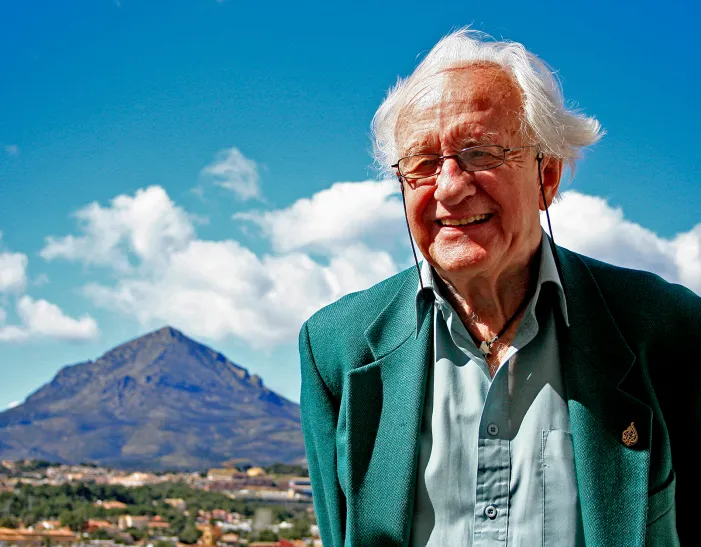
Alfaz del Pi, located between Mediterranean beaches and a couple of majestic mountains, Campana-Aitana (Man and Woman) 1500 meters high. Today this small town generously accommodates 21,500; surrounded by fertile soil, orange and olive trees, vines. Benidorm – the famous tourist resort – and Altea, more for artists, are at hand stretching distance; on the Costa Blanca – white seen from the sea – in Spain.

So far nothing special. But that little town is home to close to one hundred different nations; 57% are foreigners. The English and the Norwegians are the most frequent; the Norwegians arriving already some 45 years ago. Close to half a century of peaceful coexistence; and not only absence of violence but also positive, cooperative peace.

We, a Japanese-Norwegian couple, arrived June 1969. First time in Spain was in 1951, hitchhiking to understand fascism better. Franco had evolved from dictadura, dictatorship, after a brutal civil war, to dictablanda, the softer version. But the basic aspect of dictatorship was there like a nightmare draped over the country: fear, fear, fear; so many listening, so few talking. But some said, if you only come for the beach, stay at home. Bring books; we are isolated, not knowing what happens. Franco will not last forever, we must be prepared.

Books were brought. Customs people hardly knew how to read but quickly identifying more copies than one; hence, one of each. Books were handed over, to the right – in this case left – people, for instance at a conference in Madrid in June 1969. And the books were read.

The summer heat was unbearable. We drove to the coast to visit a friend, officer in the Norwegian army, with years of dialogues behind us. They lived in an “urbanización” that looked like a Scandinavian ghetto, making us exclaim: Never for us! In the evening we had made the downpayment for a house. How come? The beach, the mountains, the roof terrace, a depository for books in transit: Yes!

Alfaz at the time was a tiny village with dirt roads; four women dressed in black were the rush-hour traffic. Flies would fall down, legs up, victims of the afternoon heat. No doubt the influx of foreigners had a dynamizing impact: some money and mores, in exchange for sun and smiles and some mores. And no doubt Alfaz managed this well.

In the shadows of the deep evenings women pulled out the chairs, sitting in the narrow streets for a tertulia, a meeting, handling that new resource, the foreigners, in need of a gardener, a handyman, a painter. The distribution was masterly done. The village grew and grew, very few really rich or poor. Money was invested in huertas, fields, growing vegetables, whatever; shops; services; mini-industries. 300 days of sunshine per year was indeed attractive for people from the foggy North Sea and the stormy Atlantic. 365 days of smiles and charm, friendliness, warmth, that extra glimmer in the eyes, the human climate, proved even more attractive.

Alfaz became more than a summer house for rapid beach access. Alfaz became home. The story repeated itself; coming to visit a friend, parents, whatever; and the downpayment followed. Some made mistakes, underestimating the role of friends and family left behind between fog and storm, and the time needed to build new relations.

Close to half a century without serious incidents; doing what people often do by intuition, building peace. It took time to understand that “in Alfaz behave as the alfazinos do”. Talk Spanish for instance (well, some are still waiting for the Spanish to speak their language). Unfreezing, thawing, smiling. It took less time for Alfaz to pick up some informality and Nordic love mores. And inter-marriages produced ever more bilinguals.

Cooperation spread from the economy to culture. Norwegians took courses, held seminars, studied Spanish history; an institute for the study of Norway is coming; Alfaz transformed, cosmopolitan, polyglot.

And it spread to politics. Norwegians voted, they entered town council and administration; accepted as equals. Norwegians built their own institutions soon to blend with the Spanish, for instance socially for the less privileged. Conflicts, over land and/or money, jealousies were handled or faded out leaving little or no trauma.

Both quickly learned what the world looks like to the other. Food and clothes, music and art in general, serve as great openers to other cultures. National holidays follow. Alfaz respected, even celebrated the Norwegian May 17, that pioneer democratic constitution from 1814; the Norwegians took to fiestas, indeed more frequent, as keys to the Spanish soul. Accompanied by the siesta – by prejudiced eyes seen as Spanish laziness – only to discover how to make two days out of one. Soon the Spanish became more punctual than the Norwegians themselves.

What happened to books? They became summer courses in subjects Spain had missed during the isolation. Like peace and women studies: international courses in Benidorm, with the University of Alicante. Many early participants are today professors all over Spain.

Came 22 July 2011, the monstrous terrorist act; Oslo, Utöya. The mayor of Alfaz, Vicente Arques, immediately expressed the compassion of Alfaz with a country in the deepest distress – how come! – and sorrow. It is easy to celebrate together when the going is good; to share sorrow requires the deep humanity of Alfaz under those friendly skies.

Cooperation for equal benefit, empathy, conflict resolution and trauma reconciliation: key peace tasks anywhere, in the family, at school, at work, in a village-town like Alfaz, as example for a country, for the West-Islam.

And symbolized on 15 June 2013 in a wonderful sculpture by the famous Agustín Ibarrola; against terrorism, in memory of the victims, and for peace, quoting Gandhi, There is no road to Peace; Peace is the Road. Alfaz practices exactly that: think and act, locally and globally.

Homenaje a Alfaz!
Related Posts

Tony Robinson October 4, 2026 Violence is easy to recognise when someone is being beaten, shot or killed. It becomes more difficult when nobody is holding a weapon. Poverty, discrimination, exploitation and repression can restrict a human life just as effectively, although they do so in very different ways and with very different consequences. Simply adding more categories to an ever-growing list of forms of violence does not really solve the problem. The more interesting question is what all these different situations have in common and why it makes sense to describe them using the same word. Human beings do not simply react to what happens around them. They remember the past, imagine things that do not yet exist, make plans and undertake projects. Workers organise because they imagine different working conditions; people migrate because they imagine another life somewhere else; social movements emerge because people refuse to accept the...
It’s a matter of principles, courage, vision and pulling together – while the militarist world is falling apart… Peter Langille October 3, 2026 “Here, then, is the problem which we present to you, stark and dreadful and inescapable: Shall we put an end to the human race; or shall mankind renounce war?”The Bertrand Russell—Albert Einstein Manifesto, July 9, 1955 ⁕ The forecast for what’s ahead is worrisome. The sharp rise in armed conflicts over the past three years is adding to what was already the highest level in over seventy years. Genocides, which should be prevented are supported. A shared climate emergency that jeopardises survival is ignored. Diverse polls now suggest that people are war-weary, worried and interested in a more effective United Nations. And, there are viable policy options for a more secure world! Yet governments are doubling-down, betting on more war and investing heavily. If current trends persist,...
Johan Galtung 1930-2024October 2015 Published here on October 3, 2026 Let us focus on Civilization for conflict analysis and remedies. Major forms of disorder use violence; war is state organized violence. The most belligerent states are the United States of America and Israel, both with civilization roots. National Evangelism, the US Protestant Christian civilization– more national than evangelical–justifies US warfare as exceptionalism of a people chosen by God, with a manifest destiny to run the world. Orthodox Judaism justifies Israeli warfare to conquer and expand from Nile to Euphrates as a religious right and duty to the Eternal One. The third most belligerent country, the UK, no longer believes it is God-chosen but chosen by the USA; not quite the same but something. But the root cause of global disorder lies in the Occident–with Islam–seeing itself as the single, universal civilization valid for all at all times, all others being...

Recent Articles

Tony Robinson October 4, 2026 Violence is easy to recognise when someone is being beaten, shot or killed. It becomes more difficult when nobody is holding a weapon. Poverty, discrimination, exploitation and repression can restrict a human life just as effectively, although they do so in very different ways and with very different consequences. Simply adding more categories to an ever-growing list of forms of violence does not really solve the problem. The more interesting question is what all these different situations have in common and why it makes sense to describe them using the same word. Human beings do not simply react to what happens around them. They remember the past, imagine things that do not yet exist, make plans and undertake projects. Workers organise because they imagine different working conditions; people migrate because they imagine another life somewhere else; social movements emerge because people refuse to accept the...
It’s a matter of principles, courage, vision and pulling together – while the militarist world is falling apart… Peter Langille October 3, 2026 “Here, then, is the problem which we present to you, stark and dreadful and inescapable: Shall we put an end to the human race; or shall mankind renounce war?”The Bertrand Russell—Albert Einstein Manifesto, July 9, 1955 ⁕ The forecast for what’s ahead is worrisome. The sharp rise in armed conflicts over the past three years is adding to what was already the highest level in over seventy years. Genocides, which should be prevented are supported. A shared climate emergency that jeopardises survival is ignored. Diverse polls now suggest that people are war-weary, worried and interested in a more effective United Nations. And, there are viable policy options for a more secure world! Yet governments are doubling-down, betting on more war and investing heavily. If current trends persist,...
Johan Galtung 1930-2024October 2015 Published here on October 3, 2026 Let us focus on Civilization for conflict analysis and remedies. Major forms of disorder use violence; war is state organized violence. The most belligerent states are the United States of America and Israel, both with civilization roots. National Evangelism, the US Protestant Christian civilization– more national than evangelical–justifies US warfare as exceptionalism of a people chosen by God, with a manifest destiny to run the world. Orthodox Judaism justifies Israeli warfare to conquer and expand from Nile to Euphrates as a religious right and duty to the Eternal One. The third most belligerent country, the UK, no longer believes it is God-chosen but chosen by the USA; not quite the same but something. But the root cause of global disorder lies in the Occident–with Islam–seeing itself as the single, universal civilization valid for all at all times, all others being...

TFF on Substack

Discover and subscribe to more peace materials on TFF Substack

Most Popular

Tony Robinson October 4, 2026 Violence is easy to recognise when someone is being beaten, shot or killed. It becomes more difficult when nobody is holding a weapon. Poverty, discrimination, exploitation and repression can restrict a human life just as effectively, although they do so in very different ways and with very different consequences. Simply adding more categories to an ever-growing list of forms of violence does not really solve the problem. The more interesting question is what all these different situations have in common and why it makes sense to describe them using the same word. Human beings do not simply react to what happens around them. They remember the past, imagine things that do not yet exist, make plans and undertake projects. Workers organise because they imagine different working conditions; people migrate because they imagine another life somewhere else; social movements emerge because people refuse to accept the...
It’s a matter of principles, courage, vision and pulling together – while the militarist world is falling apart… Peter Langille October 3, 2026 “Here, then, is the problem which we present to you, stark and dreadful and inescapable: Shall we put an end to the human race; or shall mankind renounce war?”The Bertrand Russell—Albert Einstein Manifesto, July 9, 1955 ⁕ The forecast for what’s ahead is worrisome. The sharp rise in armed conflicts over the past three years is adding to what was already the highest level in over seventy years. Genocides, which should be prevented are supported. A shared climate emergency that jeopardises survival is ignored. Diverse polls now suggest that people are war-weary, worried and interested in a more effective United Nations. And, there are viable policy options for a more secure world! Yet governments are doubling-down, betting on more war and investing heavily. If current trends persist,...
Johan Galtung 1930-2024October 2015 Published here on October 3, 2026 Let us focus on Civilization for conflict analysis and remedies. Major forms of disorder use violence; war is state organized violence. The most belligerent states are the United States of America and Israel, both with civilization roots. National Evangelism, the US Protestant Christian civilization– more national than evangelical–justifies US warfare as exceptionalism of a people chosen by God, with a manifest destiny to run the world. Orthodox Judaism justifies Israeli warfare to conquer and expand from Nile to Euphrates as a religious right and duty to the Eternal One. The third most belligerent country, the UK, no longer believes it is God-chosen but chosen by the USA; not quite the same but something. But the root cause of global disorder lies in the Occident–with Islam–seeing itself as the single, universal civilization valid for all at all times, all others being...
Read More
Living-Peace-Sign-Budapest-copy
Tony Robinson October 4, 2026 Violence is easy to recognise when someone is being beaten, shot or killed. It becomes more difficult when nobody is holding a weapon. Poverty, discrimination, exploitation and repression can restrict a human life just as effectively, although they do so in very different ways and with very different consequences. Simply adding more categories to an ever-growing list of forms of violence does not really solve the problem. The more interesting question is what all these different situations have in common and why it makes sense to describe them using the same word. Human beings do not simply react to what happens around them. They remember the past, imagine things that do not yet exist, make plans and undertake projects. Workers organise because they imagine different working conditions; people migrate because they imagine another life somewhere else; social movements emerge because people refuse to accept the...
b54a1f10-8c65-4f0b-9dd5-4abc0a7d04cc_2659x2659
It’s a matter of principles, courage, vision and pulling together – while the militarist world is falling apart… Peter Langille October 3, 2026 “Here, then, is the problem which we present to you, stark and dreadful and inescapable: Shall we put an end to the human race; or shall mankind renounce war?”The Bertrand Russell—Albert Einstein Manifesto, July 9, 1955 ⁕ The forecast for what’s ahead is worrisome. The sharp rise in armed conflicts over the past three years is adding to what was already the highest level in over seventy years. Genocides, which should be prevented are supported. A shared climate emergency that jeopardises survival is ignored. Diverse polls now suggest that people are war-weary, worried and interested in a more effective United Nations. And, there are viable policy options for a more secure world! Yet governments are doubling-down, betting on more war and investing heavily. If current trends persist,...
010
Johan Galtung 1930-2024October 2015 Published here on October 3, 2026 Let us focus on Civilization for conflict analysis and remedies. Major forms of disorder use violence; war is state organized violence. The most belligerent states are the United States of America and Israel, both with civilization roots. National Evangelism, the US Protestant Christian civilization– more national than evangelical–justifies US warfare as exceptionalism of a people chosen by God, with a manifest destiny to run the world. Orthodox Judaism justifies Israeli warfare to conquer and expand from Nile to Euphrates as a religious right and duty to the Eternal One. The third most belligerent country, the UK, no longer believes it is God-chosen but chosen by the USA; not quite the same but something. But the root cause of global disorder lies in the Occident–with Islam–seeing itself as the single, universal civilization valid for all at all times, all others being...
Screenshot 2026-10-02 011738
Jan ObergPhD, director, The Transnational Foundation for Peace and Future Research, TFFLund, Sweden October 2, 2026 This is my full original manuscript. The Chinese Academy of Social Science, CASS, makes two publications out if it. 1. China’s Five-year plan emphasized the capabilities of basic research and original innovation. It is regarded as the goal of the future social development, which, as required, should be significantly enhanced. Can you comment on the importance of original innovation in research and academic study? I believe it is easier to define “original innovation” in the natural sciences than in social sciences. The breaking points of what constitutes something new, or innovative, are not quite as sharp in the latter. But in both fields it is about opening up something that was closed, unseen, unexplored before – making manifest what was earlier latent. Innovations come in many forms and shapes – naming something that was not...
arctic-circle-map
The agreement is catastrophic both because of what it says and what it doesn’t mention. It reduces further the major asset of security policies: Freedom of action. Jan Oberg TFF director September 25, 2026 A couple of hours before the agreement was signed on September 22, 2026, I published the following 13 hypotheses about what it would most likely contain on TFF Substack (in English). I was wrong on only the first point. Contrary to what Trump had written on his Truth Social platform, it does not appear to come into force immediately. In fact, it turned out to be worse than even I had anticipated. After these hypotheses now come a number of reflections in light of what the agreement actually contains, and does not contain, as well as the way in which it has generally been presented by major media outlets and by the public-service broadcaster DR. My...
girl-5894831_1280
Below are TFF-related media mentions, comments, videos and social media posts published elsewhere but not on this homepage. We happen to catch and list only a fraction. Regarding video comments and debates, we recommend that you go to the TFF Video Channel on Substack where many of them are reproduced. Jan Oberg is a contributor to China Daily – 52 million daily clicks – and Global Times, CGTN and CCTV (the national television), China Investment, Xinhua News Agency and several others. Articles and videos on these media very often multiply into countless Chinese (and Western media) that re-post them from these main media. Thanks to The China Academy, his analyses, interviews and comments are frequently posted on YouTube channels such as Thinkers Forum and Wave Media. These videos are often re-posted on Bilibili (China’s YouTube), the China Content Center on TikTok, and on the Chinese edition of TikTok, Douyin.com. This means reaching hundreds of millions of viewers worldwide over a year. While there are too many to catch on all these...





