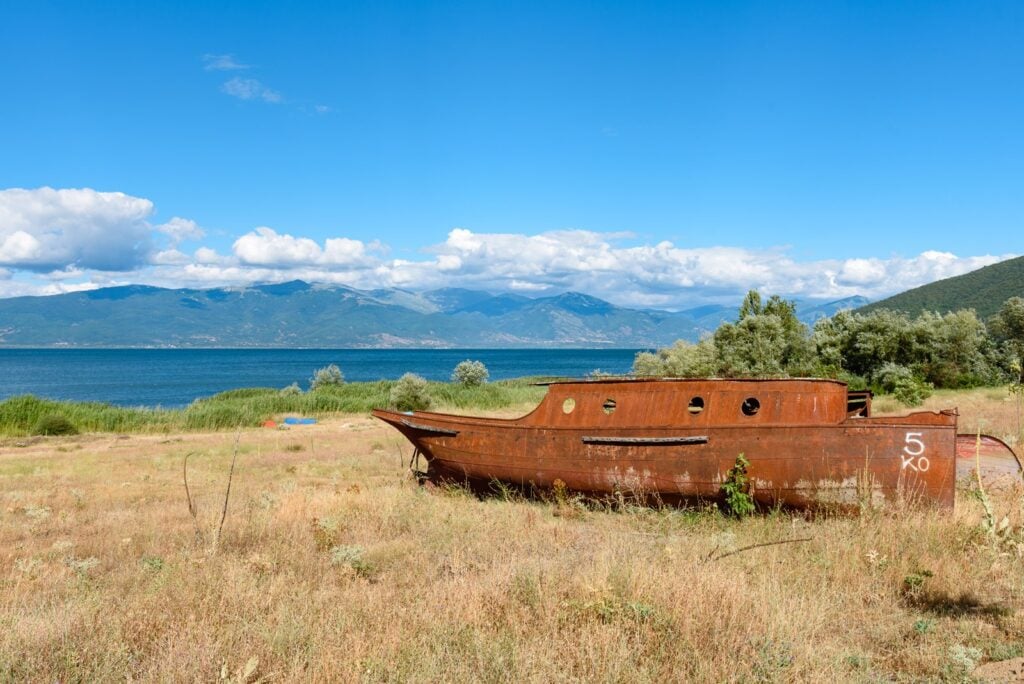
Lake Prespa in Macedonia
Abstract
The Prespa Agreement (PA) between Athens and Skopje was meant to be a final solution to the ‘name issue’. Yet the dispute has never been only about the state name, which is proved by the 20-pages long text. A plethora of other provisions is to be implemented erga omnes (internationally and domestically).
Despite the insistence of the external mediators that the name dispute has never concerned the issues of ethnicity, nationality, culture, and language, these issues indeed appear to be simultaneously central as well as the Achilles heel of the deal.
This paper does not deal with conceptual and theoretical aspects of ethnicity and
The basic premise is that instead of being a final solution to a protracted identity conflict, the PA symbolically reconceives the old Macedonian Question into a new form with an old essence. Thus, it does not resolve but rather complicates the identity security dilemma.
1. Prologue: the Naming Dispute
Macedonia’s transition was marked not only by the usual political and economic transformations typical for all post-socialist countries but also by the unique challenges related to the so-called name issue. The application for UN membership was submitted in July 1992, but it was admitted in April 1993. The UN Security Council Resolution 817 stated that the country “would provisionally for all purposes within the UN be referred to as ‘the Former Yugoslav Republic of Macedonia’ pending settlement of the difference that has arisen over the name of the state”.
The security concerns prevailed over the principle of equality and the norms
It was not the end of the country’s problems: Greece imposed a trade embargo in February 1994 aimed at “bringing Skopje to its senses.” (UPI 1994) It coincided with the UN embargo on the Federal Republic of Yugoslavia (FRY). During the 19 months-long combined blockade, Macedonia suffered huge economic loss.
It took a strong international mediation to overcome the stalemate. In the Interim agreement (1995), Greece made a commitment not to block applications in international organisations under the FYROM reference. In the coming years, Greece’s continuous objection appeared to be a paramount problem with regard to the organizations where it had a right to veto.
The failure to join NATO at the 2008 Bucharest summit contributed a lot to the future internal developments. The government launched a process of nation-building that emphasized a narrative of strengthened national pride and historic traditions, mostly known through as “Skopje 2014” (1).
The legal success before the International Court of Justice (ICJ) – which found that Greece did breach the Interim Accord and that Macedonia did not show any signs of irredentism and behaviour opposite to the Interim Accord – did not ease the situation. On the contrary, both NATO and the EU confirmed that the ruling did not affect their internal decision-making procedures where Greece held the right to veto. The pressure on the weaker, Macedonian, side became even stronger.
It took an internal political crisis, international involvement and a regime change to bring in a more cooperative government. With no prior public and expert debate or a dialogue with the political opposition, all efforts were directed towards closing the two open questions with Bulgaria and Greece which had always questioned the Macedonian ethnic and national identity. In this text, we analyse only the identity aspects of the agreement between Skopje and Athens; however, the whole complexity of the ethnicity/nationality issue could be understood only by taking into account the agreement between Skopje and Sofia as well.
2. The Significance of Ethnicity and Nationality in the Context of the Naming Dispute
The questions of ethnicity and national identity have been interwoven into the very essence of the Macedonian Question since its early days (Shkaric et al 2009, MIC 2012). The naming dispute only re-ignited the old ghosts in the early nineties. Wiberg (1993, p. 107) pointed out the roots of the problem through the prism of societal security concept, or more precisely – the identity security of the Macedonians who feel threatened by all its neighbours depending on the various elements of their identity (language, religion, territory/name, and the constitutive status in the state).
For years, the website of the Greek Ministry of Foreign Affairs
On the other side, Macedonia’s official position has never been exclusive – i.e. there was an understanding that the name may have different usages in different states/contexts. However, due to power asymmetry, the Greek position prevailed internationally.
Cowen (2000) identifies three ways of use of the word “Macedonia” by the majority Macedonian citizens: they “refer to either an ancient kingdom or a historically established (but vaguely bounded) territory ‘partitioned’ between Greece (‘Aegean Macedonia’), Serbia (‘Vardar Macedonia’) and Bulgaria (‘Pirin Macedonia’) in 1913. The third use refers to the Republic of Macedonia”.
On the other hand, Greeks use the term for the northern region of their nation-state or to refer to “a less precisely demarcated ancient kingdom of Macedonia”. Zenakos (2018) warns that the nationalism of the Greek state has been conceived as a huge, direct leap to ancient glory. Macedonia, in the Greek narrative, thus, can only refer to ancient Macedon – which is what was “liberated” in twentieth-century wars. Proeva (2010) argues that the Pan-Hellenic interpretation of human history teaches us that Greece is the cradle of the entire European civilization.
The UN mediator Matthew Nimetz had repeatedly claimed that issues about [Macedonian] “identity” were not part of his mandate. He argued that it was all about the formulation of the name of this state for diplomatic purposes, which would not impact the average person: “We’re not negotiating identity. If we were, I’d be out of here.” (BBC 2017).
In February 2018 he explicitly said he had “not heard the Greek side denying the identity of the people who live in Macedonia” (Marusic 2018). It is hard to believe since the Greek official policy had been publicly expressed, and not only on the MFS’s website. For instance, an influential think thank put it bluntly right after the ICJ’s verdict in favour of the Macedonian side:
“The ICJ Judgement changes the landscape and transfers Greece’s strategy from the sphere of international law to that of politics… It is therefore of great importance that the Greek side underlines once more the real nature of the question, which is not only about the name “Macedonia” and its derivatives, but also involves sensitive matters of national identity for FYROM’s residents as well as for residents of the Macedonian region in Greece. The name issue is also related to the way that history is being used and it should end a deliberate distortion of historical data, aiming to create a ‘national myth’.” (ELIAMEP 2012)
Seen from a historical perspective, it is obvious that the PA is a concession to the Greek nationalism: i.e. its exclusive claim to a continuity myth and narrative that links together the ancient Hellenic tradition and civilization with the modern Greek identity:
“When reference is made to the First Party (refers to the Hellenic Republic), these terms denote not only the area and people of the northern region of the First Party, but also their attributes, as well as the Hellenic civilization, history, culture, and heritage of that region from antiquity to present day.” (Article 7.2)
Rohdewald (2018, p. 589) rightly points out that “such phrasing aligns with the outlook of the right-wing position in Greece, which sees confirmed its imagination of Hellenic Greece as monolingual, monocultural, mono
Geographic Macedonia stretches across a territory of five modern Balkan countries. It also represents a historic location and hotspot of dramatic and dynamic transit routes in the Balkans. Rohdewald concludes that anything ethnically homogenous ascribed later to these societies is a cultural construction.
Hence a most reasonable way to imagine and analyse its local historical and sociocultural contexts is to refer to it as a node of networks entangled with other contexts and social spaces.
Article 7 of the PA is hardly based on the understanding of the geographic region of Macedonia as a ‘node of networks’. Instead, it follows a primordial view of nationhood. It explicitly recognizes the Greek state’s claim to the ancient Hellenic tradition but it also extends an exclusive right over the ancient tradition at the expense of all other competing regional ethnic and national identities.
Thus the Greek “invented tradition” has been moulded to fit with conceptions of modern statehood, while at the same time to confront the “invented tradition” of the Republic of Macedonia, which is more recent but no less legitimate.
These interpretations shed a different light on the following two sections of Article 7, each of which aims to restrict the links to the ancient Hellenic tradition to today’s Greek nation-state:
“When reference is made to the Second Party (refers to the Republic of North Macedonia), these terms denote its territory, language, people and their attributes, with their own history, culture, and heritage, distinctly different from those referred to under Article 7.2. (Article 7.3).
“The Second Party notes that its official language, the Macedonian language, is within the group of South Slavic languages. The Parties note that the official language and other attributes of the Second Party are not related to the ancient Hellenic civilization, history, culture and heritage of the northern region of the First Party” (Article 7.4).
The official interpretation by Athens and Skopje confirm the view that the PA presents exclusivity to the Greek nation-state over the ancient Macedonian tradition. In a speech at the plenary session prior to the vote on the ratification of the PA, Alexis Tsipras (2019) stated the following: “The fifth that we (Greece) have gained (with the Agreement) and I consider to be the most important of all, is that the Greek tradition and the historical heritage of ancient Greek Macedonia are enshrined in the clearest, legally binding way.”
Nikola Dimitrov (2018) clearly acknowledged – in line with the constructivist understanding of nationhood – that all nations are constructs. Greece has for long rebutted the constructivist conceptualization and has accordingly refused to recognize Macedonians as an ethnic group or a nation (Cowan 2000).
Instead, it has claimed that the Macedonians (citizens of the Republic of Macedonia) are not a ‘true’ nation and that their language is not a ‘true’ language or that the Macedonian national consciousness was ‘invented’ by Tito.
Zenakos (2018) is among the few Greek intellectuals that oppose the state identity politics. He has acknowledged that the process of its articulation and delineation may have been protracted, but Macedonian nationalism had already existed for at least five decades when Yugoslavia was formed in 1945. Therefore, the conclusion: if one takes the constructivist standpoint and accepts that every national narrative is, in the final analysis, a ‘construct’, then the existence of Macedonian nationalism and nationhood cannot be disputed.
The Greek nation-building ‘success’ has been a result of a state-imposed ‘Greekness’ to all ethnic groups at the expense of their minority rights. Thus the originally asymmetric naming dispute has become asymmetric in one more aspect: the Macedonian side has apparently embraced the constructivist position, while all the historical folklore and romantic nationalism has been left to Greece.
3. The Prespa Agreement and Macedonian Identity: Ethnicity, Nationality or None of Them?
The PA is a matter of bitter dispute especially concerning its identity aspects. Some claim that Greece has acknowledged the existence of the Macedonians, which is a concession with regard to nationality. The opponents argue that the identity should not, or rather must not, be a matter of any bilateral or international compromise transformed into a legal binding act. They argue that throughout time and in the PA the difference over the name has transformed into differences and negotiations over Macedonian history, Macedonian identity, Macedonian language, culture, education, the political and legal system, the constitution, and human rights and freedoms (Siljanovska-Davkova 2018, Gjurkova 2018).
The proponents of the PA argue that Article 7 has an essential significance since it stipulates that both parties have the right to use the term in their own way. This implies assigning their own meaning for their own history, their own cultural heritage, their own language as part of something that profiles the identity.
Kolozova (2018, p. 36) believes that “Article 7 relies on or is a materialization of the principle of identity self-determination. With this, for the first time, we receive from some of our neighbours, recognition of identity self-determination from Greece, even before Bulgaria. A historical step forward is being made from both sides in terms of some kind of national histories in the region. For the first time, instead of in historical folklore and romantic nationalism terms, the identity is being determined in purely political terms.”
This author, who defends the political agreement but rebuts legal considerations, conveniently overlooks the following: first, there is a confusion in terms – individual self-determination, national self-determination, and politically determined identity. The Greek side has apparently made a ‘concession’ in terms of the individual right of self-determination. Despite the violation of the rights of its citizens with Macedonian ethnic origin, the government could not overlook the international conventions when it comes to the citizens of another state.
Thus, both parties agree that ethnic identity is a feeling of belonging and self-determination, which cannot be determined by another international subject. Second, national self-determination is also something inherent to international law (
It seems that implicit at least within self‐determination lies an acknowledg
Some Macedonian professors have dramatically changed their academic positions for the sake of political pragmatism. For instance, Shkaric contradicts himself and everything that he had written and argued in the previous years both with regard to the naming issue and the Ohrid Agreement. His position now reads (2018):
“The Macedonian becomes as a synonym for the nationality of all citizens of the Macedonian state, regardless of their ethnic belonging. It is a solution that so far we could hardly imagine, let alone achieve. This novelty is a Copernican turn. Instead of a faceless, the Agreement introduces a Macedonian nationality as a political term (demos). If this novelty becomes a constitutional category and if it is accepted by all our ethnicities, and especially the Albanians, then it will have a cohesive effect on the Macedonian society. Thus the Republic of Macedonia will grow from a “community of communities” into a civic state, while multiculturalism will transform into interculturalism.”
Shkaric, Svetomir (2018)
Defining Macedonian identity in ‘purely political terms’, however, is the most troublesome point due to the deep inter-ethnic cleavages between the Macedonians and the Albanians. A power-sharing model introduced in 2001 meant de facto and de jure giving up the idea of one demos for the sake of internal peace. The Constitution embedded the concept of consociation of (at least two) demoi.
The latest constitutional bargaining ended with the Preamble that included the Framework Agreement on the insistence of the Albanian parties. It speaks for itself how much willingness there is to redefine the binational state into a civic state. According to Article 2 of the Constitutional law, the nationality will be Macedonian/citizen of the Republic of North Macedonia “which neither determines nor defines the ethnic background of the citizens.” It was a concession to the Albanian parties. In practice, all personal documents are issued in accordance with a citizen’s wish to determine his/her ethnic origin. Thus in
Having faced strong internal opposition, the government has repeatedly argued that the PA has strengthened the Macedonian ethnic and state identity. The implementation has shown a different picture. The official interpretation of the designation Macedonian/citizen of the Republic of North Macedonia is that it refers to nationality understood as citizenship (civic designation), instead of nationality as ethnicity.
Officials quote Article 2 of the Convention on Nationality of the Council of Europe, according to which: “a nationality” means the legal bond between a person and a State and does not indicate the person’s ethnic origin”. This point has been further clarified on the web page of the Greek Ministry of Foreign Affairs (2019): “The Agreement defines only the “citizenship” of the neighbor’s citizens, which is the legal bond between the citizen and the state. Moreover, FYROM formally confirmed Greece through the 16/1/2019 Memorandum of Understanding, which is legally binding on FYROM, that the use of the term “nationality” in the English version of the Prespa Agreement refers only to “citizenship.”
The answer to the question “Do we recognize the “Macedonian nation” or “Macedonian language” in the Prespa Agreement?” reads: “The Agreement does not recognize “Macedonian people” or “Macedonian nation”. Allegedly, the hotly controversial topic of nationality had been solved ingeniously.
Prof. Sygiros acknowledges that this is intended to pacify the Greeks’ concern that the inhabitants of the neighbo
An additional problem has already arisen due to the practical application/interpretation of the PA. There is an evident inclination of the day-to-day usage to deduce/draw the citizenship from the name of the country, that is to say, the citizen of North Macedonia in many instances have automatically become referred to as North Macedonians. According to some analysts, this could mean the distancing away of the national identity from the ethnic identity, and a tendency towards the creation of a new civic identity.
In reality, however, this is but a new (imposed) form of national engineering. Armakolas puts it bluntly:
“In the process, it is redesigning the next North Macedonian generation’s identity. It is doubtful whether such a dramatic reorientation of national identity has ever been undertaken in modern times. The special point is that [the North Macedonian] national narrative is now being shaped in conversation with Greece. I don’t know if Greeks understand how great this is. Imagine another neighbour coming along and deciding with us how we perceive our history and identity. Instead of seeing them competitively, we need to recognise that they, too, have taken a big step with this agreement and help them.”
Armakolas in Psaropoulos, 2019
One should, however, make a distinction between the identity-formation in a process of continual redefinition that takes place in every society, and identity-making imposed by force or trickery. The latter attempts have caused a number of identity conflicts throughout history, and the Macedonian Question is just one bitter example.
4. Conclusion
The PA is more than a standard bilateral agreement. It is hardly a compromise due to the asymmetric power relations between the two states. Issues pertaining to ethnicity and nationality have been inherent in each stage of the ‘naming dispute’: its roots, the agreement itself and its ratification and implementation processes.
The analysis shows that the Agreement has gone beyond usual legal standards, and instead penetrated the cultural sphere as well as the realm of collective and individual human rights. Thus one faces a basic contradictio in terminis: the naming issue could hardly be defined in legal terms, and even less ‘resolved’ through legal means. Instead of deconstructing the protracted identity conflict between Greece and Macedonia, the international mediators decided to put an end to the issues through an imposed agreement, which is highly controversial both in terms of internal and international law.
Stricto
Geopolitical pragmatism, combined with the internal socio-political situation (of which inter-ethnic relations have played no small part), has meant that the burden of concessions has been fully on the Macedonian side. The PA is likely to have huge implications on the bedrock of the continued (re)negotiation and re(interpretation) of ethnicity and nationality both domestically and internationally.
Thus, the PA has not resolved any identity problem – because such problems cannot be resolved through imposition and by legally binding mechanisms, which could be easily questioned from the perspective of international law.
Note
1. The government project “Skopje 2014’ had been a central point of political confrontation for quite some time. The opponents (as well as the international observers) enriched the English/Macedonian dictionary with a new word “