The forgotten camp:In the West Bank with Operations Support

Generic thumbnail

March 4, 2008

Vicky Samantha Rossi

One sunny morning last December I joined John Torday, an Operations Support Officer (OSO) (1), on a visit from the United Nations Relief and Works Agency’s (UNRWA)(2) HQ in Jerusalem to New Fahme, a village in the vicinity of Nablus in the West Bank. The aim of the trip was to confirm whether or not the residents of New Fahme were registered refugees who had somehow been overlooked by UNRWA and were in need of assistance.

On the road heading out from Jerusalem, John explained that the OSO mandate is to try to maintain the neutrality of United Nations (UN) property from abuse by Israelis or Palestinians; this includes the movement of UN food and medical convoys through Israeli checkpoints. OSOs also have a protection mandate; they might, for example, be asked to evaluate the local population’s level of food security, or to assess the damage caused to Palestinian homes following an incursion by the Israeli Defence Forces (IDF) and then liaise with a social worker to evaluate the needs of families whose houses have been destroyed, including whether they can file for compensation.

An intrinsic part of OSO work is the simple task of driving through Israeli military checkpoints inside the occupied Palestinian territory (oPt). At the first checkpoint on the way to New Fahme, we predictably found a queue of vehicles. UN cars are permitted to slowly overtake other vehicles in such instances. The procedure has been arranged with the Israeli Defence Forces (IDF) to ensure UN staff don’t get held up for hours. Despite this, as we reached the head of the queue, we were pulled over by an angry soldier. John kept his calm and explained to the soldier that the agreement between the UN and Israel existed and was necessary for the OSO work to be done. The soldier was neither convinced nor happy with what John was saying and seemed intent on getting him to promise he wouldn’t make the manoeuvre again. After repeated exchanges, the soldier eventually allowed us to drive on. I have to admit the experience made me feel tense, yet as the day progressed and we passed military checkpoint after military checkpoint, I realised that this was something OSOs had to get used to.

On the way to New Fahme the road took us near the abandoned Jewish settlement of Homesh, which I had heard about frequently in the local newspapers. Often Jewish settlers try to make their way back there in a sign of protest at their eviction. “The view from up on the hill where Homesh used to be is beautiful,” said John, “On a clear day you can see as far as the Mediterranean Sea.” We decided to take a few minutes to drive up there. It was incredible – nothing was left of Homesh settlement apart from the old water tank. We stepped out of the car to take in the view.

Despite the apparent desertedness of the place, within a few minutes four youngsters showed up and started walking towards us. John signalled to me and Haitham – a fellow OSO who was John’s interpreter – to return to the car. The first youngster was shouting angrily in Hebrew. John tried to explain he didn’t speak Hebrew. The youngster – aged around 15 – continued to shout at us aggressively. Then one of his friends took the courage to speak to us in English. His English was patchy, but certainly better than any Hebrew we spoke. The boy asked us if we believed in the Bible. He said that the Bible held that all the land of historic Palestine belonged to Israel. He felt the world had abandoned the Jews because they weren’t being supported in their moves to settle in “Judea and Samaria”.(3) We discovered that the teenagers had been camping on this hill for a number of months.

After Homesh, our drive took us passed Silat ad Daher and on to New Fahme. There, with Haitham as translator, John began his enquiry. “How many refugees live in the village?”
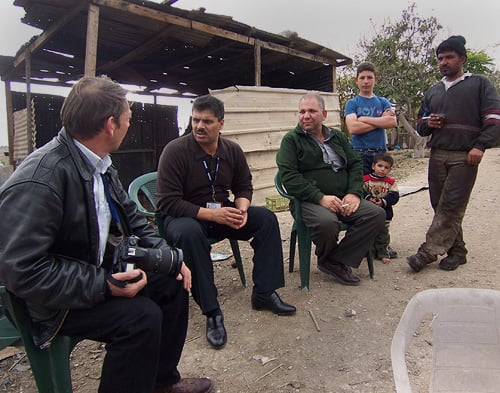

John, Haitam, head of village, and villagers • Photo The author © 2008

“Around 500,” said Mr Samir abu Sha the head of the village council, “We are the Forgotten Camp.”

Given the number of refugees involved, John went through a thorough series of questions to find out what UNRWA might or might not be able to do. Many of the refugees were originally from Haifa and Acca and had fled in 1948, whilst the others were from Gaza. Samir said they’d been brought from Gaza in trucks in 1970, under the orders of Ariel Sharon, and had been forbidden to return. John asked if they had been brought to New Fahme because they’d collaborated with the Israelis – there was a rumour to that effect. “None of the people here now are collaborators,” said Samir, “It was their predecessors.” Samir said that in 1994 – in the wake of the Oslo Accords – Israel had given these collaborators Israeli IDs and they’d moved out of New Fahme.

Samir took us to visit two Special Hardship Cases (SHCs). It turned out that 25 families in New Fahme probably come under this category of people in severe need of assistance:

Najwa was sitting in her wheel chair baking bread in an outside oven. Next to her was one of her daughters and her son, who is mentally disabled. Najwa’s leg was injured by an explosive device in January 2002. It wasn’t clear whether this device belonged to the IDF or to local militia and whether or not it was a deliberate act intended to inflict a civilian casualty. After a number of months in the hospital, the doctors decided to amputate Najwa’s leg.
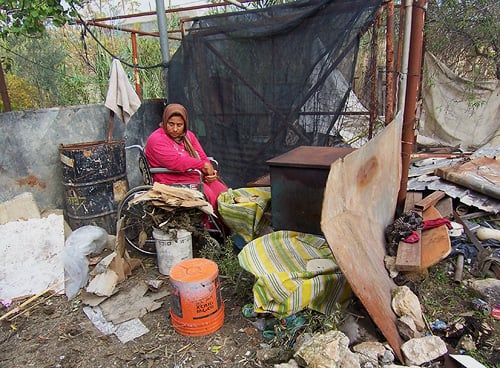
Najwa • Photo The author © 2008

Now she spends all her time at home. As I looked around it was clear that somebody had carried her outside as it wasn’t possible for Najwa to wheel herself around the rough, littered terrain; moreover, there were steps going into her home. She said the YMCA had put some ramps in her house so at least once she was inside she had some degree of mobility. The wheel chair was a second-hand one found by her husband, who makes a living collecting and selling on empty plastic bottles and aluminium cans.

The second SHC we visited was facing similarly dire challenges. Ibrahim, the head of the household, has become addicted to heroin, most likely – in my opinion – as an escape from the difficulties he faces on a daily basis. Like many of the other inhabitants of New Fahme, he is unemployed and sinking further into debt. Many of his family members are unwell: one of his sons is mentally disabled, his wife needs an operation but can’t get a permit from the Israelis to travel out of the West Bank to the hospital in Jerusalem, and his one-year-old granddaughter is suffering from a serious heart condition.
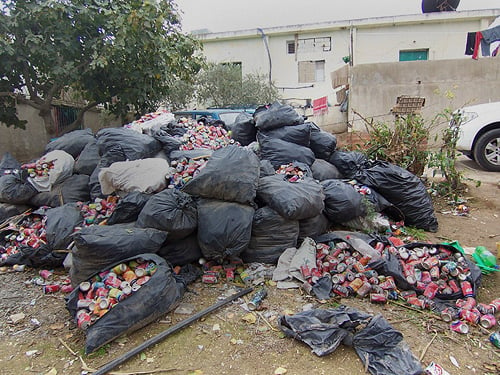
Rubbish • Photo The author © 2008

Leaving Ibrahim’s home, we returned to Samir abu Sha’s office. Samir said he hoped UNRWA might help rebuild some of the houses in the village that were at risk of collapse. John was candid and explained that the Agency (4) was experiencing an austerity period and that at best there was the hope that a social worker could visit the SHCs to make a proper assessment of their situation, after which they could apply to UNRWA for specific needs-related assistance. A mobile clinic was another option that John was considering recommending to UNRWA given the number of refugees in the village.


Would you be reading this now,
if it wasn’t useful to you?
Then please support TFF and this homepage

Despite John’s initial hesitation, an idea for salvaging the collapsing houses by applying to UNRWA’s Job Creation Programme (JCP) was broached. It seemed there was a chance that through JCP the villagers might be able to receive cement and other materials from UNRWA to enable them to restore their homes. Samir was enthusiastic about this idea not only because it would make the houses safe for villagers, but also because it would provide the men with work and an income. As with Najwa’s husband, the main source of employment at the moment in New Fahme is the sale of scrap iron, aluminium and plastic. The men used to sell this waste to Israel, but this trade has all but stopped because of the Israeli-imposed restrictions on the movement of people and goods in the oPt.
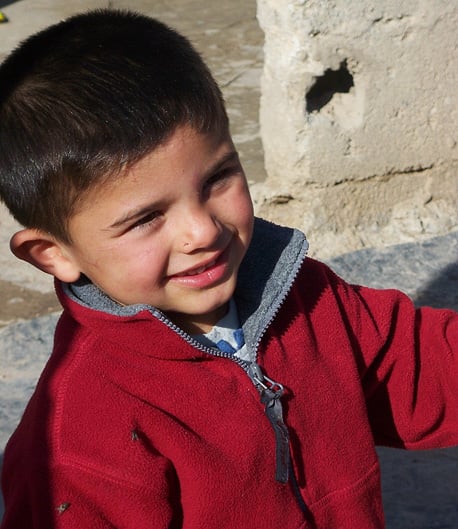
Young boy • Photo The author © 2008

Driving away from New Fahme, I admired the beauty of the undulating hills that stretched into the distance. As we approached Jerusalem, however, the view became scarred by the Barrier, a concrete wall that serpentines for kilometres between Israel and the Palestinian territory as well as around Palestinian towns themselves. This despite a July 2004 ruling by the International Court of Justice that Israel’s West Bank barrier is illegal.

Footnotes

1. “Since 2001, the Operations Support Officer (OSO) programme has supported the delivery of UNRWA’s emergency services in the occupied Palestinian territory (oPt) in conditions of heightened restrictions on access and movement within Palestinian areas. OSOs have facilitated delivery of essential aid to refugees in isolated communities, including those under military siege or curfew, and coordinated UNRWA and inter-agency responses to conflict- and non-conflict related crises.” UNRWA Emergency Appeal 2008, p.24, http://www.un.org/unrwa/emergency/appeals/2008-appeal.pdf

2. United Nations Relief and Works Agency for Palestine Refugees in the Near East

3.Judea and Samaria is how many Jews refer to the West Bank.

4.The Agency is a term used to refer to UNRWA (United Nations Relief and Works Agency for Palestine Refugees in the Near East)

Related Posts

LONDON – So far so good, at least on the wider level. While internally Iraq seems on the edge of chaos, the much heralded clash of civilizations between the Muslim and Judaeo-Christian worlds has yet to become apparent. We have anger and despair aplenty in the Arab and Muslim worlds. But very little rushing to the standard and there was no great pilgrimage of warriors to join the fight, as happened when the Soviet Union invaded Afghanistan twenty years ago, and then, having driven the Red Army out, were left to ferment in that mountainous redoubt. With the armaments supplied by the CIA the mujahidin were transformed into Al Qaeda that became, for a relatively brief moment as these things go, ‘the greatest threat to the homeland that America has ever known.’ Nevertheless a ‘Cold War’ between much of the Muslim world and the West is certainly in full swing. Winston...
The Challenge of Nuclear Weaponsin the Twenty-first CenturyA Path Forward The peoples and governments of the world face an urgent challenge relating to weaponry of mass destruction and particularly to nuclear weaponry.  At the crossroads of technology, terrorism, geopolitical ambition, and policies of preemption are new and potent dangers for humanity. Despite ending the nuclear standoff of the Cold War era, nuclear weaponry is again menacing the peoples of the world with catastrophic possibilities.  We recognize the need for any government to pursue its security interests in accordance with international law; and further, we recognize that distinctive threats to these interests now exist as a result of an active international terrorist network having declared war on the United States and its allies. Nonetheless, we reject the assessment of the current US administration that upgrading a reliance on nuclear weapons is in any sense justified as a response. We find it...
By Karin Wegestal MP, the Social Democratic Partyon behalf of the Swedish Committee for Solidarity with the Yugoslav People During the last decade, the Federal Republic of Yugoslavia has received more than 500,000 refugees from Croatia and Bosnia, and another 300,000 internally displaced persons, mainly from the province Kosovo and Metohia. For a country with about ten million inhabitants, such an influx of homeless people is obviously a very heavy burden – even under peaceful conditions. But in addition to that, the Federal Republic of Yugoslavia has been the subject to sanctions from the western powers for close to ten years and its infrastructure was badly hurt through Nato’s intense bombardment during 78 days in 1999. The result of all this is that Yugoslavia, once the most developed industrial country in Eastern Europe, is today the poorest country in Europe. In Serbia excluding Kosovo, with about ten million inhabitants and...

Recent Articles

Tony Robinson October 4, 2026 Violence is easy to recognise when someone is being beaten, shot or killed. It becomes more difficult when nobody is holding a weapon. Poverty, discrimination, exploitation and repression can restrict a human life just as effectively, although they do so in very different ways and with very different consequences. Simply adding more categories to an ever-growing list of forms of violence does not really solve the problem. The more interesting question is what all these different situations have in common and why it makes sense to describe them using the same word. Human beings do not simply react to what happens around them. They remember the past, imagine things that do not yet exist, make plans and undertake projects. Workers organise because they imagine different working conditions; people migrate because they imagine another life somewhere else; social movements emerge because people refuse to accept the...
It’s a matter of principles, courage, vision and pulling together – while the militarist world is falling apart… Peter Langille October 3, 2026 “Here, then, is the problem which we present to you, stark and dreadful and inescapable: Shall we put an end to the human race; or shall mankind renounce war?”The Bertrand Russell—Albert Einstein Manifesto, July 9, 1955 ⁕ The forecast for what’s ahead is worrisome. The sharp rise in armed conflicts over the past three years is adding to what was already the highest level in over seventy years. Genocides, which should be prevented are supported. A shared climate emergency that jeopardises survival is ignored. Diverse polls now suggest that people are war-weary, worried and interested in a more effective United Nations. And, there are viable policy options for a more secure world! Yet governments are doubling-down, betting on more war and investing heavily. If current trends persist,...
Johan Galtung 1930-2024October 2015 Published here on October 3, 2026 Let us focus on Civilization for conflict analysis and remedies. Major forms of disorder use violence; war is state organized violence. The most belligerent states are the United States of America and Israel, both with civilization roots. National Evangelism, the US Protestant Christian civilization– more national than evangelical–justifies US warfare as exceptionalism of a people chosen by God, with a manifest destiny to run the world. Orthodox Judaism justifies Israeli warfare to conquer and expand from Nile to Euphrates as a religious right and duty to the Eternal One. The third most belligerent country, the UK, no longer believes it is God-chosen but chosen by the USA; not quite the same but something. But the root cause of global disorder lies in the Occident–with Islam–seeing itself as the single, universal civilization valid for all at all times, all others being...

TFF on Substack

Discover and subscribe to more peace materials on TFF Substack

Most Popular

Tony Robinson October 4, 2026 Violence is easy to recognise when someone is being beaten, shot or killed. It becomes more difficult when nobody is holding a weapon. Poverty, discrimination, exploitation and repression can restrict a human life just as effectively, although they do so in very different ways and with very different consequences. Simply adding more categories to an ever-growing list of forms of violence does not really solve the problem. The more interesting question is what all these different situations have in common and why it makes sense to describe them using the same word. Human beings do not simply react to what happens around them. They remember the past, imagine things that do not yet exist, make plans and undertake projects. Workers organise because they imagine different working conditions; people migrate because they imagine another life somewhere else; social movements emerge because people refuse to accept the...
It’s a matter of principles, courage, vision and pulling together – while the militarist world is falling apart… Peter Langille October 3, 2026 “Here, then, is the problem which we present to you, stark and dreadful and inescapable: Shall we put an end to the human race; or shall mankind renounce war?”The Bertrand Russell—Albert Einstein Manifesto, July 9, 1955 ⁕ The forecast for what’s ahead is worrisome. The sharp rise in armed conflicts over the past three years is adding to what was already the highest level in over seventy years. Genocides, which should be prevented are supported. A shared climate emergency that jeopardises survival is ignored. Diverse polls now suggest that people are war-weary, worried and interested in a more effective United Nations. And, there are viable policy options for a more secure world! Yet governments are doubling-down, betting on more war and investing heavily. If current trends persist,...
Johan Galtung 1930-2024October 2015 Published here on October 3, 2026 Let us focus on Civilization for conflict analysis and remedies. Major forms of disorder use violence; war is state organized violence. The most belligerent states are the United States of America and Israel, both with civilization roots. National Evangelism, the US Protestant Christian civilization– more national than evangelical–justifies US warfare as exceptionalism of a people chosen by God, with a manifest destiny to run the world. Orthodox Judaism justifies Israeli warfare to conquer and expand from Nile to Euphrates as a religious right and duty to the Eternal One. The third most belligerent country, the UK, no longer believes it is God-chosen but chosen by the USA; not quite the same but something. But the root cause of global disorder lies in the Occident–with Islam–seeing itself as the single, universal civilization valid for all at all times, all others being...
Read More
Living-Peace-Sign-Budapest-copy
Tony Robinson October 4, 2026 Violence is easy to recognise when someone is being beaten, shot or killed. It becomes more difficult when nobody is holding a weapon. Poverty, discrimination, exploitation and repression can restrict a human life just as effectively, although they do so in very different ways and with very different consequences. Simply adding more categories to an ever-growing list of forms of violence does not really solve the problem. The more interesting question is what all these different situations have in common and why it makes sense to describe them using the same word. Human beings do not simply react to what happens around them. They remember the past, imagine things that do not yet exist, make plans and undertake projects. Workers organise because they imagine different working conditions; people migrate because they imagine another life somewhere else; social movements emerge because people refuse to accept the...
b54a1f10-8c65-4f0b-9dd5-4abc0a7d04cc_2659x2659
It’s a matter of principles, courage, vision and pulling together – while the militarist world is falling apart… Peter Langille October 3, 2026 “Here, then, is the problem which we present to you, stark and dreadful and inescapable: Shall we put an end to the human race; or shall mankind renounce war?”The Bertrand Russell—Albert Einstein Manifesto, July 9, 1955 ⁕ The forecast for what’s ahead is worrisome. The sharp rise in armed conflicts over the past three years is adding to what was already the highest level in over seventy years. Genocides, which should be prevented are supported. A shared climate emergency that jeopardises survival is ignored. Diverse polls now suggest that people are war-weary, worried and interested in a more effective United Nations. And, there are viable policy options for a more secure world! Yet governments are doubling-down, betting on more war and investing heavily. If current trends persist,...
010
Johan Galtung 1930-2024October 2015 Published here on October 3, 2026 Let us focus on Civilization for conflict analysis and remedies. Major forms of disorder use violence; war is state organized violence. The most belligerent states are the United States of America and Israel, both with civilization roots. National Evangelism, the US Protestant Christian civilization– more national than evangelical–justifies US warfare as exceptionalism of a people chosen by God, with a manifest destiny to run the world. Orthodox Judaism justifies Israeli warfare to conquer and expand from Nile to Euphrates as a religious right and duty to the Eternal One. The third most belligerent country, the UK, no longer believes it is God-chosen but chosen by the USA; not quite the same but something. But the root cause of global disorder lies in the Occident–with Islam–seeing itself as the single, universal civilization valid for all at all times, all others being...
Screenshot 2026-10-02 011738
Jan ObergPhD, director, The Transnational Foundation for Peace and Future Research, TFFLund, Sweden October 2, 2026 This is my full original manuscript. The Chinese Academy of Social Science, CASS, makes two publications out if it. 1. China’s Five-year plan emphasized the capabilities of basic research and original innovation. It is regarded as the goal of the future social development, which, as required, should be significantly enhanced. Can you comment on the importance of original innovation in research and academic study? I believe it is easier to define “original innovation” in the natural sciences than in social sciences. The breaking points of what constitutes something new, or innovative, are not quite as sharp in the latter. But in both fields it is about opening up something that was closed, unseen, unexplored before – making manifest what was earlier latent. Innovations come in many forms and shapes – naming something that was not...
arctic-circle-map
The agreement is catastrophic both because of what it says and what it doesn’t mention. It reduces further the major asset of security policies: Freedom of action. Jan Oberg TFF director September 25, 2026 A couple of hours before the agreement was signed on September 22, 2026, I published the following 13 hypotheses about what it would most likely contain on TFF Substack (in English). I was wrong on only the first point. Contrary to what Trump had written on his Truth Social platform, it does not appear to come into force immediately. In fact, it turned out to be worse than even I had anticipated. After these hypotheses now come a number of reflections in light of what the agreement actually contains, and does not contain, as well as the way in which it has generally been presented by major media outlets and by the public-service broadcaster DR. My...
girl-5894831_1280
Below are TFF-related media mentions, comments, videos and social media posts published elsewhere but not on this homepage. We happen to catch and list only a fraction. Regarding video comments and debates, we recommend that you go to the TFF Video Channel on Substack where many of them are reproduced. Jan Oberg is a contributor to China Daily – 52 million daily clicks – and Global Times, CGTN and CCTV (the national television), China Investment, Xinhua News Agency and several others. Articles and videos on these media very often multiply into countless Chinese (and Western media) that re-post them from these main media. Thanks to The China Academy, his analyses, interviews and comments are frequently posted on YouTube channels such as Thinkers Forum and Wave Media. These videos are often re-posted on Bilibili (China’s YouTube), the China Content Center on TikTok, and on the Chinese edition of TikTok, Douyin.com. This means reaching hundreds of millions of viewers worldwide over a year. While there are too many to catch on all these...