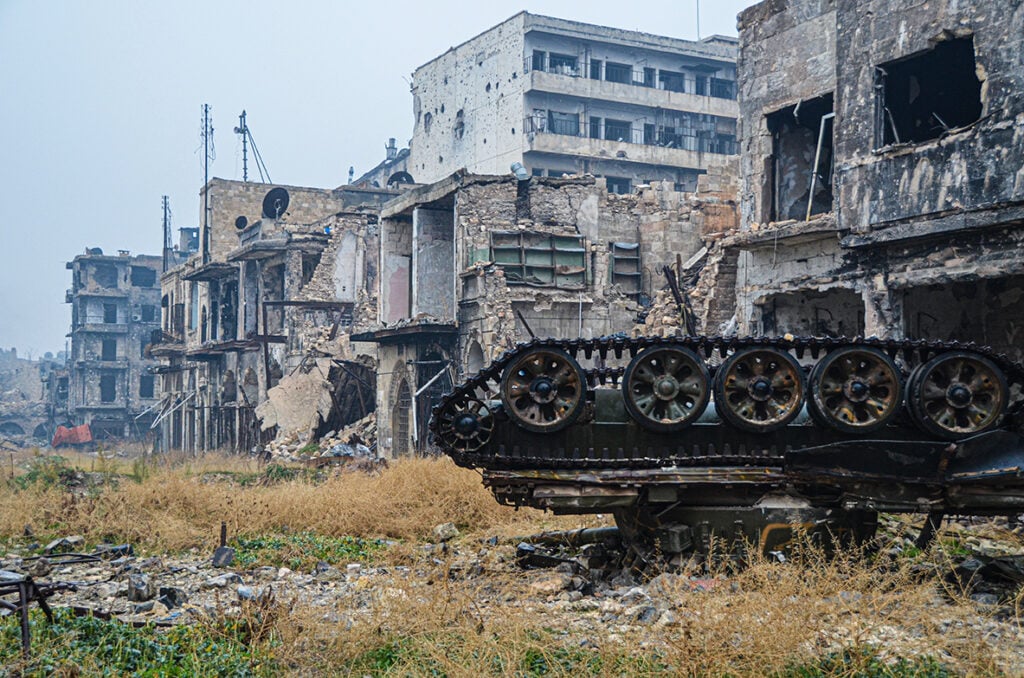
Photo – Aleppo December 2016 © Jan Oberg

Against the Institution of War

– announcing the publication of the book, The Ecological Impact of Militarism

John Scales Avery

November 27, 2020

As we start the 21st century and the new millennium, our scientific and technological civilization seems to be entering a period of crisis. Today, for the first time in history, science has given to humans the possibility of a life of comfort, free from hunger and cold, and free from the constant threat of infectious disease. At the same time, science has given us the power to destroy civilization through thermonuclear war, as well as the power to make our planet uninhabitable through pollution and overpopulation. The question of which of these alternatives we choose is a matter of life or death to ourselves and our children.

The crisis of civilization, which we face today, has been produced by the rapidity with which science and technology have developed. Our institutions and ideas adjust too slowly to the change. The great challenge which history has given to our generation is the task of building new international political structures, which will be in harmony with modern technology. At the same time, we must develop a new global ethic, which will replace our narrow loyalties by loyalty to humanity as a whole.

In the long run, because of the enormously destructive weapons, which have been produced through the misuse of science, the survival of civilization can only be insured if we are able to abolish the institution of war.

Because the world spends 1.8 trillion dollars each year on armaments, it follows that very many people make their living from war. This is the reason why it is correct to speak of war as a social institution, and also the reason why war persists, although everyone realizes that it is the cause of much of the suffering that inflicts humanity. We know that war is madness, but it persists. We know that it threatens the future survival of our species, but it persists, entrenched in the attitudes of historians, newspaper editors and television producers, entrenched in the methods by which politicians finance their campaigns, and entrenched in the financial power of arms manufacturers, entrenched also in the ponderous and costly hardware of war, the fleets of warships, bombers, tanks, nuclear missiles and so on.

Science cannot claim to be guiltless: In Eisenhower’s farewell address, he warned of the increasing power of the military-industrial complex, a threat to a democratic society. If he were making the same speech today, he might speak of the industrial-military-scientific complex. Since Hiroshima, we have known that new knowledge is not always good. There is a grave danger that nuclear weapons will soon proliferate to such an extent that they will be available to terrorists and even to the Mafia. Chemical and biological weapons also constitute a grave threat.

Besides a humane, democratic and just framework of international law and governance, we urgently need a new global ethic, – an ethic where loyalty to family, community and nation will be supplemented by a strong sense of the brotherhood of all humans, regardless of race, religion or nationality. Schiller expressed this feeling in his “Ode to Joy”, the text of Beethoven’s Ninth Symphony. Hearing Beethoven’s music and Schiller’s words, most of us experience an emotion of resonance and unity with its message: All humans are brothers and sisters – not just some – all! It is almost a national anthem of humanity. The feelings which the music and words provoke are similar to patriotism, but broader. It is this sense of a universal human family, which we need to cultivate in education, in the mass media, and in religion.

No Warming, No War: How Militarism Fuels the Climate Crisis

Here is a quotation from an article by Lorah Steichen and Lindsay Koshgarian:

“In this report, we’ll lay out how militarism and the climate crisis are deeply intertwined and mutually reinforcing. The military itself, we explain, is a huge polluter – and is often deployed to sustain the very extractive industries that destabilize our climate. This climate chaos, in turn, leads to massive displacement, militarized borders, and the prospect of further conflict.”

“True climate solutions, we argue, must have antimilitarism at their core.”

“In the face of both COVID-19 and the climate crisis, we urgently need to shift from a culture of war to a culture of care. Funnelling trillions into the military to wage endless wars and project military dominance has prevented us from investing in true security and cooperation. If we don’t transform our society and the way we confront crises, we will face even more unjust and inhumane realities in a climate-changed future.”

Rebuilding after the pandemic

The COVID-19 pandemic has thrown light on the shortcomings of our militaristic concept of security. Our military establishments could not protect us from the virus. Indeed, even without the pandemic, our “defense departments” do not really defend us. This is most obvious when we think of a nuclear war, in which hundreds of millions of innocent civilians might be killed. At present, civilians are hostages in the power struggles of politicians.

When we rebuild the world after the pandemic, it must not merely be “back to normal”. The old normal was part of the problem. We must build a new world in which the climate emergency is addressed, and rapid action is taken to prevent it.

The Green New Deal, in which jobs are created producing urgently-needed renewable energy infrastructure, offers the best model for the new world that we want. Those who say that there is not enough money to finance the Green New Deal, forget the unimaginable amounts of money wasted, or worse than wasted, on militarism. We must divert this vast river of money from its present evil use, to the constructive task of saving our planet from the existential threat of catastrophic climate change.

A new freely downloadable book

I would like to announce the publication of a new book, which discusses the ecological damage produced by militarism. The book may be downloaded free of charge and circulated from the following link:

The Ecological Impact of Militarism

You’ll find sevral other articles and book announcements of John Scales Avery – and amazingly prolific author – here on The Transnational. But they are also listed in two other places which you will find interesting – also beyond his works:

The Eqbal Ahmed Center for Public Education

The Wall Street International Magazine

The author and TFF hope that you will circulate the links in this article to friends and contacts who might be interested in constructive analyses of the global problems and their solution.

About the Author

Read more about John Scales Avery here.

Related Posts

Photo above: Carl Fredrik Reuterswärd’s Non-Violence outside UN Headquarters in New York. Kirill Levin, CC BY-NC-SA 2. Jan Oberg November 3, 2026 I am happy to be published in Horizons which is produced by the Center for International Relations and Sustainable Development, CIRSD, in Belgrade. My contribution brings out a radical re-thinking of what concepts such as defence, security, deterrence – and peace – may mean if we want to create a more peaceful world. It also summarises a few things I have been working with the last few decades. Please read it here Og her er den på dansk, takket være Johnny Baltzersens lynhurtige oversættelse
UNITE-tillid, DREAM-velstand og andre konstruktive komponenter Normally we publish articles in English here. But this is a translation of a very important TFF document that should reach as many as possible in Denmark since this country’s government has been one of the most hardline in Europe and, up till now at least, has refused to use diplomacy and, instead, spent tremendous sums on arming Ukraine with the express goal of defeating Russia. Thus this – unique – article is in Danish. Vi er Johnny Baltzersen og hans Fælles Sikkerhed – Fælles Fremtid på Substack overmåde taknemmelige for at have oversat og publiceret TFF’s 2025-portfølje for fredsidéer med henblik på Ukraines fremtid. Vi håber den nu kan nå mange flere danskere – som også vil sprede den og skabe debat – nu den danske regerings og folketingspartiernes politik på dette område siden 2022 står nu – forudsigeligt – ved vejs ende....
Jan Oberg TFF director October 28, 2026 Exactly one month has now passed since I published my criticism of the introduction to the special issue on Johan Galtung published by the Journal of Global Security Studies, JoGSS, and of Tor Egil Førland’s chapter about Galtung which serves as a preview to his forthcoming biography of Galtung to be published by PRIO. See the original on The Transnational here and the same article on TFF Substack with many general and critical comments and, in particular, the people who decided to withdraw from the biography project in protest. The special issue itself was extraordinary. It was devoted to the intellectual legacy of one of the founders of peace research and contained a number of strong assessments of his personality, scholarship, intellectual trajectory, and public role. Such assessments are, of course, entirely legitimate. No scholar is beyond criticism, and neither was Johan Galtung....

Recent Articles

Photo above: Carl Fredrik Reuterswärd’s Non-Violence outside UN Headquarters in New York. Kirill Levin, CC BY-NC-SA 2. Jan Oberg November 3, 2026 I am happy to be published in Horizons which is produced by the Center for International Relations and Sustainable Development, CIRSD, in Belgrade. My contribution brings out a radical re-thinking of what concepts such as defence, security, deterrence – and peace – may mean if we want to create a more peaceful world. It also summarises a few things I have been working with the last few decades. Please read it here Og her er den på dansk, takket være Johnny Baltzersens lynhurtige oversættelse
UNITE-tillid, DREAM-velstand og andre konstruktive komponenter Normally we publish articles in English here. But this is a translation of a very important TFF document that should reach as many as possible in Denmark since this country’s government has been one of the most hardline in Europe and, up till now at least, has refused to use diplomacy and, instead, spent tremendous sums on arming Ukraine with the express goal of defeating Russia. Thus this – unique – article is in Danish. Vi er Johnny Baltzersen og hans Fælles Sikkerhed – Fælles Fremtid på Substack overmåde taknemmelige for at have oversat og publiceret TFF’s 2025-portfølje for fredsidéer med henblik på Ukraines fremtid. Vi håber den nu kan nå mange flere danskere – som også vil sprede den og skabe debat – nu den danske regerings og folketingspartiernes politik på dette område siden 2022 står nu – forudsigeligt – ved vejs ende....
Jan Oberg TFF director October 28, 2026 Exactly one month has now passed since I published my criticism of the introduction to the special issue on Johan Galtung published by the Journal of Global Security Studies, JoGSS, and of Tor Egil Førland’s chapter about Galtung which serves as a preview to his forthcoming biography of Galtung to be published by PRIO. See the original on The Transnational here and the same article on TFF Substack with many general and critical comments and, in particular, the people who decided to withdraw from the biography project in protest. The special issue itself was extraordinary. It was devoted to the intellectual legacy of one of the founders of peace research and contained a number of strong assessments of his personality, scholarship, intellectual trajectory, and public role. Such assessments are, of course, entirely legitimate. No scholar is beyond criticism, and neither was Johan Galtung....

TFF on Substack

Discover and subscribe to more peace materials on TFF Substack

Most Popular

Photo above: Carl Fredrik Reuterswärd’s Non-Violence outside UN Headquarters in New York. Kirill Levin, CC BY-NC-SA 2. Jan Oberg November 3, 2026 I am happy to be published in Horizons which is produced by the Center for International Relations and Sustainable Development, CIRSD, in Belgrade. My contribution brings out a radical re-thinking of what concepts such as defence, security, deterrence – and peace – may mean if we want to create a more peaceful world. It also summarises a few things I have been working with the last few decades. Please read it here Og her er den på dansk, takket være Johnny Baltzersens lynhurtige oversættelse
UNITE-tillid, DREAM-velstand og andre konstruktive komponenter Normally we publish articles in English here. But this is a translation of a very important TFF document that should reach as many as possible in Denmark since this country’s government has been one of the most hardline in Europe and, up till now at least, has refused to use diplomacy and, instead, spent tremendous sums on arming Ukraine with the express goal of defeating Russia. Thus this – unique – article is in Danish. Vi er Johnny Baltzersen og hans Fælles Sikkerhed – Fælles Fremtid på Substack overmåde taknemmelige for at have oversat og publiceret TFF’s 2025-portfølje for fredsidéer med henblik på Ukraines fremtid. Vi håber den nu kan nå mange flere danskere – som også vil sprede den og skabe debat – nu den danske regerings og folketingspartiernes politik på dette område siden 2022 står nu – forudsigeligt – ved vejs ende....
Jan Oberg TFF director October 28, 2026 Exactly one month has now passed since I published my criticism of the introduction to the special issue on Johan Galtung published by the Journal of Global Security Studies, JoGSS, and of Tor Egil Førland’s chapter about Galtung which serves as a preview to his forthcoming biography of Galtung to be published by PRIO. See the original on The Transnational here and the same article on TFF Substack with many general and critical comments and, in particular, the people who decided to withdraw from the biography project in protest. The special issue itself was extraordinary. It was devoted to the intellectual legacy of one of the founders of peace research and contained a number of strong assessments of his personality, scholarship, intellectual trajectory, and public role. Such assessments are, of course, entirely legitimate. No scholar is beyond criticism, and neither was Johan Galtung....
Read More
knotted gun
Photo above: Carl Fredrik Reuterswärd’s Non-Violence outside UN Headquarters in New York. Kirill Levin, CC BY-NC-SA 2. Jan Oberg November 3, 2026 I am happy to be published in Horizons which is produced by the Center for International Relations and Sustainable Development, CIRSD, in Belgrade. My contribution brings out a radical re-thinking of what concepts such as defence, security, deterrence – and peace – may mean if we want to create a more peaceful world. It also summarises a few things I have been working with the last few decades. Please read it here Og her er den på dansk, takket være Johnny Baltzersens lynhurtige oversættelse
TFFPortfolioVign
UNITE-tillid, DREAM-velstand og andre konstruktive komponenter Normally we publish articles in English here. But this is a translation of a very important TFF document that should reach as many as possible in Denmark since this country’s government has been one of the most hardline in Europe and, up till now at least, has refused to use diplomacy and, instead, spent tremendous sums on arming Ukraine with the express goal of defeating Russia. Thus this – unique – article is in Danish. Vi er Johnny Baltzersen og hans Fælles Sikkerhed – Fælles Fremtid på Substack overmåde taknemmelige for at have oversat og publiceret TFF’s 2025-portfølje for fredsidéer med henblik på Ukraines fremtid. Vi håber den nu kan nå mange flere danskere – som også vil sprede den og skabe debat – nu den danske regerings og folketingspartiernes politik på dette område siden 2022 står nu – forudsigeligt – ved vejs ende....
JoGSS-Silent
Jan Oberg TFF director October 28, 2026 Exactly one month has now passed since I published my criticism of the introduction to the special issue on Johan Galtung published by the Journal of Global Security Studies, JoGSS, and of Tor Egil Førland’s chapter about Galtung which serves as a preview to his forthcoming biography of Galtung to be published by PRIO. See the original on The Transnational here and the same article on TFF Substack with many general and critical comments and, in particular, the people who decided to withdraw from the biography project in protest. The special issue itself was extraordinary. It was devoted to the intellectual legacy of one of the founders of peace research and contained a number of strong assessments of his personality, scholarship, intellectual trajectory, and public role. Such assessments are, of course, entirely legitimate. No scholar is beyond criticism, and neither was Johan Galtung....
Screenshot 2026-10-26 115647
An aspect of Iran’s culture and civilisation you’ve probably never heard about. Don’t be surprised if the US and Israel also try to bomb them. Jan ObergTFF director October 26, 2026 Today – under the “USraeli” threat of new “annihilating” bombings – opens the 7th International Conference on Peace and Conflict Resolution at Tehran’s University. As far as I can tell, this is the only permanent, advanced peace research institution in West Asia/the Middle East. Perhaps more countries in that region could be inspired? I mean, how many military “security” institutes and military academies do they have? Many peace research institutes and university departments have been established since the 1950s in the West. They are now all under attack; some have closed down, some have gone mainstream, yet others kept the name but do nothing to research peace and disseminate results or advice; instead, they cooperate with militarism’s platforms such...
Screenshot 2026-10-15 141837
Let’s discuss using AI to create peace – in contrast to boring geopolitics devoid of creative healing and visions. Jan Oberg TFF director October 15, 2026 I asked VEED to create a short video exemplifying how peace is preferable to war, then chose the lady as a template. Simple as that. In less than a minute, it produced this video, which any peace-loving person would appreciate. The only problem is that human intelligence (HI), at least the one that exists among Western decision-makers, isn’t half as moral or smart as AI. I have used AI to dialogue about peace and peace plans, creative conflict resolution and visions of a better future for humankind. It so happens that I am having more stimulating, intelligent, creative and moral discussions with AI than I could possibly have with any EU or NATO leader today. Yes, AI has very problematic and dangerous aspects; used...
girl-5894831_1280
Below are TFF-related media mentions, comments, videos and social media posts published elsewhere but not on this homepage. We happen to catch and list only a fraction. Regarding video comments and debates, we recommend that you go to the TFF Video Channel on Substack where many of them are reproduced. Jan Oberg is a contributor to China Daily – 52 million daily clicks – and Global Times, CGTN and CCTV (the national television), China Investment, Xinhua News Agency and several others. Articles and videos on these media very often multiply into countless Chinese (and Western media) that re-post them from these main media. Thanks to The China Academy, his analyses, interviews and comments are frequently posted on YouTube channels such as Thinkers Forum and Wave Media. These videos are often re-posted on Bilibili (China’s YouTube), the China Content Center on TikTok, and on the Chinese edition of TikTok, Douyin.com. This means reaching hundreds of millions of viewers worldwide over a year. While there are too many to catch on all these...