

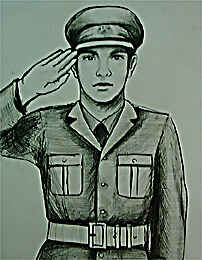
Poster at the Leadership Training Academy
for the – civilian – Kosovo Protection Corps, KPC – Photo © TFF

Report of an IOM/TFF Mission to Kosovo, March 7 to 10, 2000 

More pictures from Pristina

Kerstin Schultz’ report

Purpose

I was invited with Kerstin Schultz to contribute to training in conflict management skills of middle level leaders of the Kosovo Protection Corps, KPC. This followed the earlier involvement of Jan Oberg of TFF with a similar training exercise with the top leadership of the KPC. The three of us are members of TFF’s Balkans mitigation team based in Lund, Sweden, which has made many missions since 1991 to Kosovo and other regions of the Balkans.

Background

IOM are responsible for a comprehensive training programme for the KPC leadership that includes briefings for example from KFOR, the ICRC, UNMIK, and NGO’s working in the region concerned with rehabilitation and safety. TFF was invited to contribute some training seminars on conflict management skills.

Kerstin Schultz and I were invited to give presentations to six groups of KPC middle level leaders, about 550 persons altogether in six locations.

The head of the IOM mission in Pristina, Pasquale Lupoli, advised us that the KPC were drawn from the KLA. Nearly 14,000 of them asked for employment with the KPC and 3000 were selected through a test similar to the British army tests for intelligence, aptitude and suitability. A senior leadership of about 46 were selected from these 3000, a medium level leadership of about 560 were also selected and the remainder were considered as rank and file. We were led to believe that this selection was rather arbitrary &endash; IOM appears only to have rejected outright those that were illiterate whilst the ex-KLA personnel had influence over those given seniority.

We asked people from IOM, KFOR, and OSCE about the role expectations for the KPC – what they might be doing in a few months time. The response was vague. I asked KPC groups what they perceived their role to be but their vision seemed to me to be clouded. I felt that the main purpose of creating the KPC was to employ ex-fighters in a civilian protection Corps, giving them a post-war role rather than inclining them in their idleness towards trouble making through for example drug trafficking, kidnapping and crime as was the case with the ex-Chechen guerrilla fighters.

The TFF training seminars were intended I believe to begin to change the mentality of the KPC from a fighter mind-set to one focused on the security and livelihood of all the peoples of Kosovo. Such an attitude change in principle requires intensive workshop practice in small groups over several weeks. There was I felt a very limited potential in working with large groups for the first time for only an hour or two. In retrospect I feel that a substantial but necessarily limited achievement was effected.
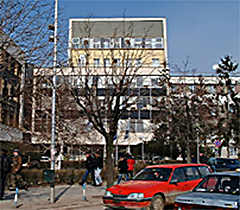
UN HQ in Pristina – Photo © TFF

My first training seminar was with about 260 of these KPC middle rank leaders in a cinema in Pristina on March 8. I was not previously advised that I would be expected to address such a large group in fixed seating accommodation. A set piece, well-orchestrated presentation was called for and I did not have adequate visual material &endash; well prepared overhead transparencies and slides &endash; to make a good impact on such a group. The interpreter from a market organisation was poor and I only had a minute or two beforehand to brief him. Nevertheless I believe that some attitudinal change took place amongst the audience who were very attentive. In asking for questions, I was surprised that a senior KFOR officer in the front row asked me to give specific advice for the situations in which the KPC would be working. Did he have a clearer perception of this role expectation than IOM or myself?
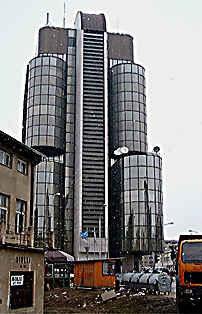
OSCE’s HQ in Pristina – Photo © TFF

My second training seminar with about 60 KPC leaders took place in the basement of a hotel in Prezren on March 9 &endash; the expected accommodation on the ground floor had been double booked. This seminar went very well: good attention, keen and appropriate questions, and several participants asked me for my seminar notes in Albanian which alas I did not have. The IOM interpreters were poor and after about five minutes a KPC officer offered to interpret and he did a very good job. Several participants were professional men: a good response came from a medical doctor, for example.My third seminar was held in a hotel in Pec on March 10 with about 50 KPC officers. The room had a very large oval table and we had to crowd around it. I gave the same seminar that went down so well in Prezren. Although the attention was good, the audience was lifeless when it came to comments and questions. A break of ten minutes would then have been welcomed before engaging the group in some but I was constrained for time as I had a long and uncertain journey that day to get to Skopje in time for my return flight.

Content and style of training seminars

I followed the spirit and intention of the agenda laid out in the IOM contract (as devised by Jan Oberg for his previous training seminar). What worked well at the second meeting was a modification of what did not work out so well with the very large first group in the cinema; the same agenda was used for the third meeting.

1. Brief introduction to myself and my engagement with post war situations in the Balkans and the Caucasus.

2. Emphasised that the KPC and myself were practising the same profession of protecting the lives and livelihoods of civilian populations against violence and suffering.

3. Violence is any action or structure that reduces or takes away fundamental human needs. Explored the hierarchy of human needs beginning with that of food, warmth, shelter, safe water, reliable utilities and the disposal of waste. Then we looked at security arrangements to which the KPC would contribute, and to societal and personal goals.

4. To reduce suffering and violence requires good conflict management skills. Without training in listening skills, conflict perception, negotiation and mediation, much suffering and violence could result.

5. Introduced concepts of forgiveness, repentance and reconciliation through the classic Vietnam war photograph of a Vietnamese girl fleeing from violence and another photograph of her reconciled many years later with one of the American airmen who dropped napalm on Vietnam who asked forgiveness of her and received it.

6. Explored negotiation between people and groups with equal power. Used cartoon of boy and girl fighting over a single orange on a tree before recognising that the boy wanted the juice whilst the girl only wanted the peel for marmalade.

7. Introduced and discussed the triad of conflict formations, attitudes/emotions arising from the conflict &endash; mostly hidden from observation &endash; and the behaviour that can result from such emotions – that could be violent leading to a change in the conflict situation, deeper wounds of feeling and more violent behaviour.

8. Discussed win-lose (zero sum) and win-win negotiations with examples.

9. Discussed asymmetric unbalanced conflict situation using conflicts over territory focussing on latent conflict, conscientization, risks of over conflict as majority population seeks to realise its basic human rights through passive resistance (India) or seizing political control (Nagorno Karabakh). Explored both non-violent and violent resolutions to such conflicts emphasising that violent methods leave a lot of hurt to be addressed.

10. Remarked that ethnic cleansing leads to alienation and with the help of the media enemy stereotypes are created that increases the alienation and makes reconciliation more difficult. To effect changes in attitudes between such alienated groups requires face to face trust building meetings that can be facilitated by third parties. Gave examples from my experience of initiatives by women and young people who have crossed hard borders to meet the other side. (Referred to exercises in which I have accompanied such people across borders in Eastern Slavonia and the North Caucasus.

11. Hurt gives rise to the negative emotions of anger, hate, fear and depression.

12. Discussed forgiveness, repentance and reconciliation between individuals and groups after violence &endash; how can the hurt be healed? Described the truth and reconciliation commission in South Africa.

13. Emphasised that we cannot be imprisoned by the past, by constantly analysing the hurt of the past and blaming that on some other party. We should take command of the present moment here and now to set up realistic goals for a better future.

14. Invited questions and comments continually.

15. Invited a Buddhist bell of mindfulness to sound in memory of all the victims of violence. (The second group sprang to attention at this point!)

Reflections and suggestions

I appreciate the need to train the KPC in conflict management skills intrinsic to building a peaceful and just society in Kosovo. This requires a major shift in attitudes and behaviour that cannot be effected simply by seminars to large groups. I recommend as a next step more intensive small group with the top leadership of the KPC over a period of several days and involving group exercises including role-play.

There are some well-trained conflict management facilitators amongst the civilian population of Pristina who could conduct some training in Albanian against a local cultural background. Naturally IOM would be apprehensive about choosing such Albanian facilitators that would be acceptable to the KPC but TFF with its long experience of Kosovo and its connection with Western NGO’s with similar experience could help in vetting appropriate trainers.

I missed the presence of IOM staff at my seminars in a support role – on two occasions I only had interpreters of no great skills. I also missed having flip charts.

I learnt much from this brief mission and would be pleased to be included in further training missions.

On another occasion it would be good to have some notes in Albanian about conflict management skills to give out to participants.

Thanks to the IOM staff in Geneva, Pristina, and Djakova for their good arrangements and attention to detail. I was on the whole very well looked after.

Related Posts

LONDON – So far so good, at least on the wider level. While internally Iraq seems on the edge of chaos, the much heralded clash of civilizations between the Muslim and Judaeo-Christian worlds has yet to become apparent. We have anger and despair aplenty in the Arab and Muslim worlds. But very little rushing to the standard and there was no great pilgrimage of warriors to join the fight, as happened when the Soviet Union invaded Afghanistan twenty years ago, and then, having driven the Red Army out, were left to ferment in that mountainous redoubt. With the armaments supplied by the CIA the mujahidin were transformed into Al Qaeda that became, for a relatively brief moment as these things go, ‘the greatest threat to the homeland that America has ever known.’ Nevertheless a ‘Cold War’ between much of the Muslim world and the West is certainly in full swing. Winston...
The Challenge of Nuclear Weaponsin the Twenty-first CenturyA Path Forward The peoples and governments of the world face an urgent challenge relating to weaponry of mass destruction and particularly to nuclear weaponry.  At the crossroads of technology, terrorism, geopolitical ambition, and policies of preemption are new and potent dangers for humanity. Despite ending the nuclear standoff of the Cold War era, nuclear weaponry is again menacing the peoples of the world with catastrophic possibilities.  We recognize the need for any government to pursue its security interests in accordance with international law; and further, we recognize that distinctive threats to these interests now exist as a result of an active international terrorist network having declared war on the United States and its allies. Nonetheless, we reject the assessment of the current US administration that upgrading a reliance on nuclear weapons is in any sense justified as a response. We find it...
By Karin Wegestal MP, the Social Democratic Partyon behalf of the Swedish Committee for Solidarity with the Yugoslav People During the last decade, the Federal Republic of Yugoslavia has received more than 500,000 refugees from Croatia and Bosnia, and another 300,000 internally displaced persons, mainly from the province Kosovo and Metohia. For a country with about ten million inhabitants, such an influx of homeless people is obviously a very heavy burden – even under peaceful conditions. But in addition to that, the Federal Republic of Yugoslavia has been the subject to sanctions from the western powers for close to ten years and its infrastructure was badly hurt through Nato’s intense bombardment during 78 days in 1999. The result of all this is that Yugoslavia, once the most developed industrial country in Eastern Europe, is today the poorest country in Europe. In Serbia excluding Kosovo, with about ten million inhabitants and...

Recent Articles

Photo above: Carl Fredrik Reuterswärd’s Non-Violence outside UN Headquarters in New York. Kirill Levin, CC BY-NC-SA 2. Jan Oberg November 3, 2026 I am happy to be published in Horizons which is produced by the Center for International Relations and Sustainable Development, CIRSD, in Belgrade. My contribution brings out a radical re-thinking of what concepts such as defence, security, deterrence – and peace – may mean if we want to create a more peaceful world. It also summarises a few things I have been working with the last few decades. Please read it here Og her er den på dansk, takket være Johnny Baltzersens lynhurtige oversættelse
UNITE-tillid, DREAM-velstand og andre konstruktive komponenter Normally we publish articles in English here. But this is a translation of a very important TFF document that should reach as many as possible in Denmark since this country’s government has been one of the most hardline in Europe and, up till now at least, has refused to use diplomacy and, instead, spent tremendous sums on arming Ukraine with the express goal of defeating Russia. Thus this – unique – article is in Danish. Vi er Johnny Baltzersen og hans Fælles Sikkerhed – Fælles Fremtid på Substack overmåde taknemmelige for at have oversat og publiceret TFF’s 2025-portfølje for fredsidéer med henblik på Ukraines fremtid. Vi håber den nu kan nå mange flere danskere – som også vil sprede den og skabe debat – nu den danske regerings og folketingspartiernes politik på dette område siden 2022 står nu – forudsigeligt – ved vejs ende....
Jan Oberg TFF director October 28, 2026 Exactly one month has now passed since I published my criticism of the introduction to the special issue on Johan Galtung published by the Journal of Global Security Studies, JoGSS, and of Tor Egil Førland’s chapter about Galtung which serves as a preview to his forthcoming biography of Galtung to be published by PRIO. See the original on The Transnational here and the same article on TFF Substack with many general and critical comments and, in particular, the people who decided to withdraw from the biography project in protest. The special issue itself was extraordinary. It was devoted to the intellectual legacy of one of the founders of peace research and contained a number of strong assessments of his personality, scholarship, intellectual trajectory, and public role. Such assessments are, of course, entirely legitimate. No scholar is beyond criticism, and neither was Johan Galtung....

TFF on Substack

Discover and subscribe to more peace materials on TFF Substack

Most Popular

Photo above: Carl Fredrik Reuterswärd’s Non-Violence outside UN Headquarters in New York. Kirill Levin, CC BY-NC-SA 2. Jan Oberg November 3, 2026 I am happy to be published in Horizons which is produced by the Center for International Relations and Sustainable Development, CIRSD, in Belgrade. My contribution brings out a radical re-thinking of what concepts such as defence, security, deterrence – and peace – may mean if we want to create a more peaceful world. It also summarises a few things I have been working with the last few decades. Please read it here Og her er den på dansk, takket være Johnny Baltzersens lynhurtige oversættelse
UNITE-tillid, DREAM-velstand og andre konstruktive komponenter Normally we publish articles in English here. But this is a translation of a very important TFF document that should reach as many as possible in Denmark since this country’s government has been one of the most hardline in Europe and, up till now at least, has refused to use diplomacy and, instead, spent tremendous sums on arming Ukraine with the express goal of defeating Russia. Thus this – unique – article is in Danish. Vi er Johnny Baltzersen og hans Fælles Sikkerhed – Fælles Fremtid på Substack overmåde taknemmelige for at have oversat og publiceret TFF’s 2025-portfølje for fredsidéer med henblik på Ukraines fremtid. Vi håber den nu kan nå mange flere danskere – som også vil sprede den og skabe debat – nu den danske regerings og folketingspartiernes politik på dette område siden 2022 står nu – forudsigeligt – ved vejs ende....
Jan Oberg TFF director October 28, 2026 Exactly one month has now passed since I published my criticism of the introduction to the special issue on Johan Galtung published by the Journal of Global Security Studies, JoGSS, and of Tor Egil Førland’s chapter about Galtung which serves as a preview to his forthcoming biography of Galtung to be published by PRIO. See the original on The Transnational here and the same article on TFF Substack with many general and critical comments and, in particular, the people who decided to withdraw from the biography project in protest. The special issue itself was extraordinary. It was devoted to the intellectual legacy of one of the founders of peace research and contained a number of strong assessments of his personality, scholarship, intellectual trajectory, and public role. Such assessments are, of course, entirely legitimate. No scholar is beyond criticism, and neither was Johan Galtung....
Read More
knotted gun
Photo above: Carl Fredrik Reuterswärd’s Non-Violence outside UN Headquarters in New York. Kirill Levin, CC BY-NC-SA 2. Jan Oberg November 3, 2026 I am happy to be published in Horizons which is produced by the Center for International Relations and Sustainable Development, CIRSD, in Belgrade. My contribution brings out a radical re-thinking of what concepts such as defence, security, deterrence – and peace – may mean if we want to create a more peaceful world. It also summarises a few things I have been working with the last few decades. Please read it here Og her er den på dansk, takket være Johnny Baltzersens lynhurtige oversættelse
TFFPortfolioVign
UNITE-tillid, DREAM-velstand og andre konstruktive komponenter Normally we publish articles in English here. But this is a translation of a very important TFF document that should reach as many as possible in Denmark since this country’s government has been one of the most hardline in Europe and, up till now at least, has refused to use diplomacy and, instead, spent tremendous sums on arming Ukraine with the express goal of defeating Russia. Thus this – unique – article is in Danish. Vi er Johnny Baltzersen og hans Fælles Sikkerhed – Fælles Fremtid på Substack overmåde taknemmelige for at have oversat og publiceret TFF’s 2025-portfølje for fredsidéer med henblik på Ukraines fremtid. Vi håber den nu kan nå mange flere danskere – som også vil sprede den og skabe debat – nu den danske regerings og folketingspartiernes politik på dette område siden 2022 står nu – forudsigeligt – ved vejs ende....
JoGSS-Silent
Jan Oberg TFF director October 28, 2026 Exactly one month has now passed since I published my criticism of the introduction to the special issue on Johan Galtung published by the Journal of Global Security Studies, JoGSS, and of Tor Egil Førland’s chapter about Galtung which serves as a preview to his forthcoming biography of Galtung to be published by PRIO. See the original on The Transnational here and the same article on TFF Substack with many general and critical comments and, in particular, the people who decided to withdraw from the biography project in protest. The special issue itself was extraordinary. It was devoted to the intellectual legacy of one of the founders of peace research and contained a number of strong assessments of his personality, scholarship, intellectual trajectory, and public role. Such assessments are, of course, entirely legitimate. No scholar is beyond criticism, and neither was Johan Galtung....
Screenshot 2026-10-26 115647
An aspect of Iran’s culture and civilisation you’ve probably never heard about. Don’t be surprised if the US and Israel also try to bomb them. Jan ObergTFF director October 26, 2026 Today – under the “USraeli” threat of new “annihilating” bombings – opens the 7th International Conference on Peace and Conflict Resolution at Tehran’s University. As far as I can tell, this is the only permanent, advanced peace research institution in West Asia/the Middle East. Perhaps more countries in that region could be inspired? I mean, how many military “security” institutes and military academies do they have? Many peace research institutes and university departments have been established since the 1950s in the West. They are now all under attack; some have closed down, some have gone mainstream, yet others kept the name but do nothing to research peace and disseminate results or advice; instead, they cooperate with militarism’s platforms such...
Screenshot 2026-10-15 141837
Let’s discuss using AI to create peace – in contrast to boring geopolitics devoid of creative healing and visions. Jan Oberg TFF director October 15, 2026 I asked VEED to create a short video exemplifying how peace is preferable to war, then chose the lady as a template. Simple as that. In less than a minute, it produced this video, which any peace-loving person would appreciate. The only problem is that human intelligence (HI), at least the one that exists among Western decision-makers, isn’t half as moral or smart as AI. I have used AI to dialogue about peace and peace plans, creative conflict resolution and visions of a better future for humankind. It so happens that I am having more stimulating, intelligent, creative and moral discussions with AI than I could possibly have with any EU or NATO leader today. Yes, AI has very problematic and dangerous aspects; used...
girl-5894831_1280
Below are TFF-related media mentions, comments, videos and social media posts published elsewhere but not on this homepage. We happen to catch and list only a fraction. Regarding video comments and debates, we recommend that you go to the TFF Video Channel on Substack where many of them are reproduced. Jan Oberg is a contributor to China Daily – 52 million daily clicks – and Global Times, CGTN and CCTV (the national television), China Investment, Xinhua News Agency and several others. Articles and videos on these media very often multiply into countless Chinese (and Western media) that re-post them from these main media. Thanks to The China Academy, his analyses, interviews and comments are frequently posted on YouTube channels such as Thinkers Forum and Wave Media. These videos are often re-posted on Bilibili (China’s YouTube), the China Content Center on TikTok, and on the Chinese edition of TikTok, Douyin.com. This means reaching hundreds of millions of viewers worldwide over a year. While there are too many to catch on all these...




