
By Paul Rogers

February 15, 2018

• The Israel-Iran antagonism risks fusing with the Russia-United States one.


Fire and smoke rise after a mortar shell hit an electricity generator in Syria, on Feb. 10, 2018. Ammar Safarjalani/PA Images. All rights reserved.
 

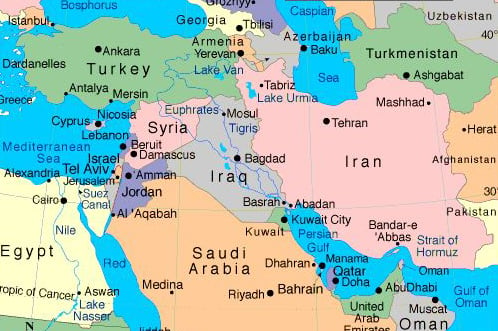
Israel’s aerial strike against Iranian and regime targets in Syria on 10 February reinforces concern that a new front is opening in the Middle East’s many-sided conflicts.The risk of outright confrontation between Israel and Iran has increased, even as Turkey, Russia, Kurdish forces, and the United States are engaged in further action to the north.That so many combatants are involved, with different agendas, means that further escalation is an ever present possibility.

Originally published by Open Democracy here

The details of the Israel-Iran episode show how unsteady the strategic situation now is.

It began when Iranian Revolutionary Guard Corps (IRGC) forces launched a drone from Tiyas airbase, which is about 100 kilometres east of Homs in west-central Syria. The drone was tracked across the Israeli border, then shot down by an Israel airforce (IAF) attack-helicopter. Eight Israeli strike-aircraft retaliated almost at once by destroying the command-centre deep inside Syria.

A Syrian anti-aircraft missile hit one of these F-16 planes as it returned to Israel, seriously injuring one of the crew.

This incident, the first time that the IAF has admitted losing a plane since the large-scale invasion of Lebanon (Operation Peace for Galilee) in 1982, helps explain the decision to launch multiple raids on the Syrian air-defence system.

Even so, these fell short of Israel’s usual policy of massive retaliation against any attack, an approach sometimes explained with reference to Israel being “impregnable in its insecurity”: a regional military superpower that feels surrounded by enemies and thus has to respond with an iron fist (see “Israel’s security trap“, 5 August 2010).

Why, on this occasion, was Israel so (relatively) restrained?

An informed source, cited in the same New York Times article, cites an angry intervention by Vladimir Putin. Israel’s raids were uncomfortably close to Russian forces, was the president’s message to his erstwhile partner, Israeli prime minister Binyamin Netanyahu (see “Putin’s Phone Call With Netanyahu Put End to Israeli Strikes in Syria“, Haaretz, 15 February 2018).

Here, Putin’s wider motive is obvious enough; Russia has benefited greatly from its support for Bashar al-Assad’s regime, but a full-scale war would put all its gains at risk.

Russia clearly wants to avoid a thickening imbroglio in the Middle East. Memories of the Red Army’s grinding war in Afghanistan in the 1980s still loom large. Moscow has also found Crimea and eastern Ukraine an expensive burden, and needs to contain, not expand, its Syrian commitment.

Moreover, Putin must manage his own imminent re-election smoothly while keeping a wary eye on potential triggers of domestic discontent.

A further worry here is that Russia’s casualties in Syria seem to be rising.

In a single example, the Associated Press reports the death of four Russian civilian contractors in a US airstrike which had been mounted to protect anti-Assad Syrian militias from an assault by pro-Assad groups (see Vladimir Isachenkov, “Russian contractors killed by US strike in Syria“, Military Times, 14 February 2018).

Some western outlets claim that the losses of military and contractor personnel run well into the hundreds. Even a more considered Reuters report indicates that at least forty Russians have died in recent months.

Moscow’s strategic calculations in the Middle East will also include intelligence about the swift if mainly hidden expansion of American bases in Iraq, Jordan and especially Syria.

Knowledge of their location stems, remarkably, from the records of a widely available smartphone fitness app used by US military trainers in the region. Jane’s Defence Weekly uses this data to reveal thirteen previously undisclosed bases: two in Syria, four in Iraq, and seven in Jordan (two of which are right on the border with Syria).

Jordan has economic troubles of its own that more than match Russia’s. A decrease in financial support from Gulf states means the authorities are facing a $700 million budget deficit, and have taken the deeply unpopular route of raising taxes on basic foodstuffs, including bread, by 50-100%.

In Israel too, the government’s domestic problems – including legal action against Netanyahu over corruption charges – are an unavoidable element in the regional mess.

A hawkish prime minister might well view a crisis with Iran as an opportunity for diversion. Jordan’s political options are fewer, but its and its people’s voice cannot be discounted.

Such internal dynamics, peripheral to the wider trends as they can seem, may yet have an impact. At present, two more basic realities overshadow them.

One is familiar: the deep Israel-Iran antagonism.

The other is quite new: the degree of penetration of Russian and US forces into the region’s least stable corners. That penetration is now spilling over into fighting that near embroils these forces.

An Iran-Israel conflict that erupts over Syria could quickly spin out of control and turn Moscow and Washington into direct protagonists. By comparison, the incident of 10 February would be a mere skirmish.


Originally published by Open Democracy here

Related Posts

Professor emeritus, TFF Associate Oxford (Special to Informed Comment; Feature) The dam has burst. Netanyahu and his far-right regime have gone too far. Public pressure on politicians in Europe and many other countries has become irresistible, forcing them to change course. Most countries, 147 of the UN’s 193 members, have formally recognized a Palestinian state, and last week, France pledged to do so at the UN meeting in September. Fourteen nations, including Canada, New Zealand and Australia, join France in a push to recognize a Palestinian state. The British Prime Minister Keir Starmer, one of Israel’s staunchest allies who even refused to condemn the Israeli blockade of food, water, medicine and fuel to the Palestinians after the terrible events of 7th October, has buckled under the pressure of public opinion. More than 255 MPs of all parties signed a letter addressed to the prime minister in which they urged him to...
The Gaza People’s Tribunal, at the end of its first public assembly in Sarajevo, issued a Declaration that expresses our commitment to peace and justice for the Palestinian people in their struggle to realize their basic rights, above all their inalienable right to self-determination. We are inviting like-minded friends to read and endorse the Sarajevo Declaration and to share the link with others who might join our solidarity initiative at this critical time. Here is the link to Change.org where you can find the full text of the Declaration and endorser information.
We’ve seen it repeatedly: You invent a pretext based on deliberate lies, fake news, exaggerations or a false flag operation which serves to construct a story that country or leader X is a threat to “us” which legitimates that we do a ‘preemptive’ strike against that – obviously invented – threat to eliminate it. Mainstream media’s task is to propagate the ploy, not to ask questions or reveal the lie. Take Serbia’s ‘genocide’ in Kosovo, Afghanistan’s responsibility for 9/11, Saddam’s possession of nukes in Iraq, Assad’s use of chemical weapons against the Syrians, Gaddafi’s ‘mass murder’ in Bengazi, Russia’s planning to occupy and administer not only Ukraine but also a series of European countries thereafter, Hamas’ attack on Israel – that Israel knew everything about before it happened – and now you have the blatant lie about Iran’s being just about to become a nuclear weapons power. Basic facts about...

Recent Articles

Tony Robinson October 4, 2026 Violence is easy to recognise when someone is being beaten, shot or killed. It becomes more difficult when nobody is holding a weapon. Poverty, discrimination, exploitation and repression can restrict a human life just as effectively, although they do so in very different ways and with very different consequences. Simply adding more categories to an ever-growing list of forms of violence does not really solve the problem. The more interesting question is what all these different situations have in common and why it makes sense to describe them using the same word. Human beings do not simply react to what happens around them. They remember the past, imagine things that do not yet exist, make plans and undertake projects. Workers organise because they imagine different working conditions; people migrate because they imagine another life somewhere else; social movements emerge because people refuse to accept the...
It’s a matter of principles, courage, vision and pulling together – while the militarist world is falling apart… Peter Langille October 3, 2026 “Here, then, is the problem which we present to you, stark and dreadful and inescapable: Shall we put an end to the human race; or shall mankind renounce war?”The Bertrand Russell—Albert Einstein Manifesto, July 9, 1955 ⁕ The forecast for what’s ahead is worrisome. The sharp rise in armed conflicts over the past three years is adding to what was already the highest level in over seventy years. Genocides, which should be prevented are supported. A shared climate emergency that jeopardises survival is ignored. Diverse polls now suggest that people are war-weary, worried and interested in a more effective United Nations. And, there are viable policy options for a more secure world! Yet governments are doubling-down, betting on more war and investing heavily. If current trends persist,...
Johan Galtung 1930-2024October 2015 Published here on October 3, 2026 Let us focus on Civilization for conflict analysis and remedies. Major forms of disorder use violence; war is state organized violence. The most belligerent states are the United States of America and Israel, both with civilization roots. National Evangelism, the US Protestant Christian civilization– more national than evangelical–justifies US warfare as exceptionalism of a people chosen by God, with a manifest destiny to run the world. Orthodox Judaism justifies Israeli warfare to conquer and expand from Nile to Euphrates as a religious right and duty to the Eternal One. The third most belligerent country, the UK, no longer believes it is God-chosen but chosen by the USA; not quite the same but something. But the root cause of global disorder lies in the Occident–with Islam–seeing itself as the single, universal civilization valid for all at all times, all others being...

TFF on Substack

Discover and subscribe to more peace materials on TFF Substack

Most Popular

Tony Robinson October 4, 2026 Violence is easy to recognise when someone is being beaten, shot or killed. It becomes more difficult when nobody is holding a weapon. Poverty, discrimination, exploitation and repression can restrict a human life just as effectively, although they do so in very different ways and with very different consequences. Simply adding more categories to an ever-growing list of forms of violence does not really solve the problem. The more interesting question is what all these different situations have in common and why it makes sense to describe them using the same word. Human beings do not simply react to what happens around them. They remember the past, imagine things that do not yet exist, make plans and undertake projects. Workers organise because they imagine different working conditions; people migrate because they imagine another life somewhere else; social movements emerge because people refuse to accept the...
It’s a matter of principles, courage, vision and pulling together – while the militarist world is falling apart… Peter Langille October 3, 2026 “Here, then, is the problem which we present to you, stark and dreadful and inescapable: Shall we put an end to the human race; or shall mankind renounce war?”The Bertrand Russell—Albert Einstein Manifesto, July 9, 1955 ⁕ The forecast for what’s ahead is worrisome. The sharp rise in armed conflicts over the past three years is adding to what was already the highest level in over seventy years. Genocides, which should be prevented are supported. A shared climate emergency that jeopardises survival is ignored. Diverse polls now suggest that people are war-weary, worried and interested in a more effective United Nations. And, there are viable policy options for a more secure world! Yet governments are doubling-down, betting on more war and investing heavily. If current trends persist,...
Johan Galtung 1930-2024October 2015 Published here on October 3, 2026 Let us focus on Civilization for conflict analysis and remedies. Major forms of disorder use violence; war is state organized violence. The most belligerent states are the United States of America and Israel, both with civilization roots. National Evangelism, the US Protestant Christian civilization– more national than evangelical–justifies US warfare as exceptionalism of a people chosen by God, with a manifest destiny to run the world. Orthodox Judaism justifies Israeli warfare to conquer and expand from Nile to Euphrates as a religious right and duty to the Eternal One. The third most belligerent country, the UK, no longer believes it is God-chosen but chosen by the USA; not quite the same but something. But the root cause of global disorder lies in the Occident–with Islam–seeing itself as the single, universal civilization valid for all at all times, all others being...
Read More
Living-Peace-Sign-Budapest-copy
Tony Robinson October 4, 2026 Violence is easy to recognise when someone is being beaten, shot or killed. It becomes more difficult when nobody is holding a weapon. Poverty, discrimination, exploitation and repression can restrict a human life just as effectively, although they do so in very different ways and with very different consequences. Simply adding more categories to an ever-growing list of forms of violence does not really solve the problem. The more interesting question is what all these different situations have in common and why it makes sense to describe them using the same word. Human beings do not simply react to what happens around them. They remember the past, imagine things that do not yet exist, make plans and undertake projects. Workers organise because they imagine different working conditions; people migrate because they imagine another life somewhere else; social movements emerge because people refuse to accept the...
b54a1f10-8c65-4f0b-9dd5-4abc0a7d04cc_2659x2659
It’s a matter of principles, courage, vision and pulling together – while the militarist world is falling apart… Peter Langille October 3, 2026 “Here, then, is the problem which we present to you, stark and dreadful and inescapable: Shall we put an end to the human race; or shall mankind renounce war?”The Bertrand Russell—Albert Einstein Manifesto, July 9, 1955 ⁕ The forecast for what’s ahead is worrisome. The sharp rise in armed conflicts over the past three years is adding to what was already the highest level in over seventy years. Genocides, which should be prevented are supported. A shared climate emergency that jeopardises survival is ignored. Diverse polls now suggest that people are war-weary, worried and interested in a more effective United Nations. And, there are viable policy options for a more secure world! Yet governments are doubling-down, betting on more war and investing heavily. If current trends persist,...
010
Johan Galtung 1930-2024October 2015 Published here on October 3, 2026 Let us focus on Civilization for conflict analysis and remedies. Major forms of disorder use violence; war is state organized violence. The most belligerent states are the United States of America and Israel, both with civilization roots. National Evangelism, the US Protestant Christian civilization– more national than evangelical–justifies US warfare as exceptionalism of a people chosen by God, with a manifest destiny to run the world. Orthodox Judaism justifies Israeli warfare to conquer and expand from Nile to Euphrates as a religious right and duty to the Eternal One. The third most belligerent country, the UK, no longer believes it is God-chosen but chosen by the USA; not quite the same but something. But the root cause of global disorder lies in the Occident–with Islam–seeing itself as the single, universal civilization valid for all at all times, all others being...
Screenshot 2026-10-02 011738
Jan ObergPhD, director, The Transnational Foundation for Peace and Future Research, TFFLund, Sweden October 2, 2026 This is my full original manuscript. The Chinese Academy of Social Science, CASS, makes two publications out if it. 1. China’s Five-year plan emphasized the capabilities of basic research and original innovation. It is regarded as the goal of the future social development, which, as required, should be significantly enhanced. Can you comment on the importance of original innovation in research and academic study? I believe it is easier to define “original innovation” in the natural sciences than in social sciences. The breaking points of what constitutes something new, or innovative, are not quite as sharp in the latter. But in both fields it is about opening up something that was closed, unseen, unexplored before – making manifest what was earlier latent. Innovations come in many forms and shapes – naming something that was not...
arctic-circle-map
The agreement is catastrophic both because of what it says and what it doesn’t mention. It reduces further the major asset of security policies: Freedom of action. Jan Oberg TFF director September 25, 2026 A couple of hours before the agreement was signed on September 22, 2026, I published the following 13 hypotheses about what it would most likely contain on TFF Substack (in English). I was wrong on only the first point. Contrary to what Trump had written on his Truth Social platform, it does not appear to come into force immediately. In fact, it turned out to be worse than even I had anticipated. After these hypotheses now come a number of reflections in light of what the agreement actually contains, and does not contain, as well as the way in which it has generally been presented by major media outlets and by the public-service broadcaster DR. My...
girl-5894831_1280
Below are TFF-related media mentions, comments, videos and social media posts published elsewhere but not on this homepage. We happen to catch and list only a fraction. Regarding video comments and debates, we recommend that you go to the TFF Video Channel on Substack where many of them are reproduced. Jan Oberg is a contributor to China Daily – 52 million daily clicks – and Global Times, CGTN and CCTV (the national television), China Investment, Xinhua News Agency and several others. Articles and videos on these media very often multiply into countless Chinese (and Western media) that re-post them from these main media. Thanks to The China Academy, his analyses, interviews and comments are frequently posted on YouTube channels such as Thinkers Forum and Wave Media. These videos are often re-posted on Bilibili (China’s YouTube), the China Content Center on TikTok, and on the Chinese edition of TikTok, Douyin.com. This means reaching hundreds of millions of viewers worldwide over a year. While there are too many to catch on all these...



