
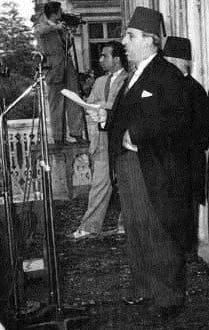
Quwatli declaring Syria’s independence from France, 17 April 1946 (Licensed under the public domain)
June 2, 2022
The United States, with occasional interruptions, has been interfering in the important Middle East nation of Syria for over 70 years, and today there are hundreds of American soldiers still present on Syrian soil. These realities are not well known.
Originally published at Globalresearch
US intrusion in Syrian affairs can be traced to the late 1940s, as outlined in 2016 by the American author Robert F. Kennedy Jr. The CIA, at the behest of Harry Truman’s government in Washington, started to destabilise Syria shortly after the country’s official independence in April 1946.
Kennedy Jr. wrote,
“The CIA began its active meddling in Syria in 1949 – barely a year after the agency’s creation. Syrian patriots had declared war on the Nazis, expelled their Vichy French colonial rulers, and crafted a fragile secularist democracy based on the American model”.
Syria at this time was governed by president Shukri al-Quwatli, a man aged in his 50s who had been elected through a democratic process in August 1943. Quwatli is a founding father of the modern Syrian state, and he is regarded by many Syrians as among the most renowned figures in the country’s 20th century history.
Quwatli had Syria’s interests at heart, and he was well acquainted with the methods of imperial powers. He repeatedly pressed for Syrian independence from its French master, often irritating politicians in France by what they perceived to be Quwatli’s stubbornness and disobedience.
It was inevitable these character traits would annoy the leaders of another major power. This time Quwatli was not dealing with a long-declining colonial state like France, but instead his country’s independence was standing in the way of the geopolitical designs of the world’s strongest country, America.
By the 1930s and 1940s, it was recognised in American political circles that the Middle East was the earth’s richest and most strategically important region, chiefly because it contains vast quantities of oil and gas. The waters beside Syria’s coastline are estimated to hold 122 trillion cubic feet of gas and around 107 billion barrels of oil.
The Truman administration wanted to construct extensive oil infrastructure, called the Trans-Arabian Pipeline, through the US ally and oil dictatorship Saudi Arabia, northwards into Syria and Lebanon. British author James Barr, a Middle East analyst, wrote, “By the fall of 1947, Syria had become as important to the United States as it had been to the Crusaders eight centuries earlier”.
The Trans-Arabian Pipeline was a venture of American corporations like Standard Oil of New Jersey (today ExxonMobil), which in the past had conducted business deals with the fascist regimes in Europe. Also involved in the Trans-Arabian Pipeline was Standard Oil of California (today Chevron) and Texaco (now part of Chevron).
Texaco likewise pursued business operations with the far-right European powers, having for example constructed a large oil refinery in Nazi Germany at the city of Hamburg, which supplied fuel for the Luftwaffe.
The CIA itself had been founded in July 1947. Two months later, in September 1947 a 31-year-old CIA agent named Miles Copeland arrived in the Syrian capital Damascus. He thereafter gathered intelligence details on the country. Copeland was soon joined in Syria by another CIA agent, Stephen Meade.
Much to the Americans’ disapproval, president Quwatli was not keen on sanctioning the US-initiated oil pipeline across Syrian territory. As a consequence it was decided in Washington that he would have to go. The CIA agents in Syria, Copeland and Meade, would perform a central role in ousting Quwatli.
The Truman administration gave its consent to the installation of a military dictatorship in Damascus, led by Brigadier-General Husni al-Zaim, someone who Kennedy Jr. described as “a convicted swindler”.
The CIA officers in Damascus advised and bribed Zaim, who was the chief-of-staff of the Syrian Army. Meade alone met with Zaim on at least 6 occasions, and they spoke about the possibility of an “army supported dictatorship”. Zaim informed Meade that the “only way to start the Syrian people along the road to progress and democracy” is “with the whip”. Bolstered by the CIA, Zaim overthrew Quwatli on 30 March 1949.
Brazilian historian Moniz Bandeira recognised the underlying reason was that the ousted Quwatli “had hesitated in approving the construction of the Trans-Arabian Pipeline, connecting the oil fields of Saudi Arabia to the ports of Lebanon, which the United States wanted to build through Syria”. Syria’s tentative democracy had been quickly smashed with US assistance.
The CIA-engineered overthrow of Quwatli was one of the first covert operations the intelligence service had undertaken. Zaim’s rule in Damascus was a brief and unpopular one, lasting for four and a half months until mid-August 1949.
He was toppled and killed by disloyal military colleagues “with the help of the United States” Bandeira noted. A succession of short-lived and mostly military autocracies reigned in Syria, until the mid-1950s. In an unlikely return Quwatli reassumed power in early September 1955.
Now aged 64, Quwatli chose a foreign policy of non-alignment outside of the American and Soviet camps. With the Cold War between west and east intensifying, Quwatli’s independent strategy bothered the Dwight D. Eisenhower administration. Eisenhower, a famous US Army general who became president in January 1953, described the Middle East two years before as “the most strategically important area of the world”.
For president Eisenhower, the Middle East state of Syria was a valuable piece on the chess board. At this time around 1955 the CIA Director under Eisenhower, Allen Dulles, and his brother the US Secretary of State, John Foster Dulles, began formulating a clandestine war against Arab nationalism; which they conveniently linked with communism, particularly when it threatened US hegemony over foreign oil sources.
Eisenhower and the Dulles brothers already had leading parts in deposing democratic governments in oil rich Iran (August 1953) not far from Syria, and Guatemala (June 1954) in Central America.
Just as Quwatli was returning to power in Damascus, Eisenhower’s regime change policy towards Syria was taking shape. The CIA Director Allen Dulles considered Syria “ripe for a coup”. From 1955, the CIA worked in tandem with Britain’s Secret Intelligence Service (MI6) and also Turkish intelligence. Together these special services colluded with the conservatives of the Syrian Social Nationalist Party, in the hope of removing Quwatli.
On 1 July 1956 the CIA officer Archibald Roosevelt Jr., grandson of former president Theodore Roosevelt, met in Damascus with Wilbur Crane Eveland, a US National Security Council member. Also present at this meeting was an ex-Syrian minister, Michail Bey Ilyan. Displeased with Quwatli’s government, the three men discussed an “anti-communist” takeover of Syria and its biggest cities, such as Damascus, Aleppo and Homs.
On 21 September 1956 – on the pretexts of containing Soviet communism and the influence of Egypt under its new left-wing leader Gamal Abdel Nasser – the Secretary of State John Foster Dulles informed America’s ambassador in Syria, James S. Moose, to continue “to seek means of assisting Western firms which are bidding for the contract for construction of the Syrian national oil refinery, in competition with bids from the Soviet bloc”.
In October 1956, the special services of America, Britain and Turkey gave the green light to what was titled Operation Straggle, a plan to eliminate Quwatli. Secret agents of the Anglo-American-Turkish powers instigated unrest along Syria’s frontiers, which would serve as the pretext for a putsch in Damascus.
The CIA-led Operation Straggle turned into a fiasco. Syria’s head of military intelligence, Colonel Abdel Hamid al-Sarraj, discovered the anti-government plot and arrested the principal Syrian conspirators. A CIA operative, Walter Snowdon, who was also the Second Secretary in the US Embassy in Damascus, was implicated and had to hastily leave Syria. As too did the US military attaché, Colonel Robert W. Molloy.
Operation Straggle was terminated on 29 October 1956, just when the so-called Suez Crisis was erupting nearby to the south-west, as president Nasser of Egypt in following days would get the better of his Western foes.
Undeterred by the setbacks, CIA subversive activities in Syria promptly resumed. In 1957 the CIA dispatched to Syria two of its agents, Howard “Rocky” Stone and Kermit Roosevelt Jr., another grandson of Theodore Roosevelt. Stone and Roosevelt Jr. had helped to organise the previously mentioned coups in Iran (Operation Ajax) and Guatemala (Operation Success), which led to such devastating results for those two countries.
Kennedy Jr. wrote,
“Flush from his Operation Ajax ‘success’ in Iran, Stone arrived in Damascus in April 1957 with $3 million to arm and incite Islamic militants, and to bribe Syrian military officers and politicians to overthrow al-Quwatli’s democratically elected secularist regime”.
Operation Straggle was reconstituted by the Americans under the new codename Operation Wappen. The CIA goals were to gather together right-wing elements in Syria’s officer corps, and bribe them with millions of dollars, along with ex-Syrian politicians exiled in neighbouring Lebanon.
The US Embassy in Damascus was now, however, under constant surveillance by anti-imperialist Syrian Army officers like Colonel Sarraj, who was an admirer of Nasser. Colonel Sarraj had prior knowledge of the coup’s development.
The plan was further denounced by Syrian military personnel who refused to accept bribes to oust Quwatli. Stone, the CIA agent in Damascus, was arrested by Syria’s authorities and on television he confessed to the plot. US Ambassador Moose was expelled from Syria, with his tenure officially ending on 30 June 1957.
Eisenhower was seriously annoyed at this turn of events, as US-Syrian relations hit one of its all time lows in mid-1957. His administration in response sent the US Sixth Fleet to the Mediterranean Sea beside Syria. The Americans were contemplating a military attack against Syria, in order to install a Western-friendly leader.
Eisenhower considered the risks too great in the end. Following the failure of these latter coup attempts in Syria, Bandeira wrote,
“President Dwight Eisenhower and Allen Dulles had no alternative but to accept the defeat. An invasion in Syria could lead to a Soviet intervention in Turkey”.
American suspicions towards Syria did not abate in February 1958, when a union was formed that month between Syria and Egypt, called the United Arab Republic. Yet the alliance lasted for less than 4 years. It was undone on 28 September 1961, as a result of a section of the Syrian military being against subordination to Nasser in Cairo.
Following more instability in Syria and another succession of short-lived regimes, General Hafez-al Assad, tied to the Arab Socialist Ba’ath Party, took power in March 1971. He was the father of the present day Syrian leader. Over ensuing years, General Assad would have a difficult relationship with the US, in part due to his uncompromising stance towards Israel, which Syria shares a southern border with.
At the beginning of his long reign in 1971, General Assad agreed that year to the Soviet Union establishing a naval base in the Syrian city of Tartus, resting on the strategically important Mediterranean Sea. In many ways, Syria is a link between the Middle East and Europe, and the Russians continue to use this vital base of operations at Tartus.
From the 1970s onward, Washington made continued efforts to erode General Assad’s position. There was the 1982 Hama revolt in western Syria, which resulted in a decisive victory for Assad’s Syrian Army.
This blood-soaked rebellion may well have been encouraged by both the US and its NATO ally Turkey, according to Bandeira. The efforts to oust Assad continually floundered; on separate occasions he crushed with an iron fist revolts enacted by the right-wing Muslim Brotherhood.
Ongoing US hostility towards Assad predictably pushed him closer to the Soviet Union. David W. Lesch, an expert in Middle East affairs wrote,
“As a function of its [Syria’s] cold war alliance with the Soviet bloc, and its traditional position as the most vehemently anti-Israeli Arab state, Syria has been perceived by Washington as an implacable foe for most of the period since World War II”.
In October 1980, Syria and the Soviet Union signed a Treaty of Friendship and Co-operation, which was meant to last for 20 years. In November 1982, with the assumption to power of the 68-year-old Russian politician Yuri Andropov, the USSR shipped to Syria advanced missile systems and warned Israel “not to take any military action against Syria”. Russian military aid partly enabled the Syrians to defeat the US Expeditionary Force present in Lebanon.
Originally published at Globalresearch
About the author
Shane Quinn obtained an honors journalism degree. He is interested in writing primarily on foreign affairs, having been inspired by authors like Noam Chomsky. He is a Research Associate of the Centre for Research on Globalization (CRG).
Sources
Robert F. Kennedy Jr., “Why the Arabs Don’t Want Us in Syria”, Politico Magazine, 22 February 2016
James Barr, “Once Upon a Time, America needed Syria”, Foreign Policy, 18 September 2018
Luiz Alberto Moniz Bandeira, The World Disorder: US Hegemony, Proxy Wars, Terrorism and Humanitarian Catastrophes (Springer; 1st ed., 4 Feb. 2019)
Adam Hochschild, “The Untold Story of the Texaco Oil Tycoon Who Loved Fascism”, The Nation, 21 March 2016
Office Of The Historian, Instruction From the Department of State to the Embassy in Syria, 21 September 1956
Luiz Alberto Moniz Bandeira, The Second Cold War: Geopolitics and the Strategic Dimensions of the USA (Springer 1st ed., 23 June 2017)
Olivia B. Waxman, “The U.S. Intervened in Syria in 1949. Here’s What Happened”, Time Magazine, 13 April 2017
David W. Lesch, When the Relationship Went Sour: Syria and the Eisenhower Administration, Presidential Studies Quarterly, Winter 1998, Published by: Wiley, Jstor
Fred H. Lawson, “Karsh, The Soviet Union and Syria”, Middle East Report, March/April 1990
Please help TFF remain truly independent by contributing if you benefited from this article





