

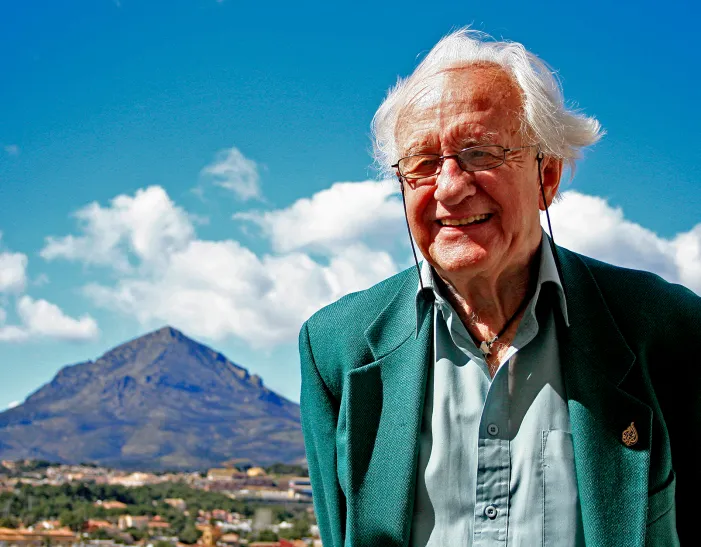
Johan Galtung (1930-2024)
TFF Associate 1985 to his death

June 18, 2025

Johan Galtung wrote this article in 2010, the original here. It is remarkable, bordering on the prophetic, that Galtung already suggested – in section 4 below – what closely resembles China’s and President Xi Jinping’s Belt and Road Initiative (BRI), which was launched in 2013.

With the current regionalization of the world where and even the biggest states will find their place, an East Asian Community of the two Chinas, the two Koreas and the three Japans (with the Ryu Kyu Islands–Okinawa–and an Ainu region both at high autonomy levels), is inevitable.  The European Community-Union got started around steel and coal, ESC; how about starting with the tricky issues, like right now Diaoyu, of the islet clusters and their economic zones in the East Asian Sea? 

An East Asian Sea Authority could declare joint sovereignty, and go beyond joint ventures, exploiting and protecting resources together, the costs and benefits being distributed according to a formula reflecting past uses of the areas.  In Europe the Danube Commission of 1856, with eleven state members and four observers, has served such purposes well, if not unproblematically.  So did the ESCC.

With the expansion of NATO eastward, and the US-Japan Security Treaty de facto westward, with South Korea and Taiwan and deployment patterns for Japan’s SDF, SCO was bound to come.  And bound to expand (currently six members, five observers with Mongolia and Sri Lanka) and a new opening as dialogue partners, gradually filling the gap of a missing Organization for Security and Cooperation in Asia-Pacific. SCO focuses on economic development, and military cooperation in anti-terrorism (China Daily News 11-09-10 reports a chiefs of general staffs of member countries meeting in Almaty); maybe somewhat single mindedly focused on economic development as the key to reducing terrorism. Political and cultural autonomy issues, being ruled by one’s own kind, if not necessarily as an independent country, may be as or more important. And “soft” economic and cultural power can be even harder than military power.

The SCO sees the situation in Afghanistan as a threat to neighboring countries, including China, exporting of terrorism, drugs and criminality; the remedy being development.  With that atrocious war slowly coming to an end, with US withdrawal on the horizon, SCO countries will play a major role in Afghanistan, facilitating more autonomy for all nations within the country, open borders to their co-nationals in neighboring countries, equal development for all nations and for both genders, and peacekeeping (not peace enforcing).  For this SCO might cooperate with the ECO, Economic Cooperation Organization of Turkey, Iran and Pakistan, founded in 1985 (as a successor to the Regional Cooperation for Development 1964-79) to help Afghanistan recover and develop in all regards.  And, how about expanding the China-Kazakhstan railroad, linking Beijing and Ankara-Istanbul through a neutral Afghanistan, having Afghanistan join the world through its SCO-ECO neighbors?

Roughly speaking from 500 to 1500 the trade from China via West Asia to East Africa (Somalia) was the overwhelming part of the world trade volume, Europe being inward-looking, the Atlantic and the Pacific oceans not yet being used.  Considerably more than silk was traded, and the “road” was mainly by the East Asian sea and the Indian Ocean.  The traders were Buddhists in the East and Muslims in the West, till the whole pattern was destroyed by the Portuguese, the English and others, in the name of their kings and companies.  Fortunately, that colonization is over.

How about expanding that “road” for goods, services, people, through Africa, and the Atlantic, to Latin America by road-rail from Dar es-Sala’am to Kinshasa’s port, saving the voyage round South Africa, opening Africa East-West and the world South-South?  Not substituting for the North-South trade established by colonialism, but complementing it?  Weaving the world better together?

The world goes through huge urbanization, and China, bridging dichotomies, is creating urban villages (that one has only 580 houses, for 3,000 inhabitants), combining collective agriculture and land ownership, with a cooperative construction company for building in Beijing and anywhere, with a former cement worker as highly entrepreneurial CEO.  The village also offers houses for retired people and others. Such imaginative bridging is very much needed all over the world, like in a Cuba in search of some kind of “capi-communism”.

In an excellent book with that title, China Society for Human Rights Studies, Beijing 2007, key concerns at individual and global levels are linked creatively.   For a world dialogue all parties should embrace both the civil-political and the economic-social-cultural conventions of 16 December 1966, and look for ways of implementing the third generation of human rights to peace, development and clean environment.  With a focus on the international, not only domestic, violations of human rights.

Academic peace studies in China could build on China’s rich harmony-focused tradition, and the 1954-55 peace pillar of cooperation with all for mutual and equal benefit.  Studies of reconciliation, mediation and peace construction would be enriched by opening for Chinese thought, and vice versa.

China should become better at explaining herself, both in a Western market-growth-democracy-human rights discourse, and in a Chinese discourse of both-and, yin-yang dialectics, distribution and social and world harmony.  An oriental Davos in Hong Kong in dialogue with that Western one; and a global TV, more like multi-angle Al Jazeera than BBC-CNN, would give the world a strong, not abrasive, Chinese voice.  With very much to say that the world in general, and the West in particular, badly need to hear.

Photo Jan Oberg 2024
Related Posts

Photo above: Carl Fredrik Reuterswärd’s Non-Violence outside UN Headquarters in New York. Kirill Levin, CC BY-NC-SA 2. Jan Oberg November 3, 2026 I am happy to be published in Horizons which is produced by the Center for International Relations and Sustainable Development, CIRSD, in Belgrade. My contribution brings out a radical re-thinking of what concepts such as defence, security, deterrence – and peace – may mean if we want to create a more peaceful world. It also summarises a few things I have been working with the last few decades. Please read it here Og her er den på dansk, takket være Johnny Baltzersens lynhurtige oversættelse
UNITE-tillid, DREAM-velstand og andre konstruktive komponenter Normally we publish articles in English here. But this is a translation of a very important TFF document that should reach as many as possible in Denmark since this country’s government has been one of the most hardline in Europe and, up till now at least, has refused to use diplomacy and, instead, spent tremendous sums on arming Ukraine with the express goal of defeating Russia. Thus this – unique – article is in Danish. Vi er Johnny Baltzersen og hans Fælles Sikkerhed – Fælles Fremtid på Substack overmåde taknemmelige for at have oversat og publiceret TFF’s 2025-portfølje for fredsidéer med henblik på Ukraines fremtid. Vi håber den nu kan nå mange flere danskere – som også vil sprede den og skabe debat – nu den danske regerings og folketingspartiernes politik på dette område siden 2022 står nu – forudsigeligt – ved vejs ende....
Jan Oberg TFF director October 28, 2026 Exactly one month has now passed since I published my criticism of the introduction to the special issue on Johan Galtung published by the Journal of Global Security Studies, JoGSS, and of Tor Egil Førland’s chapter about Galtung which serves as a preview to his forthcoming biography of Galtung to be published by PRIO. See the original on The Transnational here and the same article on TFF Substack with many general and critical comments and, in particular, the people who decided to withdraw from the biography project in protest. The special issue itself was extraordinary. It was devoted to the intellectual legacy of one of the founders of peace research and contained a number of strong assessments of his personality, scholarship, intellectual trajectory, and public role. Such assessments are, of course, entirely legitimate. No scholar is beyond criticism, and neither was Johan Galtung....

Recent Articles

Photo above: Carl Fredrik Reuterswärd’s Non-Violence outside UN Headquarters in New York. Kirill Levin, CC BY-NC-SA 2. Jan Oberg November 3, 2026 I am happy to be published in Horizons which is produced by the Center for International Relations and Sustainable Development, CIRSD, in Belgrade. My contribution brings out a radical re-thinking of what concepts such as defence, security, deterrence – and peace – may mean if we want to create a more peaceful world. It also summarises a few things I have been working with the last few decades. Please read it here Og her er den på dansk, takket være Johnny Baltzersens lynhurtige oversættelse
UNITE-tillid, DREAM-velstand og andre konstruktive komponenter Normally we publish articles in English here. But this is a translation of a very important TFF document that should reach as many as possible in Denmark since this country’s government has been one of the most hardline in Europe and, up till now at least, has refused to use diplomacy and, instead, spent tremendous sums on arming Ukraine with the express goal of defeating Russia. Thus this – unique – article is in Danish. Vi er Johnny Baltzersen og hans Fælles Sikkerhed – Fælles Fremtid på Substack overmåde taknemmelige for at have oversat og publiceret TFF’s 2025-portfølje for fredsidéer med henblik på Ukraines fremtid. Vi håber den nu kan nå mange flere danskere – som også vil sprede den og skabe debat – nu den danske regerings og folketingspartiernes politik på dette område siden 2022 står nu – forudsigeligt – ved vejs ende....
Jan Oberg TFF director October 28, 2026 Exactly one month has now passed since I published my criticism of the introduction to the special issue on Johan Galtung published by the Journal of Global Security Studies, JoGSS, and of Tor Egil Førland’s chapter about Galtung which serves as a preview to his forthcoming biography of Galtung to be published by PRIO. See the original on The Transnational here and the same article on TFF Substack with many general and critical comments and, in particular, the people who decided to withdraw from the biography project in protest. The special issue itself was extraordinary. It was devoted to the intellectual legacy of one of the founders of peace research and contained a number of strong assessments of his personality, scholarship, intellectual trajectory, and public role. Such assessments are, of course, entirely legitimate. No scholar is beyond criticism, and neither was Johan Galtung....

TFF on Substack

Discover and subscribe to more peace materials on TFF Substack

Most Popular

Photo above: Carl Fredrik Reuterswärd’s Non-Violence outside UN Headquarters in New York. Kirill Levin, CC BY-NC-SA 2. Jan Oberg November 3, 2026 I am happy to be published in Horizons which is produced by the Center for International Relations and Sustainable Development, CIRSD, in Belgrade. My contribution brings out a radical re-thinking of what concepts such as defence, security, deterrence – and peace – may mean if we want to create a more peaceful world. It also summarises a few things I have been working with the last few decades. Please read it here Og her er den på dansk, takket være Johnny Baltzersens lynhurtige oversættelse
UNITE-tillid, DREAM-velstand og andre konstruktive komponenter Normally we publish articles in English here. But this is a translation of a very important TFF document that should reach as many as possible in Denmark since this country’s government has been one of the most hardline in Europe and, up till now at least, has refused to use diplomacy and, instead, spent tremendous sums on arming Ukraine with the express goal of defeating Russia. Thus this – unique – article is in Danish. Vi er Johnny Baltzersen og hans Fælles Sikkerhed – Fælles Fremtid på Substack overmåde taknemmelige for at have oversat og publiceret TFF’s 2025-portfølje for fredsidéer med henblik på Ukraines fremtid. Vi håber den nu kan nå mange flere danskere – som også vil sprede den og skabe debat – nu den danske regerings og folketingspartiernes politik på dette område siden 2022 står nu – forudsigeligt – ved vejs ende....
Jan Oberg TFF director October 28, 2026 Exactly one month has now passed since I published my criticism of the introduction to the special issue on Johan Galtung published by the Journal of Global Security Studies, JoGSS, and of Tor Egil Førland’s chapter about Galtung which serves as a preview to his forthcoming biography of Galtung to be published by PRIO. See the original on The Transnational here and the same article on TFF Substack with many general and critical comments and, in particular, the people who decided to withdraw from the biography project in protest. The special issue itself was extraordinary. It was devoted to the intellectual legacy of one of the founders of peace research and contained a number of strong assessments of his personality, scholarship, intellectual trajectory, and public role. Such assessments are, of course, entirely legitimate. No scholar is beyond criticism, and neither was Johan Galtung....
Read More
knotted gun
Photo above: Carl Fredrik Reuterswärd’s Non-Violence outside UN Headquarters in New York. Kirill Levin, CC BY-NC-SA 2. Jan Oberg November 3, 2026 I am happy to be published in Horizons which is produced by the Center for International Relations and Sustainable Development, CIRSD, in Belgrade. My contribution brings out a radical re-thinking of what concepts such as defence, security, deterrence – and peace – may mean if we want to create a more peaceful world. It also summarises a few things I have been working with the last few decades. Please read it here Og her er den på dansk, takket være Johnny Baltzersens lynhurtige oversættelse
TFFPortfolioVign
UNITE-tillid, DREAM-velstand og andre konstruktive komponenter Normally we publish articles in English here. But this is a translation of a very important TFF document that should reach as many as possible in Denmark since this country’s government has been one of the most hardline in Europe and, up till now at least, has refused to use diplomacy and, instead, spent tremendous sums on arming Ukraine with the express goal of defeating Russia. Thus this – unique – article is in Danish. Vi er Johnny Baltzersen og hans Fælles Sikkerhed – Fælles Fremtid på Substack overmåde taknemmelige for at have oversat og publiceret TFF’s 2025-portfølje for fredsidéer med henblik på Ukraines fremtid. Vi håber den nu kan nå mange flere danskere – som også vil sprede den og skabe debat – nu den danske regerings og folketingspartiernes politik på dette område siden 2022 står nu – forudsigeligt – ved vejs ende....
JoGSS-Silent
Jan Oberg TFF director October 28, 2026 Exactly one month has now passed since I published my criticism of the introduction to the special issue on Johan Galtung published by the Journal of Global Security Studies, JoGSS, and of Tor Egil Førland’s chapter about Galtung which serves as a preview to his forthcoming biography of Galtung to be published by PRIO. See the original on The Transnational here and the same article on TFF Substack with many general and critical comments and, in particular, the people who decided to withdraw from the biography project in protest. The special issue itself was extraordinary. It was devoted to the intellectual legacy of one of the founders of peace research and contained a number of strong assessments of his personality, scholarship, intellectual trajectory, and public role. Such assessments are, of course, entirely legitimate. No scholar is beyond criticism, and neither was Johan Galtung....
Screenshot 2026-10-26 115647
An aspect of Iran’s culture and civilisation you’ve probably never heard about. Don’t be surprised if the US and Israel also try to bomb them. Jan ObergTFF director October 26, 2026 Today – under the “USraeli” threat of new “annihilating” bombings – opens the 7th International Conference on Peace and Conflict Resolution at Tehran’s University. As far as I can tell, this is the only permanent, advanced peace research institution in West Asia/the Middle East. Perhaps more countries in that region could be inspired? I mean, how many military “security” institutes and military academies do they have? Many peace research institutes and university departments have been established since the 1950s in the West. They are now all under attack; some have closed down, some have gone mainstream, yet others kept the name but do nothing to research peace and disseminate results or advice; instead, they cooperate with militarism’s platforms such...
Screenshot 2026-10-15 141837
Let’s discuss using AI to create peace – in contrast to boring geopolitics devoid of creative healing and visions. Jan Oberg TFF director October 15, 2026 I asked VEED to create a short video exemplifying how peace is preferable to war, then chose the lady as a template. Simple as that. In less than a minute, it produced this video, which any peace-loving person would appreciate. The only problem is that human intelligence (HI), at least the one that exists among Western decision-makers, isn’t half as moral or smart as AI. I have used AI to dialogue about peace and peace plans, creative conflict resolution and visions of a better future for humankind. It so happens that I am having more stimulating, intelligent, creative and moral discussions with AI than I could possibly have with any EU or NATO leader today. Yes, AI has very problematic and dangerous aspects; used...
girl-5894831_1280
Below are TFF-related media mentions, comments, videos and social media posts published elsewhere but not on this homepage. We happen to catch and list only a fraction. Regarding video comments and debates, we recommend that you go to the TFF Video Channel on Substack where many of them are reproduced. Jan Oberg is a contributor to China Daily – 52 million daily clicks – and Global Times, CGTN and CCTV (the national television), China Investment, Xinhua News Agency and several others. Articles and videos on these media very often multiply into countless Chinese (and Western media) that re-post them from these main media. Thanks to The China Academy, his analyses, interviews and comments are frequently posted on YouTube channels such as Thinkers Forum and Wave Media. These videos are often re-posted on Bilibili (China’s YouTube), the China Content Center on TikTok, and on the Chinese edition of TikTok, Douyin.com. This means reaching hundreds of millions of viewers worldwide over a year. While there are too many to catch on all these...





