
SIPRI – “The independent source on global security” – supports NATO with mainly NATO countries’ funding

Jan Oberg

April 23, 2024

When NATO turned 75, the director of SIPRI – formally, Stockholm International Peace Research Institute – Dan Smith wrote this diplomatic wishy-washy essay about the alliance with program director Barbara Kunz who has a past in the US at the German Marshall Fund and in the German Federal Foreign Office’s policy planning unit as an external expert.

The authors discuss the ‘security dilemma,’ deterrence, perceptions, and defence but do not address why NATO can be seen as co-responsible for the present, extremely serious security situation in Europe. Or, if you will, how it is a fiasco in terms of its self-perception as a defensive peace-making alliance.

They do not address NATO’s homepage’s incredibly low intellectual level, which is filled with assertions, postulates, and accusations and is devoid of clear conceptualisations, theories, and analyses. They don’t question NATO’s constant pathetic image of Russia and China – oh, the Taiwan issue! – as enemies.

The authors say that stability is the goal of the international system; it isn’t peace.

They do not problematize NATO’s doctrine of Nuclear First Use or ask themselves what the alliance has achieved concretely.

They firmly believe that NATO does not represent a problem or is outdated. They conclude that it just needs to think a little differently, respect old concepts that worked well and “stay humble.” (!)

The word peace doesn’t appear in their text.

However, according to § 2 of its Statutes, SIPRI shall “conduct scientific research on questions of conflict and cooperation of importance for international peace and security, with the aim of contributing to an understanding of the conditions for peaceful solutions of interstate conflicts and for stable peace.”

Well, that’s hardly what it does when it rubs itself with the Munich Security Conference or when its former Board Chairman, Jan Eliasson, at length describes how he thinks it was right for Sweden to join NATO.

Today, SIPRI contributes nothing to the stated understanding of peaceful solutions. Instead, it promotes the traditional weapons-focused security concepts in general and an understanding of NATOcountry policies in particular.

SIPRI recently stated that “Total global military expenditure reached $2443 billion in 2023, an increase of 6.8 per cent in real terms from 2022…In 2023 the 31 NATO members accounted for $1341 billion, equal to 55 per cent of the world’s military expenditure. Military spending by the USA rose by 2.3 per cent to reach $916 billion in 2023, representing 68 per cent of total NATO military spending.”

But SIPRI’s leaders do not see that as a problem. Smith and Kunz don’t ask why NATO is such a huge overspender relative to the rest of the world.

And here, you find the institute’s clearly pro-NATO markings of the alliance’s 75th anniversary, where you may also take note of Jan Egeland’s absurd argument that alliance membership does not hinder any member from promoting causes it believes are important. Did he ever hear about, say, disarmament, nuclear abolition or confidence building with Russia?

You get the gist. The above-mentioned essay and the SIPRI’s materials presented to mark NATO’s 75th anniversary could hardly be more toothless. They represent neither peace nor free research. They smack of commissioned work within an intellectual “groupthink” thriving inside an echo chamber of political correctness.

The world receives SIPRI’s publications as statistically authoritative, and that is not wrong, many are – such as those on military expenditures and arms trade. However, this type of bean-counting isn’t what SIPRI was originally established to do. And that explains why SIPRI so seldom manages to create debate about the existentially important issues it works with.

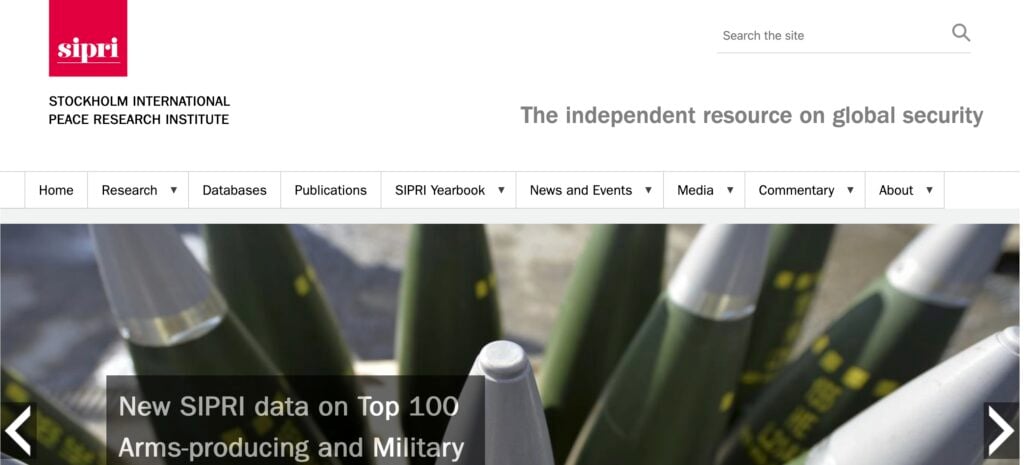
SIPRI now (on top of all its pages) calls itself “The independent resource on global security”—note that SIPRI decades ago was proud of associating itself with the word “peace;” then it became an independent resource on security and peace, and now “peace” has been dropped.

Well, that is at least indicative of some honesty.

Eight years ago, in a scathing critique, I argued that SIPRI was no longer a peace research institute and recommended a name change to Stockholm International Military Security Institute, SIMSI. Everything I wrote back then is worse now.

As mentioned, SIPRI pathetically prides itself on being an independent source of security. The word “independent,” however, is clearly dishonest.

If you look at SIPRI’s funding, virtually 100% comes from NATO members and partners. The largest is Sweden and various institutions, including Uppsala University, but you also notice the governments and various organisations in the EU, Germany, Holland, the UK, USAID, Open Societies Foundation, Japan, and Taiwan.

Ask yourself why all these NATO-related countries support SIPRI. What is in it for them? What would the price for SIPRI to pay if the institute published a series of critical analyses of the basic propensity of our time to use military means no matter what the problem is? If it criticised the world’s larger military consumers and war-fighting countries – that is, NATO? And if it devised imminently possible alternatives to the arms races, sabre-rattling, militarism and, say, NATO’s extremely ill-conceived, tension-increasing expansion against all promises given to Gorbachev and in defiance of all – also Western – experts warnings that that expansion would end us all in a war? And what if it published true conflict-resolution ideas and principles that show, in one conflict after the other, how things could be done differently?

Unthinkable, of course. SIPRI is anything but independent. Its funding is extremely biased.

Over time, SIPRI has become as intellectually boring and politically mainstream as NATO itself – and as quite a few other peace research institutes. The discourse on peace – in research, politics and media – has been disappeared in the maelstrom of contemporary Western militarism.

In such a situation, SIPRI could have stood up like a beacon for international peace through true peace research. Its leadership – and the backing Swedish government – chose not to and must, therefore, be deemed increasingly irrelevant. There are more than enough traditional security research institutes around the world.

If she knew where SIPRI stands today, the founding mother of SIPRI, Alva Myrdal, would likely rotate in her grave because she was a world-renowned woman of peace and vision, a disarmament ambassador, a leader of the international disarmament movement, a social democrat and a recipient of the Nobel Peace Prize. Her vision has been destroyed by the very thinking and forces she devoted her life to reducing – which is also indicative of what has happened to the social democracy that, once upon a time, was oriented towards peace.

Note
There are several ‘schools’ and several partial and comprehensive definitions of the academic discipline of peace and conflict research. However, it is enough for the purpose of this article to convey to the reader that what I imply, grosso modo, is research that aims at understanding how all types of violence can be reduced, and how peace – in the sense of realising the potentials of humans and society – can be promoted. The endeavour is embedded in Article 1 of the UN Charter that ‘peace shall be established by peaceful means.’ You may say that peace research resembles the discipline of medicine very much which can be understood as aiming to reduce diseases and promote positive health. They are clearly goal-oriented and both work with diagnosis, prognosis and treatment.

Peace & future researcher + ‌Art Photographer

Related Posts

Tony Robinson October 4, 2026 Violence is easy to recognise when someone is being beaten, shot or killed. It becomes more difficult when nobody is holding a weapon. Poverty, discrimination, exploitation and repression can restrict a human life just as effectively, although they do so in very different ways and with very different consequences. Simply adding more categories to an ever-growing list of forms of violence does not really solve the problem. The more interesting question is what all these different situations have in common and why it makes sense to describe them using the same word. Human beings do not simply react to what happens around them. They remember the past, imagine things that do not yet exist, make plans and undertake projects. Workers organise because they imagine different working conditions; people migrate because they imagine another life somewhere else; social movements emerge because people refuse to accept the...
It’s a matter of principles, courage, vision and pulling together – while the militarist world is falling apart… Peter Langille October 3, 2026 “Here, then, is the problem which we present to you, stark and dreadful and inescapable: Shall we put an end to the human race; or shall mankind renounce war?”The Bertrand Russell—Albert Einstein Manifesto, July 9, 1955 ⁕ The forecast for what’s ahead is worrisome. The sharp rise in armed conflicts over the past three years is adding to what was already the highest level in over seventy years. Genocides, which should be prevented are supported. A shared climate emergency that jeopardises survival is ignored. Diverse polls now suggest that people are war-weary, worried and interested in a more effective United Nations. And, there are viable policy options for a more secure world! Yet governments are doubling-down, betting on more war and investing heavily. If current trends persist,...
Johan Galtung 1930-2024October 2015 Published here on October 3, 2026 Let us focus on Civilization for conflict analysis and remedies. Major forms of disorder use violence; war is state organized violence. The most belligerent states are the United States of America and Israel, both with civilization roots. National Evangelism, the US Protestant Christian civilization– more national than evangelical–justifies US warfare as exceptionalism of a people chosen by God, with a manifest destiny to run the world. Orthodox Judaism justifies Israeli warfare to conquer and expand from Nile to Euphrates as a religious right and duty to the Eternal One. The third most belligerent country, the UK, no longer believes it is God-chosen but chosen by the USA; not quite the same but something. But the root cause of global disorder lies in the Occident–with Islam–seeing itself as the single, universal civilization valid for all at all times, all others being...

Recent Articles

Tony Robinson October 4, 2026 Violence is easy to recognise when someone is being beaten, shot or killed. It becomes more difficult when nobody is holding a weapon. Poverty, discrimination, exploitation and repression can restrict a human life just as effectively, although they do so in very different ways and with very different consequences. Simply adding more categories to an ever-growing list of forms of violence does not really solve the problem. The more interesting question is what all these different situations have in common and why it makes sense to describe them using the same word. Human beings do not simply react to what happens around them. They remember the past, imagine things that do not yet exist, make plans and undertake projects. Workers organise because they imagine different working conditions; people migrate because they imagine another life somewhere else; social movements emerge because people refuse to accept the...
It’s a matter of principles, courage, vision and pulling together – while the militarist world is falling apart… Peter Langille October 3, 2026 “Here, then, is the problem which we present to you, stark and dreadful and inescapable: Shall we put an end to the human race; or shall mankind renounce war?”The Bertrand Russell—Albert Einstein Manifesto, July 9, 1955 ⁕ The forecast for what’s ahead is worrisome. The sharp rise in armed conflicts over the past three years is adding to what was already the highest level in over seventy years. Genocides, which should be prevented are supported. A shared climate emergency that jeopardises survival is ignored. Diverse polls now suggest that people are war-weary, worried and interested in a more effective United Nations. And, there are viable policy options for a more secure world! Yet governments are doubling-down, betting on more war and investing heavily. If current trends persist,...
Johan Galtung 1930-2024October 2015 Published here on October 3, 2026 Let us focus on Civilization for conflict analysis and remedies. Major forms of disorder use violence; war is state organized violence. The most belligerent states are the United States of America and Israel, both with civilization roots. National Evangelism, the US Protestant Christian civilization– more national than evangelical–justifies US warfare as exceptionalism of a people chosen by God, with a manifest destiny to run the world. Orthodox Judaism justifies Israeli warfare to conquer and expand from Nile to Euphrates as a religious right and duty to the Eternal One. The third most belligerent country, the UK, no longer believes it is God-chosen but chosen by the USA; not quite the same but something. But the root cause of global disorder lies in the Occident–with Islam–seeing itself as the single, universal civilization valid for all at all times, all others being...

TFF on Substack

Discover and subscribe to more peace materials on TFF Substack

Most Popular

Tony Robinson October 4, 2026 Violence is easy to recognise when someone is being beaten, shot or killed. It becomes more difficult when nobody is holding a weapon. Poverty, discrimination, exploitation and repression can restrict a human life just as effectively, although they do so in very different ways and with very different consequences. Simply adding more categories to an ever-growing list of forms of violence does not really solve the problem. The more interesting question is what all these different situations have in common and why it makes sense to describe them using the same word. Human beings do not simply react to what happens around them. They remember the past, imagine things that do not yet exist, make plans and undertake projects. Workers organise because they imagine different working conditions; people migrate because they imagine another life somewhere else; social movements emerge because people refuse to accept the...
It’s a matter of principles, courage, vision and pulling together – while the militarist world is falling apart… Peter Langille October 3, 2026 “Here, then, is the problem which we present to you, stark and dreadful and inescapable: Shall we put an end to the human race; or shall mankind renounce war?”The Bertrand Russell—Albert Einstein Manifesto, July 9, 1955 ⁕ The forecast for what’s ahead is worrisome. The sharp rise in armed conflicts over the past three years is adding to what was already the highest level in over seventy years. Genocides, which should be prevented are supported. A shared climate emergency that jeopardises survival is ignored. Diverse polls now suggest that people are war-weary, worried and interested in a more effective United Nations. And, there are viable policy options for a more secure world! Yet governments are doubling-down, betting on more war and investing heavily. If current trends persist,...
Johan Galtung 1930-2024October 2015 Published here on October 3, 2026 Let us focus on Civilization for conflict analysis and remedies. Major forms of disorder use violence; war is state organized violence. The most belligerent states are the United States of America and Israel, both with civilization roots. National Evangelism, the US Protestant Christian civilization– more national than evangelical–justifies US warfare as exceptionalism of a people chosen by God, with a manifest destiny to run the world. Orthodox Judaism justifies Israeli warfare to conquer and expand from Nile to Euphrates as a religious right and duty to the Eternal One. The third most belligerent country, the UK, no longer believes it is God-chosen but chosen by the USA; not quite the same but something. But the root cause of global disorder lies in the Occident–with Islam–seeing itself as the single, universal civilization valid for all at all times, all others being...
Read More
Living-Peace-Sign-Budapest-copy
Tony Robinson October 4, 2026 Violence is easy to recognise when someone is being beaten, shot or killed. It becomes more difficult when nobody is holding a weapon. Poverty, discrimination, exploitation and repression can restrict a human life just as effectively, although they do so in very different ways and with very different consequences. Simply adding more categories to an ever-growing list of forms of violence does not really solve the problem. The more interesting question is what all these different situations have in common and why it makes sense to describe them using the same word. Human beings do not simply react to what happens around them. They remember the past, imagine things that do not yet exist, make plans and undertake projects. Workers organise because they imagine different working conditions; people migrate because they imagine another life somewhere else; social movements emerge because people refuse to accept the...
b54a1f10-8c65-4f0b-9dd5-4abc0a7d04cc_2659x2659
It’s a matter of principles, courage, vision and pulling together – while the militarist world is falling apart… Peter Langille October 3, 2026 “Here, then, is the problem which we present to you, stark and dreadful and inescapable: Shall we put an end to the human race; or shall mankind renounce war?”The Bertrand Russell—Albert Einstein Manifesto, July 9, 1955 ⁕ The forecast for what’s ahead is worrisome. The sharp rise in armed conflicts over the past three years is adding to what was already the highest level in over seventy years. Genocides, which should be prevented are supported. A shared climate emergency that jeopardises survival is ignored. Diverse polls now suggest that people are war-weary, worried and interested in a more effective United Nations. And, there are viable policy options for a more secure world! Yet governments are doubling-down, betting on more war and investing heavily. If current trends persist,...
010
Johan Galtung 1930-2024October 2015 Published here on October 3, 2026 Let us focus on Civilization for conflict analysis and remedies. Major forms of disorder use violence; war is state organized violence. The most belligerent states are the United States of America and Israel, both with civilization roots. National Evangelism, the US Protestant Christian civilization– more national than evangelical–justifies US warfare as exceptionalism of a people chosen by God, with a manifest destiny to run the world. Orthodox Judaism justifies Israeli warfare to conquer and expand from Nile to Euphrates as a religious right and duty to the Eternal One. The third most belligerent country, the UK, no longer believes it is God-chosen but chosen by the USA; not quite the same but something. But the root cause of global disorder lies in the Occident–with Islam–seeing itself as the single, universal civilization valid for all at all times, all others being...
Screenshot 2026-10-02 011738
Jan ObergPhD, director, The Transnational Foundation for Peace and Future Research, TFFLund, Sweden October 2, 2026 This is my full original manuscript. The Chinese Academy of Social Science, CASS, makes two publications out if it. 1. China’s Five-year plan emphasized the capabilities of basic research and original innovation. It is regarded as the goal of the future social development, which, as required, should be significantly enhanced. Can you comment on the importance of original innovation in research and academic study? I believe it is easier to define “original innovation” in the natural sciences than in social sciences. The breaking points of what constitutes something new, or innovative, are not quite as sharp in the latter. But in both fields it is about opening up something that was closed, unseen, unexplored before – making manifest what was earlier latent. Innovations come in many forms and shapes – naming something that was not...
arctic-circle-map
The agreement is catastrophic both because of what it says and what it doesn’t mention. It reduces further the major asset of security policies: Freedom of action. Jan Oberg TFF director September 25, 2026 A couple of hours before the agreement was signed on September 22, 2026, I published the following 13 hypotheses about what it would most likely contain on TFF Substack (in English). I was wrong on only the first point. Contrary to what Trump had written on his Truth Social platform, it does not appear to come into force immediately. In fact, it turned out to be worse than even I had anticipated. After these hypotheses now come a number of reflections in light of what the agreement actually contains, and does not contain, as well as the way in which it has generally been presented by major media outlets and by the public-service broadcaster DR. My...
girl-5894831_1280
Below are TFF-related media mentions, comments, videos and social media posts published elsewhere but not on this homepage. We happen to catch and list only a fraction. Regarding video comments and debates, we recommend that you go to the TFF Video Channel on Substack where many of them are reproduced. Jan Oberg is a contributor to China Daily – 52 million daily clicks – and Global Times, CGTN and CCTV (the national television), China Investment, Xinhua News Agency and several others. Articles and videos on these media very often multiply into countless Chinese (and Western media) that re-post them from these main media. Thanks to The China Academy, his analyses, interviews and comments are frequently posted on YouTube channels such as Thinkers Forum and Wave Media. These videos are often re-posted on Bilibili (China’s YouTube), the China Content Center on TikTok, and on the Chinese edition of TikTok, Douyin.com. This means reaching hundreds of millions of viewers worldwide over a year. While there are too many to catch on all these...




