
Russia is making its biggest geopolitical shift in 300 years. Here’s how it’s playing out.

Dmitry Trenin is a research professor at the Higher School of Economics and a lead research fellow at the Institute of World Economy and International Relations. He is also a member of the Russian International Affairs Council.

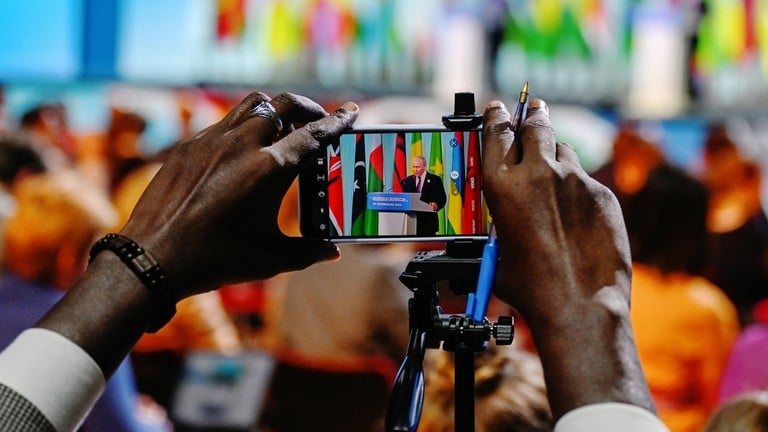
The Russia-Africa summit in St. Petersburg was a landmark event in Moscow’s foreign policy concept and practice. Not so much because it brought scores of African leaders and senior officials to the country. The first summit, four years ago in Sochi, featured even more African heads of state. Also, it is not solely because its agenda expanded beyond economics and included a humanitarian dimension: this is important, but this isn’t all.

Essentially, the meeting, with the bureaucratic preparation and the wide public coverage it has received within Russia, testifies to a sea change in Moscow’s worldview and international positioning toward the world’s rising non-Western majority, as laid down in the recently adopted Foreign Policy Concept.

St. Petersburg was founded by Peter the Great in the early 18th century as a ‘window to Europe,’ and last week, it served the same purpose for Africa.

Eurocentrism, of course, is still deeply embedded in the Russian elite’s thinking and aspirations. Nevertheless, the failure of Russia’s long travails of Western integration in the wake of the demise of the Soviet Union has now exploded into the proxy war against the United States and NATO in Ukraine. This has produced a historic shift in Moscow’s policies, comparable to the time of Peter the Great in its significance, though in a wholly different direction. For the foreseeable future, the universe of Russia’s foreign policy will remain divided in two large parts: the house of foes including Europe, North America, and the rest of the Anglosphere, and the house of friends elsewhere. The dividing line between the two is a country’s position in relation to the sanctions regime against Russia.

Africa, in this regard, is largely on the right side of that divide. 49 nations out of the continent’s 54 were represented in St. Petersburg. True, only 17 of them participated at the top level. No longer a curious and skeptical observer, as during the Sochi summit four years ago, the West this time made a determined effort, advising, cajoling or threatening African leaders against going to Russia and dealing directly with President Putin. As a matter of fact, Western pressure scored some points (the number of top leaders in St. Petersburg was about half of what it was in Sochi), but failed to undercut the event. What was lost in the status of representation was compensated in intensity of interaction. The amount of time Vladimir Putin personally invested in the event – that actually lasted three days rather than two – was impressive and noteable. 

The need to counter Western accusations of Russia’s responsibility for the spike in food prices following Moscow’s withdrawal from the Black Sea grain deal (while conveniently ignoring the fact that promises to Moscow to end the Western blockage of Russia’s agricultural exports were never kept) made the Kremlin go beyond the usual verbal rebuttal. At the summit, Putin not only promised to deliver grain free of charge to five of Africa’s poorest nations, but announced plans to expand commercial shipping and to build logistics by sea and air linking Russia to Africa, create a hub in Africa for Russian trade, and expand Russia’s share of African food imports. As for dealing with Western propaganda, Moscow envisages a major expansion of the Russian media presence on the continent. The idea is that Russians and Africans need to have the means of learning about each other directly, rather than through non-neutral intermediaries in London, Paris, or New York.  

Russia certainly has its work cut out for it. Having abandoned the Soviet Union’s rich legacy in Africa in the early 1990s, Moscow faces strong competition there. Compared to China’s Africa trade ($280 billion), or America’s ($60 billion), Russia’s is a puny $18 billion. However, Moscow can do much better. The summit in St. Petersburg focussed on a number of areas, from food security to healthcare and pharma to nuclear energy and security assistance. Of particular importance is education and IT. Since the early 1960s, Moscow’s Lumumba University has been a flagship for training African professionals in Russia. After the break-up of the Soviet Union, the school lost much of its luster. But this is now changing and the number of stipends for Africans to study in Russia is being tripled, and many Russian universities are encouraged to seek cooperation partners in Africa.

Recently, Russia has made enormous progress in terms of making the Internet available across its vast territory and turning Moscow into one of the of the world’s most advanced metropolitan areas in terms of public Wi-Fi access. This experience is certainly something to share.

Russia’s revived interest in Africa is strategic rather than tactical. It goes way beyond the important but mundane issues of economic, security and technological cooperation. It also reaches beyond the war in Ukraine – which inevitably also came under discussion in St. Petersburg, – allowing Putin to explain his rationale for acting the way he has and lay out his views on the modalities of peace. In more strategic terms, Russian policymakers increasingly see Africa – along with Asia and Latin America – as part of the rising wave that will help replace the current Western-dominated world order with a more diversified construct built around a number of civilizations.

Some Russians claim that they have a continent of friends in Africa. This is largely true as far as popular sentiments are concerned. Indeed, Russia – in contrast to Western countries – is unblemished by colonial and neo-colonial exploitation of the continent. In the 20th century, it actually provided military assistance to a number of national liberation movements, and economically supported many of Africa’s newly-independent states through infrastructure projects. It trained thousands of doctors, engineers, and teachers, yet the political reality is more complex than that. The US and the former colonial powers France, Britain and others – not to forget Germany – see the continent as essentially their market and resource base, and will seek to protect their economic dominance and political influence. They will make Russia’s progress in Africa as difficult as possible. 

Faced with that opposition, Moscow should avoid falling for the temptation of competing with outside powers for spheres of influence. It needs to be guided by its national interest, which lies in expanding all-around cooperation with African partners, as well as by its aspiration to a new, more equitable, non-Western-dominated world order. The second Russia-Africa summit, for all the complexities and complications it has encountered on the road to St. Petersburg, was a success. However, what is more important is the paradigm shift in Russian thinking and actions towards Africa, which is turning formerly “exotic” states into normal and valuable partners.

Related Posts

UNITE-tillid, DREAM-velstand og andre konstruktive komponenter Normally we publish articles in English here. But this is a translation of a very important TFF document that should reach as many as possible in Denmark since this country’s government has been one of the most hardline in Europe and, up till now at least, has refused to use diplomacy and, instead, spent tremendous sums on arming Ukraine with the express goal of defeating Russia. Thus this – unique – article is in Danish. Vi er Johnny Baltzersen og hans Fælles Sikkerhed – Fælles Fremtid på Substack overmåde taknemmelige for at have oversat og publiceret TFF’s 2025-portfølje for fredsidéer med henblik på Ukraines fremtid. Vi håber den nu kan nå mange flere danskere – som også vil sprede den og skabe debat – nu den danske regerings og folketingspartiernes politik på dette område siden 2022 står nu – forudsigeligt – ved vejs ende....
Below are TFF-related media mentions, comments, videos and social media posts published elsewhere but not on this homepage. We happen to catch and list only a fraction. Regarding video comments and debates, we recommend that you go to the TFF Video Channel on Substack where many of them are reproduced. Jan Oberg is a contributor to China Daily – 52 million daily clicks – and Global Times, CGTN and CCTV (the national television), China Investment, Xinhua News Agency and several others. Articles and videos on these media very often multiply into countless Chinese (and Western media) that re-post them from these main media. Thanks to The China Academy, his analyses, interviews and comments are frequently posted on YouTube channels such as Thinkers Forum and Wave Media. These videos are often re-posted on Bilibili (China’s YouTube), the China Content Center on TikTok, and on the Chinese edition of TikTok, Douyin.com. This means reaching hundreds of millions of viewers worldwide over a year. While there are too many to catch on all these...
Small and different + among the 10% most active + 9,000 texts + 150 Associates + 60 000 a day — and a stubborn belief that peace is smarter and must be secured by peaceful means. In 2026, the Transnational Foundation for Peace and Future Research (TFF) turns 40. On Monday, October 5, 2026, a new TFF homepage will go live — a new gateway to more than 9,000 articles, analyses, research papers and other contributions produced over four decades of independent peace research. But this is not simply a new website. For four decades, TFF has worked from a simple conviction: peace is smarter than militarism and can be brought about by peaceful means. This is not merely an aspiration. It is the principle expressed in the UN Charter and the Gandhian tradition that has guided our work from the beginning. TFF is a research-based, independent and people-financed foundation....

Recent Articles

Photo above: Carl Fredrik Reuterswärd’s Non-Violence outside UN Headquarters in New York. Kirill Levin, CC BY-NC-SA 2. Jan Oberg November 3, 2026 I am happy to be published in Horizons which is produced by the Center for International Relations and Sustainable Development, CIRSD, in Belgrade. My contribution brings out a radical re-thinking of what concepts such as defence, security, deterrence – and peace – may mean if we want to create a more peaceful world. It also summarises a few things I have been working with the last few decades. Please read it here Og her er den på dansk, takket være Johnny Baltzersens lynhurtige oversættelse
UNITE-tillid, DREAM-velstand og andre konstruktive komponenter Normally we publish articles in English here. But this is a translation of a very important TFF document that should reach as many as possible in Denmark since this country’s government has been one of the most hardline in Europe and, up till now at least, has refused to use diplomacy and, instead, spent tremendous sums on arming Ukraine with the express goal of defeating Russia. Thus this – unique – article is in Danish. Vi er Johnny Baltzersen og hans Fælles Sikkerhed – Fælles Fremtid på Substack overmåde taknemmelige for at have oversat og publiceret TFF’s 2025-portfølje for fredsidéer med henblik på Ukraines fremtid. Vi håber den nu kan nå mange flere danskere – som også vil sprede den og skabe debat – nu den danske regerings og folketingspartiernes politik på dette område siden 2022 står nu – forudsigeligt – ved vejs ende....
Jan Oberg TFF director October 28, 2026 Exactly one month has now passed since I published my criticism of the introduction to the special issue on Johan Galtung published by the Journal of Global Security Studies, JoGSS, and of Tor Egil Førland’s chapter about Galtung which serves as a preview to his forthcoming biography of Galtung to be published by PRIO. See the original on The Transnational here and the same article on TFF Substack with many general and critical comments and, in particular, the people who decided to withdraw from the biography project in protest. The special issue itself was extraordinary. It was devoted to the intellectual legacy of one of the founders of peace research and contained a number of strong assessments of his personality, scholarship, intellectual trajectory, and public role. Such assessments are, of course, entirely legitimate. No scholar is beyond criticism, and neither was Johan Galtung....

TFF on Substack

Discover and subscribe to more peace materials on TFF Substack

Most Popular

Photo above: Carl Fredrik Reuterswärd’s Non-Violence outside UN Headquarters in New York. Kirill Levin, CC BY-NC-SA 2. Jan Oberg November 3, 2026 I am happy to be published in Horizons which is produced by the Center for International Relations and Sustainable Development, CIRSD, in Belgrade. My contribution brings out a radical re-thinking of what concepts such as defence, security, deterrence – and peace – may mean if we want to create a more peaceful world. It also summarises a few things I have been working with the last few decades. Please read it here Og her er den på dansk, takket være Johnny Baltzersens lynhurtige oversættelse
UNITE-tillid, DREAM-velstand og andre konstruktive komponenter Normally we publish articles in English here. But this is a translation of a very important TFF document that should reach as many as possible in Denmark since this country’s government has been one of the most hardline in Europe and, up till now at least, has refused to use diplomacy and, instead, spent tremendous sums on arming Ukraine with the express goal of defeating Russia. Thus this – unique – article is in Danish. Vi er Johnny Baltzersen og hans Fælles Sikkerhed – Fælles Fremtid på Substack overmåde taknemmelige for at have oversat og publiceret TFF’s 2025-portfølje for fredsidéer med henblik på Ukraines fremtid. Vi håber den nu kan nå mange flere danskere – som også vil sprede den og skabe debat – nu den danske regerings og folketingspartiernes politik på dette område siden 2022 står nu – forudsigeligt – ved vejs ende....
Jan Oberg TFF director October 28, 2026 Exactly one month has now passed since I published my criticism of the introduction to the special issue on Johan Galtung published by the Journal of Global Security Studies, JoGSS, and of Tor Egil Førland’s chapter about Galtung which serves as a preview to his forthcoming biography of Galtung to be published by PRIO. See the original on The Transnational here and the same article on TFF Substack with many general and critical comments and, in particular, the people who decided to withdraw from the biography project in protest. The special issue itself was extraordinary. It was devoted to the intellectual legacy of one of the founders of peace research and contained a number of strong assessments of his personality, scholarship, intellectual trajectory, and public role. Such assessments are, of course, entirely legitimate. No scholar is beyond criticism, and neither was Johan Galtung....
Read More
knotted gun
Photo above: Carl Fredrik Reuterswärd’s Non-Violence outside UN Headquarters in New York. Kirill Levin, CC BY-NC-SA 2. Jan Oberg November 3, 2026 I am happy to be published in Horizons which is produced by the Center for International Relations and Sustainable Development, CIRSD, in Belgrade. My contribution brings out a radical re-thinking of what concepts such as defence, security, deterrence – and peace – may mean if we want to create a more peaceful world. It also summarises a few things I have been working with the last few decades. Please read it here Og her er den på dansk, takket være Johnny Baltzersens lynhurtige oversættelse
TFFPortfolioVign
UNITE-tillid, DREAM-velstand og andre konstruktive komponenter Normally we publish articles in English here. But this is a translation of a very important TFF document that should reach as many as possible in Denmark since this country’s government has been one of the most hardline in Europe and, up till now at least, has refused to use diplomacy and, instead, spent tremendous sums on arming Ukraine with the express goal of defeating Russia. Thus this – unique – article is in Danish. Vi er Johnny Baltzersen og hans Fælles Sikkerhed – Fælles Fremtid på Substack overmåde taknemmelige for at have oversat og publiceret TFF’s 2025-portfølje for fredsidéer med henblik på Ukraines fremtid. Vi håber den nu kan nå mange flere danskere – som også vil sprede den og skabe debat – nu den danske regerings og folketingspartiernes politik på dette område siden 2022 står nu – forudsigeligt – ved vejs ende....
JoGSS-Silent
Jan Oberg TFF director October 28, 2026 Exactly one month has now passed since I published my criticism of the introduction to the special issue on Johan Galtung published by the Journal of Global Security Studies, JoGSS, and of Tor Egil Førland’s chapter about Galtung which serves as a preview to his forthcoming biography of Galtung to be published by PRIO. See the original on The Transnational here and the same article on TFF Substack with many general and critical comments and, in particular, the people who decided to withdraw from the biography project in protest. The special issue itself was extraordinary. It was devoted to the intellectual legacy of one of the founders of peace research and contained a number of strong assessments of his personality, scholarship, intellectual trajectory, and public role. Such assessments are, of course, entirely legitimate. No scholar is beyond criticism, and neither was Johan Galtung....
Screenshot 2026-10-26 115647
An aspect of Iran’s culture and civilisation you’ve probably never heard about. Don’t be surprised if the US and Israel also try to bomb them. Jan ObergTFF director October 26, 2026 Today – under the “USraeli” threat of new “annihilating” bombings – opens the 7th International Conference on Peace and Conflict Resolution at Tehran’s University. As far as I can tell, this is the only permanent, advanced peace research institution in West Asia/the Middle East. Perhaps more countries in that region could be inspired? I mean, how many military “security” institutes and military academies do they have? Many peace research institutes and university departments have been established since the 1950s in the West. They are now all under attack; some have closed down, some have gone mainstream, yet others kept the name but do nothing to research peace and disseminate results or advice; instead, they cooperate with militarism’s platforms such...
Screenshot 2026-10-15 141837
Let’s discuss using AI to create peace – in contrast to boring geopolitics devoid of creative healing and visions. Jan Oberg TFF director October 15, 2026 I asked VEED to create a short video exemplifying how peace is preferable to war, then chose the lady as a template. Simple as that. In less than a minute, it produced this video, which any peace-loving person would appreciate. The only problem is that human intelligence (HI), at least the one that exists among Western decision-makers, isn’t half as moral or smart as AI. I have used AI to dialogue about peace and peace plans, creative conflict resolution and visions of a better future for humankind. It so happens that I am having more stimulating, intelligent, creative and moral discussions with AI than I could possibly have with any EU or NATO leader today. Yes, AI has very problematic and dangerous aspects; used...
girl-5894831_1280
Below are TFF-related media mentions, comments, videos and social media posts published elsewhere but not on this homepage. We happen to catch and list only a fraction. Regarding video comments and debates, we recommend that you go to the TFF Video Channel on Substack where many of them are reproduced. Jan Oberg is a contributor to China Daily – 52 million daily clicks – and Global Times, CGTN and CCTV (the national television), China Investment, Xinhua News Agency and several others. Articles and videos on these media very often multiply into countless Chinese (and Western media) that re-post them from these main media. Thanks to The China Academy, his analyses, interviews and comments are frequently posted on YouTube channels such as Thinkers Forum and Wave Media. These videos are often re-posted on Bilibili (China’s YouTube), the China Content Center on TikTok, and on the Chinese edition of TikTok, Douyin.com. This means reaching hundreds of millions of viewers worldwide over a year. While there are too many to catch on all these...




