
Russia and China tell Biden: The old days are over

In separate incidents, Moscow and Beijing sent a strong message that they will not tolerate being told what to do or how to behave

Tony Kevin

April 26, 2021

The past week has marked a watershed moment in Russia’s relations with the West – and the US in particular. In two dramatic, televised moments, US President Joe Biden and Russian President Vladimir Putin changed the dynamics between their countries, perhaps irrevocably.

Originally posted on Asia Times on March 26, 2021

Most commentators in the West have focused on Putin’s “trolling” of Biden by dryly – though, according to Putin, unironically – wishing his American counterpart “good health.” This, of course, came after Biden called Putin a “killer.”

But a more careful and complete reading of Putin’s message to the US is necessary to understand how a Russian leader is, finally, ready to tell the US: Do not judge us by your claimed standards, and do not try to tell us what to do.

Putin has never asserted these propositions so bluntly. And it matters when he does.

Putin’s message to Biden

The tense test of strength began when Biden was asked about Putin in an interview with ABC News’ George Stephanopoulos and agreed he was “a killer” and didn’t have a soul. He also said Putin will “pay a price” for his actions.

Putin then took the unusual step of going on the state broadcaster VGTRK with a prepared five-minute statement in response to Biden.

In an unusually pointed manner, Putin recalled the US history of genocide of its indigenous people, the cruel experience of slavery, the continuing repression of black Americans today and the unprovoked US nuclear bombing of Hiroshima and Nagasaki in World War II.

He suggested states should not judge others by their own standards: “Whatever you say about others is what you are yourself.”

Some American journalists and observers have reacted to this as “trolling.” It was not.

It was the preamble to Putin’s most important message in years to what he called the American “establishment, the ruling class.” He said the US leadership is determined to have relations with Russia, but only “on its own terms.”
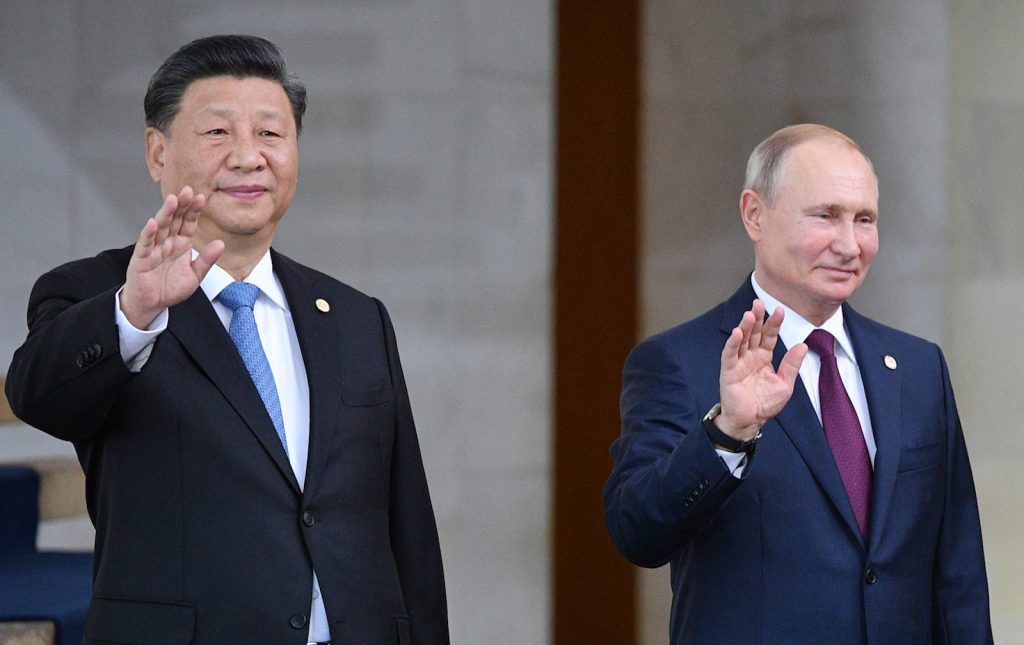
Chinese President Xi Jinping and Russian President Vladimir Putin pose for a family photo at the 11th BRICS leaders summit in Brasilia, Brazil, in 2019. The two countries both reject America’s claimed right to set the rules for the ‘world order.’ Photo: Ramil Sitdikov / Sputnik

“Although they think that we are the same as they are, we are different people. We have a different genetic, cultural and moral code. But we know how to defend our own interests.

“And we will work with them, but in those areas in which we ourselves are interested, and on those conditions that we consider beneficial for ourselves. And they will have to reckon with it. They will have to reckon with this, despite all attempts to stop our development. Despite the sanctions, insults, they will have to reckon with this.”

This is new for Putin. He has for years made the point, always politely, that Western powers need to deal with Russia on a basis of correct diplomatic protocols and mutual respect for national sovereignty, if they want to ease tensions.

But never before has he been as blunt as this, saying in effect: Do not dare try to judge us or punish us for not meeting what you say are universal standards, because we are different from you. Those days are now over.

China pushing back too

Putin’s forceful statement is remarkably similar to the equally firm public statements made by senior Chinese diplomats to US Secretary of State Antony Blinken in Alaska last week.

Blinken opened the meeting by lambasting China’s increasing authoritarianism and aggressiveness at home and abroad – in Tibet, Xinjiang, Hong Kong and the South China Sea. He claimed such conduct was threatening “the rules-based order that maintains global stability.”

Yang Jiechi, the Communist Party of China’s foreign-affairs chief, responded by denouncing American hypocrisy. He said:

“The US does not have the qualification to say that it wants to speak to China from a position of strength. The US uses its military force and financial hegemony to carry out long-arm jurisdiction and suppress other countries. It abuses so-called notions of national security to obstruct normal trade exchanges, and to incite some countries to attack China.”

He said the US had no right to push its own version of democracy when it was dealing with so much discontent and human-rights problems at home.

Russia, China drawing closer together

Putin’s statement was given added weight by two diplomatic actions: Russia’s recalling of its ambassador in the US, and Foreign Minister Sergey Lavrov’s meeting in China with his counterpart, Wang Yi.

Beijing and Moscow agreed at the summit to stand firm against Western sanctions and boost ties between their countries to reduce their dependence on the US dollar in international trade and settlements. Lavrov also said: “We both believe the US has a destabilizing role. It relies on Cold War military alliances and is trying to set up new alliances to undermine the world order.”

Though Biden’s undiplomatic comments about Putin may have been unscripted, the impact has nonetheless been profound. Together with the harsh tone of the US-China foreign ministers’ meeting in Alaska – also provoked by the US side – it is clear there has been a major change in the atmosphere of US-China-Russia relations.

What will this mean in practice? Both Russia and China are signaling they will only deal with the West where and when it suits them. Sanctions no longer worry them.

The two powers are also showing they are increasingly comfortable working together as close partners, if not yet military allies. They will step up their cooperation in areas where they have mutual interests and the development of alternatives to the Western-dominated trade and payments systems.

Countries in Asia and further afield are closely watching the development of this alternative international order, led by Moscow and Beijing. And they can also recognize the signs of increasing US economic and political decline.

It is a new kind of Cold War, but not one based on ideology like the first incarnation. It is a war for international legitimacy, a struggle for hearts and minds and money in the very large part of the world not aligned to the US or the North Atlantic Treaty Organization.

The US and its allies will continue to operate under their narrative, while Russia and China will push their competing narrative. This was made crystal clear over these past few dramatic days of major-power diplomacy.

The global balance of power is shifting, and for many nations, the smart money might be on Russia and China now.

We bring you high-quality analyses and documents like this on a permanent basis. Why not appreciate TFF’s true independence and productivity by contributing if you benefited from this article? Thanks.

Tony Kevin is an Emeritus Fellow at the Australian National University. He was a professional Australian diplomat from 1968-98, and was ambassador to Poland 1991-94 and to Cambodia 1994-97


Related Posts

Photo above: Carl Fredrik Reuterswärd’s Non-Violence outside UN Headquarters in New York. Kirill Levin, CC BY-NC-SA 2. Jan Oberg November 3, 2026 I am happy to be published in Horizons which is produced by the Center for International Relations and Sustainable Development, CIRSD, in Belgrade. My contribution brings out a radical re-thinking of what concepts such as defence, security, deterrence – and peace – may mean if we want to create a more peaceful world. It also summarises a few things I have been working with the last few decades. Please read it here Og her er den på dansk, takket være Johnny Baltzersens lynhurtige oversættelse
UNITE-tillid, DREAM-velstand og andre konstruktive komponenter Normally we publish articles in English here. But this is a translation of a very important TFF document that should reach as many as possible in Denmark since this country’s government has been one of the most hardline in Europe and, up till now at least, has refused to use diplomacy and, instead, spent tremendous sums on arming Ukraine with the express goal of defeating Russia. Thus this – unique – article is in Danish. Vi er Johnny Baltzersen og hans Fælles Sikkerhed – Fælles Fremtid på Substack overmåde taknemmelige for at have oversat og publiceret TFF’s 2025-portfølje for fredsidéer med henblik på Ukraines fremtid. Vi håber den nu kan nå mange flere danskere – som også vil sprede den og skabe debat – nu den danske regerings og folketingspartiernes politik på dette område siden 2022 står nu – forudsigeligt – ved vejs ende....
Johan Galtung 1930-2024October 2015 Published here on October 3, 2026 Let us focus on Civilization for conflict analysis and remedies. Major forms of disorder use violence; war is state organized violence. The most belligerent states are the United States of America and Israel, both with civilization roots. National Evangelism, the US Protestant Christian civilization– more national than evangelical–justifies US warfare as exceptionalism of a people chosen by God, with a manifest destiny to run the world. Orthodox Judaism justifies Israeli warfare to conquer and expand from Nile to Euphrates as a religious right and duty to the Eternal One. The third most belligerent country, the UK, no longer believes it is God-chosen but chosen by the USA; not quite the same but something. But the root cause of global disorder lies in the Occident–with Islam–seeing itself as the single, universal civilization valid for all at all times, all others being...

Recent Articles

Photo above: Carl Fredrik Reuterswärd’s Non-Violence outside UN Headquarters in New York. Kirill Levin, CC BY-NC-SA 2. Jan Oberg November 3, 2026 I am happy to be published in Horizons which is produced by the Center for International Relations and Sustainable Development, CIRSD, in Belgrade. My contribution brings out a radical re-thinking of what concepts such as defence, security, deterrence – and peace – may mean if we want to create a more peaceful world. It also summarises a few things I have been working with the last few decades. Please read it here Og her er den på dansk, takket være Johnny Baltzersens lynhurtige oversættelse
UNITE-tillid, DREAM-velstand og andre konstruktive komponenter Normally we publish articles in English here. But this is a translation of a very important TFF document that should reach as many as possible in Denmark since this country’s government has been one of the most hardline in Europe and, up till now at least, has refused to use diplomacy and, instead, spent tremendous sums on arming Ukraine with the express goal of defeating Russia. Thus this – unique – article is in Danish. Vi er Johnny Baltzersen og hans Fælles Sikkerhed – Fælles Fremtid på Substack overmåde taknemmelige for at have oversat og publiceret TFF’s 2025-portfølje for fredsidéer med henblik på Ukraines fremtid. Vi håber den nu kan nå mange flere danskere – som også vil sprede den og skabe debat – nu den danske regerings og folketingspartiernes politik på dette område siden 2022 står nu – forudsigeligt – ved vejs ende....
Jan Oberg TFF director October 28, 2026 Exactly one month has now passed since I published my criticism of the introduction to the special issue on Johan Galtung published by the Journal of Global Security Studies, JoGSS, and of Tor Egil Førland’s chapter about Galtung which serves as a preview to his forthcoming biography of Galtung to be published by PRIO. See the original on The Transnational here and the same article on TFF Substack with many general and critical comments and, in particular, the people who decided to withdraw from the biography project in protest. The special issue itself was extraordinary. It was devoted to the intellectual legacy of one of the founders of peace research and contained a number of strong assessments of his personality, scholarship, intellectual trajectory, and public role. Such assessments are, of course, entirely legitimate. No scholar is beyond criticism, and neither was Johan Galtung....

TFF on Substack

Discover and subscribe to more peace materials on TFF Substack

Most Popular

Photo above: Carl Fredrik Reuterswärd’s Non-Violence outside UN Headquarters in New York. Kirill Levin, CC BY-NC-SA 2. Jan Oberg November 3, 2026 I am happy to be published in Horizons which is produced by the Center for International Relations and Sustainable Development, CIRSD, in Belgrade. My contribution brings out a radical re-thinking of what concepts such as defence, security, deterrence – and peace – may mean if we want to create a more peaceful world. It also summarises a few things I have been working with the last few decades. Please read it here Og her er den på dansk, takket være Johnny Baltzersens lynhurtige oversættelse
UNITE-tillid, DREAM-velstand og andre konstruktive komponenter Normally we publish articles in English here. But this is a translation of a very important TFF document that should reach as many as possible in Denmark since this country’s government has been one of the most hardline in Europe and, up till now at least, has refused to use diplomacy and, instead, spent tremendous sums on arming Ukraine with the express goal of defeating Russia. Thus this – unique – article is in Danish. Vi er Johnny Baltzersen og hans Fælles Sikkerhed – Fælles Fremtid på Substack overmåde taknemmelige for at have oversat og publiceret TFF’s 2025-portfølje for fredsidéer med henblik på Ukraines fremtid. Vi håber den nu kan nå mange flere danskere – som også vil sprede den og skabe debat – nu den danske regerings og folketingspartiernes politik på dette område siden 2022 står nu – forudsigeligt – ved vejs ende....
Jan Oberg TFF director October 28, 2026 Exactly one month has now passed since I published my criticism of the introduction to the special issue on Johan Galtung published by the Journal of Global Security Studies, JoGSS, and of Tor Egil Førland’s chapter about Galtung which serves as a preview to his forthcoming biography of Galtung to be published by PRIO. See the original on The Transnational here and the same article on TFF Substack with many general and critical comments and, in particular, the people who decided to withdraw from the biography project in protest. The special issue itself was extraordinary. It was devoted to the intellectual legacy of one of the founders of peace research and contained a number of strong assessments of his personality, scholarship, intellectual trajectory, and public role. Such assessments are, of course, entirely legitimate. No scholar is beyond criticism, and neither was Johan Galtung....
Read More
knotted gun
Photo above: Carl Fredrik Reuterswärd’s Non-Violence outside UN Headquarters in New York. Kirill Levin, CC BY-NC-SA 2. Jan Oberg November 3, 2026 I am happy to be published in Horizons which is produced by the Center for International Relations and Sustainable Development, CIRSD, in Belgrade. My contribution brings out a radical re-thinking of what concepts such as defence, security, deterrence – and peace – may mean if we want to create a more peaceful world. It also summarises a few things I have been working with the last few decades. Please read it here Og her er den på dansk, takket være Johnny Baltzersens lynhurtige oversættelse
TFFPortfolioVign
UNITE-tillid, DREAM-velstand og andre konstruktive komponenter Normally we publish articles in English here. But this is a translation of a very important TFF document that should reach as many as possible in Denmark since this country’s government has been one of the most hardline in Europe and, up till now at least, has refused to use diplomacy and, instead, spent tremendous sums on arming Ukraine with the express goal of defeating Russia. Thus this – unique – article is in Danish. Vi er Johnny Baltzersen og hans Fælles Sikkerhed – Fælles Fremtid på Substack overmåde taknemmelige for at have oversat og publiceret TFF’s 2025-portfølje for fredsidéer med henblik på Ukraines fremtid. Vi håber den nu kan nå mange flere danskere – som også vil sprede den og skabe debat – nu den danske regerings og folketingspartiernes politik på dette område siden 2022 står nu – forudsigeligt – ved vejs ende....
JoGSS-Silent
Jan Oberg TFF director October 28, 2026 Exactly one month has now passed since I published my criticism of the introduction to the special issue on Johan Galtung published by the Journal of Global Security Studies, JoGSS, and of Tor Egil Førland’s chapter about Galtung which serves as a preview to his forthcoming biography of Galtung to be published by PRIO. See the original on The Transnational here and the same article on TFF Substack with many general and critical comments and, in particular, the people who decided to withdraw from the biography project in protest. The special issue itself was extraordinary. It was devoted to the intellectual legacy of one of the founders of peace research and contained a number of strong assessments of his personality, scholarship, intellectual trajectory, and public role. Such assessments are, of course, entirely legitimate. No scholar is beyond criticism, and neither was Johan Galtung....
Screenshot 2026-10-26 115647
An aspect of Iran’s culture and civilisation you’ve probably never heard about. Don’t be surprised if the US and Israel also try to bomb them. Jan ObergTFF director October 26, 2026 Today – under the “USraeli” threat of new “annihilating” bombings – opens the 7th International Conference on Peace and Conflict Resolution at Tehran’s University. As far as I can tell, this is the only permanent, advanced peace research institution in West Asia/the Middle East. Perhaps more countries in that region could be inspired? I mean, how many military “security” institutes and military academies do they have? Many peace research institutes and university departments have been established since the 1950s in the West. They are now all under attack; some have closed down, some have gone mainstream, yet others kept the name but do nothing to research peace and disseminate results or advice; instead, they cooperate with militarism’s platforms such...
Screenshot 2026-10-15 141837
Let’s discuss using AI to create peace – in contrast to boring geopolitics devoid of creative healing and visions. Jan Oberg TFF director October 15, 2026 I asked VEED to create a short video exemplifying how peace is preferable to war, then chose the lady as a template. Simple as that. In less than a minute, it produced this video, which any peace-loving person would appreciate. The only problem is that human intelligence (HI), at least the one that exists among Western decision-makers, isn’t half as moral or smart as AI. I have used AI to dialogue about peace and peace plans, creative conflict resolution and visions of a better future for humankind. It so happens that I am having more stimulating, intelligent, creative and moral discussions with AI than I could possibly have with any EU or NATO leader today. Yes, AI has very problematic and dangerous aspects; used...
girl-5894831_1280
Below are TFF-related media mentions, comments, videos and social media posts published elsewhere but not on this homepage. We happen to catch and list only a fraction. Regarding video comments and debates, we recommend that you go to the TFF Video Channel on Substack where many of them are reproduced. Jan Oberg is a contributor to China Daily – 52 million daily clicks – and Global Times, CGTN and CCTV (the national television), China Investment, Xinhua News Agency and several others. Articles and videos on these media very often multiply into countless Chinese (and Western media) that re-post them from these main media. Thanks to The China Academy, his analyses, interviews and comments are frequently posted on YouTube channels such as Thinkers Forum and Wave Media. These videos are often re-posted on Bilibili (China’s YouTube), the China Content Center on TikTok, and on the Chinese edition of TikTok, Douyin.com. This means reaching hundreds of millions of viewers worldwide over a year. While there are too many to catch on all these...



