
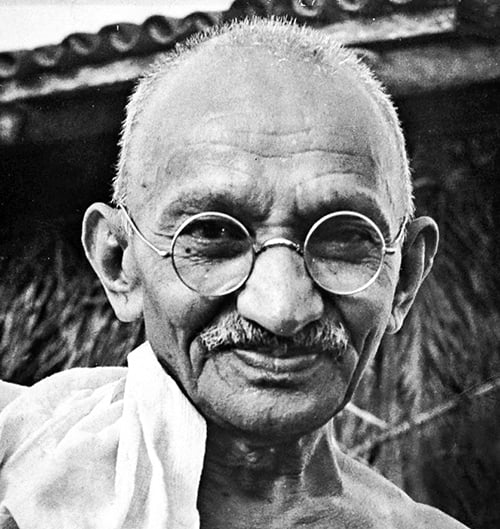

Recalling Gandhi’s Vision of Freedom and Liberty as Creating an Inclusive, Plural, Tolerant India with a Sense of Humour!

 People’s Union For Civil Liberties

May 16, 2021

On 30th January, 2021, we marked the 73rd anniversary of the very date when Mahatma Gandhi was assassinated by someone who did not share his vision of an inclusive and plural India. The PUCL – People’s Union for Civil Liberties – would like to mark this important date by remembering the values which Gandhiji stood for which are under threat today.

We want to remember a Gandhiji which the current establishment would rather forget, namely someone who was deeply committed to the ideal of ‘political freedom’ which was not just ‘freedom from the British’ but a commitment to fundamental values and principles.

For Gandhiji, “Civil liberties consistent with the observance of non-violence are the first step towards Swaraj. It is the breath of political and social life. It is the foundation of freedom. There is no room there for dilution or compromise. It is the water of life”.

Originally published at Countercurrents.org

It is this commitment to civil liberties which we need to uphold in the contemporary context. An essential dimension of civil liberties is the freedom of speech, expression and association- all of which are under attack today. We live in an egg shell democracy where ‘hurt sentiments of a community’ as well as state intolerance of criticism are reasons to shut down speech.

The words of Gandhiji give us a sense of moral clarity on how we should approach this question of a state and community quick to take offence to speech they consider ‘offensive’ or ‘seditious’. As Gandhiji put it:

“Liberty of speech means that it is unassailed even when the speech hurts; liberty of the press can be said to be truly respected only when the press can comment in the severest terms upon and even misrepresent matters…. Freedom of association is truly respected when assemblies of people can discuss even revolutionary projects”.

This commitment to speech as form of truth telling to the state, where the individual lays bare the injustices of the state is best seen in the famous Ahmedabad trial when Gandhiji was prosecuted for sedition.

Gandiji had written a series of articles lambasting the colonial state making the case that, ‘We are challenging the might of this Government because we consider its activity to be wholly evil. We want to overthrow the Government. We want to compel its submission to the peoples will. We desire to show that the Government exists to serve the people, not the people the government”.

For this writing Gandhiji was prosecuted under Sec. 124-A IPC, for sedition, which under law is ‘exciting disaffection against the state’. Gandhiji’s response in Court was to plead guilty and make a statement which challenges the sedition law under which he was prosecuted. He says:

“Section 124-A under which I am happily charged is perhaps the prince among the political sections of the Indian Penal Code designed to suppress the liberty of the citizen. Affection cannot be manufactured or regulated by law. If one has no affection for a person or system, one should be free to give the fullest expression to his disaffection, so long as he does not contemplate, promote or incite violence… But I hold it to be a virtue to be disaffected towards a Government which in its totality had done more harm to India than any previous system”.

One hopes that the message of Gandhiji resonates far and wide, reaching the ears of those in power that ‘affection cannot be manufactured by law’ and that if the citizen has ‘no affection’ towards the state, she must be free to give vent to that ‘disaffection’ as long the expression is non-violent.

Another aspect of Gandhiji we wish to remember is that when the British enacted the Rowlatt Act which authorized preventive detention and denied detainees the right to legal representation, Gandhiji was outraged. He began the nationwide civil disobedience movement to repeal the draconian Rowlatt Act as according to Gandhiji the state had no right to lock up its opponents without trial and without legal representation.

Today we have in place a law which in every way parallels the Rowlatt Act, namely the Unlawful Activities Prevention Act (UAPA). The state has used it as a tool to detain its critics as seen by the arbitrary and malicious arrest of sixteen human rights activists in the Bhima Koregaon incident as well as the continued detention of the constitutionally minded and democratically committed anti-CAA activists as well as human rights activists in all parts of the country including Kashmir.

The state has more recently invoked these provisions against the farmers who are protesting against the farm laws as well. In short, the message is clear. Opponents of the state will be targeted with the draconian UAPA.

Those arrested have not been released on bail and some of them have spent over two years and more in jail. Remembering Gandhiji today is to commit ourselves to fighting against this unjust law and demanding `repeal of the UAPA’ and the release of those unjustly incarcerated.

Finally, in remembering Gandhiji we would not like to forget that Gandhiji was not just a brave freedom fighter with an indomitable commitment to the basic freedoms which define what it is to be human, namely the freedom to think, the freedom to protest and the freedom to worship, but also a human being with an impish sense of humour.

Sarojini Naidu jokingly called him ‘Mickey Mouse’ because of the way his ears stuck out and he himself was not averse to cracking jokes. When he met King George V and a reporter reputedly asked him why he had so little clothes on, Gandhi is said to have remarked, ‘The King has enough clothes on for both of us’.

Why we would like to remember the mischievous Gandhiji especially today is because, Munawar Farooqui, a young comedian from Gandhiji’s own state, languishes in jail because he dares to crack jokes at the current political establishment.

Ironically Munawar was arrested by the MP police for a comedy programme which did not even take place! The dark tragedy of the police abuse of law is mirrored by the High Court refusal of bail on the ground that no one can be permitted to offend religious sentiments, unmindful of the fact that the alleged offensive statements had not been made.

It is a sad commentary of our democracy that today comedians of all stripes and hues find themselves under unprecedented attack as the state has lost its sense of humour and comedy is criminalised.

We would like to commemorate the values Gandhi stood for by demanding that the state

· Repeal the UAPA

· Release all those falsely arrested under UAPA

· Stop using UAPA as a tool of harassment

· Respect the constitutional right to freedom of speech and expression

· Develop a sense of humour


Dr. V. Suresh, General Secretary, PUCL &
On behalf of PUCL, #StandWithStan and over a hundred organizations and #REPEALUAPA

More about Dr. V. Suresh here.

Originally published at Countercurrents.org

Please help TFF remain truly independent by contributing if you benefited from this article

Related Posts

Tony Robinson October 4, 2026 Violence is easy to recognise when someone is being beaten, shot or killed. It becomes more difficult when nobody is holding a weapon. Poverty, discrimination, exploitation and repression can restrict a human life just as effectively, although they do so in very different ways and with very different consequences. Simply adding more categories to an ever-growing list of forms of violence does not really solve the problem. The more interesting question is what all these different situations have in common and why it makes sense to describe them using the same word. Human beings do not simply react to what happens around them. They remember the past, imagine things that do not yet exist, make plans and undertake projects. Workers organise because they imagine different working conditions; people migrate because they imagine another life somewhere else; social movements emerge because people refuse to accept the...
It’s a matter of principles, courage, vision and pulling together – while the militarist world is falling apart… Peter Langille October 3, 2026 “Here, then, is the problem which we present to you, stark and dreadful and inescapable: Shall we put an end to the human race; or shall mankind renounce war?”The Bertrand Russell—Albert Einstein Manifesto, July 9, 1955 ⁕ The forecast for what’s ahead is worrisome. The sharp rise in armed conflicts over the past three years is adding to what was already the highest level in over seventy years. Genocides, which should be prevented are supported. A shared climate emergency that jeopardises survival is ignored. Diverse polls now suggest that people are war-weary, worried and interested in a more effective United Nations. And, there are viable policy options for a more secure world! Yet governments are doubling-down, betting on more war and investing heavily. If current trends persist,...
Johan Galtung 1930-2024October 2015 Published here on October 3, 2026 Let us focus on Civilization for conflict analysis and remedies. Major forms of disorder use violence; war is state organized violence. The most belligerent states are the United States of America and Israel, both with civilization roots. National Evangelism, the US Protestant Christian civilization– more national than evangelical–justifies US warfare as exceptionalism of a people chosen by God, with a manifest destiny to run the world. Orthodox Judaism justifies Israeli warfare to conquer and expand from Nile to Euphrates as a religious right and duty to the Eternal One. The third most belligerent country, the UK, no longer believes it is God-chosen but chosen by the USA; not quite the same but something. But the root cause of global disorder lies in the Occident–with Islam–seeing itself as the single, universal civilization valid for all at all times, all others being...

Recent Articles

Tony Robinson October 4, 2026 Violence is easy to recognise when someone is being beaten, shot or killed. It becomes more difficult when nobody is holding a weapon. Poverty, discrimination, exploitation and repression can restrict a human life just as effectively, although they do so in very different ways and with very different consequences. Simply adding more categories to an ever-growing list of forms of violence does not really solve the problem. The more interesting question is what all these different situations have in common and why it makes sense to describe them using the same word. Human beings do not simply react to what happens around them. They remember the past, imagine things that do not yet exist, make plans and undertake projects. Workers organise because they imagine different working conditions; people migrate because they imagine another life somewhere else; social movements emerge because people refuse to accept the...
It’s a matter of principles, courage, vision and pulling together – while the militarist world is falling apart… Peter Langille October 3, 2026 “Here, then, is the problem which we present to you, stark and dreadful and inescapable: Shall we put an end to the human race; or shall mankind renounce war?”The Bertrand Russell—Albert Einstein Manifesto, July 9, 1955 ⁕ The forecast for what’s ahead is worrisome. The sharp rise in armed conflicts over the past three years is adding to what was already the highest level in over seventy years. Genocides, which should be prevented are supported. A shared climate emergency that jeopardises survival is ignored. Diverse polls now suggest that people are war-weary, worried and interested in a more effective United Nations. And, there are viable policy options for a more secure world! Yet governments are doubling-down, betting on more war and investing heavily. If current trends persist,...
Johan Galtung 1930-2024October 2015 Published here on October 3, 2026 Let us focus on Civilization for conflict analysis and remedies. Major forms of disorder use violence; war is state organized violence. The most belligerent states are the United States of America and Israel, both with civilization roots. National Evangelism, the US Protestant Christian civilization– more national than evangelical–justifies US warfare as exceptionalism of a people chosen by God, with a manifest destiny to run the world. Orthodox Judaism justifies Israeli warfare to conquer and expand from Nile to Euphrates as a religious right and duty to the Eternal One. The third most belligerent country, the UK, no longer believes it is God-chosen but chosen by the USA; not quite the same but something. But the root cause of global disorder lies in the Occident–with Islam–seeing itself as the single, universal civilization valid for all at all times, all others being...

TFF on Substack

Discover and subscribe to more peace materials on TFF Substack

Most Popular

Tony Robinson October 4, 2026 Violence is easy to recognise when someone is being beaten, shot or killed. It becomes more difficult when nobody is holding a weapon. Poverty, discrimination, exploitation and repression can restrict a human life just as effectively, although they do so in very different ways and with very different consequences. Simply adding more categories to an ever-growing list of forms of violence does not really solve the problem. The more interesting question is what all these different situations have in common and why it makes sense to describe them using the same word. Human beings do not simply react to what happens around them. They remember the past, imagine things that do not yet exist, make plans and undertake projects. Workers organise because they imagine different working conditions; people migrate because they imagine another life somewhere else; social movements emerge because people refuse to accept the...
It’s a matter of principles, courage, vision and pulling together – while the militarist world is falling apart… Peter Langille October 3, 2026 “Here, then, is the problem which we present to you, stark and dreadful and inescapable: Shall we put an end to the human race; or shall mankind renounce war?”The Bertrand Russell—Albert Einstein Manifesto, July 9, 1955 ⁕ The forecast for what’s ahead is worrisome. The sharp rise in armed conflicts over the past three years is adding to what was already the highest level in over seventy years. Genocides, which should be prevented are supported. A shared climate emergency that jeopardises survival is ignored. Diverse polls now suggest that people are war-weary, worried and interested in a more effective United Nations. And, there are viable policy options for a more secure world! Yet governments are doubling-down, betting on more war and investing heavily. If current trends persist,...
Johan Galtung 1930-2024October 2015 Published here on October 3, 2026 Let us focus on Civilization for conflict analysis and remedies. Major forms of disorder use violence; war is state organized violence. The most belligerent states are the United States of America and Israel, both with civilization roots. National Evangelism, the US Protestant Christian civilization– more national than evangelical–justifies US warfare as exceptionalism of a people chosen by God, with a manifest destiny to run the world. Orthodox Judaism justifies Israeli warfare to conquer and expand from Nile to Euphrates as a religious right and duty to the Eternal One. The third most belligerent country, the UK, no longer believes it is God-chosen but chosen by the USA; not quite the same but something. But the root cause of global disorder lies in the Occident–with Islam–seeing itself as the single, universal civilization valid for all at all times, all others being...
Read More
Living-Peace-Sign-Budapest-copy
Tony Robinson October 4, 2026 Violence is easy to recognise when someone is being beaten, shot or killed. It becomes more difficult when nobody is holding a weapon. Poverty, discrimination, exploitation and repression can restrict a human life just as effectively, although they do so in very different ways and with very different consequences. Simply adding more categories to an ever-growing list of forms of violence does not really solve the problem. The more interesting question is what all these different situations have in common and why it makes sense to describe them using the same word. Human beings do not simply react to what happens around them. They remember the past, imagine things that do not yet exist, make plans and undertake projects. Workers organise because they imagine different working conditions; people migrate because they imagine another life somewhere else; social movements emerge because people refuse to accept the...
b54a1f10-8c65-4f0b-9dd5-4abc0a7d04cc_2659x2659
It’s a matter of principles, courage, vision and pulling together – while the militarist world is falling apart… Peter Langille October 3, 2026 “Here, then, is the problem which we present to you, stark and dreadful and inescapable: Shall we put an end to the human race; or shall mankind renounce war?”The Bertrand Russell—Albert Einstein Manifesto, July 9, 1955 ⁕ The forecast for what’s ahead is worrisome. The sharp rise in armed conflicts over the past three years is adding to what was already the highest level in over seventy years. Genocides, which should be prevented are supported. A shared climate emergency that jeopardises survival is ignored. Diverse polls now suggest that people are war-weary, worried and interested in a more effective United Nations. And, there are viable policy options for a more secure world! Yet governments are doubling-down, betting on more war and investing heavily. If current trends persist,...
010
Johan Galtung 1930-2024October 2015 Published here on October 3, 2026 Let us focus on Civilization for conflict analysis and remedies. Major forms of disorder use violence; war is state organized violence. The most belligerent states are the United States of America and Israel, both with civilization roots. National Evangelism, the US Protestant Christian civilization– more national than evangelical–justifies US warfare as exceptionalism of a people chosen by God, with a manifest destiny to run the world. Orthodox Judaism justifies Israeli warfare to conquer and expand from Nile to Euphrates as a religious right and duty to the Eternal One. The third most belligerent country, the UK, no longer believes it is God-chosen but chosen by the USA; not quite the same but something. But the root cause of global disorder lies in the Occident–with Islam–seeing itself as the single, universal civilization valid for all at all times, all others being...
Screenshot 2026-10-02 011738
Jan ObergPhD, director, The Transnational Foundation for Peace and Future Research, TFFLund, Sweden October 2, 2026 This is my full original manuscript. The Chinese Academy of Social Science, CASS, makes two publications out if it. 1. China’s Five-year plan emphasized the capabilities of basic research and original innovation. It is regarded as the goal of the future social development, which, as required, should be significantly enhanced. Can you comment on the importance of original innovation in research and academic study? I believe it is easier to define “original innovation” in the natural sciences than in social sciences. The breaking points of what constitutes something new, or innovative, are not quite as sharp in the latter. But in both fields it is about opening up something that was closed, unseen, unexplored before – making manifest what was earlier latent. Innovations come in many forms and shapes – naming something that was not...
arctic-circle-map
The agreement is catastrophic both because of what it says and what it doesn’t mention. It reduces further the major asset of security policies: Freedom of action. Jan Oberg TFF director September 25, 2026 A couple of hours before the agreement was signed on September 22, 2026, I published the following 13 hypotheses about what it would most likely contain on TFF Substack (in English). I was wrong on only the first point. Contrary to what Trump had written on his Truth Social platform, it does not appear to come into force immediately. In fact, it turned out to be worse than even I had anticipated. After these hypotheses now come a number of reflections in light of what the agreement actually contains, and does not contain, as well as the way in which it has generally been presented by major media outlets and by the public-service broadcaster DR. My...
girl-5894831_1280
Below are TFF-related media mentions, comments, videos and social media posts published elsewhere but not on this homepage. We happen to catch and list only a fraction. Regarding video comments and debates, we recommend that you go to the TFF Video Channel on Substack where many of them are reproduced. Jan Oberg is a contributor to China Daily – 52 million daily clicks – and Global Times, CGTN and CCTV (the national television), China Investment, Xinhua News Agency and several others. Articles and videos on these media very often multiply into countless Chinese (and Western media) that re-post them from these main media. Thanks to The China Academy, his analyses, interviews and comments are frequently posted on YouTube channels such as Thinkers Forum and Wave Media. These videos are often re-posted on Bilibili (China’s YouTube), the China Content Center on TikTok, and on the Chinese edition of TikTok, Douyin.com. This means reaching hundreds of millions of viewers worldwide over a year. While there are too many to catch on all these...




