PressInfo #90 – Lift the Sanctions and Bring

More Aid to People in Yugoslavia

“Lift the sanctions and help people in Yugoslavia – or stop talking about humanitarian politics and intervention,” say TFF conflict-mitigation team members Soren Sommelius and Jan Oberg upon returning from a fact-finding mission to Serbia and Montenegro. “If journalists would provide people all over Europé and the rest of the world an opportunity to see what we have seen, only the heartless would continue the present policies. The sanctions contribute to widespread social misery, they hit those who are already poor, and demolish the middle class. In addition, the opposition which the West officially supports also wants the sanctions lifted, knowing that they undermine the socio-economic basis for any democratization process.The international community’s commitment to protect, help and repatriate the Albanian refugees and displaced persons is as noble as it is shameful to not do the same when other – equally innocent – ethnic groups in the same conflict region are in obvious need of humanitarian aid. There is only one word for it: obscene. Sanctions are a mass-destructive weapon,” say Sommelius and Oberg who support the campaign, recently launched in Sweden, to get the sanctions lifted.

THE SITUATION

Here are some facts from UNHCR – and if you have not heard about them numerous times already, you may ask what free media and democratic policies are for:

Today’s Federal Republic of Yugoslavia (FRY) – Serbia and Montenegro – hosts more than 500.000 refugees from the wars in Croatia (250.000 from Krajina and some 50.000 from Eastern Slavonia) and Bosnia (some 200.000). In addition, there are 250.000 who have recently been forced to leave the Kosovo province. Some of those from Croatia have been refugees since 1991-92 when the war raged in ex-Yugoslavia. This total of 750.000 to 800.000 creates Europe’s largest refugee problem. Most are Serbs but there are also Muslims, Albanians, Romas and others among them. Only 40.000 of all these are in collective centres, the rest live with relatives or friends. About 50.000 of all the refugees and displaced persons presently live in Montenegro, the population of which is estimated at 650,000, while Serbia’s population is 9-10 million.

Since 1995 only about 40.000 have been able to return to Croatia. UNHCR believes that local integration is the lasting solution for the majority of refugees currently in FRY.

As if this was not enough, Serbia’s ever worsening economic conditions force more and more citizens, older people and children in particular, to queue up at soup kitchens. The FRY Red Cross and International Federation of Red Cross and Red Crescent Societies (IFRC) assist, in one way or another, 1,25 million people in FRY, i.e. about 500.000 social welfare cases who are not refugees or displaced persons.

THE REASONS BEHIND

Why are there so many suffering? There are many reasons:1) FRY displays the same symptoms of human misery and class divisions as other East European countries in transition towards market economy; the widening socio-economic gaps and appropriation of social property by new elites, including party bosses.2) Economic policies have left much to be desired. Many citizens told us that they think the Milosevic regime has robbed them by all kinds of manipulation, the use of inflation, and by siphoning off profits and resources to their own accounts abroad.3) The socio-economic crisis of the 1970s was a major reason why Yugoslavia broke down and war broke out. The structural adjustment programs of the IMF and the World Bank sent hundred of thousands into unemployment ten years before the wars started. Due to the structural changes of world capitalism, Yugoslavia’s major industries – textile, shipbuilding, electronics, machinery, sub-assembly and license production &endash; were ‘outsourced’ to the low-wage countries in South-East Asia. The consequences of this – and not only the demise of Communism – are also seen today.
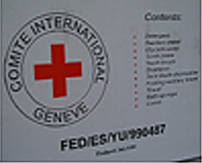
Aid package to those in need
Belgrade April 2000

4) The leadership in Belgrade has been involved in no less than four wars in former Yugoslavia: Slovenia, Croatia, Bosnia-Herzegovina and, most recently, Kosovo. In the choice between ‘guns and butter,’the former has prevailed for a decade.

5) International sanctions were introduced in 1992. As usual, they hit ordinary citizens, not the military, economic and political elites.

6) Sanctions produce a black market, an ever larger and richer mafia class deeply intertwined with politics; it’s the only segment which has international relations. Furthermore, the sanctions have cost FRY’s neighbours and trade partners an estimated loss of some US $ 25 billion and thus deprived these countries of vitally important income, i.e. caused unnecessary human suffering there. None of these countries, e.g. Macedonia, have received any compensation for their losses. They paid the price for the West’s sanctions because of Serbia’s importance in their foreign trade, while Serbia was a minor trade partner for everybody in the West.

7) NATO’s war against FRY last year wrought physical destruction in the country in the range of US $ 40 and 100 billion, the majority of targets being not purely military but also civilian.

Two things should be taken into account: a) it is impossible to conclude how much each factor contributes to today’s humanitarian situation, and b) it is irrelevant. The only thing that ought to count is that innocent people are suffering, their numbers are constantly increasing suffer, and that they have been driven away like their Albanian counterparts “not because of what they have done, but because of who they are” to use President Clinton’s formulation. They have a right to aid, to a decent life; they have a right to be assisted if they wish to return.

THE PEOPLE WE MET

During this, the 39th mission to former Yugoslavia, we visited a collective centre in Obrenovac, a distribution centre and a soup kitchen in Rakovijca in the outskirts of Belgrade. What were our experiences of the human suffering?
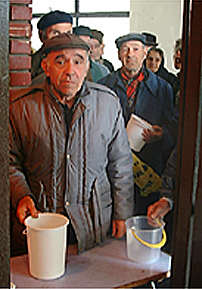
Photo © TFF

Pensioners, people who built old Yugoslavia, Serbia March 2000

Living conditions in barracks are extremely poor, children are often malnourished and many seem mentally handicapped. In Obrenovac one doctor comes to see 300 refugees once every 15 days. There is no medicine available. Children had not had milk for the last 6 months. In a soup kitchen we met a teenage girl with diabetes; her family was unable to buy the insulin she needs.

In another centre we met a crying woman whose husband had worked for many years in the mining industry in Africa and had earned 400 Deutsch marks a month; over the years they saved as much as they could on a foreign currency account. She told us that that had been confiscated. For the last three years, her husband has been sick in bed, unmovable. No medicine, no money for an operation. Her daughter’s family counted 7, sharing 18 square meters. Everywhere we were told that medicine is either unavailable or else so expensive in the private pharmacies that most can’t afford it. Patients must bring bed sheets, plastic gloves, injection needles, etc when they turn to a hospital.

We met an old man from Bosnia with a wooden leg; he could not get his pension in Bosnia from where he had been forced to leave and neither was he entitled to pension in FRY. His wounds were festering and he needed a new wooden leg, but the family – three generations living in the same room – had no savings to make that dream come true.

The average old-age pension is 600-1200 dinars per month, equivalent to 26-52 Deutsch mark or US $ 15-30 – if paid every month. An old man showed us his pension card: he had just (March) received the minimum of 387 dinars, but for January. Although the average price level is much lower than in Western Europe, nobody can live on that but must be supported by children and relatives. Those who aren’t end up in the soup kitchens. This is how the regime rewards those who built the old and the new Yugoslavia! And this is the situation for which the international community is co-responsible while pretending to care about human rights.

THERE IS A WILL AND A PRIDE

We met only hardworking, conscientious aid workers and centre leaders. The aid DOES reach those in need; books, registration cards, entitlements etc were kept rigorously everywhere we visited. Volunteer workers have made themselves available to humanitarian organizations; there is a remarkable solidarity throughout society.
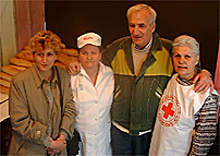
Photo © TFF

Volunteers helping in the soup kitchen in Rakovijca, Serbia, March 2000

The socially disadvantages and refugees we interviewed had retained their human dignity and refused to lose hope. Most told us not to feel sorry about the bombing but asked us to tell people back home how grateful they were for the food, hygiene articles and other aid they had recently received. We saw old people beginning to cultivate some land between their barracks, lots of small building projects. The people of Serbia have not turned into clients. They have learnt not to expect much good from abroad,” say Sommelius and Oberg.

REMEMBER YOUR HUMANITY

“In summary, the only right thing to do is to lift the sanctions. There can be no stability in the region as long as they are there. Whenever Western leaders defend their policies in the Balkans, they mention Western standards, human rights and European values. But if Europe and the United States let the situation for these 10 million Europeans deteriorate further, it will remain a blatant contradiction of these very values and rights. They say that the West was not – is not – at war with the people of Yugoslavia. But we are. They say they think humanitarian intervention is desirable and speak of human rights and moral foreign policy. All this remains empty rhetoric until they cease to differentiate on ethnic and political grounds, between people in extreme need of humanitarian aid and assistance to return. The people in Kosovo needed it, the people in Serbia need it. Why are we waiting?” – ask Sommelius and Oberg.

“We argued against the sanctions back in 1992. Those who believed they were a good idea have had 8 years to learn how counterproductive they have been. To use Milosevic as an excuse for not lifting the sanctions and doing much more to help these 1,2 million victims is an active act of inhumanity. Investing billions of military and civilian dollars in one side of an ethnic conflict and letting millions of civilians suffer on the other, is discrimination and militates against the basic norm that humanitarian assistance shall be given only according to human needs.

To paraphrase Einstein: remember your humanity and forget the rest. If we don’t, we fail in moral leadership as well as humanism, and the EU as a peace project and the Stability Pact for the Balkans will remain illusions.

Peace & future researcher + ‌Art Photographer

Related Posts

The agreement is catastrophic both because of what it says and what it doesn’t mention. It reduces further the major asset of security policies: Freedom of action. Jan Oberg TFF director September 25, 2026 A couple of hours before the agreement was signed on September 22, 2026, I published the following 13 hypotheses about what it would most likely contain on TFF Substack (in English). I was wrong on only the first point. Contrary to what Trump had written on his Truth Social platform, it does not appear to come into force immediately. In fact, it turned out to be worse than even I had anticipated. After these hypotheses now come a number of reflections in light of what the agreement actually contains, and does not contain, as well as the way in which it has generally been presented by major media outlets and by the public-service broadcaster DR. My...
Below are TFF-related media mentions, comments, videos and social media posts published elsewhere but not on this homepage. We happen to catch and list only a fraction. Regarding video comments and debates, we recommend that you go to the TFF Video Channel on Substack where many of them are reproduced. Jan Oberg is a contributor to China Daily – 52 million daily clicks – and Global Times, CGTN and CCTV (the national television), China Investment, Xinhua News Agency and several others. Articles and videos on these media very often multiply into countless Chinese (and Western media) that re-post them from these main media. Thanks to The China Academy, his analyses, interviews and comments are frequently posted on YouTube channels such as Thinkers Forum and Wave Media. These videos are often re-posted on Bilibili (China’s YouTube), the China Content Center on TikTok, and on the Chinese edition of TikTok, Douyin.com. This means reaching hundreds of millions of viewers worldwide over a year. While there are too many to catch on all these...
Jan Oberg May 15, 2026 Go to this Fox News page and scroll the whole way down: President Donald Trump tells the world that his meeting with President Xi Jinping yielded a lot of very concrete political and economic results – of course, only where the Chinese side, according to him, agreed with him. He does not mention the Taiwan issue, but Secretary of State, Marco Rubio, says that it did not feature prominently in their talks and that the US policy on Taiwan has not changed. Then go to China Daily – or Global Times – and you will see that for the Chinese it is framework, principles, structure of cooperation etc. that matters – all embedded in the overall idea of “constructive bilateral relationship of strategic stability.” Nowhere is any concrete agreement or deal – all that Trump refers to – mentioned. At the general level, this gives you insights into the very different social...

Recent Articles

Tony Robinson October 4, 2026 Violence is easy to recognise when someone is being beaten, shot or killed. It becomes more difficult when nobody is holding a weapon. Poverty, discrimination, exploitation and repression can restrict a human life just as effectively, although they do so in very different ways and with very different consequences. Simply adding more categories to an ever-growing list of forms of violence does not really solve the problem. The more interesting question is what all these different situations have in common and why it makes sense to describe them using the same word. Human beings do not simply react to what happens around them. They remember the past, imagine things that do not yet exist, make plans and undertake projects. Workers organise because they imagine different working conditions; people migrate because they imagine another life somewhere else; social movements emerge because people refuse to accept the...
It’s a matter of principles, courage, vision and pulling together – while the militarist world is falling apart… Peter Langille October 3, 2026 “Here, then, is the problem which we present to you, stark and dreadful and inescapable: Shall we put an end to the human race; or shall mankind renounce war?”The Bertrand Russell—Albert Einstein Manifesto, July 9, 1955 ⁕ The forecast for what’s ahead is worrisome. The sharp rise in armed conflicts over the past three years is adding to what was already the highest level in over seventy years. Genocides, which should be prevented are supported. A shared climate emergency that jeopardises survival is ignored. Diverse polls now suggest that people are war-weary, worried and interested in a more effective United Nations. And, there are viable policy options for a more secure world! Yet governments are doubling-down, betting on more war and investing heavily. If current trends persist,...
Johan Galtung 1930-2024October 2015 Published here on October 3, 2026 Let us focus on Civilization for conflict analysis and remedies. Major forms of disorder use violence; war is state organized violence. The most belligerent states are the United States of America and Israel, both with civilization roots. National Evangelism, the US Protestant Christian civilization– more national than evangelical–justifies US warfare as exceptionalism of a people chosen by God, with a manifest destiny to run the world. Orthodox Judaism justifies Israeli warfare to conquer and expand from Nile to Euphrates as a religious right and duty to the Eternal One. The third most belligerent country, the UK, no longer believes it is God-chosen but chosen by the USA; not quite the same but something. But the root cause of global disorder lies in the Occident–with Islam–seeing itself as the single, universal civilization valid for all at all times, all others being...

TFF on Substack

Discover and subscribe to more peace materials on TFF Substack

Most Popular

Tony Robinson October 4, 2026 Violence is easy to recognise when someone is being beaten, shot or killed. It becomes more difficult when nobody is holding a weapon. Poverty, discrimination, exploitation and repression can restrict a human life just as effectively, although they do so in very different ways and with very different consequences. Simply adding more categories to an ever-growing list of forms of violence does not really solve the problem. The more interesting question is what all these different situations have in common and why it makes sense to describe them using the same word. Human beings do not simply react to what happens around them. They remember the past, imagine things that do not yet exist, make plans and undertake projects. Workers organise because they imagine different working conditions; people migrate because they imagine another life somewhere else; social movements emerge because people refuse to accept the...
It’s a matter of principles, courage, vision and pulling together – while the militarist world is falling apart… Peter Langille October 3, 2026 “Here, then, is the problem which we present to you, stark and dreadful and inescapable: Shall we put an end to the human race; or shall mankind renounce war?”The Bertrand Russell—Albert Einstein Manifesto, July 9, 1955 ⁕ The forecast for what’s ahead is worrisome. The sharp rise in armed conflicts over the past three years is adding to what was already the highest level in over seventy years. Genocides, which should be prevented are supported. A shared climate emergency that jeopardises survival is ignored. Diverse polls now suggest that people are war-weary, worried and interested in a more effective United Nations. And, there are viable policy options for a more secure world! Yet governments are doubling-down, betting on more war and investing heavily. If current trends persist,...
Johan Galtung 1930-2024October 2015 Published here on October 3, 2026 Let us focus on Civilization for conflict analysis and remedies. Major forms of disorder use violence; war is state organized violence. The most belligerent states are the United States of America and Israel, both with civilization roots. National Evangelism, the US Protestant Christian civilization– more national than evangelical–justifies US warfare as exceptionalism of a people chosen by God, with a manifest destiny to run the world. Orthodox Judaism justifies Israeli warfare to conquer and expand from Nile to Euphrates as a religious right and duty to the Eternal One. The third most belligerent country, the UK, no longer believes it is God-chosen but chosen by the USA; not quite the same but something. But the root cause of global disorder lies in the Occident–with Islam–seeing itself as the single, universal civilization valid for all at all times, all others being...
Read More
Living-Peace-Sign-Budapest-copy
Tony Robinson October 4, 2026 Violence is easy to recognise when someone is being beaten, shot or killed. It becomes more difficult when nobody is holding a weapon. Poverty, discrimination, exploitation and repression can restrict a human life just as effectively, although they do so in very different ways and with very different consequences. Simply adding more categories to an ever-growing list of forms of violence does not really solve the problem. The more interesting question is what all these different situations have in common and why it makes sense to describe them using the same word. Human beings do not simply react to what happens around them. They remember the past, imagine things that do not yet exist, make plans and undertake projects. Workers organise because they imagine different working conditions; people migrate because they imagine another life somewhere else; social movements emerge because people refuse to accept the...
b54a1f10-8c65-4f0b-9dd5-4abc0a7d04cc_2659x2659
It’s a matter of principles, courage, vision and pulling together – while the militarist world is falling apart… Peter Langille October 3, 2026 “Here, then, is the problem which we present to you, stark and dreadful and inescapable: Shall we put an end to the human race; or shall mankind renounce war?”The Bertrand Russell—Albert Einstein Manifesto, July 9, 1955 ⁕ The forecast for what’s ahead is worrisome. The sharp rise in armed conflicts over the past three years is adding to what was already the highest level in over seventy years. Genocides, which should be prevented are supported. A shared climate emergency that jeopardises survival is ignored. Diverse polls now suggest that people are war-weary, worried and interested in a more effective United Nations. And, there are viable policy options for a more secure world! Yet governments are doubling-down, betting on more war and investing heavily. If current trends persist,...
010
Johan Galtung 1930-2024October 2015 Published here on October 3, 2026 Let us focus on Civilization for conflict analysis and remedies. Major forms of disorder use violence; war is state organized violence. The most belligerent states are the United States of America and Israel, both with civilization roots. National Evangelism, the US Protestant Christian civilization– more national than evangelical–justifies US warfare as exceptionalism of a people chosen by God, with a manifest destiny to run the world. Orthodox Judaism justifies Israeli warfare to conquer and expand from Nile to Euphrates as a religious right and duty to the Eternal One. The third most belligerent country, the UK, no longer believes it is God-chosen but chosen by the USA; not quite the same but something. But the root cause of global disorder lies in the Occident–with Islam–seeing itself as the single, universal civilization valid for all at all times, all others being...
Screenshot 2026-10-02 011738
Jan ObergPhD, director, The Transnational Foundation for Peace and Future Research, TFFLund, Sweden October 2, 2026 This is my full original manuscript. The Chinese Academy of Social Science, CASS, makes two publications out if it. 1. China’s Five-year plan emphasized the capabilities of basic research and original innovation. It is regarded as the goal of the future social development, which, as required, should be significantly enhanced. Can you comment on the importance of original innovation in research and academic study? I believe it is easier to define “original innovation” in the natural sciences than in social sciences. The breaking points of what constitutes something new, or innovative, are not quite as sharp in the latter. But in both fields it is about opening up something that was closed, unseen, unexplored before – making manifest what was earlier latent. Innovations come in many forms and shapes – naming something that was not...
arctic-circle-map
The agreement is catastrophic both because of what it says and what it doesn’t mention. It reduces further the major asset of security policies: Freedom of action. Jan Oberg TFF director September 25, 2026 A couple of hours before the agreement was signed on September 22, 2026, I published the following 13 hypotheses about what it would most likely contain on TFF Substack (in English). I was wrong on only the first point. Contrary to what Trump had written on his Truth Social platform, it does not appear to come into force immediately. In fact, it turned out to be worse than even I had anticipated. After these hypotheses now come a number of reflections in light of what the agreement actually contains, and does not contain, as well as the way in which it has generally been presented by major media outlets and by the public-service broadcaster DR. My...
girl-5894831_1280
Below are TFF-related media mentions, comments, videos and social media posts published elsewhere but not on this homepage. We happen to catch and list only a fraction. Regarding video comments and debates, we recommend that you go to the TFF Video Channel on Substack where many of them are reproduced. Jan Oberg is a contributor to China Daily – 52 million daily clicks – and Global Times, CGTN and CCTV (the national television), China Investment, Xinhua News Agency and several others. Articles and videos on these media very often multiply into countless Chinese (and Western media) that re-post them from these main media. Thanks to The China Academy, his analyses, interviews and comments are frequently posted on YouTube channels such as Thinkers Forum and Wave Media. These videos are often re-posted on Bilibili (China’s YouTube), the China Content Center on TikTok, and on the Chinese edition of TikTok, Douyin.com. This means reaching hundreds of millions of viewers worldwide over a year. While there are too many to catch on all these...