PressInfo #227 – Tackling terrorism is women’s work

The UN International Day of Peace

One half of the population, here and in the Middle East, is barely being used when it comes either to causing terror or preventing it. Ninety seven percent of bombers and suicide bombers are male, as are over ninety percent of those conducting the so-called ‘war on terror’.

Maybe it is time to consider what women would do. In fact, most governments have signed up to United Nations Resolution 1325, which is a worldwide agreement that we will include women in preventing and resolving violence. Why? Because all over the world women have shown that they’re good at it.

Dekha Ibrahim Abdi is a Muslim woman from the borders of Kenya and Somalia. In 1992 she managed to stop a clan war that had cost 1,500 lives, by getting together with women from the opposing clan. This was not sewing circle stuff. She said “If a member of my clan kills a member of your family, will you still work with me for peace? If you can’t say yes, don’t join.” They were so successful in solving disputes that the Kenyan President gave her an office in Nairobi and she now teaches her methods in other parts of Africa.

In Northern Ireland the Women’s Peace Party played a significant part in the Good Friday Agreement. Jo Berry, daughter of a Tory MP killed in the Brighton bombing, sought out the man who planted the bomb when he came out of jail in 1999, went through a gradual process of reconciliation with him, and now works with him to support victims and perpetrators of political violence in finding peace.

Dr Sima Semar, now Minister for Human Rights in Afghanistan, has for years systematically set up education and health centres for Afghani women and girls, knowing that they hold the key to peace. Her offices have twice been blown up, but she says she’s too busy to be afraid and simply continues her work.

When the five warring clans in Somalia were unable to reach agreement, Somali women asked to participate in the negotiations and were turned down. So under the leadership of Asha Haji Elmi, and the women’s network Save Somali Women and Children, they formed themselves into the sixth clan. They have since made a significant contribution to building peace in Somalia.

Women working for peace..but made invisible

And so on, but invisibly. It is thought that there are literally thousands of women’s peace initiatives springing up at grassroots level in the world’s tougher corners, and the London-based organisation Peace Direct is setting out to document just how many there are.

This is not to say that men are no good at peace-building; many have been spectacularly successful. It’s simply that when it comes to terror, the female way of doing things, which can be done effectively by either sex, is under used. This way of doing things tends to invest a lot of time in listening to human needs, to value the making of connections, and to favour the use of respect rather than the use of force.

Measures such as training a significant number of women for the police forces, and supporting the role of women in development and education can bring striking results in areas of conflict. The first lady of Egypt has recently established an international organisation to train women, especially in the Middle East, in state-of-the-art conflict resolution and peace-building techniques.

Special concern for the Iraqi women

But in Iraq, life for women is getting tougher. Just as Iraqi women were anticipating a new era of democracy and freedom, a wave of intimidation by extremist groups has arisen to crush their hopes. The NGO Shevolution reports that insurgents and religious fundamentalists are using rape, acid and assassination to force Iraqi women to wear the veil &endash; the first signal of further repression to come. Many Iraqi women have never worn the scarf. Now, dead bodies of girls and women are found in rivers and on waste ground with a veil tied around the head, as a message.

Violent oppression of women is spreading across Iraq, but there is silence from world leaders, religious leaders, politicians and the media. Yet Iraqi women could be the key to the country’s future. Due to decades of war, 62% of the adult population of Iraq are female and most are well educated. What is needed now is legislation to protect women’s rights, a national education programme to inform women of their rights, and to raise awareness among men of the value of including women in every walk of life, including politics.

So what could female power do in Britain to make us safer?

Women could be chiefly responsible for driving a powerful ‘human security’ or ‘soft’ approach to tackling the threat from terrorism – based on winning hearts and minds through addressing the real human needs that, frustrated and ignored, fuel violence.

In Britain it will mean adopting a gender-aware approach to dealing with the underlying causes of terrorism. For both policy makers and communities, it is essential to fully involve Muslim women in raising grievances and addressing problems within their communities and more widely.

People habitually find it easier to talk to women, and difficult to talk to the police. Therefore it would make sense to set up a national free hotline, where the caller remained anonymous and their number unidentifiable, to enable people anxious about the activities of people they know, to talk about it to women. At the very least this would help to build up a profile not only of how widespread are the preparations for attacks, but also of the motives.

In order to prevent attacks it is essential to understand why people are driving themselves to such extremes as suicide bombing. Mothers, sisters and girlfriends spend a lot of time listening, and what they pick up could, again anonymously, form the basis for profiles on the causes of fury. In the British cases it seems that the bombers were not psychotic, but rather ordinary young men who had become driven by intense fury, fuelled no doubt by indoctrination. It is crucial that that fury is understood, analysed and listened to.

In the corporate world women are actively sought out for middle management roles because it is widely recognised that they are effective communicators and have a natural talent for building bridges. It is time for women to be not just allowed, but actively encouraged, to introduce their particular ways of doing things into all our efforts to deal with terrorism.

Scilla Elworthy and Gabrielle Rifkind are authors of ‘Hearts and Minds: human security approaches to terrorism’ published in July 2005 by Demos. See also PeaceDirect.

© TFF and the author 2005
Related Posts

The agreement is catastrophic both because of what it says and what it doesn’t mention. It reduces further the major asset of security policies: Freedom of action. Jan Oberg TFF director September 25, 2026 A couple of hours before the agreement was signed on September 22, 2026, I published the following 13 hypotheses about what it would most likely contain on TFF Substack (in English). I was wrong on only the first point. Contrary to what Trump had written on his Truth Social platform, it does not appear to come into force immediately. In fact, it turned out to be worse than even I had anticipated. After these hypotheses now come a number of reflections in light of what the agreement actually contains, and does not contain, as well as the way in which it has generally been presented by major media outlets and by the public-service broadcaster DR. My...
Below are TFF-related media mentions, comments, videos and social media posts published elsewhere but not on this homepage. We happen to catch and list only a fraction. Regarding video comments and debates, we recommend that you go to the TFF Video Channel on Substack where many of them are reproduced. Jan Oberg is a contributor to China Daily – 52 million daily clicks – and Global Times, CGTN and CCTV (the national television), China Investment, Xinhua News Agency and several others. Articles and videos on these media very often multiply into countless Chinese (and Western media) that re-post them from these main media. Thanks to The China Academy, his analyses, interviews and comments are frequently posted on YouTube channels such as Thinkers Forum and Wave Media. These videos are often re-posted on Bilibili (China’s YouTube), the China Content Center on TikTok, and on the Chinese edition of TikTok, Douyin.com. This means reaching hundreds of millions of viewers worldwide over a year. While there are too many to catch on all these...
Jan Oberg May 15, 2026 Go to this Fox News page and scroll the whole way down: President Donald Trump tells the world that his meeting with President Xi Jinping yielded a lot of very concrete political and economic results – of course, only where the Chinese side, according to him, agreed with him. He does not mention the Taiwan issue, but Secretary of State, Marco Rubio, says that it did not feature prominently in their talks and that the US policy on Taiwan has not changed. Then go to China Daily – or Global Times – and you will see that for the Chinese it is framework, principles, structure of cooperation etc. that matters – all embedded in the overall idea of “constructive bilateral relationship of strategic stability.” Nowhere is any concrete agreement or deal – all that Trump refers to – mentioned. At the general level, this gives you insights into the very different social...

Recent Articles

Tony Robinson October 4, 2026 Violence is easy to recognise when someone is being beaten, shot or killed. It becomes more difficult when nobody is holding a weapon. Poverty, discrimination, exploitation and repression can restrict a human life just as effectively, although they do so in very different ways and with very different consequences. Simply adding more categories to an ever-growing list of forms of violence does not really solve the problem. The more interesting question is what all these different situations have in common and why it makes sense to describe them using the same word. Human beings do not simply react to what happens around them. They remember the past, imagine things that do not yet exist, make plans and undertake projects. Workers organise because they imagine different working conditions; people migrate because they imagine another life somewhere else; social movements emerge because people refuse to accept the...
It’s a matter of principles, courage, vision and pulling together – while the militarist world is falling apart… Peter Langille October 3, 2026 “Here, then, is the problem which we present to you, stark and dreadful and inescapable: Shall we put an end to the human race; or shall mankind renounce war?”The Bertrand Russell—Albert Einstein Manifesto, July 9, 1955 ⁕ The forecast for what’s ahead is worrisome. The sharp rise in armed conflicts over the past three years is adding to what was already the highest level in over seventy years. Genocides, which should be prevented are supported. A shared climate emergency that jeopardises survival is ignored. Diverse polls now suggest that people are war-weary, worried and interested in a more effective United Nations. And, there are viable policy options for a more secure world! Yet governments are doubling-down, betting on more war and investing heavily. If current trends persist,...
Johan Galtung 1930-2024October 2015 Published here on October 3, 2026 Let us focus on Civilization for conflict analysis and remedies. Major forms of disorder use violence; war is state organized violence. The most belligerent states are the United States of America and Israel, both with civilization roots. National Evangelism, the US Protestant Christian civilization– more national than evangelical–justifies US warfare as exceptionalism of a people chosen by God, with a manifest destiny to run the world. Orthodox Judaism justifies Israeli warfare to conquer and expand from Nile to Euphrates as a religious right and duty to the Eternal One. The third most belligerent country, the UK, no longer believes it is God-chosen but chosen by the USA; not quite the same but something. But the root cause of global disorder lies in the Occident–with Islam–seeing itself as the single, universal civilization valid for all at all times, all others being...

TFF on Substack

Discover and subscribe to more peace materials on TFF Substack

Most Popular

Tony Robinson October 4, 2026 Violence is easy to recognise when someone is being beaten, shot or killed. It becomes more difficult when nobody is holding a weapon. Poverty, discrimination, exploitation and repression can restrict a human life just as effectively, although they do so in very different ways and with very different consequences. Simply adding more categories to an ever-growing list of forms of violence does not really solve the problem. The more interesting question is what all these different situations have in common and why it makes sense to describe them using the same word. Human beings do not simply react to what happens around them. They remember the past, imagine things that do not yet exist, make plans and undertake projects. Workers organise because they imagine different working conditions; people migrate because they imagine another life somewhere else; social movements emerge because people refuse to accept the...
It’s a matter of principles, courage, vision and pulling together – while the militarist world is falling apart… Peter Langille October 3, 2026 “Here, then, is the problem which we present to you, stark and dreadful and inescapable: Shall we put an end to the human race; or shall mankind renounce war?”The Bertrand Russell—Albert Einstein Manifesto, July 9, 1955 ⁕ The forecast for what’s ahead is worrisome. The sharp rise in armed conflicts over the past three years is adding to what was already the highest level in over seventy years. Genocides, which should be prevented are supported. A shared climate emergency that jeopardises survival is ignored. Diverse polls now suggest that people are war-weary, worried and interested in a more effective United Nations. And, there are viable policy options for a more secure world! Yet governments are doubling-down, betting on more war and investing heavily. If current trends persist,...
Johan Galtung 1930-2024October 2015 Published here on October 3, 2026 Let us focus on Civilization for conflict analysis and remedies. Major forms of disorder use violence; war is state organized violence. The most belligerent states are the United States of America and Israel, both with civilization roots. National Evangelism, the US Protestant Christian civilization– more national than evangelical–justifies US warfare as exceptionalism of a people chosen by God, with a manifest destiny to run the world. Orthodox Judaism justifies Israeli warfare to conquer and expand from Nile to Euphrates as a religious right and duty to the Eternal One. The third most belligerent country, the UK, no longer believes it is God-chosen but chosen by the USA; not quite the same but something. But the root cause of global disorder lies in the Occident–with Islam–seeing itself as the single, universal civilization valid for all at all times, all others being...
Read More
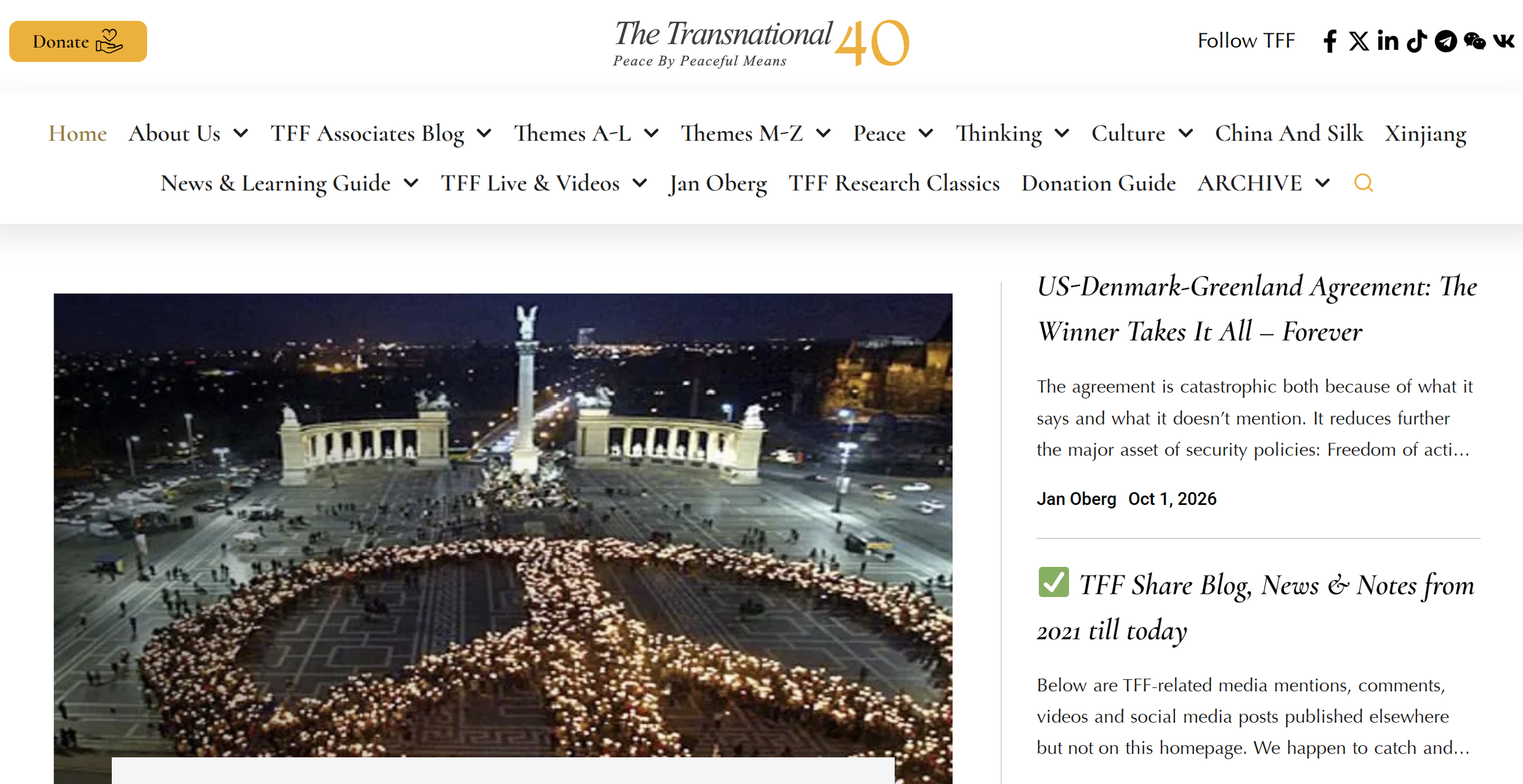
Living-Peace-Sign-Budapest-copy
Tony Robinson October 4, 2026 Violence is easy to recognise when someone is being beaten, shot or killed. It becomes more difficult when nobody is holding a weapon. Poverty, discrimination, exploitation and repression can restrict a human life just as effectively, although they do so in very different ways and with very different consequences. Simply adding more categories to an ever-growing list of forms of violence does not really solve the problem. The more interesting question is what all these different situations have in common and why it makes sense to describe them using the same word. Human beings do not simply react to what happens around them. They remember the past, imagine things that do not yet exist, make plans and undertake projects. Workers organise because they imagine different working conditions; people migrate because they imagine another life somewhere else; social movements emerge because people refuse to accept the...
b54a1f10-8c65-4f0b-9dd5-4abc0a7d04cc_2659x2659
It’s a matter of principles, courage, vision and pulling together – while the militarist world is falling apart… Peter Langille October 3, 2026 “Here, then, is the problem which we present to you, stark and dreadful and inescapable: Shall we put an end to the human race; or shall mankind renounce war?”The Bertrand Russell—Albert Einstein Manifesto, July 9, 1955 ⁕ The forecast for what’s ahead is worrisome. The sharp rise in armed conflicts over the past three years is adding to what was already the highest level in over seventy years. Genocides, which should be prevented are supported. A shared climate emergency that jeopardises survival is ignored. Diverse polls now suggest that people are war-weary, worried and interested in a more effective United Nations. And, there are viable policy options for a more secure world! Yet governments are doubling-down, betting on more war and investing heavily. If current trends persist,...
010
Johan Galtung 1930-2024October 2015 Published here on October 3, 2026 Let us focus on Civilization for conflict analysis and remedies. Major forms of disorder use violence; war is state organized violence. The most belligerent states are the United States of America and Israel, both with civilization roots. National Evangelism, the US Protestant Christian civilization– more national than evangelical–justifies US warfare as exceptionalism of a people chosen by God, with a manifest destiny to run the world. Orthodox Judaism justifies Israeli warfare to conquer and expand from Nile to Euphrates as a religious right and duty to the Eternal One. The third most belligerent country, the UK, no longer believes it is God-chosen but chosen by the USA; not quite the same but something. But the root cause of global disorder lies in the Occident–with Islam–seeing itself as the single, universal civilization valid for all at all times, all others being...
Screenshot 2026-10-02 011738
Jan ObergPhD, director, The Transnational Foundation for Peace and Future Research, TFFLund, Sweden October 2, 2026 This is my full original manuscript. The Chinese Academy of Social Science, CASS, makes two publications out if it. 1. China’s Five-year plan emphasized the capabilities of basic research and original innovation. It is regarded as the goal of the future social development, which, as required, should be significantly enhanced. Can you comment on the importance of original innovation in research and academic study? I believe it is easier to define “original innovation” in the natural sciences than in social sciences. The breaking points of what constitutes something new, or innovative, are not quite as sharp in the latter. But in both fields it is about opening up something that was closed, unseen, unexplored before – making manifest what was earlier latent. Innovations come in many forms and shapes – naming something that was not...
arctic-circle-map
The agreement is catastrophic both because of what it says and what it doesn’t mention. It reduces further the major asset of security policies: Freedom of action. Jan Oberg TFF director September 25, 2026 A couple of hours before the agreement was signed on September 22, 2026, I published the following 13 hypotheses about what it would most likely contain on TFF Substack (in English). I was wrong on only the first point. Contrary to what Trump had written on his Truth Social platform, it does not appear to come into force immediately. In fact, it turned out to be worse than even I had anticipated. After these hypotheses now come a number of reflections in light of what the agreement actually contains, and does not contain, as well as the way in which it has generally been presented by major media outlets and by the public-service broadcaster DR. My...
girl-5894831_1280
Below are TFF-related media mentions, comments, videos and social media posts published elsewhere but not on this homepage. We happen to catch and list only a fraction. Regarding video comments and debates, we recommend that you go to the TFF Video Channel on Substack where many of them are reproduced. Jan Oberg is a contributor to China Daily – 52 million daily clicks – and Global Times, CGTN and CCTV (the national television), China Investment, Xinhua News Agency and several others. Articles and videos on these media very often multiply into countless Chinese (and Western media) that re-post them from these main media. Thanks to The China Academy, his analyses, interviews and comments are frequently posted on YouTube channels such as Thinkers Forum and Wave Media. These videos are often re-posted on Bilibili (China’s YouTube), the China Content Center on TikTok, and on the Chinese edition of TikTok, Douyin.com. This means reaching hundreds of millions of viewers worldwide over a year. While there are too many to catch on all these...