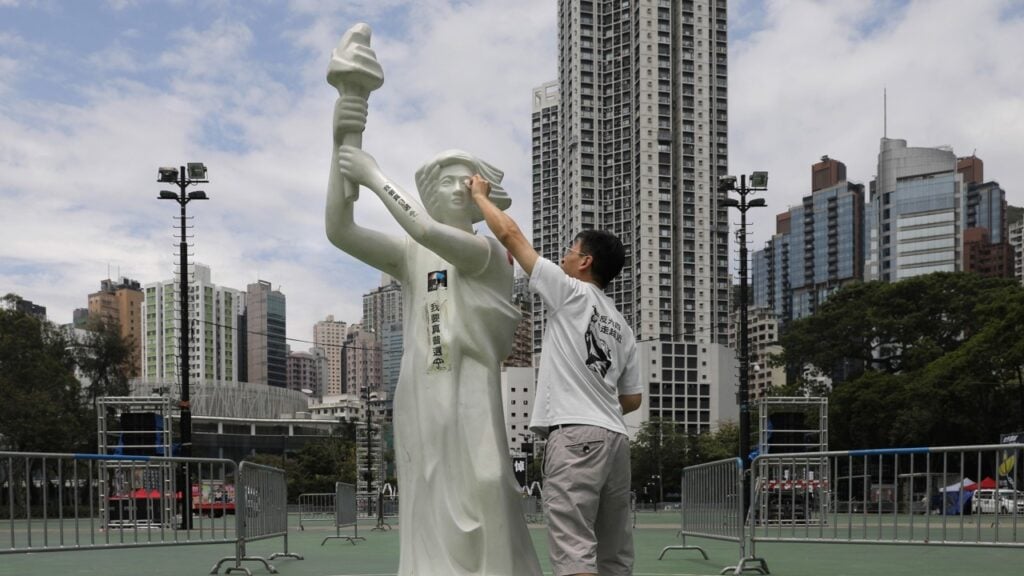
The Goddess of democracy at Victoria Park in Hong Kong. Photo credit: AP
The notion of a globally menacing ‘authoritarian China’ is too simplistic. Dig deeper, and you will find signs of local democratic experiments, thanks to its skittish rulers afraid of losing control
January 2, 2019
As China rapidly moves to the centre of the international order, the question that’s becoming increasingly pertinent is: what kind of a political system is this new global power?
In the booming business of China watching, the standard answer is that it is an “authoritarian” regime, with qualifiers such as “soft authoritarianism”, “hard authoritarianism” and “authoritarian capitalism” commonplace.
But by all accounts, China is reckoned the antithesis of a “liberal democracy” defined by open competition among freely formed political parties.
Originally published at The South China Morning Star scmp.com
Some Chinese observers celebrate the advantages of this “authoritarianism” and welcome the triumph of a “post-democracy” freed from the curse of free and fair elections and “showbiz democracy”.
Outsiders find this inference alarming. They warn of the rise of a globally menacing “authoritarian China”. Still others warn of the onset of dictatorial authoritarianism as the party leadership concentrates titles and decision making in the hands of one man, Xi Jinping.
Perhaps they are right about the dangers. But what’s wrong with their prediction, and their grand interpretation of China’s authoritarianism, is not just its liberal bias, or its reductionist view of democracy as synonymous with elections.
Its most serious weakness is its failure to understand the striking paradox of Chinese politics today – its vaguely democratic sensibility, strange as it may sound.
From Xi downwards, state officials understand well the old Chinese proverb that when trees fall monkeys scatter (shu dao husun san), which is why they have no love for open scrutiny and restraint of their arbitrary powers.
No, public monitoring of power, or monitory democracy (jian du shi min zhu), is not their thing. That is why the slightest whiff of a challenge to their power can bring down the hammer, as evidenced in mass detention camps in Xinjiang and attempts to silence dissent in Hong Kong.
But they also know that powerful people should fear too much power just as pigs fear growing fat.
The anxiety about unrestrained power and the fear of power-sharing, power-chastening democracy explain why China is more a “phantom democracy” (shenjingshi min zhu) – where the fear of democracy forces a style of political management that in many ways mirrors and mimics electoral democracies, where the fear of elections puts leaders in constant campaign mode.
The leadership knows by instinct that full rice bowls, skyscrapers, shopping malls and holidays abroad aren’t enough. And that is why, for some time, it has been trumpeting China as a “people’s democracy” (ren min min zhu) that conducts experiments with a wide range of locally crafted democratic tools designed to win public support, to deal productively with what the leadership labels mass incidents (an estimated 100,000 annually) and, primarily, to avoid the fate of its Soviet counterpart by becoming what some Chinese scholars call a “learning party”.
Democratic tools
But what exactly are these locally made, so-called democratic tools?
The examples are numerous. Most obvious are the election of village committees by villagers themselves, and (less obvious) the spread of a culture of elections into social media, city administration and experiments of business houses with “consultative democracy” among their staff.
Democracy made in China also includes efforts to apply the rule of law selectively, in the shape of contract law, integrity and compliance units (within the newly established Asian Infrastructure Investment Bank, for instance), and local mobile courts.
Nearly a million mediation committees assisted by “people’s mediators” now handle most conflicts (perhaps 90 per cent) inside and outside courts, at no cost to the litigants, in such areas as economic and labour disputes, divorce and minor criminal matters and civil disputes at the township level.
There are public forums, neighbourhood assemblies, democratic hearings and participatory budgeting experiments. Accountability and competition mechanisms are built into public bureaucracy.
Chinese democracy makes room for independent public opinion leaders (yu lun ling xiu), figures such as the online satirist Papi Jiang and former Chinese army officer turned transgender dance star and choreographer Jin Xing, known affectionately as “poison tongue” (du she), who use Sina Weibo and WeChat as public amplifiers to say things that grate on official ears.
Democracy made in China thrives on the clever utilisation of public opinion polls and democratic campaign styles by party officials, and the use of digitally networked media as early warning devices and as sophisticated tools of public opinion formation and policymaking.
Media scandals
These and many other locally made democracy experiments are typically ignored by those who beat the drum against Chinese authoritarianism.
That is unfortunate, if only because the conflict-producing and loyalty-inducing effects of these experiments are not to be underestimated, even if they fall far short of the standards of power-sharing democracy.
Take the current scandal surrounding ineffective vaccines supplied by Changsheng Biotechnology Company, initially protected by the local and national drug administrations.
State media and local authorities sprang into action when all hell broke loose on social media. The People’s Daily called on local regulators to “rapidly take action, do a complete investigation and announce authoritative information in a timely manner to pacify public anxiety”.
Premier Li Keqiang chimed in with talk of “illegal and criminal acts that endanger the safety of people’s lives”.
Xi interrupted his state visit to Rwanda to order severe punishments “to safeguard the public interest and social security”.

Media storms like these are chronic in China. They are allegories of the skittishness (fei chang min gan de) of the powerful. They also reveal the Achilles’ heel of the whole system: its failure to deal with the systematic misuse of power through independent, sharp-tooth monitory mechanisms.
But this weakness equally helps explain why talk of democracy in China is not oxymoronic. Locally made forms of democracy enjoy a measure of public acceptance.
Despite their phantom qualities, they have real effects on the ground. They reinforce the felt sense that those who rule are less powerful than they might suppose.
Hence, whereas governing China used to be like hammering nails into wood, it now much more closely resembles the art of balancing on slippery eggs.
Democratic style
China’s rulers have drawn anew the conclusion that shepherding the people means winning their hearts and minds through the use of democratic style.
Supposing the existence of an unwritten contract (mo xu) between themselves and the people, party leaders have come for the first time to mount the public catwalk, and to pay meticulous attention to body language, diction and decor, manners and charm.
In the name of serving the people, as if they were up for election, they embrace the aesthetics of the permanent campaign. They step out from behind closed doors, and go walking among the people.
Seemingly unscripted, they appear in unusual locales. There they pause to breathe the local atmosphere, to establish themselves as the guardians of the political order, to measure the loyalty of their supporters, to charm cynics or win over those who fear they are being devoured by the jaws of power.
In the hallowed name of the people, the party showboats. It practises the common touch, as when Xi springs a well-crafted “surprise” appearance and presses the flesh in a Beijing bun shop, rides on a bicycle with his daughter, embarks on a poverty tour in western China, and kicks a Gaelic football during an official visit to Ireland; or when his partner, the former singer and opera star Peng Liyuan, the first-ever First Lady, brings high heels and proto-democratic style for the first time into the field of high-level diplomacy and foreign policy.
Opinion polls
None of this may seem new. For centuries popular and elite discourse on the arts of government in China has rested on the understanding rulers ought to be the expression of the will of the people.
In many classic texts, rulers are seen as the sons of heaven and fathers of the people, upon whom heaven has bestowed the right to rule, so that in effect the will of heaven is equivalent to the will of the people.
The implication is that rulers shouldn’t indulge their own interests at the expense of the needs of the people. If they do, for example, by failing to govern benevolently and stirring up disorder, poverty and war, then they lose their “mandate of heaven” (tian ming).
But the new anxiety-fuelled efforts of the current rulers to experiment with democratic mechanisms are truly without historical precedent.
The official embrace of organised market research and opinion polling techniques is an example. Since the early 1980s, the regime has built a giant information gathering apparatus.
The contraption has many parts, comprising different types of information gathering, including hundreds of registered polling firms. Some of them are classified as unofficial (private, for-profit, not directly part of state structures).
Others are semi-official (for-profit, operating at some distance from state ministries); still others are controlled directly by the state, as happens at the People’s Daily Online Public Opinion Monitoring Centre, which uses data-harvesting algorithms to send summaries of internet chatter trends in real time to officials, often with advice about which language to use and avoid in handling hot topics.
Some polling agencies are joint ventures with foreign firms and agencies such as A.C. Nielsen, Gallup, Tailor Nelsen and Pew Research Centre.
Practically every institution of higher education hosts a public opinion research unit, chartered to analyse trends and hotspots with the help of social scientists who have swapped their former “redness” for the mantle of “expert” functionaries in a booming public opinion polling and survey research industry.
Elsewhere in the polity, the data harvesting machine includes local party branches, which function as listening posts, as do the party schools where up-and-coming cadres are sent periodically for “study”.
Higher up within the polity, the network of People’s Political Consultative Congresses and other consultative organs are all designed to win the support and collect the opinions of business people, intellectuals and various party and non-party people.
The information harvesting machine extends far beyond the territorial borders of China.
China’s surging foreign press corps is an example: stationed around the world, its journalists are more than reporters filing stories from abroad – they double as providers of regular intelligence to a state that is increasingly reliant on open flows of information.
Data gathering and opinion polling machinery function as early warning detectors, protecting governing structures from political resistance and social disorder.
Polls are also cleverly used to calibrate proposed policy changes considered potentially controversial, such as measures to increase public transport fares.
A case in point is the role played by the Canton Public Opinion Research Centre (C-por), the largest independent public opinion research agency in China, in dampening and managing the public rumpus triggered in early 2014 by local government plans to reduce traffic congestion by increasing parking fees in Guangzhou.
But the Changsheng scandal shows the really remarkable thing is that those who govern China simultaneously honour and do everything to crush the formation of publics with independent views about matters of public concern.
The authorities know the old rule that every form of government rests upon opinion (min yi). But when they say that the survival or extinction of the regime depends on “winning or losing public support”, as Xi puts it, they give the old rule a new twist – if opinion is the foundation of stable government, the government itself must create stable opinion.
It follows that the imperative is to watch, to keep an ear to the
The party-state must work constantly to stay closely in touch with the people, to ensure that “separation from the masses” (
The rulers thus acknowledge that power doesn’t flow ultimately from the barrels of guns, or from Xinjiang-style arrests and internments. Very little props up the political order except people’s belief in it.
The Changsheng scandal also shows that much the same proto-democratic dynamic is operative in the world of online media.
Everybody knows the authorities firewall, censor and crack down on subversive messaging and “inappropriate discussions”. Early-morning swoops by plain-clothes police, illegal detentions and violent beatings by unidentified thugs happen.
Total cyber-surveillance of citizens is slowly becoming a reality. Equally striking but less obvious is the way the authorities use digital media as a listening post, as a medium through which internet users are urged to chat and vent their grievances, to move closer to the state authorities, even to fight against the abuse of power.

Hence the recent calls by officials, for instance in Shandong province, for journalists to do their job of in-depth investigation; the proliferation of sophisticated digital strategies such as the Blue Map App designed to inform citizens in real-time about water quality, local sources of pollution, and to scrutinise emissions from polluting companies; e-consultations and online Q&A sessions; virtual petition sites and online webcast of public forums that come packaged in official assurances about the need to encourage transparency.
China’s future?
The idea of China as a phantom democracy, rather than a fake democracy or a system of authoritarianism, naturally prompts basic questions about the efficacy and durability of these practices, and where they are steering the political order.
The short answer is, nobody knows. In politics, as in life, surprise is often the most powerful player in defining what comes next.
Among the biggest possible surprises is that the powerful rulers of the People’s Republic of China, driven by skittishness, succeed in harnessing locally made democratic mechanisms to win the loyalty of their citizens and, thus, legitimate and strengthen their one-party rule.
Suppose the present political system managed to stay more or less intact. Then imagine that those who govern this polity mastered the art of paying homage to their subjects, to better rule them, on the basis of a surprising degree of self-scrutiny and experimentation.
Let’s also imagine that a combination of such measures as economic growth, social policy, state surveillance, political repression, middle-class support, dreams of restoring China to greatness and American foolishness helped consolidate the polity.
If that happened, in defiance of all the political science handbooks, wouldn’t China celebrate its return to the global stage armed with a strange new soft power weapon?
An ultra-modern, one-party polity grounded in the voluntary servitude of its people, a strange new reality with a democratic feel?
Not a “thoroughgoing return to totalitarian politics”, as Chinese scholar Xu Zhangrun warns in a widely circulated essay in recent days, but a tremendous phantom-democratic political order triumphantly beating a path towards a future world well beyond power-sharing constitutional democracy as it was known, practised and enjoyed by millions of people on our planet during times that now seem rapidly to be fading into the distant past?
Originally published at The South China Morning Post scmp.com
John Keane is Professor of Politics at the University of Sydney and author of ‘The Life and Death of Democracy’ and ‘When Trees Fall, Monkeys Scatter: Rethinking Democracy In China’. He is also the director of the Sydney Democracy Network