
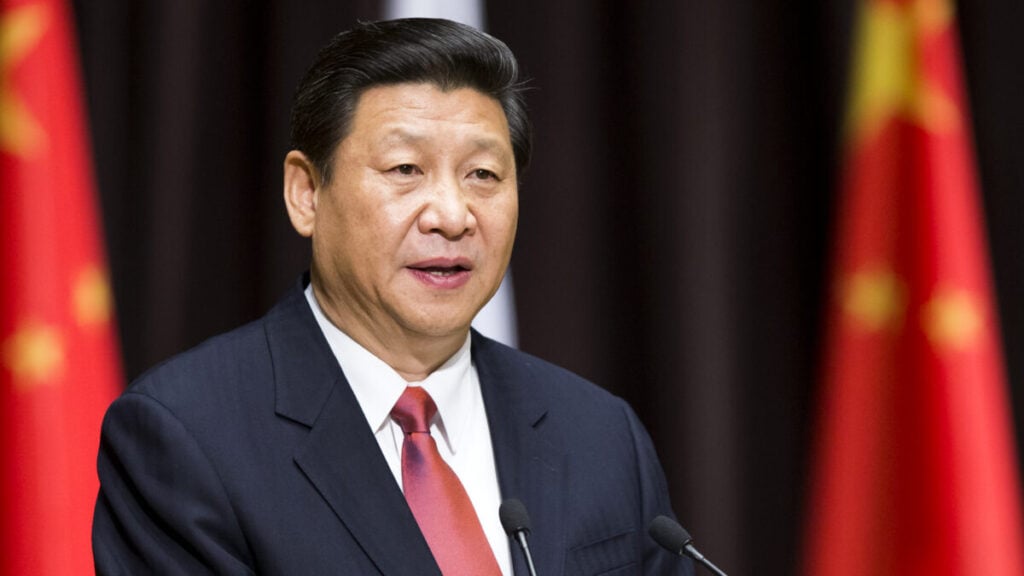
Peter McKillop: Xi Jinping says it’s time for an ‘ecological civilization’

Peter McKillop

November 8, 2021

The Chinese president did not attend COP26, but China already has a master plan for climate action. Do you, President Biden?

It may be one of the great ironies of COP26 that the leader of the nation that emits more carbon than the United States, India and the European Union combined is skipping the climate conference in Glasgow. For China and President Xi Jinping, it’s politics as usual. Perhaps it’s about maintaining COVID protocols, or he is still smarting from the new nuclear submarine deal between the U.S. and Australia. For whatever reason, President Xi will limit his COP presence to a video link.

But Xi’s physical absence at the summit should not be mistaken for inaction on climate change. Besides a commitment to check the increase in greenhouse gas emissions in 2030 and reach net zero by 2060, China has quietly put together an extraordinarily comprehensive climate plan. 

Originally published by Climate and Capital Media

Climate & Capital has spent the last several weeks listening to senior Chinese officials explain –– not merely how they will combat climate change –– but how they will finance the process. Moreover, they were remarkably candid about how they expect climate action to bolster China’s global “soft power” initiatives. The officials insisted on being off the record, so what follows is our take on China’s emerging climate roadmap.

It is worth noting, by the way, that in addition to China, India and Europe are all well into the technical and financial details of their own comprehensive approaches to the global climate crisis. By contrast, the United States, for all its talk, has so far offered little more than a patchwork of policy proposals. Not for lack of trying but noticeably on the way to COP, Biden’s U.S. is all goals, no plan.  

The official goal in China is to ensure that the country delivers on Xi Jinping’s pledge to be net zero by 2060. To that end, the country this week accelerated its efforts to control peak carbon emissions and reduce overall carbon intensity before 2030. 

“We embrace a green world economy,” said one Chinese senior finance official.

But the Chinese are not just about tweaking rules to make up numbers. What’s most compelling about their approach is that climate action has been elevated to a singular level of national prominence reminiscent of truly historic Chinese Communist Party campaigns.

If he lacks Mao’s flair for the poetry of destiny or Deng Xiaoping’s combination of political sense and pragmatism, Xi Jinping offered his own iteration of China’s next Great Leap Forward during a climate conference in Kunming in early October. “We shall take the development of an ecological civilization as our guide,” he announced, “to coordinate the relationship between man and nature.” 

Xi went on to exhort that the grand objective is for China to “live within planetary boundaries and build a green, low-carbon circular economy.” That’s a worthy goal for the whole world to keep in mind, particularly at COP26. At his direction, however, it’s pretty clear that all of China is likely hard at work setting practical targets for that ecological civilization, planetary boundaries notwithstanding. 

As the world heads to COP26, it’s clear China sees an emerging green economy as the ticket to future domestic prosperity and global economic dominance. “We embrace a green world economy,” said one Chinese senior finance official, who described it as “digitally-driven and market-based.” As Bloomberg’s David Fickling said in a recent pre-COP briefing: “For China on climate, it’s not about what international negotiators say, it’s what Xi Jinping says.” 

In other words, expect Xi and the Chinese Communist Party to want to make “green” a critical element of all future financing, investing and trading with the aim to make China the world’s dominant player in eco and climate-related products and services. Chinese officials see green finance as having a “multiplier effect that will accelerate green financial innovation and scale a green economy.”

Sustainable development, they say, will have to go hand in hand with escalating geopolitical competition.

This means Chinese banks will be encouraged to offer green credit, a new generation of wealth managers will be selling green retail financial products and efforts will be accelerated to build a vibrant green capital market complete with derivative futures, swaps and options. The centerpiece is a new carbon trading market that opened in July with little global attention. Immediately it became the world’s largest carbon trading scheme by volume and emissions.

Climate transition and geopolitical competition

The country’s realpolitik officials are also cold-eyed about the challenges of developing –– and dominating –– a global climate economy. Sustainable development, they say, will be a tangible factor in any escalating geopolitical competition. They recognize that economic tensions will intensify, particularly with the U.S. There is specific concern already about President Joe Biden’s recent decision to order a strategic review of battery supply chains, and labeling lithium and cobalt as critical materials. It’s important to note here that Chinese officials made it clear that they hope deepening economic ties with American companies will offset deteriorating bilateral government relations.

Xi Jinping’s coal paradox 

The glaring blemish on China’s green ambitions is massive and black as coal. There are no plans to end coal-fired power, which accounts for more than 60% of the country’s energy supply. With 80% of all global energy derived from fossil fuels, Chinese officials stress the need to balance new and traditional energy. Ironically, all of this should be music to the ears of American Republican legislators, and the fossil fuel industry which, not surprisingly, are insisting on a similar go-slow carbon transition. “The dominance of traditional energies won’t be changed overnight given new energies are still toddling along,” says one official. 

Climate action as ‘soft power’

China also hopes to use climate policy to bolster its soft power ambitions with much of the developing world. This means, Chinese officials say, balancing decarbonization with “survival” and “development.” Any drastic reduction of carbon emissions cannot come at the expense of economic progress for developing countries. “Decarbonization will threaten survival,” they say. To reduce poverty in Africa by 30% will require a 204% increase in emissions. That seems like a lot until you understand that Africa’s carbon footprint is just 2 to 3% of the world’s carbon dioxide emissions from energy and industrial sources.

To reduce poverty in Africa by 30% will require a 204% increase in emissions, Chinese officials say.

The question now is how China’s private sector will live up to Xi’s new slogan. “We really have no idea how we will meet these climate goals,” one official said. “But at least we know what to do.”  

Embrace the E, but ignore the S and G of ESG?

And then there is the knotty problem of the ‘s’ and the ‘g’ of Environmental, Social and Governance (ESG). In all the discussions, the focus is 100% on climate and technical environmental issues. China may be determined to build and dominate the emerging climate economy, but any discussion of the country’s social or governance issues is not on the agenda. 

There is still much work for China ahead. But those attending COP26 would do well to recognize that China’s empty chair at the talks doesn’t mean the country isn’t stepping right up to lead global climate action. Unlike the United States, the country seems to not only have a climate plan but a way to pull it off to make this century China’s century.

Originally published at Climate and Capital Media

About the author

Peter McKillop is the founder of Climate & Capital Media, a mission-driven information platform exploring the business and finance of climate change.

Please help TFF remain truly independent by contributing if you benefited from this article

Related Posts

Jan Oberg February 19, 2026 What a thrill to be interviewed by former British diplomat Ian Proud! Don’t waste a minute: acquaint yourself with him here on his homepage, which he elegantly calls “Proud Diplomat.” Notice also his book, A Misfit In Moscow. Ian is, of course, also on Substack, where he calls himself The Peace Monger, and recently he set up his own PeaceMonger Channel on YouTube. For once, I was not interviewed as if I were a military geopolitical expert, where I normally have to twist the whole thing in the direction of peace. No, we both had a focus on peace – why it has been disappeared by research, politics and the media, but also what can be done to shape a more peaceful future for us all. One idea we came up with was that of connecting people through citizens diplomacy – in an era where...
This is not another geopolitical commentary on the Arctic. It is a visionary peace proposal that can save the region from militarised rivalry and ecological ruin. A blueprint for shared security, sustainable development, and human dignity — benefitting Greenland, the Arctic, and the rest of us. Jan Oberg TFF director Lund, Sweden, February 17, 2026 I. Four Principles for a New Arctic Vision The Arctic is often framed as a cold arena of rivalry — a place where great powers test each other’s resolve. But this worldview is outdated, unimaginative, and ultimately self‑defeating. The Arctic is not a vacuum waiting to be militarised; it is a living region, a climate stabiliser, and a cultural homeland whose future will shape the future of humanity. If we begin from that understanding, a far more rational Arctic order becomes possible — one that is peaceful, cooperative, and centred on the people who actually live there. This vision rests...
By Jan ObergTFF co-founder and director February 11, 2026 PART 3 — ECONOMICS, TRADE & FINANCIAL SOVEREIGNTY A. Trade Measures & Market Signaling Economic pressure can be applied instantly and scaled without violence. Immediate Measures (within a week) Government boycott US goods and services  A very powerful signal which over time will be felt. Targeted tariffs on selected U.S. goods Symbolic but high-visibility sectors send a clear message. Suspend trade facilitation talks A peaceful pause that signals deep concern. Freeze U.S. participation in public procurement – military procurement in particular A nonviolent way to reduce influence. Competition law review of U.S. corporations A legal tool to scrutinise market dominance. Longer-Term Measures EU–Asia–Africa trade corridors Reducing reliance on U.S. markets. European supply chains for critical minerals Strategic autonomy in resource access. European Strategic Trade Authority Monitoring coercive practices globally. Euro-denominated commodity markets Weakening the dollar’s pricing monopoly. The EU must resume contacts and negotiations with Russia, focusing on energy cooperation To...

Recent Articles

Tony Robinson October 4, 2026 Violence is easy to recognise when someone is being beaten, shot or killed. It becomes more difficult when nobody is holding a weapon. Poverty, discrimination, exploitation and repression can restrict a human life just as effectively, although they do so in very different ways and with very different consequences. Simply adding more categories to an ever-growing list of forms of violence does not really solve the problem. The more interesting question is what all these different situations have in common and why it makes sense to describe them using the same word. Human beings do not simply react to what happens around them. They remember the past, imagine things that do not yet exist, make plans and undertake projects. Workers organise because they imagine different working conditions; people migrate because they imagine another life somewhere else; social movements emerge because people refuse to accept the...
It’s a matter of principles, courage, vision and pulling together – while the militarist world is falling apart… Peter Langille October 3, 2026 “Here, then, is the problem which we present to you, stark and dreadful and inescapable: Shall we put an end to the human race; or shall mankind renounce war?”The Bertrand Russell—Albert Einstein Manifesto, July 9, 1955 ⁕ The forecast for what’s ahead is worrisome. The sharp rise in armed conflicts over the past three years is adding to what was already the highest level in over seventy years. Genocides, which should be prevented are supported. A shared climate emergency that jeopardises survival is ignored. Diverse polls now suggest that people are war-weary, worried and interested in a more effective United Nations. And, there are viable policy options for a more secure world! Yet governments are doubling-down, betting on more war and investing heavily. If current trends persist,...
Johan Galtung 1930-2024October 2015 Published here on October 3, 2026 Let us focus on Civilization for conflict analysis and remedies. Major forms of disorder use violence; war is state organized violence. The most belligerent states are the United States of America and Israel, both with civilization roots. National Evangelism, the US Protestant Christian civilization– more national than evangelical–justifies US warfare as exceptionalism of a people chosen by God, with a manifest destiny to run the world. Orthodox Judaism justifies Israeli warfare to conquer and expand from Nile to Euphrates as a religious right and duty to the Eternal One. The third most belligerent country, the UK, no longer believes it is God-chosen but chosen by the USA; not quite the same but something. But the root cause of global disorder lies in the Occident–with Islam–seeing itself as the single, universal civilization valid for all at all times, all others being...

TFF on Substack

Discover and subscribe to more peace materials on TFF Substack

Most Popular

Tony Robinson October 4, 2026 Violence is easy to recognise when someone is being beaten, shot or killed. It becomes more difficult when nobody is holding a weapon. Poverty, discrimination, exploitation and repression can restrict a human life just as effectively, although they do so in very different ways and with very different consequences. Simply adding more categories to an ever-growing list of forms of violence does not really solve the problem. The more interesting question is what all these different situations have in common and why it makes sense to describe them using the same word. Human beings do not simply react to what happens around them. They remember the past, imagine things that do not yet exist, make plans and undertake projects. Workers organise because they imagine different working conditions; people migrate because they imagine another life somewhere else; social movements emerge because people refuse to accept the...
It’s a matter of principles, courage, vision and pulling together – while the militarist world is falling apart… Peter Langille October 3, 2026 “Here, then, is the problem which we present to you, stark and dreadful and inescapable: Shall we put an end to the human race; or shall mankind renounce war?”The Bertrand Russell—Albert Einstein Manifesto, July 9, 1955 ⁕ The forecast for what’s ahead is worrisome. The sharp rise in armed conflicts over the past three years is adding to what was already the highest level in over seventy years. Genocides, which should be prevented are supported. A shared climate emergency that jeopardises survival is ignored. Diverse polls now suggest that people are war-weary, worried and interested in a more effective United Nations. And, there are viable policy options for a more secure world! Yet governments are doubling-down, betting on more war and investing heavily. If current trends persist,...
Johan Galtung 1930-2024October 2015 Published here on October 3, 2026 Let us focus on Civilization for conflict analysis and remedies. Major forms of disorder use violence; war is state organized violence. The most belligerent states are the United States of America and Israel, both with civilization roots. National Evangelism, the US Protestant Christian civilization– more national than evangelical–justifies US warfare as exceptionalism of a people chosen by God, with a manifest destiny to run the world. Orthodox Judaism justifies Israeli warfare to conquer and expand from Nile to Euphrates as a religious right and duty to the Eternal One. The third most belligerent country, the UK, no longer believes it is God-chosen but chosen by the USA; not quite the same but something. But the root cause of global disorder lies in the Occident–with Islam–seeing itself as the single, universal civilization valid for all at all times, all others being...
Read More
Living-Peace-Sign-Budapest-copy
Tony Robinson October 4, 2026 Violence is easy to recognise when someone is being beaten, shot or killed. It becomes more difficult when nobody is holding a weapon. Poverty, discrimination, exploitation and repression can restrict a human life just as effectively, although they do so in very different ways and with very different consequences. Simply adding more categories to an ever-growing list of forms of violence does not really solve the problem. The more interesting question is what all these different situations have in common and why it makes sense to describe them using the same word. Human beings do not simply react to what happens around them. They remember the past, imagine things that do not yet exist, make plans and undertake projects. Workers organise because they imagine different working conditions; people migrate because they imagine another life somewhere else; social movements emerge because people refuse to accept the...
b54a1f10-8c65-4f0b-9dd5-4abc0a7d04cc_2659x2659
It’s a matter of principles, courage, vision and pulling together – while the militarist world is falling apart… Peter Langille October 3, 2026 “Here, then, is the problem which we present to you, stark and dreadful and inescapable: Shall we put an end to the human race; or shall mankind renounce war?”The Bertrand Russell—Albert Einstein Manifesto, July 9, 1955 ⁕ The forecast for what’s ahead is worrisome. The sharp rise in armed conflicts over the past three years is adding to what was already the highest level in over seventy years. Genocides, which should be prevented are supported. A shared climate emergency that jeopardises survival is ignored. Diverse polls now suggest that people are war-weary, worried and interested in a more effective United Nations. And, there are viable policy options for a more secure world! Yet governments are doubling-down, betting on more war and investing heavily. If current trends persist,...
010
Johan Galtung 1930-2024October 2015 Published here on October 3, 2026 Let us focus on Civilization for conflict analysis and remedies. Major forms of disorder use violence; war is state organized violence. The most belligerent states are the United States of America and Israel, both with civilization roots. National Evangelism, the US Protestant Christian civilization– more national than evangelical–justifies US warfare as exceptionalism of a people chosen by God, with a manifest destiny to run the world. Orthodox Judaism justifies Israeli warfare to conquer and expand from Nile to Euphrates as a religious right and duty to the Eternal One. The third most belligerent country, the UK, no longer believes it is God-chosen but chosen by the USA; not quite the same but something. But the root cause of global disorder lies in the Occident–with Islam–seeing itself as the single, universal civilization valid for all at all times, all others being...
Screenshot 2026-10-02 011738
Jan ObergPhD, director, The Transnational Foundation for Peace and Future Research, TFFLund, Sweden October 2, 2026 This is my full original manuscript. The Chinese Academy of Social Science, CASS, makes two publications out if it. 1. China’s Five-year plan emphasized the capabilities of basic research and original innovation. It is regarded as the goal of the future social development, which, as required, should be significantly enhanced. Can you comment on the importance of original innovation in research and academic study? I believe it is easier to define “original innovation” in the natural sciences than in social sciences. The breaking points of what constitutes something new, or innovative, are not quite as sharp in the latter. But in both fields it is about opening up something that was closed, unseen, unexplored before – making manifest what was earlier latent. Innovations come in many forms and shapes – naming something that was not...
arctic-circle-map
The agreement is catastrophic both because of what it says and what it doesn’t mention. It reduces further the major asset of security policies: Freedom of action. Jan Oberg TFF director September 25, 2026 A couple of hours before the agreement was signed on September 22, 2026, I published the following 13 hypotheses about what it would most likely contain on TFF Substack (in English). I was wrong on only the first point. Contrary to what Trump had written on his Truth Social platform, it does not appear to come into force immediately. In fact, it turned out to be worse than even I had anticipated. After these hypotheses now come a number of reflections in light of what the agreement actually contains, and does not contain, as well as the way in which it has generally been presented by major media outlets and by the public-service broadcaster DR. My...
girl-5894831_1280
Below are TFF-related media mentions, comments, videos and social media posts published elsewhere but not on this homepage. We happen to catch and list only a fraction. Regarding video comments and debates, we recommend that you go to the TFF Video Channel on Substack where many of them are reproduced. Jan Oberg is a contributor to China Daily – 52 million daily clicks – and Global Times, CGTN and CCTV (the national television), China Investment, Xinhua News Agency and several others. Articles and videos on these media very often multiply into countless Chinese (and Western media) that re-post them from these main media. Thanks to The China Academy, his analyses, interviews and comments are frequently posted on YouTube channels such as Thinkers Forum and Wave Media. These videos are often re-posted on Bilibili (China’s YouTube), the China Content Center on TikTok, and on the Chinese edition of TikTok, Douyin.com. This means reaching hundreds of millions of viewers worldwide over a year. While there are too many to catch on all these...




