
Pepe Escobar: Say hello to Russian gold and Chinese petroyuan

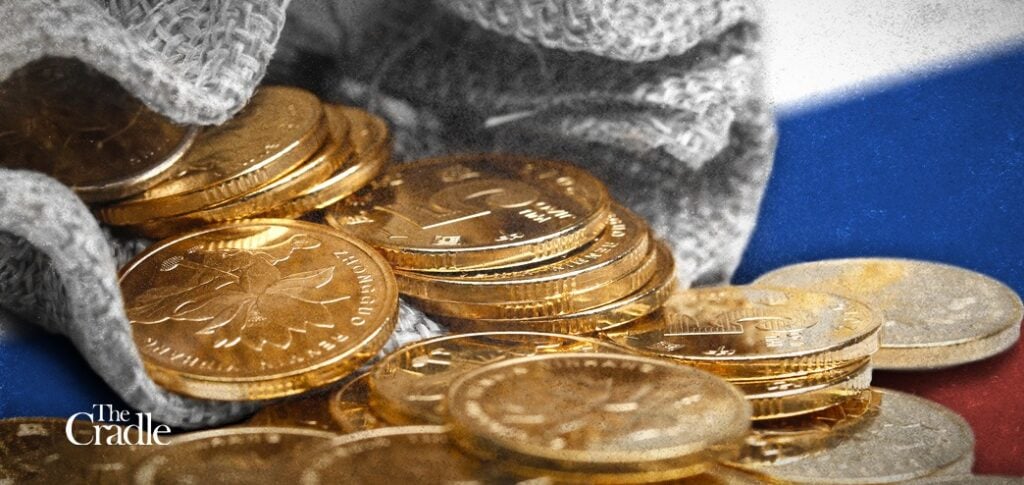
Russia says half its gold assets were frozen – is this for real or a slick play by Moscow? Photo Credit: The Cradle

Pepe Escobar

March 29, 2022

The Russia-led Eurasia Economic Union and China just agreed to design the mechanism for an independent financial and monetary system that would bypass dollar transactions.

Originally posted on The Cradle on March 15, 2022 here

It was a long time coming, but finally some key lineaments of the multipolar world’s new foundations are being revealed.

After a recent video conference meeting, the Eurasian Economic Union (EAEU) and China agreed to design the mechanism for an independent international monetary and financial system. The EAEU consists of Russia, Kazakhstan, Kyrgyzstan, Belarus and Armenia, is establishing free trade deals with other Eurasian nations, and is progressively interconnecting with the Chinese Belt and Road Initiative (BRI).

For all practical purposes, the idea comes from Sergei Glazyev, Russia’s foremost independent economist, a former adviser to President Vladimir Putin and the Minister for Integration and Macroeconomics of the Eurasia Economic Commission, the regulatory body of the EAEU.

Glazyev’s central role in devising the new Russian and Eurasian economic/financial strategy has been examined here. He saw the western financial squeeze on Moscow coming light-years before others.

Quite diplomatically, Glazyev attributed the fruition of the idea to “the common challenges and risks associated with the global economic slowdown and restrictive measures against the EAEU states and China.”

Translation: as China is as much a Eurasian power as Russia, and they need to coordinate their strategies to bypass the US unipolar system.

The Eurasian system will be based on “a new international currency,” most probably with the yuan as reference, calculated as an index of the national currencies of the participating countries, as well as commodity prices. The first draft will be already discussed by the end of the month.

The Eurasian system is bound to become a serious alternative to the US dollar, as the EAEU may attract not only nations that have joined BRI (Kazakhstan, for instance, is a member of both) but also the leading players in the Shanghai Cooperation Organization (SCO) as well as ASEAN. West Asian actors – Iran, Iraq, Syria, Lebanon – will be inevitably interested.

In the medium to long term, the spread of the new system will translate into the weakening of the Bretton Woods system, which even serious US market players/strategists admit is rotten from the inside. The US dollar and imperial hegemony are facing stormy seas.

Show me that frozen gold

Meanwhile, Russia has a serious problem to tackle. This past weekend, Finance Minister Anton Siluanov confirmed that half of Russia’s gold and foreign reserves have been frozen by unilateral sanctions. It boggles the mind that Russian financial experts have placed a great deal of the nation’s wealth where it can be easily accessed – and even confiscated – by the ‘Empire of Lies’ (copyright Putin).

At first, it was not exactly clear what Siluanov had meant. How could the Central Bank’s Elvira Nabiulina and her team let half of foreign reserves and even gold be stored in Western banks and/or vaults? Or is this some sneaky diversionist tactic by Siluanov?

No one is better equipped to answer these questions than the inestimable Michael Hudson, author of the recent revised edition of Super Imperialism: The Economic Strategy of the American Empire.

Hudson was quite frank: “When I first heard the word ‘frozen,’ I thought that this meant that Russia was not going to expend its precious gold reserves on supporting the ruble, trying to fight against a Soros-style raid from the West. But now the word ‘frozen’ seems to have meant that Russia had sent it abroad, outside of its control.”

“It looks like at least as of last June, all Russian gold was kept in Russia itself. At the same time, it would have been natural to have kept securities and bank deposits in the United States and Britain, because that is where most intervention in world foreign exchange markets occurs,” Hudson added.

Essentially, it’s all still up in the air: “My first reading assumed that Russia must be doing something smart. If it was smart to move gold abroad, perhaps it was doing what other central banks do: ‘lend” it to speculators, for an interest payment or fee. Until Russia tells the world where its gold was put, and why, we can’t fathom it. Was it in the Bank of England – even after England confiscated Venezuela’s gold? Was it in the New York Fed – even after the Fed confiscated Afghanistan’s reserves?”

So far, there has been no extra clarification either from Siluanov or Nabiulina. Scenarios swirl about a string of deportations to northern  Siberia for national treason. Hudson adds important elements to the puzzle:

“If [the reserves] are frozen, why is Russia paying interest on its foreign debt falling due? It can direct the “freezer’ to pay, to shift the blame for default. It can talk about Chase Manhattan’s freezing of Iran’s bank account from which Iran sought to pay interest on its dollar-denominated debt. It can insist that any payments by NATO countries be settled in advance by physical gold. Or it can land paratroopers on the Bank of England, and recover gold – sort of like Goldfinger at Fort Knox. What is important is for Russia to explain what happened and how it was attacked, as a warning to other countries.”

As a clincher, Hudson could not but wink at Glazyev: “Maybe Russia should appoint a non-pro-westerner at the Central Bank.”

The petrodollar game-changer

It’s tempting to read into Russian Foreign Minister Sergey Lavrov’s words at the diplomatic summit in Antalya last Thursday as a veiled admission that Moscow may not have been totally prepared for the heavy financial artillery deployed by the Americans:

“We will solve the problem – and the solution will be to no longer depend on our western partners, be it governments or companies that are acting as tools of western political aggression against Russia instead of pursuing the interests of their businesses. We will make sure that we never again find ourselves in a similar situation and that neither some Uncle Sam nor anybody else can make decisions aimed at destroying our economy. We will find a way to eliminate this dependence. We should have done it long ago.”

So, ‘long ago’ starts now. And one of its planks will be the Eurasian financial system. Meanwhile, ‘the market’ (as in, the American speculative casino) has ‘judged’ (according to its self-made oracles) that Russian gold reserves – the ones that stayed in Russia – cannot support the ruble.

That’s not the issue – on several levels. The self-made oracles, brainwashed for decades, believe that the Hegemon dictates what ‘the market’ does. That’s mere propaganda. The crucial fact is that in the new, emerging paradigm, NATO nations amount to at best 15 percent of the world’s population. Russia won’t be forced to practice autarky because it does not need to: most of the world – as we’ve seen represented in the hefty non-sanctioning nation list – is ready to do business with Moscow.

Iran has shown how to do it. Persian Gulf traders confirmed to The Cradle that Iran is selling no less than 3 million barrels of oil a day even now, with no signed JCPOA (Joint Comprehensive Plan of Action agreement, currently under negotiation in Vienna). Oil is re-labeled, smuggled, and transferred from tankers in the dead of night.

Another example: the Indian Oil Corporation (IOC), a huge refiner, just bought 3 million barrels of Russian Urals from trader Vitol for delivery in May. There are no sanctions on Russian oil – at least not yet.

Washington’s reductionist, Mackinderesque plan is to manipulate Ukraine as a disposable pawn to go scorched-earth on Russia, and then hit China. Essentially, divide-and-rule to smash not only one but two peer competitors in Eurasia who are advancing in lockstep as comprehensive strategic partners.

As Hudson sees it: “China is in the cross-hairs, and what happened to Russia is a dress rehearsal for what can happen to China. Best to break sooner than later under these conditions. Because the leverage is highest now.”

All the blather about “crashing Russian markets,” ending foreign investment, destroying the ruble, a “full trade embargo,” expelling Russia from “the community of nations,” and so forth – that’s for the zombified galleries. Iran has been dealing with the same thing for four decades, and survived.

Historical poetic justice, as Lavrov intimated, now happens to rule that Russia and Iran are about to sign a very important agreement, which may likely be an equivalent of the Iran-China strategic partnership. The three main nodes of Eurasia integration are perfecting their interaction on the go, and sooner rather than later, may be utilizing a new, independent monetary and financial system.

But there’s more poetic justice on the way, revolving around the ultimate game-changer. And it came much sooner than we all thought.

Saudi Arabia is considering accepting Chinese yuan – and not US dollars – for selling oil to China. Translation: Beijing told Riyadh this is the new groove. The end of the petrodollar is at hand – and that is the certified nail in the coffin of the indispensable Hegemon.

Meanwhile, there’s a mystery to be solved: where is that frozen Russian gold?

Please help TFF post more quality articles like this and to remain truly independent by contributing if you benefited from this article

NOTE

Read also this very informative analysis by Katharina Buchholz, “Who Holds Russia’s Central Bank Reserves?” You may be surprised.
Pepe Escobar

Pepe Escobar is a columnist at The Cradle, editor-at-large at Asia Times and an independent geopolitical analyst focused on Eurasia. Since the mid-1980s he has lived and worked as a foreign correspondent in London, Paris, Milan, Los Angeles, Singapore and Bangkok. He is the author of countless books; his latest one is Raging Twenties. 

Related Posts

Photo above: Carl Fredrik Reuterswärd’s Non-Violence outside UN Headquarters in New York. Kirill Levin, CC BY-NC-SA 2. Jan Oberg November 3, 2026 I am happy to be published in Horizons which is produced by the Center for International Relations and Sustainable Development, CIRSD, in Belgrade. My contribution brings out a radical re-thinking of what concepts such as defence, security, deterrence – and peace – may mean if we want to create a more peaceful world. It also summarises a few things I have been working with the last few decades. Please read it here Og her er den på dansk, takket være Johnny Baltzersens lynhurtige oversættelse
Johan Galtung 1930-2024October 2015 Published here on October 3, 2026 Let us focus on Civilization for conflict analysis and remedies. Major forms of disorder use violence; war is state organized violence. The most belligerent states are the United States of America and Israel, both with civilization roots. National Evangelism, the US Protestant Christian civilization– more national than evangelical–justifies US warfare as exceptionalism of a people chosen by God, with a manifest destiny to run the world. Orthodox Judaism justifies Israeli warfare to conquer and expand from Nile to Euphrates as a religious right and duty to the Eternal One. The third most belligerent country, the UK, no longer believes it is God-chosen but chosen by the USA; not quite the same but something. But the root cause of global disorder lies in the Occident–with Islam–seeing itself as the single, universal civilization valid for all at all times, all others being...
Jan Oberg February 19, 2026 What a thrill to be interviewed by former British diplomat Ian Proud! Don’t waste a minute: acquaint yourself with him here on his homepage, which he elegantly calls “Proud Diplomat.” Notice also his book, A Misfit In Moscow. Ian is, of course, also on Substack, where he calls himself The Peace Monger, and recently he set up his own PeaceMonger Channel on YouTube. For once, I was not interviewed as if I were a military geopolitical expert, where I normally have to twist the whole thing in the direction of peace. No, we both had a focus on peace – why it has been disappeared by research, politics and the media, but also what can be done to shape a more peaceful future for us all. One idea we came up with was that of connecting people through citizens diplomacy – in an era where...

Recent Articles

Photo above: Carl Fredrik Reuterswärd’s Non-Violence outside UN Headquarters in New York. Kirill Levin, CC BY-NC-SA 2. Jan Oberg November 3, 2026 I am happy to be published in Horizons which is produced by the Center for International Relations and Sustainable Development, CIRSD, in Belgrade. My contribution brings out a radical re-thinking of what concepts such as defence, security, deterrence – and peace – may mean if we want to create a more peaceful world. It also summarises a few things I have been working with the last few decades. Please read it here Og her er den på dansk, takket være Johnny Baltzersens lynhurtige oversættelse
UNITE-tillid, DREAM-velstand og andre konstruktive komponenter Normally we publish articles in English here. But this is a translation of a very important TFF document that should reach as many as possible in Denmark since this country’s government has been one of the most hardline in Europe and, up till now at least, has refused to use diplomacy and, instead, spent tremendous sums on arming Ukraine with the express goal of defeating Russia. Thus this – unique – article is in Danish. Vi er Johnny Baltzersen og hans Fælles Sikkerhed – Fælles Fremtid på Substack overmåde taknemmelige for at have oversat og publiceret TFF’s 2025-portfølje for fredsidéer med henblik på Ukraines fremtid. Vi håber den nu kan nå mange flere danskere – som også vil sprede den og skabe debat – nu den danske regerings og folketingspartiernes politik på dette område siden 2022 står nu – forudsigeligt – ved vejs ende....
Jan Oberg TFF director October 28, 2026 Exactly one month has now passed since I published my criticism of the introduction to the special issue on Johan Galtung published by the Journal of Global Security Studies, JoGSS, and of Tor Egil Førland’s chapter about Galtung which serves as a preview to his forthcoming biography of Galtung to be published by PRIO. See the original on The Transnational here and the same article on TFF Substack with many general and critical comments and, in particular, the people who decided to withdraw from the biography project in protest. The special issue itself was extraordinary. It was devoted to the intellectual legacy of one of the founders of peace research and contained a number of strong assessments of his personality, scholarship, intellectual trajectory, and public role. Such assessments are, of course, entirely legitimate. No scholar is beyond criticism, and neither was Johan Galtung....

TFF on Substack

Discover and subscribe to more peace materials on TFF Substack

Most Popular

Photo above: Carl Fredrik Reuterswärd’s Non-Violence outside UN Headquarters in New York. Kirill Levin, CC BY-NC-SA 2. Jan Oberg November 3, 2026 I am happy to be published in Horizons which is produced by the Center for International Relations and Sustainable Development, CIRSD, in Belgrade. My contribution brings out a radical re-thinking of what concepts such as defence, security, deterrence – and peace – may mean if we want to create a more peaceful world. It also summarises a few things I have been working with the last few decades. Please read it here Og her er den på dansk, takket være Johnny Baltzersens lynhurtige oversættelse
UNITE-tillid, DREAM-velstand og andre konstruktive komponenter Normally we publish articles in English here. But this is a translation of a very important TFF document that should reach as many as possible in Denmark since this country’s government has been one of the most hardline in Europe and, up till now at least, has refused to use diplomacy and, instead, spent tremendous sums on arming Ukraine with the express goal of defeating Russia. Thus this – unique – article is in Danish. Vi er Johnny Baltzersen og hans Fælles Sikkerhed – Fælles Fremtid på Substack overmåde taknemmelige for at have oversat og publiceret TFF’s 2025-portfølje for fredsidéer med henblik på Ukraines fremtid. Vi håber den nu kan nå mange flere danskere – som også vil sprede den og skabe debat – nu den danske regerings og folketingspartiernes politik på dette område siden 2022 står nu – forudsigeligt – ved vejs ende....
Jan Oberg TFF director October 28, 2026 Exactly one month has now passed since I published my criticism of the introduction to the special issue on Johan Galtung published by the Journal of Global Security Studies, JoGSS, and of Tor Egil Førland’s chapter about Galtung which serves as a preview to his forthcoming biography of Galtung to be published by PRIO. See the original on The Transnational here and the same article on TFF Substack with many general and critical comments and, in particular, the people who decided to withdraw from the biography project in protest. The special issue itself was extraordinary. It was devoted to the intellectual legacy of one of the founders of peace research and contained a number of strong assessments of his personality, scholarship, intellectual trajectory, and public role. Such assessments are, of course, entirely legitimate. No scholar is beyond criticism, and neither was Johan Galtung....
Read More
knotted gun
Photo above: Carl Fredrik Reuterswärd’s Non-Violence outside UN Headquarters in New York. Kirill Levin, CC BY-NC-SA 2. Jan Oberg November 3, 2026 I am happy to be published in Horizons which is produced by the Center for International Relations and Sustainable Development, CIRSD, in Belgrade. My contribution brings out a radical re-thinking of what concepts such as defence, security, deterrence – and peace – may mean if we want to create a more peaceful world. It also summarises a few things I have been working with the last few decades. Please read it here Og her er den på dansk, takket være Johnny Baltzersens lynhurtige oversættelse
TFFPortfolioVign
UNITE-tillid, DREAM-velstand og andre konstruktive komponenter Normally we publish articles in English here. But this is a translation of a very important TFF document that should reach as many as possible in Denmark since this country’s government has been one of the most hardline in Europe and, up till now at least, has refused to use diplomacy and, instead, spent tremendous sums on arming Ukraine with the express goal of defeating Russia. Thus this – unique – article is in Danish. Vi er Johnny Baltzersen og hans Fælles Sikkerhed – Fælles Fremtid på Substack overmåde taknemmelige for at have oversat og publiceret TFF’s 2025-portfølje for fredsidéer med henblik på Ukraines fremtid. Vi håber den nu kan nå mange flere danskere – som også vil sprede den og skabe debat – nu den danske regerings og folketingspartiernes politik på dette område siden 2022 står nu – forudsigeligt – ved vejs ende....
JoGSS-Silent
Jan Oberg TFF director October 28, 2026 Exactly one month has now passed since I published my criticism of the introduction to the special issue on Johan Galtung published by the Journal of Global Security Studies, JoGSS, and of Tor Egil Førland’s chapter about Galtung which serves as a preview to his forthcoming biography of Galtung to be published by PRIO. See the original on The Transnational here and the same article on TFF Substack with many general and critical comments and, in particular, the people who decided to withdraw from the biography project in protest. The special issue itself was extraordinary. It was devoted to the intellectual legacy of one of the founders of peace research and contained a number of strong assessments of his personality, scholarship, intellectual trajectory, and public role. Such assessments are, of course, entirely legitimate. No scholar is beyond criticism, and neither was Johan Galtung....
Screenshot 2026-10-26 115647
An aspect of Iran’s culture and civilisation you’ve probably never heard about. Don’t be surprised if the US and Israel also try to bomb them. Jan ObergTFF director October 26, 2026 Today – under the “USraeli” threat of new “annihilating” bombings – opens the 7th International Conference on Peace and Conflict Resolution at Tehran’s University. As far as I can tell, this is the only permanent, advanced peace research institution in West Asia/the Middle East. Perhaps more countries in that region could be inspired? I mean, how many military “security” institutes and military academies do they have? Many peace research institutes and university departments have been established since the 1950s in the West. They are now all under attack; some have closed down, some have gone mainstream, yet others kept the name but do nothing to research peace and disseminate results or advice; instead, they cooperate with militarism’s platforms such...
Screenshot 2026-10-15 141837
Let’s discuss using AI to create peace – in contrast to boring geopolitics devoid of creative healing and visions. Jan Oberg TFF director October 15, 2026 I asked VEED to create a short video exemplifying how peace is preferable to war, then chose the lady as a template. Simple as that. In less than a minute, it produced this video, which any peace-loving person would appreciate. The only problem is that human intelligence (HI), at least the one that exists among Western decision-makers, isn’t half as moral or smart as AI. I have used AI to dialogue about peace and peace plans, creative conflict resolution and visions of a better future for humankind. It so happens that I am having more stimulating, intelligent, creative and moral discussions with AI than I could possibly have with any EU or NATO leader today. Yes, AI has very problematic and dangerous aspects; used...
girl-5894831_1280
Below are TFF-related media mentions, comments, videos and social media posts published elsewhere but not on this homepage. We happen to catch and list only a fraction. Regarding video comments and debates, we recommend that you go to the TFF Video Channel on Substack where many of them are reproduced. Jan Oberg is a contributor to China Daily – 52 million daily clicks – and Global Times, CGTN and CCTV (the national television), China Investment, Xinhua News Agency and several others. Articles and videos on these media very often multiply into countless Chinese (and Western media) that re-post them from these main media. Thanks to The China Academy, his analyses, interviews and comments are frequently posted on YouTube channels such as Thinkers Forum and Wave Media. These videos are often re-posted on Bilibili (China’s YouTube), the China Content Center on TikTok, and on the Chinese edition of TikTok, Douyin.com. This means reaching hundreds of millions of viewers worldwide over a year. While there are too many to catch on all these...




