
Photo credit: uschinadialogue.georgetown.edu

June 10, 2021
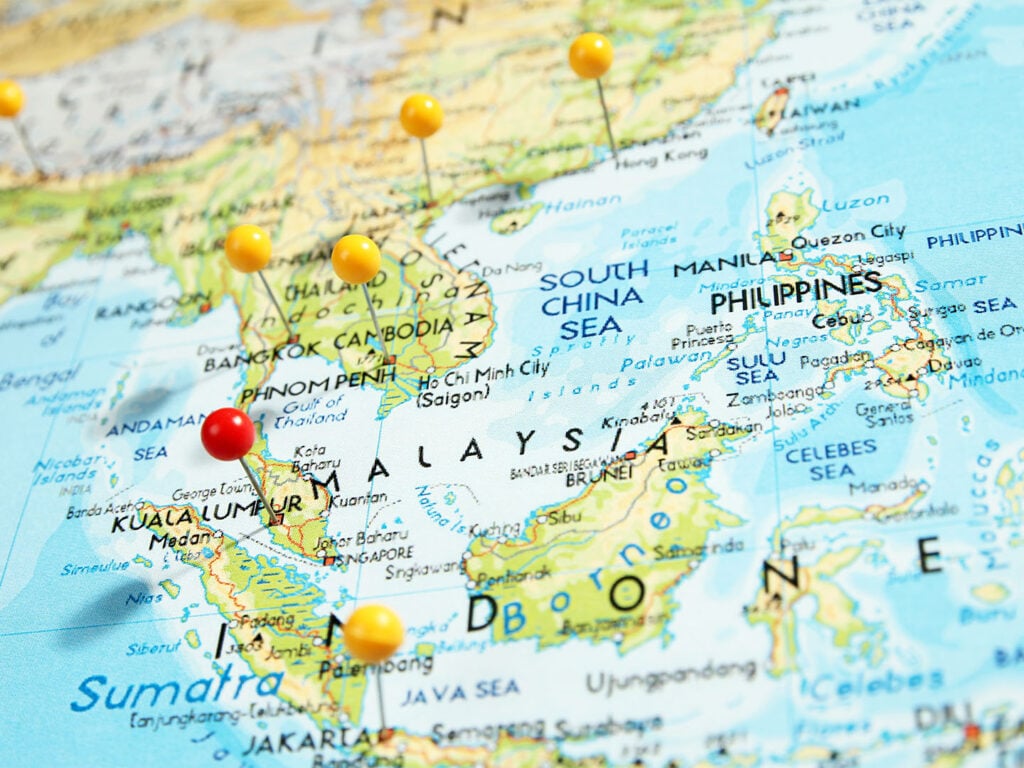
Let me start with my friend and the boat. Admittedly, they might not seem to have anything to do with each other. The boat, a guided-missile destroyer named the USS Curtis Wilbur, reportedly passed through the Straits of Taiwan and into the South China Sea, skirting the Paracel Islands that China has claimed as its own. It represented yet another Biden-era challenge to the planet’s rising power from its falling one. My friend was thousands of miles away on the West Coast of the United States, well vaccinated and going nowhere in Covid-stricken but improving America.
Published at juancole.com & Tomdispatch.com 06.07.2021
As it happens, she’s slightly younger than me, but still getting up there, and we were chatting on the phone about our world, about the all-too-early first wildfire near Los Angeles, the intensifying mega-drought across the West and Southwest, the increasing nightmare of hurricane season in the Atlantic and so on.
We were talking about the way in which we humans — and we Americans in particular (though you could toss in the Chinese without a blink) — have been wreaking fossil-fuelized havoc on this planet and what was to come.
And oh yes, we were talking about our own deaths, also to come at some unknown future moment but one not as far away as either of us might wish. My friend then said to me abashedly, “I sometimes think it’s lucky I won’t be here to see what’s going to happen to the world.” And even as she began stumbling all over herself apologizing for saying such a thing, I understood exactly what she meant.
I had had the very same thought and sense of shame and horror at even thinking it — at even thinking I would, in some strange sense, get off easy and leave a world from hell to my children and grandchildren.
Nothing, in fact, could make me sadder.
And you know what’s the worst thing? Whether I’m thinking about that “destroyer” in the Strait of Taiwan or the destruction of planet Earth, one thing is clear enough: it wouldn’t have to be this way.
China on the Brain
Now, let’s focus on the Curtis Wilbur for a moment. And in case you hadn’t noticed, Joe Biden and his foreign-policy team have China on the brain. No surprise there, though, only history. Don’t you remember how, when Biden was still vice president, President Obama announced that, in foreign and especially military policy, the U.S. was planning a “pivot to Asia“?
His administration was, in other words, planning on leaving this country’s war-on-terror disasters in the Greater Middle East behind (not that he would actually prove capable of doing so) and refocusing on this planet’s true rising power. Donald Trump would prove similarly eager to dump America’s Greater Middle Eastern wars (though he, too, failed to do so) and refocus on Beijing — tariffs first, but warships not far behind.
Now, as they withdraw the last U.S. troops from Afghanistan, the Biden team finds itself deep in its own version of a pivot-to-Asia strategy, with their collective foreign-policy brain remarkably focused on challenging China (at least until Israel briefly got in the way).
Think of it as a kind of pandemic of anxiety, a fear that, without a major refocus, the U.S. might indeed be heading for the imperial scrapheap of history. In a sense, this may prove to be the true Achilles heel of the Biden era.
Or put another way, the president’s foreign-policy crew seems, at some visceral level, to fear deeply for the America they’ve known and valued so, the one that was expected to loom invincibly over the rest of the planet once the Soviet Union collapsed in 1991; the imperial power our politicians (until Donald Trump) had long hailed as the greatest, most “exceptional” nation on the planet; the one with “the finest fighting force that the world has ever known” (Barack Obama), aka “the greatest force for freedom in the history of the world” (George W. Bush).
We’re talking, of course, about the same great power that, after almost 20 years of disastrous wars, drone strikes, and counterterror operations across vast stretches of the planet, looks like it is sinking fast, a country whose political parties can no longer agree on anything that matters.
In such a context, let’s consider, for a moment, that flu-like China obsession, the one that leaves Washington’s politicians and military leaders with strikingly high temperatures and an irrational urge to send American warships into distant waters near the coast of China, while regularly upping the ante, militarily and politically.
In that context, here’s an obsessional fact of our moment: these days, it seems as if President Biden can hardly appear anywhere or talk to anyone without mentioning China or that sinking country he now heads and that sinking feeling he has about it.
He did it the other week in an interview with David Brooks when, with an obvious on-the-page shudder, he told the New York Times columnist, “We’re kind of at a place where the rest of the world is beginning to look to China.”
Brrr… it’s cold in here (or maybe too hot to handle?) in an increasingly chaotic, still partly Trumpian, deeply divided Washington, and in a country where, from suppressing the vote to suppressing the teaching of history to encouraging the carrying of unlicensed weapons, democracy is looking ill indeed.
Oh, and that very same week when the president talked to Brooks, he went to the Coast Guard Academy to address its graduating class and promptly began discussing — yes! — that crucial, central subject for Washingtonians these days, freedom of navigation in the South China Sea. (“When nations try to game the system or tip the rules in their favor, it throws everything off balance. That’s why we are so adamant that these areas of the world that are the arteries of trade and shipping remain peaceful — whether that’s the South China Sea, the Arabian Gulf, and, increasingly, the Arctic.”)
You didn’t know, did you, that a guided-missile destroyer, not to speak of aircraft carrier battle groups, and other naval vessels had been anointed with the job of keeping “freedom of navigation” alive halfway across the planet or that the U.S. Coast Guard simply guards our coastlines.
These days, it should really be called the Coasts Guard. After all, you can find its members “guarding” coasts ranging from Iran’s in the Persian Gulf to the South China Sea.
Evidently, even the coast of the island of Taiwan, which, since 1949, China has always claimed as its own and where a subtle dance between Beijing and Washington has long played out, has become just another coast for guarding in nothing less than a new “partnership.” (“Our new agreement for the Coast Guard to partner with Taiwan,” said the president, “will help ensure that we’re positioned to better respond to shared threats in the region and to conduct coordinated humanitarian and environmental missions.”)
Consider that a clear challenge to the globe’s rising power in what’s become ever more of a showdown at the naval equivalent of the O.K. Corral, part of an emerging new cold war between the two countries.
And none of this is out of the ordinary. In his late April address to Congress, for instance, President Biden anxiously told the assembled senators and congressional representatives that “we’re in a competition with China and other countries to win the twenty-first century… China and other countries are closing in fast” — and in his own strange way, Donald Trump exhibited similar worries.
What Aren’t We Guarding?
Now, here’s the one thing that doesn’t seem to strike anyone in Congress, at the Coast Guard Academy, or at the New York Times as particularly strange: that American ships should be protecting “maritime freedom” on the other side of the globe, or that the Coast Guard should be partnering for the same.
Imagine, just for a second, that Chinese naval vessels and their Coast Guard equivalent were patrolling our coasts, or parts of the Caribbean, while edging ever closer to Florida. You know just what an uproar of shock and outrage, what cries of horror would result.
But it’s assumed that the equivalent on the other side of the globe is a role too obvious even to bother to explain and that our leaders should indeed be crying out in horror at China’s challenges to it.
It’s increasingly clear that, from Japan to the Taiwan Strait to the South China Sea to the Indian Ocean, Washington is pushing China hard, challenging its positions big time and often in a military fashion. And no, China itself, whether in the South China Sea or elsewhere, is no angel.
Still, the U.S. military, while trying to leave its failed terror wars in the dust, is visibly facing off against that economically rising power in an ever more threatening manner, one that already seems too close to a possible military conflict of some sort.
And you don’t even want to know what sort of warfare this country’s military leaders are now imagining there as, in fact, they did so long ago. (Daniel Ellsberg of Pentagon Papers fame only recently revealed that, according to a still-classified document, in response to the Chinese shelling of Taiwan in 1958, U.S. military leaders seriously considered launching nuclear strikes against mainland China.)
Indeed, as U.S. Navy ships are eternally sent to challenge China, challenging words in Washington only escalate as well. As Deputy Secretary of Defense Kathleen Hicks put it in March, while plugging for an ever larger Pentagon budget, “Beijing is the only competitor potentially capable of combining its economic, diplomatic, military, and technological power to mount a sustained challenge to a stable and open international system… Secretary [of Defense Lloyd] Austin and I believe that the [People’s Republic of China] is the pacing challenge for the United States military.”
And in that context, the U.S. Navy, the Air Force, and the Coast Guard are all “pacing” away. The latest proposed version of an always-rising Pentagon budget, for instance, now includes $5.1 billion for what’s called the Pacific Deterrence Initiative, “a fund created by Congress to counter China in the Indo-Pacific region.”
In fact, the U.S. Indo-Pacific Command is also requesting $27 billion in extra spending between 2022 and 2027 for “new missiles and air defenses, radar systems, staging areas, intelligence-sharing centers, supply depots and testing ranges throughout the region.”
And so it goes in the pandemic world of 2021.
Though seldom asked, the real question, the saddest one I think, the one that brings us back to my conversation with my friend about the world we may leave behind us, is: What aren’t we guarding on this planet of ours?
A New Cold War on a Melting Planet?
Let’s start with this: the old pattern of rising and falling empires should be seen as a thing of the past. It’s true that, in a traditional sense, China is now rising and the U.S. seemingly falling, at least economically speaking. But something else is rising and something else is falling, too.
I’m thinking, of course, about rising global temperatures that, sometime in the next five years, have a reasonable chance of exceeding the 1.5 degree Celsius limit (above the pre-industrial era) set by the Paris Climate Accords and what that future heat may do to the very idea of a habitable planet.
Meanwhile, when it comes to the U.S., the Atlantic hurricane season is only expected to worsen, the mega-drought in the Southwest to intensify (as fires burn ever higher in previously wetter mountainous elevations in that region), and so on.
Within this century, major coastal cities in this country and China like New Orleans, Miami, Shanghai, and Hong Kong could find themselves flooded out by rising sea levels, thanks in part to the melting of Antarctica and Greenland. As for a rising China, that supposedly ultimate power of the future, even its leadership must know that parts of the north China plain, now home to 400 million people, could become quite literally uninhabitable by century’s end due to heat waves capable of killing the healthy within hours.
In such a context, on such a planet, ask yourself: Is there really a future for us in which the essential relationship between the U.S. and China — the two largest greenhouse gas emitters of this moment — is a warlike one? Whether a literal war results or not, one thing should be clear enough: if the two greatest carbon emitters can’t figure out how to cooperate instead of picking endless fights with each other, the human future is likely to prove grim and dim indeed.
“Containing” China is the foreign-policy focus of the moment, a throwback to another age in Washington. And yet this is the very time when what truly needs to be contained is the overheating of this planet. And in truth, given human ingenuity, climate change should indeed be containable.
And yet the foreign-policy wing of the Biden administration and Congress (where Democrats are successfully infusing money into the economy under the rubric of a struggle with China, a rare subject the Republicans can go all in on) seem focused on creating a future of eternal Sino-American hostility and endless armed competition. In the already overheated world we inhabit, who could honestly claim that this is a formula for “national security”?
Returning to the conversation with my friend, I wonder why this approach to our planet doesn’t seem to more people like an obvious formula for disaster.
Why aren’t more of us screaming at the top of our lungs about the dangers of Washington’s urge to return to a world in which a “cold war” is a formula for success? It leaves me ever more fearful for the planet that, one of these days, I will indeed be leaving to others who deserved so much better.
Copyright 2021 Tom Engelhardt
Published at juancole.com 06.07.2021
Follow TomDispatch on Twitter and join us on Facebook. Check out the newest Dispatch Books, John Feffer’s new dystopian novel, Songlands(the final one in his Splinterlands series), Beverly Gologorsky’s novel Every Body Has a Story, and Tom Engelhardt’s A Nation Unmade by War, as well as Alfred McCoy’s In the Shadows of the American Century: The Rise and Decline of U.S. Global Power and John Dower’s The Violent American Century: War and Terror Since World War II.
Please help TFF remain truly independent by contributing if you benefited from this article





