
On Edward Said:Remarks on September 25, 2003 – Drew University, Conference on The American Empire?

We are gathered this evening at a moment of great sadness, especially for those of us blessed by friendship with Edward Said. This sense of loss is both wide and deep. Edward touched many, many lives, including all those people throughout the world who knew him through words, written and spoken. His warmth and interest in the life of every person with whom he came into contact with was legendary. Edward never gave anyone the sense that they were “ordinary.” He conveyed to everyone he encountered, however routinely, of their importance to him.

These last years of Edward’s life were both a tragic ordeal for him and those close to him, and a glorious chapter in an extraordinary life. It was glorious, despite the pain and suffering, because Edward’s courage and perseverance were so inspirational for his family, friends, colleagues, and activist collaborators. During this period Edward never lost his robust commitment to life, especially to those he loved, but also his engagement with friendship, fine food, high culture, humor. In this period, Edward was angry, but never bitter.

Edward became an academic celebrity on the basis of his literary criticism and cultural studies long before he became famous as the most powerful voice of advocacy on behalf of the Palestinian people. Edward was multi-talented, performing as a piano soloist in public concerts, writing influential music criticism, especially on opera. He even excelled in sports, as I discovered to my chagrin in the course of tennis and squash battles.

Edward’s struggle with leukemia cannot be separated from his experience of the afflictions in these years of the Palestinian people. Edward never abandoned either struggle&emdash;that for his own health and life, and that for the survival of the Palestinian people. No way of honoring Edward’s life would be more in keeping with his sensibility than to support this struggle for Palestinian rights.

Let me comment ever so briefly on Edward’s scholarly work. There will be countless conferences and symposium issues of scholarly journals devoted to Edward’s memory and achievement. Edward achieved widespread recognition early in his career as a literary critic of breadth and originality, his study of the Anglo-Polish writer, Joseph Conrad, being particularly admired and discussed. Conrad, who had a profound feeling for the racist and nihilistic implications of the European colonial project, and yet spoke with a Western accent, remained a crucial figure in Edward’s later work. This interest, culminating in the publication of Orientalism, which became one of the most influential books written in the prior century, and established Edward as a public intellectual throughout the world. This book, more effectively than any other, instructed a whole generation as to the deep structures of inter-civilizational bias, and about how this bias is linked to the mis-representations associated with narrating the history and culture of “the other,” as well as with colonialist rationales for subjugating and exploiting an alien civilization, in this instance the Islamic world of the Middle East. In particular, Edward shows how the leading Western scholarly specialists constructed a self-serving account of this “Oriental” other that greatly reinforced the colonialist mentality.

These same Orientalists, more shameless and dangerous than ever, have gained great prominence and pernicious influence in the aftermath of 9/11. Such individuals as Bernard Lewis and Fouad Ajami have been repeatedly consulted by the Bush White House, and give repeated prime-time exposure on mainstream TV. And what is worse, dissident voices have been excluded. These new expressions of Orientalism have added a self-satisfied aura of justification to American foreign policy, providing encouragement for recourse to aggressive warmaking around the world, but especially in relation to the Islamic world and the Palestinian struggle. The main policy argument put forward by the Lewis/Ajami assessment is that the Arab world in particular, but the Islamic world in general, respond only to the language of force.

There are, of course, many other dimensions of Edward’s work as “public” and “critical” intellectual that could be mentioned, but I will not attempt to do so now. As is widely known, Edward became very disillusioned by the postmodernist turn of literary and cultural studies, especially carrying the literary methods of deconstruction to the point of making any given meaning a matter of arbitrary assertion. Edward always believed in the humanist context of cultural inquiry, and that the identity of the critic had to be associated with an engagement in the historical struggles of his era. Therefore, he found the obscurity and apolitical stance of most postmodernists as a sterile and unacceptable retreat from engagement. Edward’s spirit can be epitomized by a line from the Palestinian national poet, Mahmoud Darwish’s line: “What use is thought if not for the sake of humanity.”

The publication of Culture and Imperialism in 1993 was another milestone in Edward’s remarkable career. This books explores in fascinating detail how culture and geopolitics are organically connected for better and worse. Just as Orientalism shows how the imperialist uses culture and knowledge as a weapon of oppression, Culture and Imprerialism demonstrates how the cultural output of the imperialist becomes part of the reality of those who are situated in the colonized world and act in anti-imperialist modes. Edward’s contributions here are both to recognize what might be called “the politics of knowledge,” and to contend convincingly that great writers are inevitable universal, not merely national, figures. Shakespeare belongs to the South just as much as to Britain, and the English-speaking world. Edward himself epitomized both the cosmopolitanism and the sense of exile associated with this complex hybridity, involving both rootedness in the specifics of experience and displacement and the mobility of ideas.

Edward believed deeply in cultural experience as transformative in ways that transcended diplomacy. He often mentioned how important to him was his collaboration with the fine Israeli pianist, Daniel Barenboim. They published a book of conversations not long ago, which discloses the potentiality in humanist discourse for a transcendence of the most bloody and relentless confrontation of two peoples at this time. Edward worked with Barenboim also to establish summer workshops for gifted young musicians from Israel and Palestine, allowing the language of music to challenge the hegemony of the language of violence. In 2002 they shared the Asturias Concord Prize in recognition of this collaborative work that combined art and politics symbolically and substantively.

There are several notable features of Edward’s central preoccupation with the Palestine/Israel conflict. From the first unfurling of the Oslo Peace Process in 1993, Edward was skeptical, if not dismissive. He stood apart from many Palestinian and progressive friends by this insistence that this “peace process” was either a road to nowhere or a clever diplomatic strategy to formalize Israeli domination. He also stood apart from the “responsible” consensus by rejecting the two-state option, and insisting that genuine peace for the two peoples could only arise within the framework of a bi-national state. More and more of those involved in searching for a solution are reluctantly reaching the conclusion that a two-state solution is no longer viable, given the cumulative effects of Israeli establishment of “facts on the ground.” If such issues as the Israeli settlements and bypass roads, Palestinian refugees, the city of Jerusalem, and the sharing of water are taken into account, then only a bi-national state offers hope of a peaceful and just solution. Of course, this outcome must still be classified as “utopian,” although the alternatives are worse as “dysutopian.”

Poetry is often more meaningful than words of remembrance. I would like to read two poems that somehow for me express the essential quality of this sad day. The first poem is by the Welsh poet, Dylan Thomas, and is about the death of his father. It seemed appropriate as Edward often said during these final years of illness and political disappointment that “it was my anger that keeps me going.”

Do not go gentle into that good night

Do not go gentle into that good night,
Old age should burn and rave at close of day;
Rage, rage against the dying of the light.

Though wise men at their end know dark is right,
Because their words had forked no lightning they
Do not go gentle into that good night.

Good me, the last wave by, crying how
Their frail deeds might have danced in a green bay,
Rage, rage against the dying of the light.
Wild men who caught and sang the sun in flight,
And learn, too late, they grieved on its way,
Do not go gentle into that good night.

Grave men, near death, who see the blinding sight
Blind eye could blaze like meteors and be gay,
Rage, rage against the dying of the light.

And you, my father, there on the sad height,
Curse, bless, me now with your fierce tears. I pray.
Do not go gentle into that good night.
Rage, rage against the dying of the light.

The second poem is by W. H. Auden on the death of William Butler Yeats, entitled “In memory of W. B. Yeats.” As with Edward’s relationship to the Palestinian struggle, Yeats had a complicated relationship with Irish national politics, lamenting the excesses of the Irish Revolution, yet remaining passionately involved in the Irish experience. I include here only the first of the two-part poem, although the whole poem is relevant.

In memory of W.B. Yeats

He disappeared in the dead of winter:
The brooks were frozen, the airports almost deserted.
And snow disfigured the public statues;
The mercury sand in the mouth of the dying day.
What instruments we have agree
The day of his death was a dark cold day

Far from his illness
The wolves ran on through the evergreen forests,
The peasant river was untempted by the fashionable quays;
By mourning tongues
The death of the poet was kept from his poems.

But for him it was last afternoon as himself,
As afternoon or nurses and rumours;
The provinces of his body revolted,
The squares of his mind were empty.
Silence invaded the suburbs.
The current of his feeling failed; he became his admirers.

Now he is scattered among a hundred cities
And wholly given over to unfamiliar affections,
To find his happiness in another kind of wood
And be punished under a foreign code of conscience.
The words of a dead man
Are modified in the guts of the living.

But in the importance and noise of to-morrow
When the brokers are roaring like beasts on the floor of the Bourse,
And the poor have the sufferings to which they’re fairly accustomed,
And each in the cell of himself is almost convinced of his freedom.
A few thousand will think of this day
As one thinks of a day when one did something slightly unusual.
What instruments we have agree
The day of his death was a dark cold day.
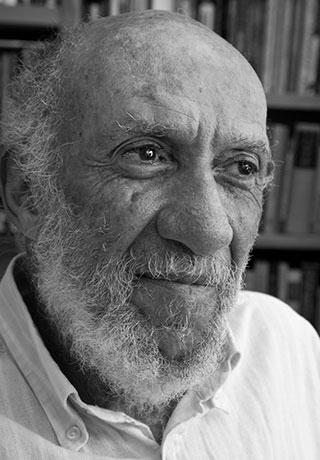

Professor Falk became an adviser to TFF when it was established in 1985.

Related Posts

LONDON – So far so good, at least on the wider level. While internally Iraq seems on the edge of chaos, the much heralded clash of civilizations between the Muslim and Judaeo-Christian worlds has yet to become apparent. We have anger and despair aplenty in the Arab and Muslim worlds. But very little rushing to the standard and there was no great pilgrimage of warriors to join the fight, as happened when the Soviet Union invaded Afghanistan twenty years ago, and then, having driven the Red Army out, were left to ferment in that mountainous redoubt. With the armaments supplied by the CIA the mujahidin were transformed into Al Qaeda that became, for a relatively brief moment as these things go, ‘the greatest threat to the homeland that America has ever known.’ Nevertheless a ‘Cold War’ between much of the Muslim world and the West is certainly in full swing. Winston...
The Challenge of Nuclear Weaponsin the Twenty-first CenturyA Path Forward The peoples and governments of the world face an urgent challenge relating to weaponry of mass destruction and particularly to nuclear weaponry.  At the crossroads of technology, terrorism, geopolitical ambition, and policies of preemption are new and potent dangers for humanity. Despite ending the nuclear standoff of the Cold War era, nuclear weaponry is again menacing the peoples of the world with catastrophic possibilities.  We recognize the need for any government to pursue its security interests in accordance with international law; and further, we recognize that distinctive threats to these interests now exist as a result of an active international terrorist network having declared war on the United States and its allies. Nonetheless, we reject the assessment of the current US administration that upgrading a reliance on nuclear weapons is in any sense justified as a response. We find it...
By Karin Wegestal MP, the Social Democratic Partyon behalf of the Swedish Committee for Solidarity with the Yugoslav People During the last decade, the Federal Republic of Yugoslavia has received more than 500,000 refugees from Croatia and Bosnia, and another 300,000 internally displaced persons, mainly from the province Kosovo and Metohia. For a country with about ten million inhabitants, such an influx of homeless people is obviously a very heavy burden – even under peaceful conditions. But in addition to that, the Federal Republic of Yugoslavia has been the subject to sanctions from the western powers for close to ten years and its infrastructure was badly hurt through Nato’s intense bombardment during 78 days in 1999. The result of all this is that Yugoslavia, once the most developed industrial country in Eastern Europe, is today the poorest country in Europe. In Serbia excluding Kosovo, with about ten million inhabitants and...

Recent Articles

Tony Robinson October 4, 2026 Violence is easy to recognise when someone is being beaten, shot or killed. It becomes more difficult when nobody is holding a weapon. Poverty, discrimination, exploitation and repression can restrict a human life just as effectively, although they do so in very different ways and with very different consequences. Simply adding more categories to an ever-growing list of forms of violence does not really solve the problem. The more interesting question is what all these different situations have in common and why it makes sense to describe them using the same word. Human beings do not simply react to what happens around them. They remember the past, imagine things that do not yet exist, make plans and undertake projects. Workers organise because they imagine different working conditions; people migrate because they imagine another life somewhere else; social movements emerge because people refuse to accept the...
It’s a matter of principles, courage, vision and pulling together – while the militarist world is falling apart… Peter Langille October 3, 2026 “Here, then, is the problem which we present to you, stark and dreadful and inescapable: Shall we put an end to the human race; or shall mankind renounce war?”The Bertrand Russell—Albert Einstein Manifesto, July 9, 1955 ⁕ The forecast for what’s ahead is worrisome. The sharp rise in armed conflicts over the past three years is adding to what was already the highest level in over seventy years. Genocides, which should be prevented are supported. A shared climate emergency that jeopardises survival is ignored. Diverse polls now suggest that people are war-weary, worried and interested in a more effective United Nations. And, there are viable policy options for a more secure world! Yet governments are doubling-down, betting on more war and investing heavily. If current trends persist,...
Johan Galtung 1930-2024October 2015 Published here on October 3, 2026 Let us focus on Civilization for conflict analysis and remedies. Major forms of disorder use violence; war is state organized violence. The most belligerent states are the United States of America and Israel, both with civilization roots. National Evangelism, the US Protestant Christian civilization– more national than evangelical–justifies US warfare as exceptionalism of a people chosen by God, with a manifest destiny to run the world. Orthodox Judaism justifies Israeli warfare to conquer and expand from Nile to Euphrates as a religious right and duty to the Eternal One. The third most belligerent country, the UK, no longer believes it is God-chosen but chosen by the USA; not quite the same but something. But the root cause of global disorder lies in the Occident–with Islam–seeing itself as the single, universal civilization valid for all at all times, all others being...

TFF on Substack

Discover and subscribe to more peace materials on TFF Substack

Most Popular

Tony Robinson October 4, 2026 Violence is easy to recognise when someone is being beaten, shot or killed. It becomes more difficult when nobody is holding a weapon. Poverty, discrimination, exploitation and repression can restrict a human life just as effectively, although they do so in very different ways and with very different consequences. Simply adding more categories to an ever-growing list of forms of violence does not really solve the problem. The more interesting question is what all these different situations have in common and why it makes sense to describe them using the same word. Human beings do not simply react to what happens around them. They remember the past, imagine things that do not yet exist, make plans and undertake projects. Workers organise because they imagine different working conditions; people migrate because they imagine another life somewhere else; social movements emerge because people refuse to accept the...
It’s a matter of principles, courage, vision and pulling together – while the militarist world is falling apart… Peter Langille October 3, 2026 “Here, then, is the problem which we present to you, stark and dreadful and inescapable: Shall we put an end to the human race; or shall mankind renounce war?”The Bertrand Russell—Albert Einstein Manifesto, July 9, 1955 ⁕ The forecast for what’s ahead is worrisome. The sharp rise in armed conflicts over the past three years is adding to what was already the highest level in over seventy years. Genocides, which should be prevented are supported. A shared climate emergency that jeopardises survival is ignored. Diverse polls now suggest that people are war-weary, worried and interested in a more effective United Nations. And, there are viable policy options for a more secure world! Yet governments are doubling-down, betting on more war and investing heavily. If current trends persist,...
Johan Galtung 1930-2024October 2015 Published here on October 3, 2026 Let us focus on Civilization for conflict analysis and remedies. Major forms of disorder use violence; war is state organized violence. The most belligerent states are the United States of America and Israel, both with civilization roots. National Evangelism, the US Protestant Christian civilization– more national than evangelical–justifies US warfare as exceptionalism of a people chosen by God, with a manifest destiny to run the world. Orthodox Judaism justifies Israeli warfare to conquer and expand from Nile to Euphrates as a religious right and duty to the Eternal One. The third most belligerent country, the UK, no longer believes it is God-chosen but chosen by the USA; not quite the same but something. But the root cause of global disorder lies in the Occident–with Islam–seeing itself as the single, universal civilization valid for all at all times, all others being...
Read More
Living-Peace-Sign-Budapest-copy
Tony Robinson October 4, 2026 Violence is easy to recognise when someone is being beaten, shot or killed. It becomes more difficult when nobody is holding a weapon. Poverty, discrimination, exploitation and repression can restrict a human life just as effectively, although they do so in very different ways and with very different consequences. Simply adding more categories to an ever-growing list of forms of violence does not really solve the problem. The more interesting question is what all these different situations have in common and why it makes sense to describe them using the same word. Human beings do not simply react to what happens around them. They remember the past, imagine things that do not yet exist, make plans and undertake projects. Workers organise because they imagine different working conditions; people migrate because they imagine another life somewhere else; social movements emerge because people refuse to accept the...
b54a1f10-8c65-4f0b-9dd5-4abc0a7d04cc_2659x2659
It’s a matter of principles, courage, vision and pulling together – while the militarist world is falling apart… Peter Langille October 3, 2026 “Here, then, is the problem which we present to you, stark and dreadful and inescapable: Shall we put an end to the human race; or shall mankind renounce war?”The Bertrand Russell—Albert Einstein Manifesto, July 9, 1955 ⁕ The forecast for what’s ahead is worrisome. The sharp rise in armed conflicts over the past three years is adding to what was already the highest level in over seventy years. Genocides, which should be prevented are supported. A shared climate emergency that jeopardises survival is ignored. Diverse polls now suggest that people are war-weary, worried and interested in a more effective United Nations. And, there are viable policy options for a more secure world! Yet governments are doubling-down, betting on more war and investing heavily. If current trends persist,...
010
Johan Galtung 1930-2024October 2015 Published here on October 3, 2026 Let us focus on Civilization for conflict analysis and remedies. Major forms of disorder use violence; war is state organized violence. The most belligerent states are the United States of America and Israel, both with civilization roots. National Evangelism, the US Protestant Christian civilization– more national than evangelical–justifies US warfare as exceptionalism of a people chosen by God, with a manifest destiny to run the world. Orthodox Judaism justifies Israeli warfare to conquer and expand from Nile to Euphrates as a religious right and duty to the Eternal One. The third most belligerent country, the UK, no longer believes it is God-chosen but chosen by the USA; not quite the same but something. But the root cause of global disorder lies in the Occident–with Islam–seeing itself as the single, universal civilization valid for all at all times, all others being...
Screenshot 2026-10-02 011738
Jan ObergPhD, director, The Transnational Foundation for Peace and Future Research, TFFLund, Sweden October 2, 2026 This is my full original manuscript. The Chinese Academy of Social Science, CASS, makes two publications out if it. 1. China’s Five-year plan emphasized the capabilities of basic research and original innovation. It is regarded as the goal of the future social development, which, as required, should be significantly enhanced. Can you comment on the importance of original innovation in research and academic study? I believe it is easier to define “original innovation” in the natural sciences than in social sciences. The breaking points of what constitutes something new, or innovative, are not quite as sharp in the latter. But in both fields it is about opening up something that was closed, unseen, unexplored before – making manifest what was earlier latent. Innovations come in many forms and shapes – naming something that was not...
arctic-circle-map
The agreement is catastrophic both because of what it says and what it doesn’t mention. It reduces further the major asset of security policies: Freedom of action. Jan Oberg TFF director September 25, 2026 A couple of hours before the agreement was signed on September 22, 2026, I published the following 13 hypotheses about what it would most likely contain on TFF Substack (in English). I was wrong on only the first point. Contrary to what Trump had written on his Truth Social platform, it does not appear to come into force immediately. In fact, it turned out to be worse than even I had anticipated. After these hypotheses now come a number of reflections in light of what the agreement actually contains, and does not contain, as well as the way in which it has generally been presented by major media outlets and by the public-service broadcaster DR. My...
girl-5894831_1280
Below are TFF-related media mentions, comments, videos and social media posts published elsewhere but not on this homepage. We happen to catch and list only a fraction. Regarding video comments and debates, we recommend that you go to the TFF Video Channel on Substack where many of them are reproduced. Jan Oberg is a contributor to China Daily – 52 million daily clicks – and Global Times, CGTN and CCTV (the national television), China Investment, Xinhua News Agency and several others. Articles and videos on these media very often multiply into countless Chinese (and Western media) that re-post them from these main media. Thanks to The China Academy, his analyses, interviews and comments are frequently posted on YouTube channels such as Thinkers Forum and Wave Media. These videos are often re-posted on Bilibili (China’s YouTube), the China Content Center on TikTok, and on the Chinese edition of TikTok, Douyin.com. This means reaching hundreds of millions of viewers worldwide over a year. While there are too many to catch on all these...




